
What if the rest you've been prescribed is actually the very thing keeping your knee stiff and sore? It's a common story we hear in our local community. You feel a sharp pinch when squatting or a stubborn tightness after a long drive, and your first instinct is to stop moving to protect the joint. It's completely natural to feel anxious that you're wearing out the cartilage or causing permanent damage every time you take a step.
We've helped many people realise that movement, when guided by clinical evidence, is often the most effective medicine. In this guide, you'll discover why that nagging soreness in the back of your knee persists and how clinical pilates for knee rehabilitation provides a structured way to build resilience without triggering pain. We'll debunk five common myths that keep people stuck on the sidelines and provide a clear, optimistic path toward long-term recovery. By the end, you'll understand the actual cause of your discomfort, helping you avoid unnecessary surgery or injections while regaining your independence and confidence in every movement.
Key Takeaways
- Learn why pain in the popliteal fossa-the hollow at the back of your knee-is often a "crossroad" issue rather than a sign of permanent structural damage.
- Discover why the traditional "rest and ice" approach might be slowing your recovery and how gentle, progressive loading actually helps to stabilise the joint.
- Understand the truth about Baker’s cysts and why addressing the underlying joint irritation is the real key to avoiding unnecessary surgery or injections.
- Explore how clinical pilates for knee rehabilitation allows you to rebuild strength and movement confidence in a safe, low-impact environment.
- Find out how partnering with an Accredited Exercise Physiologist can help you move beyond temporary fixes to treat the root cause of your soreness.
Understanding Soreness in the Back of the Knee (Posterior Pain)
Have you ever felt a strange "fullness" behind your knee after a long walk around Westerfolds Park? Or perhaps a sharp pinch when you're trying to crouch down to pick up something from the floor? This discomfort is known as posterior knee pain. It occurs in the popliteal fossa, which is the anatomical name for the shallow, diamond-shaped hollow at the back of your joint.
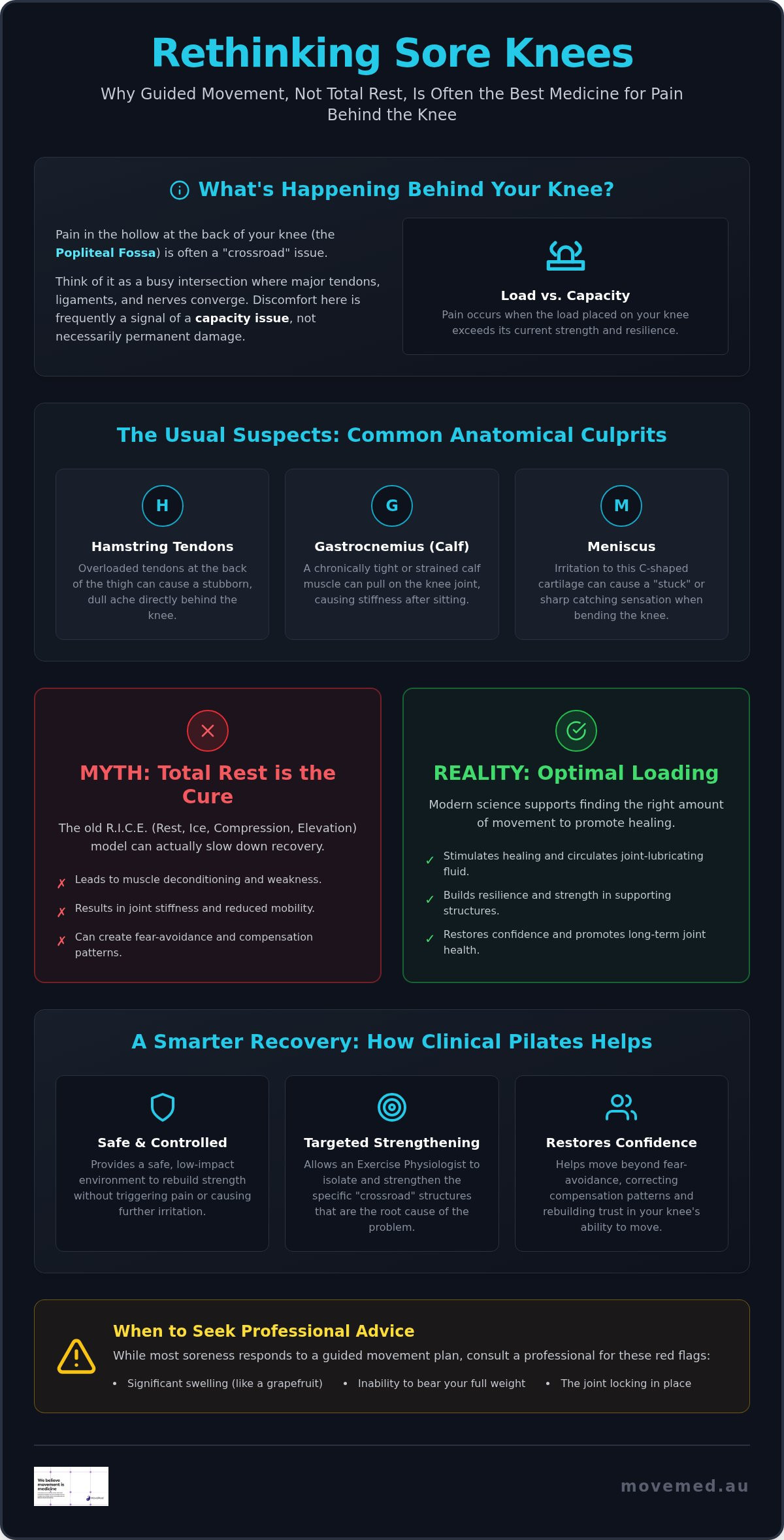
Think of this area as a busy Melbourne intersection. It's a complex "crossroad" where major tendons, ligaments, and nerves converge to facilitate movement. Because so many structures pass through this small space, identifying the exact source of your soreness requires a methodical approach. While there are many causes of knee pain, posterior soreness is frequently a sign of a capacity issue. This simply means your knee is being asked to do more work than it currently has the strength or resilience to handle. When the load exceeds your current tolerance, the body uses pain as a protective signal. It's not necessarily a sign of permanent damage, but rather a nudge to change your approach to movement.
Common Anatomical Culprits
The hamstrings are often the first suspect. If the tendons at the back of your thigh become overloaded, they can manifest as a stubborn, dull ache right behind the knee. Similarly, the gastrocnemius, your large calf muscle, attaches above the knee joint. If it's chronically tight or strained, it pulls on the posterior capsule, causing that familiar feeling of stiffness after sitting for long periods. We also look at the meniscus, specifically the posterior horn. This C-shaped piece of cartilage acts as a shock absorber. Small tears or irritations here can cause a "stuck" sensation or a sharp catch when you bend the joint deeply. Understanding these structures is the first step in using clinical pilates for knee rehabilitation to build the support your joint needs.
When to Seek Professional Advice in Melbourne
While most soreness can be managed with the right movement plan, certain red flags require immediate attention. If you notice significant swelling that looks like a grapefruit behind the knee, an inability to bear weight, or the joint locking in place, it's time to see a professional. In the Manningham area, your local GP might refer you to an Accredited Exercise Physiologist (AEP) before suggesting expensive scans. An AEP specialises in diagnosing the specific movement patterns that lead to overload. This is why clinical pilates for knee rehabilitation is so effective; it allows us to isolate and strengthen those crossroad structures in a controlled, supportive environment. We partner with you to create a roadmap that moves beyond temporary relief toward long-term resilience.
Myth #1: Total Rest is the Only Way to Fix Knee Soreness
Stopping all activity might seem like the safest choice when you're dealing with Pain in back of knee when straightening the leg. For years, the RICE model (Rest, Ice, Compression, Elevation) was the standard advice for any injury. However, modern sports medicine has moved toward "Optimal Loading." This means finding the right amount of movement to stimulate healing without making the irritation worse. Complete rest often leads to muscle deconditioning, where the supporting structures around the joint weaken, making you more vulnerable to future flares.
Think of movement as the natural lubricant for your joints. When you move, your body circulates synovial fluid, which acts like the oil in a car engine. This fluid delivers nutrients to the cartilage and clears out inflammatory waste products. By staying sedentary, you're essentially letting the "engine" seize up, which often results in that characteristic morning stiffness many of our clients describe. Movement isn't just about fitness; it's a biological requirement for joint health.
The Danger of "Protecting" Your Knee Too Much
It's common to start limping or changing how you walk to protect a sore joint. This "guarding" behaviour often creates a domino effect, leading to secondary aches in your hips or lower back as they overcompensate for the knee. There's also a psychological component known as fear-avoidance, where the anxiety about "wearing out" the joint prevents you from doing the things you love. Utilising clinical reformer pilates Templestowe provides a safe, low-impact way to maintain mobility while bypassing these compensation patterns. It allows you to build confidence in your body again by moving in ways that don't trigger the "threat" response in your nervous system.
Active Recovery vs. Passive Waiting
Passive waiting is simply hoping the pain goes away; active recovery is a deliberate strategy to improve tissue health. When you work with an Exercise Physiologist, they "grade" your movement capacity to find your unique threshold. This might involve simple mobility drills or specific exercises that keep the joint moving without increasing soreness. In 2026, active recovery is recognised as the gold standard for long-term joint health. Clinical pilates for knee rehabilitation offers a structured way to implement this, ensuring your progress is measurable and tailored to your specific needs. If you're tired of waiting for things to get better on their own, you can partner with our team to start your active recovery journey today.
Myth #2: Soreness Always Means a Baker’s Cyst or Surgery
It's a common scenario: you feel a lump or a sense of pressure behind your knee and immediately jump to the worst-case scenario. Perhaps you've even had a scan that mentioned a "Baker's cyst." While that sounds clinical and intimidating, it's actually just a collection of fluid caused by inflammation within the joint. Think of it as the knee's way of "spilling over" when it's irritated. The cyst itself isn't usually the problem; the underlying joint irritation is what we need to address. This is why many people fear surgery is the only answer, but for the vast majority of posterior knee issues, evidence-based movement is far more effective than a scalpel.
If your scan mentions "wear and tear" or "degeneration," don't lose heart. These findings are often perfectly normal for your age, much like getting grey hair or a few wrinkles. They don't necessarily correlate with the level of pain you feel. In fact, many people with "messy" scans have no pain at all, while others with "clean" scans feel significant discomfort. This highlights why a clinical assessment of how you move is more valuable than a picture of your bones. We focus on how your joint functions in real life, not just how it looks on a screen.
The Truth About Knee Osteoarthritis (OA)
We often hear the term "bone on bone," which is a misleading phrase that creates unnecessary fear. Even in joints with advanced osteoarthritis, there is almost always space and capacity for improvement. By strengthening the muscle back knee structures through targeted exercises, we can effectively offload the joint. This reduces the pressure on the irritated areas and allows you to return to the activities you love. For those managing joint changes, our GLA:D program for hip osteoarthritis and knee education provides a proven framework for avoiding surgery through better movement and education.
Muscle vs. Joint: Identifying the Source
Is it a muscle strain or something inside the joint? If your soreness feels like a tight pull in the calf or hamstring, it's likely muscular. However, soreness in back of knee when bending often suggests involvement of the meniscus or the posterior cruciate ligament (PCL). These internal structures respond exceptionally well to the controlled, low-impact environment of clinical pilates for knee rehabilitation. Rather than relying on a "Dr. Google" diagnosis, which often leads to more anxiety, a professional assessment helps us identify exactly which tissues need support. This clarity is the first step toward reclaiming your confidence and moving without that nagging sense of worry.
Managing Knee Discomfort: From Home Care to Clinical Support
Managing soreness doesn't always require an immediate trip to the clinic, but it does require a deliberate strategy. Your first step is to identify your specific triggers. If walking the steep hills in Doncaster causes a flare, don't simply stop moving. Instead, modify the "dose" of that activity by choosing a flatter route or reducing your walking time for a week. This allows the irritation to settle without your muscles becoming deconditioned. Next, incorporate gentle mobility. Using a stationary bike on a low resistance setting is a brilliant way to flush the joint with synovial fluid without adding stress. Once the sharpest pain subsides, focus on strengthening your quads and glutes. These muscles act as the primary shock absorbers for your lower body. When they're resilient, they take the brunt of the load, sparing the sensitive structures at the back of your knee.
While home care is a great starting point, there comes a time to transition to professional guidance. If your progress has plateaued or you're feeling anxious about "doing more damage," a structured programme provides the safety net you need. We move beyond masking pain with over the counter options and focus on the mechanics of how you move every day.
Hydrotherapy: The Low-Impact Entry Point
When land-based movement feels too painful to perform effectively, hydrotherapy is an ideal entry point. The warmth of the water in our Manningham area facilities helps soothe aching tissues and reduces muscle guarding, which is that protective "tightness" your body creates around a sore joint. Buoyancy significantly reduces your body weight, allowing you to perform strengthening exercises that might be too provocative on solid ground. This is especially beneficial for those navigating workcover hydrotherapy claims, as it provides a gentle but effective way to rebuild work-ready strength without the risk of a setback.
Clinical Pilates for Knee Stability
As your tolerance for movement increases, clinical pilates for knee rehabilitation becomes the cornerstone of your long-term recovery. Unlike a general gym class where exercises are "one size fits all," our sessions are led by experts who understand the nuances of joint pathology. We use the Reformer's spring resistance to "re-educate" the muscles around your knee, ensuring they fire with the correct timing and force. This focus on alignment and control is what prevents future soreness in back of knee from returning. By integrating clinical pilates for knee rehabilitation into your routine, you're not just managing a symptom; you're building a more resilient joint for the years ahead. If you're ready to move beyond temporary fixes, you can book an assessment with our Exercise Physiologists to start your tailored recovery journey.
Beyond the Quick Fix: Long-term Recovery at MoveMed
At MoveMed, we don't believe in band-aid solutions that only mask discomfort for a few days. Our philosophy is built on treating the underlying cause of your soreness, rather than just managing the symptom. When you partner with our Accredited Exercise Physiologists (AEPs), you aren't just getting a generic list of exercises. You're receiving a tailored roadmap designed specifically for your knee's current capacity and your future goals. We're deeply invested in the health of our local community, serving residents across Templestowe Lower, Doncaster, and the wider Manningham area. Our goal is to guide you through a clear pathway: moving from the frustration of acute soreness to the confidence of independent, pain-free movement.
This journey often begins with clinical pilates for knee rehabilitation. In these sessions, we focus on the fine-tuning of your movement patterns to ensure your joint is supported by the right muscles at the right time. By addressing the "how" of your movement, we make sure that every step you take is a step toward resilience. We see this as a partnership; we provide the clinical expertise and the supportive environment, while you regain the agency to manage your own health. It's a methodical process that prioritises your long-term value and return to activity.
The GLA:D® Programme Advantage
For those specifically dealing with joint changes or persistent chronic soreness, the GLA:D® programme offers a powerful, evidence-based solution. This programme is a core offering at our Templestowe clinic and consists of 12 supervised sessions designed to strengthen the joint and improve functional stability. Research consistently shows that this structured approach can significantly reduce pain and improve quality of life. In many cases, it can even delay or remove the need for surgical intervention. It's about empowering you with the physical capacity to manage your knee health independently, well beyond the walls of our clinic.
NDIS and Funded Support Options
We believe that high-quality care should be accessible to everyone in our community. Our ndis exercise physiology services support individuals with permanent disabilities to improve their independence and overall health. Beyond the NDIS, we also assist clients with DVA, TAC, and WorkCover claims, providing specialised knee rehab tailored to specific regulatory requirements. Navigating these systems can feel overwhelming, but we handle the complicated paperwork so you can focus on your recovery. We invite you to sit down with us for a consultation to discuss your specific funding options and your personal goals for the future.
Reclaiming Your Movement Confidence
Soreness behind the knee doesn't have to be a permanent barrier to your active lifestyle. We've explored how that nagging tightness is often a signal of capacity rather than a sign of irreversible joint damage or the need for surgery. By moving away from total rest and embracing optimal loading, you provide your body with the nutrients and mechanical stimulus it needs to heal. Whether you're navigating a chronic condition like osteoarthritis or recovering from a workplace injury, the right movement plan makes all the difference.
Our team of Accredited Manningham Exercise Physiologists is here to partner with you on this journey. We specialise in evidence-based programmes like GLA:D® and provide expert-led clinical pilates for knee rehabilitation to help you build a more resilient joint. We also support those with NDIS, TAC, or DVA funding, ensuring high-quality care is accessible to our local community. It's time to move beyond temporary fixes and focus on long-term health outcomes. You can book an Exercise Physiology consultation at MoveMed to reclaim your mobility today. We look forward to helping you regain your independence and confidence in every step.
Frequently Asked Questions
Is it okay to walk with soreness in the back of my knee?
Yes, walking is generally encouraged because movement keeps the joint mobile and healthy. If your pain is mild, around a 3 out of 10, it's usually safe to continue. However, if the soreness causes you to limp or significantly increases after your walk, you should modify your route. Choosing flatter paths around Doncaster or reducing your total steps can help you stay active without over-taxing the sensitive structures in the popliteal fossa.
What is the most common cause of pain behind the knee?
Posterior knee pain is most frequently caused by soft tissue overload in the hamstrings or calf muscles. These large muscle groups attach directly behind the joint. When they become overworked or "unfit" for the tasks you're asking of them, the tendons can become irritated. This results in a persistent ache or a sharp pull. Identifying the specific muscle at fault is a key part of our clinical assessment process.
How do I know if my knee soreness is a Baker’s cyst?
A Baker's cyst typically presents as a distinct feeling of "fullness" or a visible lump that feels like a small water balloon behind the joint. You might notice it most when your leg is fully straightened or bent. While the cyst itself causes pressure, it's usually a secondary sign that there's some inflammation or a minor tear inside the knee joint that's causing an overproduction of fluid.
Can tight hamstrings cause soreness in the back of the knee?
Absolutely, tight or overworked hamstrings are a leading cause of discomfort in this area. Because the hamstring tendons insert right at the back of the knee, any tension in the muscle belly pulls directly on the joint's posterior capsule. This often feels like a stubborn "tightness" that doesn't resolve with simple stretching. Strengthening these muscles through clinical pilates for knee rehabilitation is often more effective than stretching alone for long term relief.
Should I use heat or ice for posterior knee pain?
Use ice if you notice active swelling or heat, but opt for heat if you're dealing with chronic stiffness. Ice is a great tool for calming down an angry, inflamed joint after a long day on your feet. Conversely, heat is excellent for relaxing tight muscles and improving blood flow before you start your exercises. We often suggest a "trial and error" approach to see which provides you with the most comfort.
How long does it take for knee soreness to go away with exercise physiology?
Most clients notice a meaningful reduction in soreness within 6 to 12 weeks of starting a structured programme. Soft tissues like tendons and ligaments require consistent, progressive loading to build resilience and change their structure. While some relief happens quickly as movement patterns improve, the long term benefits of clinical pilates for knee rehabilitation come from the gradual strengthening of the supporting muscles. Patience and consistency are your best allies during this recovery.
When should I be worried about pain behind the knee?
You should seek professional advice if you experience "locking," where the joint gets stuck, or if you cannot bear any weight on the leg. Other concerning signs include significant, rapid swelling or a feeling of instability where the knee "gives way." If the area feels unusually cold or looks pale, it's important to consult your GP or an Exercise Physiologist to rule out any more serious vascular or structural issues.
Does the GLA:D® programme help with soreness even if I don’t have arthritis?
Yes, the GLA:D® programme is highly beneficial for anyone looking to improve their joint control and strength. While it's famously effective for osteoarthritis, the core principles of neuromuscular exercise apply to many types of knee soreness. It teaches you how to align your hip, knee, and ankle correctly during daily tasks. This improved mechanics reduces the daily "wear" on your joint, regardless of whether you have a formal arthritis diagnosis.


