
Imagine waking up in your Templestowe home, ready to start the day, only to be held back by that familiar, stubborn stiffness in your lower back. It's a frustrating cycle that many of our local community members face, often leading to a reliance on pain medication and a growing fear that the wrong exercise might actually do more harm than good. You want to get back to the things you love, like tending to the garden or keeping up with the grandkids, but the path to getting there feels clouded by conflicting advice and confusing paperwork for NDIS or TAC funding.
We understand that when you're in pain, you don't just need a workout; you need a clear, expert-led management plan. Choosing between clinical pilates vs hydrotherapy for back pain is a common crossroad on the recovery journey, and the right choice depends entirely on your current stage of healing. In this article, we'll explore how the gentle buoyancy of a heated pool compares to the focused resistance of a Clinical Reformer. You'll discover which environment offers the best support for your unique injury, helping you reclaim your independence and move with confidence once again.
Key Takeaways
- Learn why Accredited Exercise Physiologists are your best allies in using movement as medicine to move beyond simply masking symptoms.
- Understand how Clinical Reformer Pilates builds a "natural corset" of deep core strength to support your spine during daily activities like gardening.
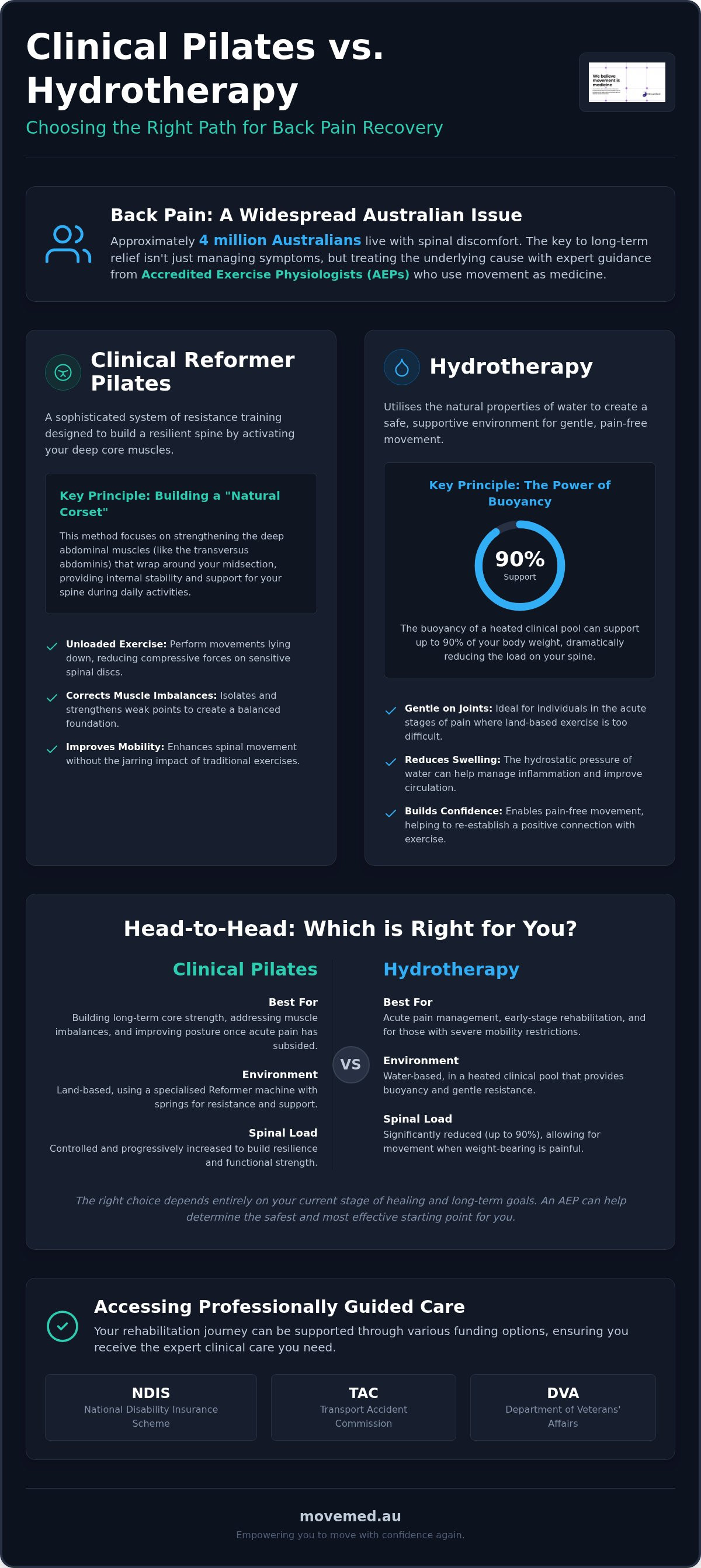
- Discover how the buoyancy of a heated clinical pool can support up to 90% of your body weight, providing a gentle environment for those in acute pain.
- Compare clinical pilates vs hydrotherapy for back pain to identify which approach suits your current stage of recovery and long-term mobility goals.
- Find out how to navigate NDIS, TAC, and DVA funding options to ensure your rehabilitation journey is accessible and professionally guided.
The Role of Health Allied Professionals in Managing Back Pain
Back pain is a quiet epidemic in Australia. Approximately 4 million Australians live with spinal discomfort, which often results in significant time away from work and a diminished quality of life. It’s a burden that affects more than just your physical body; it impacts your ability to engage with your family, your community, and your career. When you're stuck in a cycle of stiffness and discomfort, the traditional "rest and wait" approach rarely provides a long-term solution.
This is where health allied professionals step in. Unlike general fitness instructors, these university-trained experts specialise in using movement as medicine. They don't just look at where it hurts; they investigate why it hurts. By shifting the focus from simply managing symptoms with heat packs or medication to treating the underlying cause of the injury, they help you build a body that is resilient and capable.
What is an Exercise Physiologist (AEP)?
An Accredited Exercise Physiologist (AEP) is a university-qualified health professional who prescribes clinical exercise interventions for people with chronic conditions or injuries. They understand the complex mechanics of the human spine and how different types of load affect recovery. AEPs bridge the gap between acute medical care and returning to your favourite hobbies, such as bowls, gardening, or walking the dog along the Yarra trails. For a deeper look at how this discipline works, you can explore our What is Exercise Physiology? guide.
Why Clinical Movement Matters for Back Pain
General gym programs often fail people with back injuries because they lack specificity. A "one size fits all" workout can easily aggravate a sensitive disc or a strained muscle if the intensity or form is slightly off. Clinical movement, however, prioritises precision over perspiration. It’s about doing the right movement at the right time for your specific stage of healing.
When deciding between clinical pilates vs hydrotherapy for back pain, the choice usually hinges on how much load your spine can currently handle. At MoveMed, our philosophy is built on empowering Templestowe locals to move with confidence again. We use evidence-based tools to guide you through this process. Whether your path involves land-based strength or Aquatic therapy for rehabilitation, the goal is always the same: reclaiming your independence. By focusing on controlled, deliberate movements, we ensure that every session is a step toward recovery rather than a risk of re-injury. Choosing clinical pilates vs hydrotherapy for back pain isn't about which exercise is "better" in a general sense, but which one is safer and more effective for your body right now.
Clinical Reformer Pilates: Building a Resilient Spine
Many people mistake Pilates for a general floor-based stretching routine. However, Clinical Reformer Pilates is a sophisticated system of resistance training designed specifically for rehabilitation. The Reformer machine uses a series of springs and pulleys to either support your body or provide a precise challenge. This mechanical advantage is vital for those debating clinical pilates vs hydrotherapy for back pain, especially if you find standing or walking for long periods uncomfortable. By lying on the carriage, you can perform strengthening exercises in an "unloaded" position, which reduces the compressive forces on your sensitive spinal discs while still building essential muscle.
The primary goal of these sessions is to activate your "natural corset." This involves the deep core muscles, such as the transversus abdominis and multifidus, which wrap around your midsection to provide internal stability. Under the watchful eye of an Accredited Exercise Physiologist, you'll learn to coordinate your breathing with movement to ensure your pelvis stays in a neutral, safe alignment. This level of expert supervision is what separates a clinical session from a standard gym class; it ensures you're moving with intent rather than just going through the motions. Professionals in the field often rely on advanced planning tools like ReformerFlow by Ginty to design structured, effective sequences that help patients achieve these stability goals safely.
One of the greatest strengths of the Reformer is its ability to address muscle imbalances. Often, back pain is caused by one side of the body working harder than the other, leading to a "tug-of-war" on your spine. The machine allows us to isolate these weak points and correct them. This builds a balanced foundation, improving your spinal mobility without the jarring impact often found in traditional exercise. If you're looking for a structured way to start, our Clinical Reformer Pilates in Templestowe offers a safe, expert-led environment to begin your recovery.
Is It Just "Fancy Stretching"?
It’s a common myth that Pilates is only about flexibility. In reality, it is a form of progressive resistance training. Science supports this approach; a Cochrane review on Pilates for low back pain highlights its effectiveness in improving function and reducing pain compared to minimal intervention. By gradually increasing the spring tension, we help your body adapt and grow stronger, which is the best defence against future "blowouts" or flare-ups.
Whether you’re a senior aiming to stay active or a younger individual navigating a TAC or WorkCover claim, the program is tailored to your specific needs. We don't just want you to feel better for an hour; we want to help you build long-term resilience. If you're ready to see how a personalised plan can change your outlook, you might consider booking an initial assessment with our team to discuss your goals.
Hydrotherapy: The Power of Water-Based Recovery
While Clinical Pilates focuses on precision and controlled resistance, hydrotherapy offers a unique environment where gravity is no longer the enemy. It involves performing specific, therapeutic exercises in a purpose-built clinical pool, typically heated to a soothing 32–34°C. This warmth is not just for comfort; it plays a vital role in desensitising the nervous system and relaxing "guarded" muscles that have tightened up to protect a painful spine.
The true magic of water-based rehab lies in the science of buoyancy. When you're submerged to chest depth, the water supports up to 90% of your body weight. This effectively "offloads" your spine, taking the crushing pressure off your intervertebral discs and facet joints. For someone weighing up clinical pilates vs hydrotherapy for back pain, this weightless environment allows for movements that would be far too painful to attempt on land. Additionally, the hydrostatic pressure (the gentle force the water exerts on your body) acts like a full-body compression sleeve. This helps to reduce local swelling and improves circulation around the lower back, which is essential for the healing process.
When Hydrotherapy is the Better Choice
There are certain stages of recovery where the pool is the clear winner. If you're experiencing an acute flare-up where even standing or walking feels like a monumental task, hydrotherapy provides a safe entry point. It's also an excellent option for NDIS clients with complex mobility needs or those who have a high fear of movement. The water provides a sense of security that land-based exercise simply can't match. To understand the full scope of this treatment, you can read The Complete Guide to Hydrotherapy.
The MoveMed Approach to Water Therapy
At MoveMed, we believe hydrotherapy should be as rigorous and goal-oriented as any other clinical intervention. Our Accredited Exercise Physiologists (AEPs) guide you through a personalised programme designed for your specific injury. We don't believe in "splashing about" aimlessly. Instead, we focus on gait retraining (learning to walk correctly again) and gentle core activation while using the water's natural resistance to build strength.
The ultimate goal of our water therapy is to prepare you for life back on land. As your pain levels decrease and your confidence grows, we slowly transition your programme from the pool to the studio. This ensures that the gains you make in the water translate to your daily life in Templestowe, whether that’s getting in and out of the car or walking to the local shops without discomfort. Choosing clinical pilates vs hydrotherapy for back pain isn't a permanent decision; it's a strategic shift based on what your body needs to thrive at each stage of your journey.
Head-to-Head: Clinical Pilates vs Hydrotherapy for Back Pain
Deciding between clinical pilates vs hydrotherapy for back pain isn't about finding a "winner." It’s about choosing the right tool for your body’s current state of healing. Hydrotherapy is generally the preferred choice for managing acute flare-ups and reducing immediate pain, whereas Clinical Pilates serves as the gold standard for chronic management and building long-term spinal resilience. Both options offer a path away from pain, but they do so by addressing different physical needs.
The Comparison Framework
To help you visualise the differences, we’ve broken down the key features of each modality below. This framework helps our Exercise Physiologists determine which environment will provide the most benefit for your specific injury profile.
| Feature | Hydrotherapy | Clinical Pilates |
|---|---|---|
| Impact Level | Near-zero impact due to buoyancy. | Low to moderate controlled impact. |
| Primary Goal | Pain relief, offloading, and mobility. | Strength, stability, and posture. |
| Best for Stage | Acute (early) stage of injury. | Sub-acute to chronic (long-term) stage. |
| Equipment Used | Heated clinical pool and water weights. | Reformer, springs, and pulleys. |
Many of our clients in the Manningham area find that a hybrid approach works best for their lifestyle. You might start in the pool for a few weeks to calm a sensitive nervous system, then slowly transition into the studio as your tolerance for gravity increases. This "phased" recovery is often fully supported through funding streams like the TAC, NDIS, DVA, or WorkCover. If you're using private health insurance, it's a good idea to check your "Extras" cover, as most Australian funds provide rebates for sessions led by an Accredited Exercise Physiologist.
Which One Should You Start With?
A simple rule of thumb: if you can't walk for 10 minutes or stand to wash the dishes without significant pain, the pool is your best starting point. The water provides the physical "buffer" your spine needs to move without fear. However, if your goal is to return to the golf course, enjoy heavy gardening, or get back to high-impact sport, Clinical Pilates is essential. It provides the progressive resistance necessary to build a back that can handle the demands of daily life. For those dealing with persistent discomfort, combining these sessions with our Chronic Pain Management Techniques can provide a holistic path to lasting relief.
If you’re still unsure which path is right for your recovery, the best first step is a professional assessment. We’ll sit down with you, listen to your story, and organise a plan that fits your goals and your budget. You don't have to guess your way through rehab. If you're ready to take that next step, book a consultation with our clinical team today to start your journey back to full activity.
Accessing Clinical Care in Templestowe: Funding and Next Steps
Starting a rehabilitation journey shouldn't feel like a second job. We understand that when you are already dealing with morning stiffness or the fear of re-injury, the last thing you need is a mountain of paperwork. At MoveMed, we see ourselves as your local community ally. We don't just provide therapy; we help you navigate the systems that fund it. Our team specialises in supporting residents across Templestowe Lower, Doncaster, and the wider Manningham area to ensure their recovery is consistent, professional, and stress-free.
Whether you are looking for long-term resilience or immediate relief, having a clear management plan is the first step toward reclaiming your independence. We work closely with various funding bodies to ensure our clinical services are accessible to those who need them most. By handling the clinical reporting and coordination, we allow you to focus entirely on your movement and health. Additionally, for those who are also balancing their recovery with reproductive health goals, the Dr Christine Cui Fertility Clinic provides integrated Traditional Chinese Medicine and acupuncture to support your journey.
Navigating Funded Therapy Schemes
For many Australians, the cost of clinical care can be a significant concern. However, there are several pathways available to help cover your sessions. If you have been involved in a road accident or a workplace incident, the TAC and WorkCover systems are designed to support your return to work and daily life. Our Accredited Exercise Physiologists (AEPs) are experienced in providing the specific documentation these bodies require to approve ongoing treatment.
If you are an NDIS participant, you can often utilise your "Improved Health and Wellbeing" or "Core" budgets to access our services. This funding ensures that the choice between clinical pilates vs hydrotherapy for back pain is based on your specific physical needs rather than your bank balance. For a detailed breakdown of how this works, you can view our NDIS Exercise Physiology Guide. Additionally, we proudly support DVA clients, providing tailored programmes for veterans who require specialised spinal care.
Booking Your Initial Assessment
We never throw our clients into the deep end, literally or figuratively. Every successful recovery begins with a comprehensive initial clinical assessment. This is a dedicated 45-minute session where your AEP will sit with you to understand your history, your pain triggers, and your lifestyle goals. We don't believe in "one size fits all" exercise; we believe in precision.
During this assessment, we will determine whether clinical pilates vs hydrotherapy for back pain is the safest and most effective starting point for your body. We look at your current strength, your range of motion, and your confidence levels. From there, we build a clear, actionable plan. This might start with the gentle support of the pool or the focused control of the Reformer. If you're ready to stop guessing and start moving with confidence, contact MoveMed today to book your assessment near Doncaster and Templestowe. Let's work together to get you back to the activities you love.
Reclaiming Your Movement Confidence
Back pain shouldn't be a permanent barrier to the life you love. Whether you find relief in the weightless support of a heated pool or build resilience through the precision of a Reformer, the choice between clinical pilates vs hydrotherapy for back pain is a strategic step toward your recovery. We've explored how hydrotherapy calms acute flare-ups by offloading the spine, while Clinical Pilates builds the "natural corset" of strength required for long-term health and daily activity.
At MoveMed, our Accredited Exercise Physiologists are here to guide you through every stage. As a specialist NDIS and TAC provider, we take pride in serving the Templestowe and Doncaster community with care that is both clinically rigorous and deeply personal. We'll handle the complex paperwork and the clinical planning so you can focus on reclaiming your independence. The journey to a stronger, more mobile spine begins with a single, expert-led conversation. Book your initial Exercise Physiology assessment at MoveMed Templestowe Lower today to discover the right path for your body. You don't have to navigate this alone; let's start moving forward together.
Frequently Asked Questions
Do I need a GP referral for Clinical Pilates or Hydrotherapy at MoveMed?
No, you don't need a formal referral to see an Exercise Physiologist as a private patient. However, if you're seeking a Medicare rebate under a Chronic Disease Management plan, or if you're claiming through DVA, a GP referral is essential. We recommend checking with your doctor if you have a complex medical history, but you can book your initial clinical assessment directly with our team today.
Can I use my NDIS funding for both Pilates and Hydrotherapy?
Yes, you can typically use your NDIS funding for both services if they're deemed "reasonable and necessary" to meet your specific goals. Most participants use their "Improved Health and Wellbeing" or "Core" budgets for these sessions. When weighing up clinical pilates vs hydrotherapy for back pain, our AEPs will help you determine the best mix of services to maximise your plan's value and support your independence.
What should I wear to my first Clinical Reformer Pilates session?
Comfortable, stretchy clothing that allows for a full range of movement is best. Most clients choose leggings or tracksuits and a comfortable t-shirt. For safety and hygiene on the Reformer, we require you to wear grip socks, which are socks with rubber dots on the bottom. If you don't have a pair, we usually have them available at the clinic. Avoid clothing with bulky zips that might damage the equipment.
Is hydrotherapy suitable if I am not a strong swimmer?
Absolutely, you don't need to be a swimmer to benefit from hydrotherapy. Our sessions take place in a clinical pool where you can always touch the bottom. Your Exercise Physiologist will be with you to guide every movement, ensuring you feel safe and supported. We focus on vertical exercises like walking and core activation rather than swimming laps, making it a very accessible environment for everyone in our community.
How many sessions will it take before my back pain starts to improve?
Everyone's recovery timeline is unique, but most clients feel a difference in their mobility or pain levels within three to six sessions. While hydrotherapy often provides immediate relief from stiffness, building the long-term strength found in Clinical Pilates takes consistent effort over several weeks. We'll set clear milestones during your initial assessment so you can track your progress and stay confident in your personalised management plan.
Can Clinical Pilates make my back pain worse if I have a bulging disc?
When led by an Accredited Exercise Physiologist, Clinical Pilates is specifically designed to be safe for conditions like bulging discs. Unlike a general gym class, we use "unloaded" movements on the Reformer to strengthen your spine without causing irritation. We focus on neutral pelvic alignment and precision to ensure you're building support rather than adding stress. If an exercise feels uncomfortable, we adapt it immediately to suit your body.
Does Medicare cover Exercise Physiology for chronic back pain?
Yes, Medicare provides rebates for Exercise Physiology sessions if you have a Chronic Disease Management (CDM) plan from your GP. This plan allows for up to five rebated allied health sessions per calendar year for chronic conditions lasting six months or longer. While there's usually a small gap fee, this funding makes accessing expert care for back pain more affordable for many members of our local Templestowe community.
Is there parking available at the MoveMed Templestowe Lower clinic?
Yes, we have convenient on-site parking available for all our clients. We understand that when you're in pain, walking long distances from your car is the last thing you want to do. Our Templestowe Lower clinic is designed for easy access, ensuring you can get from your vehicle to your session with minimal fuss. This makes it a stress-free option for locals coming from Doncaster or surrounding suburbs.


