
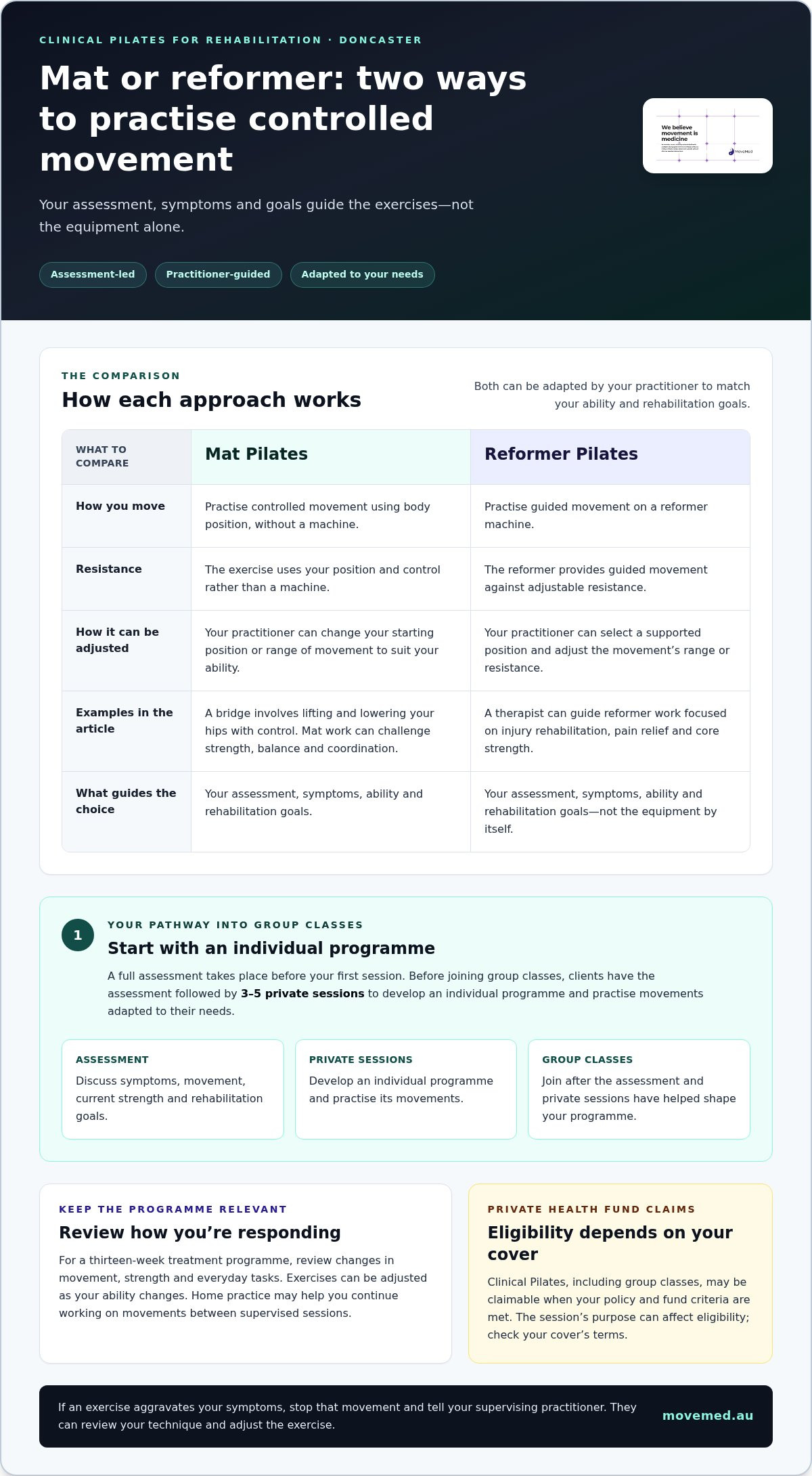
Supervised clinical Pilates for rehabilitation in Doncaster starts with a full assessment before your first session, then exercises are tailored to your needs and guided by a practitioner. Before joining group classes, clients have an assessment followed by 3-5 private sessions to develop an individual program. Private health fund claims may apply, depending on your cover and the fund’s criteria.
If you’re managing pain, recovering from an injury or unsure which movement feels safe, you need clear guidance rather than a generic exercise routine. This article explains how clinical Pilates for rehabilitation in Doncaster can support a tailored approach, what to consider when choosing a service and how private health fund claims may work. It also compares individual sessions with group classes to help you decide what may suit your needs.
Key Takeaways
- Your assessment helps shape an exercise plan around your rehabilitation needs, abilities and goals.
- Private health fund claims depend on your cover and the fund’s criteria, including the purpose of your sessions.
- Mat and reformer exercises offer different ways to practise controlled movement, with exercise choices guided by your program.
- Supervision helps you learn technique and adjust exercises as your confidence and capacity develop.
Individualised exercise programs
An individual program starts with a full assessment before your first session. The practitioner considers your symptoms, movement, current strength and rehabilitation goals. Before joining group classes, clients have that assessment followed by 3-5 private sessions to develop an individual program. These sessions allow time to practise movements and adapt exercises to your needs.
Clinical Pilates uses targeted, supervised exercises for rehabilitation, while general Pilates usually follows broader fitness aims. Physiotherapy focuses on assessing and treating injury or physical conditions, and may use different treatment approaches. The right approach depends on your goals and the support you need.
When choosing clinical movement support in Doncaster, look for an initial assessment, a program tailored to your needs and clear guidance on how exercises can be adapted as your ability changes. MoveMed’s accredited exercise physiologists are university-trained allied health professionals who design, deliver and evaluate safe, effective exercise interventions.
You don’t need a GP referral to book with MoveMed. An initial one-on-one assessment helps an accredited exercise physiologist understand your needs and develop a personalised exercise program.
For a thirteen-week treatment program, use review points to track changes in movement, strength and everyday tasks. Exercises can be adjusted as your ability changes, keeping the program relevant to your goals. Home practice may help you continue working on movements between supervised sessions, while Clinical Reformer Pilates offers therapist-led work with a reformer machine. Your practitioner can guide your technique and progressions.
Osteoarthritis may call for a more specific pathway. The GLA:D program is an evidence-based exercise and education program for hip and knee osteoarthritis that reduces pain and improves function.
If an exercise aggravates your symptoms, stop that movement and tell your supervising practitioner. They can review your technique and adjust the exercise. If your condition changes suddenly, seek an appropriate clinical assessment.
Can I claim my Pilates sessions through my private health fund?
Clinical Pilates may be claimable through private health insurance, depending on your policy and fund criteria. Group classes may also qualify when they meet your fund’s requirements and are attended for injury rehabilitation. Check the terms of your cover, as the session’s purpose can affect eligibility.
Clinical Pilates can be part of rehabilitation when an injury or condition affects movement, strength or control. The practitioner selects exercises to suit your needs and goals. For example, a program might focus on trunk control after an injury or practise balance and strength when movement feels difficult. The exercises should reflect your needs rather than follow a fixed routine.
Mat and reformer Pilates offer different ways to practise controlled movement. A reformer uses a machine to provide guided resistance, and a therapist can lead sessions focused on injury rehabilitation, pain relief and core strength. Mat exercises use body position and control without a machine. A practitioner can adapt either type of movement, explain what to notice and guide your technique.
Rehabilitation can help you work towards everyday activities such as lifting, walking for longer or returning to a chosen sport. Progress may involve practising a movement, noticing how your body responds and adjusting its difficulty. Pay attention to discomfort, fatigue or changes in control so you can describe your experience during a session.
For injury prevention, supervised practice can build strength and movement control relevant to tasks you repeat, such as lifting or reaching. It can also help you recognise when a movement needs adjustment. If you’re considering a rehabilitation-focused approach, explore clinical Pilates for injury rehabilitation and how guided exercise can fit your goals.
Mat and Pilates equipment exercises
Clinical Pilates for rehabilitation in Doncaster may combine mat work with equipment-based movements, depending on your assessment and goals. A studio session could begin with a supported movement, then adjust the position or resistance as your control develops. The setting should let you practise exercises with guidance, rather than simply follow a class sequence. You can ask how each movement relates to your rehabilitation aims.
Mat exercises use body position and controlled movement to challenge strength, balance and coordination. For example, a bridge involves lifting and lowering your hips with control. A practitioner can change your starting position or range of movement to suit your ability, helping you practise technique before progressing the exercise.
A reformer is Pilates equipment used for guided movement against adjustable resistance. Your practitioner can select a supported position and guide you through the movement. The equipment doesn’t determine the program by itself; your assessment, symptoms and goals inform exercise selection. You can describe how a movement feels, so the practitioner can adjust its range or resistance during the session.
Reformer equipment can guide a movement, while mat exercises develop control without a machine. For example, balance work may begin in a stable position before progressing to a more challenging variation. There’s no fixed order: your practitioner selects exercises based on how you perform them and what you’re working towards.
If you’re considering clinical Pilates for rehabilitation in Doncaster, think about the activities you want to return to, such as walking, lifting or gardening. During a studio visit, follow the practitioner’s instructions, ask about unfamiliar movements and share changes in symptoms. That feedback helps guide exercise choices and keeps your session connected to your rehabilitation goals.
Supervised clinical Pilates for rehabilitation
Supervision gives you the chance to practise movements with guidance and receive specific feedback. A practitioner can observe your alignment, breathing and control, then suggest an adjustment. For example, if bridging feels uncomfortable, they might change your range or starting position. Describe what you feel so the next instruction responds to your experience.
Clear cues help you understand how to perform a movement, not just copy its shape. During a balance exercise, the practitioner might ask you to steady your hips before progressing. They can also explain which muscles should be working and when to pause. This guidance helps you recognise the difference between a controlled challenge and a movement that needs changing.
Progress should reflect what you can do consistently. A practitioner may observe a familiar movement, then adjust its resistance, range or position. If you’re practising a squat, for example, they can change its depth before adding another challenge. Reviewing your technique keeps each exercise connected to your rehabilitation goal.
Classes and individual sessions provide different levels of guidance. In pilates classes, you follow a shared sequence, while a practitioner can still offer cues and exercise adjustments. Individual supervision allows closer attention to your movement and symptoms. If you’re located in Doncaster, plan how a studio visit fits alongside your usual routine, so attending remains practical whilst you work towards regular activity.
After a session, note which movements felt manageable and which needed adjustment. Bring those observations to your next appointment, along with a specific goal, such as walking comfortably or reaching overhead. This gives the practitioner useful feedback for planning the next session. For guidance tailored to your rehabilitation, discuss supervised Pilates sessions with the team.
MoveMed: Exercise Physiology Consultations
MoveMed provides Exercise Physiology Consultations for people who need structured support with injury recovery, movement or ongoing health concerns. An Accredited Exercise Physiologist can assess your current capacity, discuss your goals and develop a personalised exercise plan. This can help if Pilates alone doesn’t address the broader strength, mobility or function you want to work on.
Your next step could be discussing how Exercise Physiology may support your rehabilitation, or whether another MoveMed service, such as Hydrotherapy, better suits your needs. Hydrotherapy is delivered in a warm-water pool and offers low-impact exercise. MoveMed also provides funded therapy for eligible NDIS and aged care clients. You can start by talking through your abilities, goals and relevant funding arrangements.
Contact MoveMed to discuss your rehabilitation goals and possible next steps.
Take your next step towards confident movement
Rehabilitation can feel more purposeful when it connects with something you want to do in daily life. Before your appointment, choose a meaningful activity, such as gardening or feeling steadier on stairs. Consider what feels difficult now and what progress would look like for you. These details can help shape a practical conversation about your goals.
If you’re considering clinical Pilates for rehabilitation in Doncaster, focus on finding an approach that supports your needs and fits your routine. You can talk through your goals, concerns and possible next steps with MoveMed, without needing to have every answer ready.
Discuss your rehabilitation goals with MoveMed and take a considered step towards moving with greater confidence.
Frequently Asked Questions
What does each session involve?
A session usually begins with an update about how you’ve been moving since your last visit. You then practise selected movements while your practitioner observes how you manage them. If turning or reaching remains difficult, for example, the session can focus on movements related to that task. You’ll have time to discuss what felt manageable and what you’d like to work towards next.
Do you also see clients from Doncaster?
MoveMed’s clinic is in Templestowe, serving people from nearby communities including Templestowe Lower, Doncaster, Doncaster East, Bulleen, Warrandyte, Lower Plenty, Balwyn North and Box Hill. If you live in one of these areas and want supervised movement support, discuss your goals with MoveMed to find a suitable service.
How can I book a class?
Book through the “Book an Appointment” button on MoveMed’s website or call the clinic. Before booking, consider whether you’re looking for rehabilitation support, help with a chronic condition or guidance to improve everyday movement. Sharing your goal when arranging the appointment can help focus your first conversation.
What clinical Pilates services do you offer?
MoveMed offers Clinical Reformer Pilates, with therapist-led sessions using a reformer machine. The exercises are designed to address specific physical conditions and support mobility and rehabilitation. This differs from open gym access: sessions are guided by a clinical practitioner. If you’re managing an injury or movement difficulty, you can explain what activities you want to return to when discussing whether this service suits your goals.
What is clinical Pilates and how is it used for rehabilitation?
Clinical Pilates is guided exercise adapted to a person’s physical needs, rather than a general fitness class with the same sequence for everyone. For rehabilitation, a practitioner can use controlled movements to work towards goals such as improving mobility or building confidence with everyday tasks. Depending on your needs, exercises may relate to getting up from a chair or reaching overhead.
Are clinical Pilates sessions covered by Medicare, private health insurance, or NDIS in Australia?
Private health fund claims for Clinical Pilates depend on your policy and the fund’s criteria; injury rehabilitation may affect eligibility for group classes. Medicare and NDIS funding depend on the relevant service and scheme requirements, so don’t assume a Pilates session itself is covered. MoveMed accepts all compensable schemes and offers Exercise Physiology for eligible clients. Discuss the funding pathway for the service you need.


