
For people in Doncaster, clinical exercise physiology supports strength, mobility and physical function through exercise tailored to health conditions, injuries or disability. Accredited Exercise Physiologists are university-trained allied health professionals who design and guide these programs. The focus is safe, purposeful movement that helps you work towards the activities and independence that matter to you.
If you’re unsure how exercise physiology differs from general fitness training, or whether NDIS funding may apply, it’s understandable to want clear answers before taking the next step. This guide explains what exercise physiology involves, how NDIS funding may relate to your goals and what to consider when finding local support. You’ll also learn how MoveMed supports people in Doncaster and nearby suburbs with practical plans shaped around their needs.
Key Takeaways
- Learn how an Accredited Exercise Physiologist can tailor structured exercise to your health needs, abilities and everyday goals.
- Understand how NDIS support categories and your plan’s funding arrangements can affect access to exercise physiology.
- Explore local practitioner options across Doncaster East and nearby suburbs, then consider which location best suits your routine.
- Identify how a personalised exercise plan can work towards improving strength, mobility, balance and physical function.
- See how MoveMed’s Exercise Physiology Consultations and NDIS Funded Therapy may support your next step.
What is Exercise Physiology?
For people considering clinical exercise physiology in Doncaster, the central idea is purposeful movement tailored to health needs. Accredited Exercise Physiologists are university-trained allied health professionals who design and evaluate exercise interventions. They can support people living with chronic conditions, recovering from injuries or managing disability. A chronic medical condition is one that has been, or is likely to be, present for at least six months.
An exercise plan starts with your health history, current abilities and personal goals. Your practitioner may consider how pain, fatigue, balance or medication affects movement, then adapt activities to suit. Someone with a musculoskeletal condition, for example, may practise strength-building movements that support joint stability. A person recovering from injury may gradually work on movements needed for daily tasks.
Chronic conditions and neurological rehabilitation
For chronic disease management, structured exercise can help build capacity and support self-management. A plan may include strength, aerobic activity, balance or flexibility, guided by your condition and goals. For Parkinson’s disease, multiple sclerosis or stroke, exercise may focus on coordination, walking, balance and motor control. Activities can be adjusted as your function changes.
A diabetes case study shows how progress measures can inform care. A 56-year-old man joined an eight-week education and exercise program, two years after his type 2 diabetes diagnosis. His HbA1c, which indicates blood glucose control over three months, was 10.9 before the program and 7.3 afterwards. His blood pressure changed from 140/90 to 132/87. These individual results don’t predict another person’s outcome.
What happens at your first appointment?
Expect to discuss your health history, symptoms, current activity and goals, then complete relevant movement or fitness checks. Your practitioner uses this information to shape a plan and explain how each activity relates to your priorities.
Bring details of your condition, medications and current care team. For example, if fatigue affects walking, describe when it occurs and which activities it limits. This helps your practitioner understand your starting point and tailor the assessment.
Medicare and safe starting points
Medicare’s Chronic Disease Management pathway may be discussed with your GP if you have a chronic condition. Talk about your exercise goals and how they fit your broader care plan. Choosing clinical exercise physiology in Doncaster can then begin with a clear understanding of the role exercise may play in your care.
Seek medical guidance before starting if you have new or worsening symptoms, an unstable health condition or concerns about exercising safely. Chest discomfort, unusual breathlessness or dizziness during activity are examples to raise with a health professional. Sharing these concerns helps your practitioner consider an appropriate starting point and adapt activities to your needs.
NDIS-funded exercise physiology
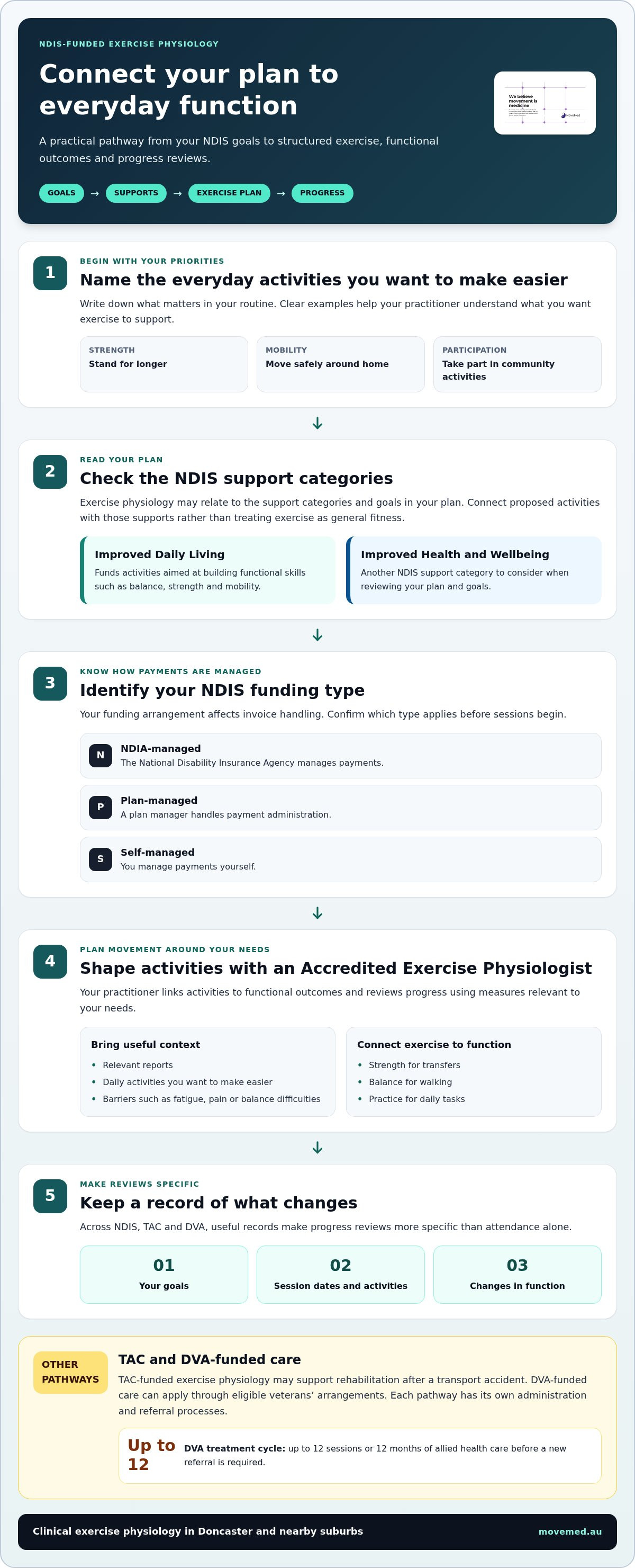
NDIS-funded exercise physiology connects planned movement with goals in your plan. Those goals might include building strength to transfer from a chair, improving balance while walking or practising daily tasks with greater confidence. Your practitioner links activities to functional outcomes and reviews progress using measures relevant to your needs. With clinical exercise physiology in Doncaster, the aim is to make the plan relevant to both your NDIS goals and everyday routines.
Start by looking at your NDIS plan and its NDIS support categories. Exercise physiology may relate to Improved Daily Living, which funds activities aimed at building functional skills such as balance, strength and mobility. Improved Health and Wellbeing is another category in the NDIS context. Connect proposed activities with the goals and supports in your plan, rather than treating exercise as general fitness.
Your plan may use one of three NDIS funding types: NDIA-managed, plan-managed or self-managed. With NDIA-managed funding, the National Disability Insurance Agency manages payments. A plan manager handles payment administration for plan-managed funding, while self-managed participants manage payments themselves. These arrangements affect invoice handling. Before sessions begin, identify your funding type and make sure the exercise plan, goals and payment process align.
A practical preparation step is to write down the daily activities you want to make easier. For example, note whether you want to stand for longer, move safely around your home or take part in community activities. Bring relevant reports and describe barriers such as fatigue, pain or balance difficulties. This gives your practitioner useful context for planning activities and recording functional changes over time.
NDIS is not the only funded pathway. TAC-funded exercise physiology may support rehabilitation after a transport accident, while DVA-funded care can apply through eligible veterans’ arrangements. Each pathway has its own administration and referral processes, so keep relevant approval and claim details together. For DVA allied health, a treatment cycle provides up to 12 sessions or 12 months of care before a new referral is required.
Across NDIS, TAC and DVA, useful records include your goals, session dates, activities completed and changes in function. These details make progress reviews more specific than attendance alone. If you’re considering clinical exercise physiology in Doncaster, exercise physiology consultations can provide an opportunity to discuss how structured exercise may connect with your functional goals.
Practitioner locations in Doncaster East and nearby suburbs
For local care, location affects more than travel time. Consider how easily you can reach appointments from home, work or regular commitments. MoveMed Exercise Physiology is listed 1.2 km from Doncaster, making it a nearby option for people comparing services around Doncaster and Doncaster East. Your best fit also depends on appointment access, transport and the type of support you need.
MoveMed’s clinic in Templestowe is accessible to people from Templestowe Lower, Templestowe, Doncaster, Doncaster East, Bulleen, Warrandyte, Lower Plenty, Balwyn North and Box Hill. When planning your visit, map the route you would actually take rather than judging distance alone. A familiar trip from Box Hill, for example, may be easier to manage than a shorter route involving difficult parking or transfers.
Think through the practical details before choosing how to get to an appointment. Check your travel options, whether public transport or a support person is part of the plan, and how the appointment fits your day. If fatigue or mobility affects travel, plan transport, allow time to arrive and bring any mobility aid you use.
Hydrotherapy adds another location consideration because sessions take place in water. Ask how the pool-based session is organised, including where you enter the water and what changing arrangements apply. For someone with painful joints, the buoyancy of water can make movement feel more manageable than land-based exercise. The exercise plan still needs to match your abilities and treatment goals.
Pool access is not the same as hydrotherapy. A therapy session is structured around movement goals, such as practising walking or building strength, rather than independent swimming. Consider the pool location alongside the rest of your care. If you already travel to Doncaster East for appointments, combining trips may make your routine easier to maintain.
Use these steps to compare local options:
- Set your travel area: include Doncaster, Doncaster East and suburbs you can reach consistently.
- Match the setting to your needs: consider whether your goals suit land-based exercise or supervised pool-based movement.
- Plan the full trip: account for transport, access and the support you need before and after a session.
For example, someone in Warrandyte who wants to work on walking confidence may prioritise a straightforward route and a suitable exercise setting. A person near Box Hill seeking water-based exercise may weigh pool access and travel together. These practical details can help you choose a local arrangement that supports regular participation and your functional goals.
Strength, mobility and physical function
Strength and mobility matter most when they help you do something meaningful. You might want to rise from a low chair, carry groceries from the car or walk safely across a busy room. An exercise physiologist can turn these activities into practical goals, then select movements that build the capacity each task requires.
Strength work can involve body weight, resistance bands or equipment, depending on your current ability and health needs. For example, repeated sit-to-stands practise leg strength and the movement pattern used to get up from a chair. Your clinician can adjust the chair height, hand support or resistance to make the task suitably challenging.
Mobility refers to how comfortably and effectively you move through a useful range. If shoulder stiffness makes dressing difficult, a program might include controlled reaching and upper-body movement. If ankle movement affects walking, exercises can practise weight shifting and stepping. The aim is to connect each movement with a real task, rather than exercise for its own sake.
Balance and coordination also shape physical function. A person with Parkinson’s disease, for instance, may practise controlled stepping, turning or changing direction. Someone recovering after a stroke may work on weight transfer and using the affected side during everyday activities. Exercise selection depends on ability, symptoms and the specific movement goal.
Progress is easier to understand when you track the task, not only the exercise. You could record how much support you need to stand, how steadily you walk or whether you can complete a household activity with less difficulty. These observations help guide adjustments to resistance, movement range or task complexity in later sessions.
A useful way to describe your goals is to name the activity and the barrier. For example, “I avoid the stairs because my legs feel weak” gives more direction than “I want to get fitter”. Your exercise physiologist can explore the movement involved and build a plan around the abilities you want to develop.
- For strength: practise a task such as standing from a chair or lifting a light household item.
- For mobility: identify a restricted movement, such as reaching overhead to put away a cup.
- For balance: describe situations that feel unsteady, such as turning in a narrow hallway.
- For stamina: note where fatigue interrupts a valued activity, such as walking to local shops.
Daily practice can help connect supervised exercise with life outside the session. Your plan may include manageable movements at home, with clear guidance on technique and how to adapt them. If pain, fatigue or confidence changes, share an example with your clinician so the exercise can be reviewed against your current function and priorities.
Exercise physiology providers in Doncaster
When comparing clinical exercise physiology options in Doncaster, provider numbers alone won’t tell you which service suits your needs. Consider clinical focus, accreditation, location and how the practitioner connects exercise with your goals.
Comparing Doncaster Providers
Healthdirect lists 30 exercise physiology results within 9 km of Doncaster, Victoria. That gives you a starting point, not a measure of clinical fit. Compare whether the practitioner works with your condition or disability, and whether their approach matches your priorities. For example, your main goal may be improving balance, managing a chronic condition or rebuilding confidence after injury.
Location also affects whether appointments fit your routine. Doncaster, Doncaster East, Templestowe Lower, Templestowe, Bulleen, Warrandyte, Lower Plenty, Balwyn North and Box Hill are all relevant when planning local travel to MoveMed’s Templestowe clinic. Look at the whole journey, including transport, accessibility and whether a support person needs to attend. Telehealth by video is another option for clinical movement care.
Ask how progress is reviewed and connected to daily function. A useful plan might track whether you can stand from a chair more easily or walk with greater steadiness. Clear goals and regular review help you understand what sessions are working towards, rather than focusing only on attendance or exercise equipment.
Choosing an Accredited Practitioner
Choose an Accredited Exercise Physiologist with ESSA accreditation and experience relevant to your health needs. Ask how the practitioner will assess your starting point, adapt exercises and measure changes in activities that matter to you.
During an initial discussion, explain your condition, current limitations and goals. For instance, if stairs feel difficult, describe when the challenge occurs and what support you use. A suitable practitioner should connect assessment findings with a plan you can understand, then explain how exercise choices relate to your goals.
Funding and administration also matter. If you have an NDIS plan, identify its funding type and relevant goals before arranging sessions. For TAC or DVA support, keep the applicable approval or referral details accessible. Clear communication about these arrangements can help prevent avoidable confusion around appointments and records.
Use these practical points to compare options:
- Accreditation: look for ESSA accreditation as an Accredited Exercise Physiologist.
- Relevant experience: match the practitioner’s clinical focus with your condition and functional goals.
- Local access: consider travel from Doncaster, Doncaster East or nearby suburbs.
- Progress review: ask how changes in movement or everyday tasks will be recorded.
For a considered next step, talk through your exercise goals and the support that may suit your needs.
MoveMed: Exercise Physiology Consultations
MoveMed offers Exercise Physiology Consultations for people seeking structured support with strength, mobility or physical function. An accredited Exercise Physiologist can develop an evidence-based plan around your health needs and the daily activities you want to manage more confidently.
If you use NDIS funding, NDIS Assistance can connect movement support with goals in your plan. Aged Care Funded Therapy may support older people working towards function and independence. Hydrotherapy offers a warm-water pool setting for low-impact exercise.
MoveMed may be a suitable next step if you want clinical guidance to turn a functional goal into a practical exercise plan. Contact MoveMed or visit movemed.au to discuss your needs.
Make your next step practical
Start with one activity you’d like to make easier, such as getting up from a chair, walking to the shops or feeling steadier on your feet. Naming a specific task gives your first conversation a useful focus and helps shape goals around your everyday life.
If you’re considering clinical exercise physiology in Doncaster, think about what you want to change and what currently makes that task difficult. Share those details with MoveMed to discuss an approach suited to your health needs and priorities.
Contact MoveMed about exercise physiology to take the next step towards movement that supports the life you want to lead.
Frequently Asked Questions
Who can they help?
Exercise physiology can support people living with chronic health conditions, injuries or disability, as well as older adults wanting to maintain physical function. For example, you might need a structured way to rebuild activity after surgery, manage chronic pain or adapt movement around a neurological condition. MoveMed’s accredited Exercise Physiologists develop individual plans following a one-on-one assessment, with activities shaped around your health needs and goals.
What clinical exercise physiology services are available in Doncaster, Victoria?
Local options include Exercise Physiology, Hydrotherapy and Clinical Reformer Pilates. MoveMed also provides NDIS Assistance and Aged Care Funded Therapy. Hydrotherapy uses a warm-water pool for low-impact exercise, while Clinical Reformer Pilates uses a reformer machine for therapist-led sessions. Telehealth provides clinical movement care by video. The most suitable service depends on your goals, health needs and funding pathway.
Which accredited exercise physiologists in Doncaster provide clinical services?
MoveMed provides clinical exercise physiology through its accredited exercise physiologists. These university-trained allied health professionals assess your needs and develop an evidence-based exercise plan. When considering a practitioner, look for ESSA accreditation and experience relevant to your condition. You can also ask how they’ll explain the plan, adapt exercises to your abilities and relate each activity to a practical goal, such as managing household tasks.
Where are clinical exercise physiology clinics located in and near Doncaster, Victoria?
MoveMed’s clinic is in Templestowe and serves people across nearby areas including Doncaster, Doncaster East, Templestowe Lower, Bulleen, Warrandyte, Lower Plenty, Balwyn North and Box Hill. Telehealth provides an alternative for clinical movement care delivered by video. If travelling to the clinic, consider your transport needs and how the trip fits your routine, especially if fatigue or mobility affects getting to appointments.
What conditions can clinical exercise physiology help treat?
Exercise physiology programs can support people with cardiovascular, neurological, musculoskeletal, metabolic, cardiac, pulmonary and mental health conditions. They may also form part of care for chronic pain, diabetes, obesity, hypertension or high cholesterol. For example, an exercise plan for osteoarthritis may focus on movement and strength, while a neurological program may address balance or coordination. Your assessment helps connect exercise choices with your condition and daily needs.
How much does an exercise physiology consultation cost in Doncaster?
The cost depends on the consultation, service setting and funding pathway, and is provided after a quote request. For example, an appointment funded privately may be handled differently from NDIS Funded Therapy or another eligible scheme. Ask about the fee for your specific appointment and whether your funding arrangement applies. MoveMed doesn’t provide a general cost figure here, so avoid relying on an unrelated service’s price.
Does Medicare cover exercise physiology in Australia, and what referral is needed?
Medicare support may apply through an eligible chronic disease management pathway, subject to your circumstances and Medicare requirements. MoveMed does not require a GP referral, but booking directly does not establish eligibility for a Medicare contribution. If you’re seeking Medicare support, discuss your care plan and any referral or documentation with your GP before arranging the appointment.
Can private health insurance cover exercise physiology in Doncaster?
Private health fund benefits may apply, depending on your policy, level of cover and fund rules. Before budgeting, review your extras cover and ask your fund whether exercise physiology is included, what documentation it requires and how claims are assessed. Keep your receipt and appointment details together if you plan to claim. A fund benefit is separate from NDIS or other compensable funding arrangements.


