
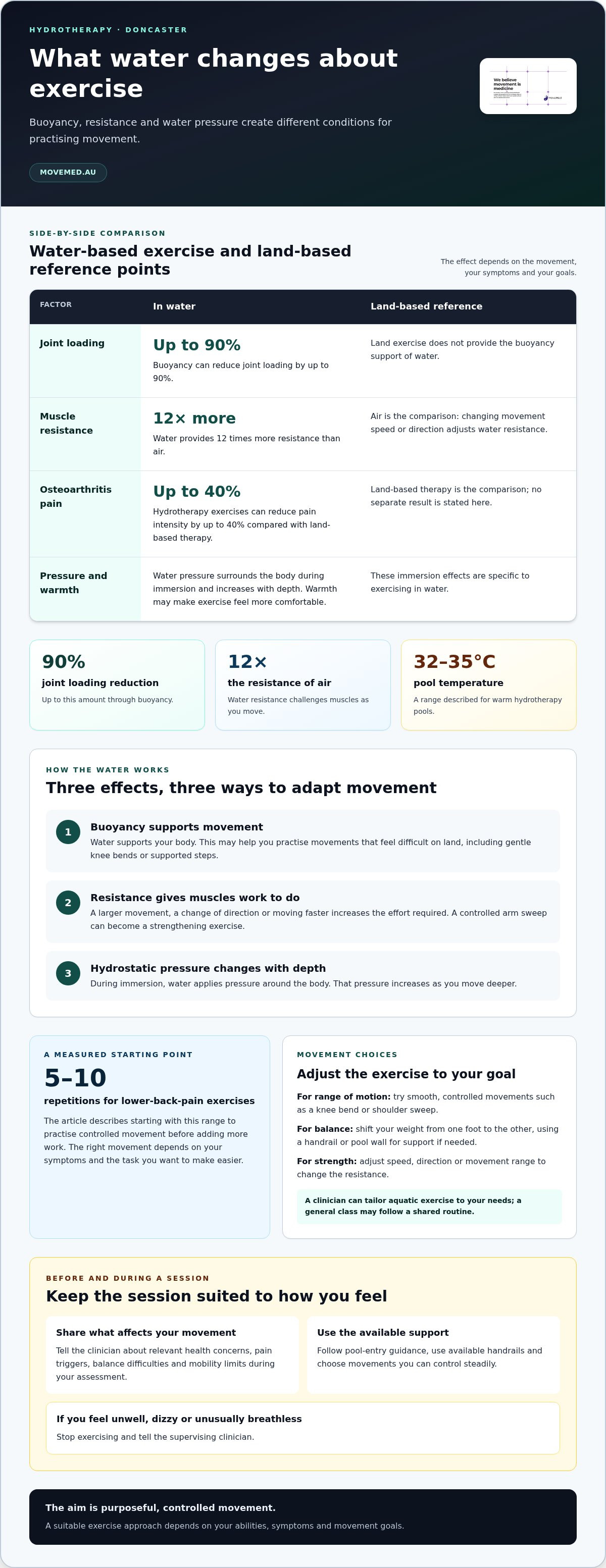
Water can make movement feel more manageable without removing the effort your muscles need. A hydrotherapy program in Doncaster uses water-based exercise to support pain management, mobility and joint movement. Buoyancy can reduce joint loading by up to 90%, while water resistance gives your muscles work to do.
If pain or stiffness makes exercise on land difficult, it’s understandable to wonder whether moving in a pool could feel safer or more comfortable. Hydrotherapy isn’t a cure, but it can be one way to practise movement with support and build confidence at a pace suited to your needs.
This guide explains how buoyancy, water resistance and water pressure affect exercise, and which conditions may benefit from clinic-based sessions in Doncaster East. You’ll also learn what a programme can involve, what influences the cost and how to take a considered next step towards improving your mobility.
Key Takeaways
- Water-based exercise can make movement more manageable when pain or stiffness limits what you can do on land.
- Buoyancy supports your body, while water resistance lets you work muscles by changing how you move.
- Osteoarthritis, back pain, fibromyalgia and some balance difficulties are among the conditions that may benefit from hydrotherapy.
- Your abilities, symptoms and movement goals help shape suitable exercises and the pace of a clinic-based programme.
- MoveMed’s Exercise Physiology Consultations can help you explore whether hydrotherapy fits your goals and support needs.
Hydrotherapy for pain and mobility
When walking or bending hurts, exercise in water can offer another way to practise movement. Buoyancy supports your body, while the water still provides resistance as you move. A hydrotherapy programme in Doncaster can focus on pain, joint movement, strength and everyday tasks, such as standing from a chair or climbing steps.
For osteoarthritis, hydrotherapy exercises can reduce pain intensity by up to 40% compared with land-based therapy. The aim is not simply to exercise in a pool. A structured session matches movements to your goals, such as improving knee bend, walking tolerance or confidence when changing direction. Progress is guided by how you move and respond during exercise.
Lower-back-pain exercises can start with 5-10 repetitions, allowing you to practise controlled movement before adding more work. For example, you might begin with gentle trunk movements, then build towards walking or leg exercises in the water. The right movement depends on your symptoms and the task you want to make easier, rather than a fixed routine for everyone.
How does hydrotherapy compare with physiotherapy or aquatic exercise in Doncaster? Hydrotherapy describes exercise in water; physiotherapy is a health discipline that can include assessment and treatment, while aquatic exercise describes the activity itself. A clinician can tailor aquatic exercise to your needs, whereas a general class may follow a shared routine.
Mobile exercise physiology in Doncaster can bring an exercise plan to your home, such as practising sit-to-stand movements beside a sturdy chair. It is land-based, so it cannot provide the buoyancy of a pool. Mobile aquatic physiotherapy involves clinical care in an aquatic setting; water-based sessions require access to a suitable pool, rather than exercise at home.
Does Medicare, NDIS, or private health insurance cover hydrotherapy in Australia? Eligible patients with a chronic condition and complex care needs managed by a GP under a Chronic Disease Management plan can claim up to five allied health services per calendar year. NDIS funding may cover hydrotherapy when it is reasonable and necessary for a participant’s disability, with an allied health recommendation typically used to support the request. Private health cover depends on the policy and the service claimed.
Before starting, share relevant health concerns, pain triggers, balance difficulties and mobility limits during your assessment. Follow the clinician’s pool-entry guidance, use available handrails and choose movements you can control steadily. If you feel unwell, dizzy or unusually breathless, stop and tell the supervising clinician. This helps shape a session around purposeful movement.
How buoyancy, water resistance and hydrostatic pressure support exercise
Water changes how your body experiences movement, creating options for flexibility, balance and strength exercises. Buoyancy supports movement, resistance challenges muscles, and hydrostatic pressure surrounds the body during immersion.
Water support during exercise
Physio Partners says water buoyancy reduces the effects of gravity on muscles and joints, allowing movements and exercises that may be difficult on land. Water resistance provides a separate challenge: moving faster, changing direction or using a larger movement increases the effort required. Water provides 12 times more resistance than air, so even a controlled arm sweep can become strengthening exercise.
Hydrostatic pressure is the force water applies around an immersed body, increasing with depth. It gives you a different physical sensation as you move and change position. In a pool kept between 32 and 35°C, warmth can make an exercise session feel more comfortable. Look for movements that match your goals, not simply the deepest water or fastest pace.
Arthritis-friendly water exercises
For arthritis, start with smooth, controlled movements that keep joints moving without sudden impact. A gentle knee bend, shoulder sweep or supported step can practise range of motion and strength. Water supports movement while its resistance gives muscles work to do.
Notice how each movement feels during and after exercise. If a shoulder sweep feels comfortable, you can gradually increase its range; if it causes sharp discomfort, reduce the movement and discuss another option with your clinician. Warm water between 32 and 35°C is common in Melbourne hydrotherapy pools.
Balance and flexibility exercises can also use the water’s support. Shifting weight from one foot to the other, for example, practises balance, while a controlled ankle movement works through joint range. A handrail or pool wall can support you as you focus on posture and control. Changing movement speed and direction adjusts resistance without weights.
Exercise physiology for rehabilitation applies exercise principles to goals such as walking more steadily, building strength after injury or returning to daily tasks. An accredited exercise physiologist prescribes an individualised program after a one-on-one assessment, taking your movement, symptoms and priorities into account. Someone working towards easier stair climbing might practise stepping, leg strength and balance, then progress as control improves.
To compare exercises, identify the movement you want to improve, then consider whether water support helps you practise it with control. A clinician can adjust depth, direction, speed and range to suit that task. For individualised exercise guidance, a clinical assessment can help connect your movement goals with an appropriate exercise approach.
Water resistance challenges muscles, and changing movement speed or direction adjusts the effort. Choose a pace that suits your ability and goals.
Buoyancy and joint support
Joint pain can make ordinary movements feel demanding, particularly when standing, stepping or bending. In water, buoyancy supports part of your body weight, so joints experience less load during movement. This support can help you practise a knee bend or arm raise through a comfortable range. Muscles still work against the water’s resistance.
How much support you feel depends partly on immersion depth. A clinician can adjust the support by changing your position in the water. For example, standing in deeper water provides more support than standing in shallower water. This can make weight-bearing exercise more manageable while you practise control and movement.
An assessment helps connect pool exercises with your needs. It can consider which joint hurts, which movements are restricted and what daily task you want to improve. If knee stiffness makes rising from a chair difficult, the program might include controlled knee bends and supported stepping. If reaching overhead is limited, gentle shoulder movements may be more relevant.
Buoyancy supports movement, but joint stability still matters. Joint stability is the ability of muscles and ligaments to keep a joint aligned during movement. When practising a supported step, for example, you can focus on keeping the knee aligned over the foot. Moving slowly and staying within a controlled range can make that alignment easier to notice.
Water-based exercise can also help you practise a movement before trying it on land. A supported weight shift, for instance, can build confidence with balance and controlled loading. A clinician can adjust the direction, range or speed to change the challenge. If a task feels difficult, a smaller movement can be a useful starting point.
For osteoarthritis, water exercise can support joint movement and strengthening without relying only on land-based tasks. Exercises should connect to your goals, such as walking more comfortably or managing stairs. The focus is not on pushing through pain. Instead, practise controlled movement and build towards useful tasks as your capacity develops.
After an assessment, note which movements feel easier in water and which remain challenging. For example, compare a gentle knee bend with a step, or a shoulder sweep with reaching. This helps guide exercise choices and track changes in movement. Your program can then focus on the joint and everyday activity that need support.
Physio Partners says water buoyancy supports body weight and reduces stress on joints, allowing a greater range of motion. Physio Partners also says water buoyancy reduces the effects of gravity on muscles and joints, allowing movements and exercises that may be difficult on land. This support can make a restricted movement more accessible in the pool, where you can explore a greater range of motion than may be comfortable on land.
Conditions that may benefit from hydrotherapy
Hydrotherapy may be considered when a health condition affects movement, strength or confidence with physical activity. Start with the task you want to manage more comfortably. For example, describe difficulties with household routines, recreation or returning to a usual activity. This helps connect exercise planning to your priorities rather than focusing on a diagnosis alone.
Osteoarthritis: Hip or knee osteoarthritis can affect daily movement and ability to stay active. A program can focus on your priorities, such as staying active around the home or building confidence with exercise. Tracking a simple measure, like how easily you complete a regular task, can help you and your clinician review whether the exercises remain relevant.
Back pain: If back pain affects your usual routine, note which positions or activities are difficult and when symptoms arise. This information helps shape a plan around your movement tolerance and rehabilitation goals. You might also record how you feel after activity, so changes in comfort and participation can inform discussions about exercise progression.
Rheumatoid arthritis and shoulder pain: These conditions can affect different joints and activities, so the exercise focus should reflect your own difficulties. Consider which movements matter most for self-care, work or hobbies. For shoulder concerns, explain whether the main challenge involves dressing, reaching or another task, rather than relying on a general exercise list.
Fibromyalgia: Widespread pain and fatigue can influence how you plan activity across the day. Identify a manageable exercise goal and consider how it fits with your energy levels and routine. Brief notes about activity and fatigue can help guide conversations about adjusting the focus or effort of a program.
Rehabilitation following surgery: The operation, stage of recovery and movement goals all shape rehabilitation priorities. Discuss which activities you are working towards and what your current plan allows. This gives the exercise program a clear purpose and connects pool-based practice to your wider recovery, rather than treating it as a standalone activity.
Balance and co-ordination problems: These concerns can affect confidence during movement and participation in daily routines. Tell your clinician which situations feel difficult, such as changing direction or moving through busy spaces. That context helps identify relevant practice goals and ways to review progress, including whether you feel more confident with chosen tasks.
Before starting, write down your main movement goal, the activities affected and any changes you have noticed. This gives your assessment a practical focus and helps you take an active role in shaping exercise around the life you want to lead.
Clinic-based hydrotherapy in Doncaster East
Clinic-based sessions in Doncaster East pair a pool environment with exercises linked to your movement goals. Booking, session timing and pool access all affect how you plan to begin.
Booking and referrals
To arrange a session in Doncaster, contact a clinic and ask about its booking pathway. Explain your main difficulty, such as painful knee movement or unsteady walking, and describe what you want exercise to help you practise.
Bring relevant referral or funding information if you have it, along with a brief list of health concerns and current movement limits. Your first appointment includes a one-on-one assessment to establish goals, discuss suitable exercises and inform your personalised treatment plan. If funding arrangements apply, have the relevant plan details ready.
Session times and program lengths
Session times and programme lengths vary between local providers, so there is no single Doncaster East timetable or standard programme duration. Appointment timing depends on clinic scheduling, pool access and the exercise plan. The programme length is shaped by your goals, progress and how sessions fit into your routine.
For example, improving confidence with walking may involve different exercises from rebuilding shoulder movement. Ask what your appointment includes, how exercise progress is reviewed and how future sessions are arranged. These details help you plan transport, work or caring responsibilities around pool visits.
A clinic-based setting gives you a defined place to practise in water, rather than doing land exercises at home. Before your first visit, plan how you will manage arrival, changing and getting to the pool area. If walking is difficult, consider the route from the entrance to the pool and whether you need support carrying belongings.
Pool features matter because they affect access and exercise choices. For example, a handrail can help with controlled entry, while a poolside bench may support rest between movements. Identify whether you need assistance with changing, steps or balance, and factor these needs into your session plan. Do not assume every facility has the same layout.
Use a short preparation list: record your movement goal, note activities that increase discomfort, and bring relevant referral or funding paperwork. If stairs are difficult, for instance, tell the clinician whether the challenge is stepping up, lowering down or maintaining balance. A specific example makes it easier to connect pool exercises with daily life.
When comparing clinic-based options in Doncaster East, focus on how the session supports your goal, the booking pathway and access needs. A useful next step is to discuss your hydrotherapy goals and identify what you need from a clinic-based programme.
MoveMed: Exercise Physiology Consultations
MoveMed provides Exercise Physiology Consultations and Hydrotherapy to help you work towards meaningful movement goals. If pain, stiffness or reduced balance makes exercise difficult, an accredited exercise physiologist can develop an evidence-based plan around your health needs and daily activities.
In an Exercise Physiology Consultation, you can discuss what you want to improve, such as walking more steadily or managing everyday tasks with greater confidence. Hydrotherapy may form part of a plan when supported movement in water suits your needs. Aged Care Funded Therapy and NDIS Assistance may also be relevant if you use those funding pathways.
Contact MoveMed to discuss your goals and the next step for exercise support.
Take the next step towards easier movement
Choosing an exercise approach starts with a practical question: which everyday movement would you most like to make easier? It might be standing from a chair, walking with greater confidence or reaching without discomfort. Keeping that goal in focus can help you discuss suitable support and decide what progress would look like in your daily routine.
A hydrotherapy program in Doncaster may suit you if water-based exercise matches your movement needs. MoveMed offers Hydrotherapy and Exercise Physiology Consultations, with exercise guidance shaped around your health goals. Aged Care Funded Therapy is also available for people whose care pathway includes that support.
You don’t need to have every detail planned before taking the next step. Share the movement that matters most to you, along with any concerns that affect exercise, and start a conversation about an appropriate path forward. Contact MoveMed about hydrotherapy and take a considered step towards building confidence in movement.
Frequently Asked Questions
What is Hydrotherapy?
Hydrotherapy is guided exercise in water, rather than simply swimming or using a pool for recreation. At MoveMed, an initial one-on-one assessment informs a personalised treatment plan and first exercise program, giving the exercises a clinical purpose. You can discuss your priorities and how water-based exercise could fit alongside your broader movement goals.
What hydrotherapy programs are available in Doncaster, Victoria?
MoveMed provides Hydrotherapy and Exercise Physiology, with exercise plans shaped around your needs. The first step is to book an appointment and discuss what you want to work towards. Book online through the “Book an Appointment” button or call the clinic. No GP referral is required, so you can start by sharing your goals and relevant health information.
Which hydrotherapy providers and pools are near Doncaster, Australia?
MoveMed provides clinic-based Hydrotherapy in Templestowe for people from Doncaster and surrounding suburbs. Sessions are delivered as a clinical service, not as open pool access. To plan your visit, book online or call the clinic, and consider how you’ll travel from your suburb. People in Doncaster East, Bulleen, Warrandyte, Lower Plenty, Balwyn North and Box Hill can also access the clinic’s local services.
What conditions and rehabilitation goals can hydrotherapy help with?
Hydrotherapy can support rehabilitation goals when a tailored exercise plan suits your health needs. Rather than relying on a diagnosis alone, discuss a practical outcome you want to work towards, such as returning to a valued activity or building confidence with movement. An accredited exercise physiologist can use your assessment and priorities to shape an evidence-based plan and review its relevance as your needs change.
Who is eligible for hydrotherapy programs in Doncaster?
Suitability depends on your health needs, movement goals and the support you’re seeking. MoveMed accepts all compensable schemes, including Medicare and the NDIS, and offers Aged Care Funded Therapy and NDIS Assistance. Eligible plans and schemes may be bulk-billed. No GP referral is required to book directly, and you can discuss your circumstances and funding pathway at your appointment.


