
A strong hydrotherapy funding request links sessions to your disability-related needs and functional goals. NDIS funding for hydrotherapy sessions in Box Hill may be available through Capacity Building funding, often under Improved Daily Living, when the therapy is structured and supports your plan goals. General pool entry is not usually covered as therapy.
It’s understandable to wonder whether hydrotherapy means pool access or a recognised therapy support. Under the NDIS, the key distinction is the purpose of the sessions: they need to be part of a therapeutic program, not recreation.
This article explains how funding categories and plan management affect payment, how pool entry fees are handled, and what evidence can show why hydrotherapy supports your goals. You’ll also learn how an allied health professional can link therapy to practical outcomes such as strength, balance or mobility.
Key Takeaways
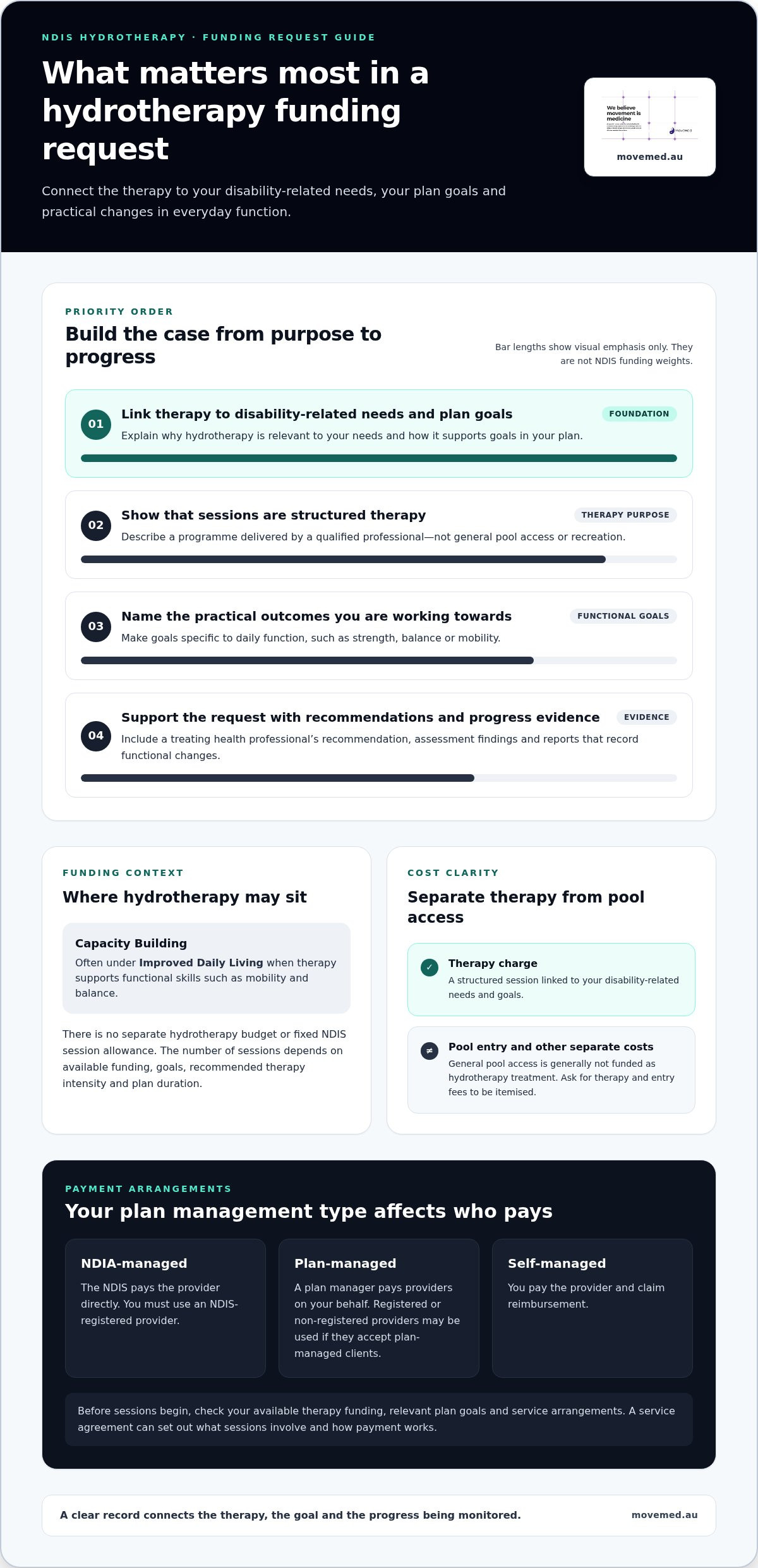
- Identify whether your plan is NDIA-managed, plan-managed or self-managed, as this determines how approved therapy providers are paid.
- Separate therapy charges from pool entry fees when planning costs; general pool access is generally not funded as hydrotherapy treatment.
- Look for hydrotherapy funding under Capacity Building, commonly Improved Daily Living, rather than treating it as a separate budget.
- Build your request around disability-related needs, functional goals and evidence of measurable progress.
NDIS Hydrotherapy: Is It Funded and How Does It Work?
NDIS funding may cover structured hydrotherapy when it relates to disability-related needs and plan goals. Payment arrangements depend on whether your plan is NDIA-managed, plan-managed or self-managed.
Payment management options
Plan management determines who handles payments for approved therapy and how providers are paid. With an NDIA-managed plan, the NDIS pays the provider directly, and you must use an NDIS-registered provider. A plan manager pays providers on your behalf; you can use registered or non-registered providers who accept plan-managed clients. If you self-manage, you pay the provider and claim reimbursement. These arrangements affect your provider options and how payments are processed.
Checking plan funding and service arrangements
Before sessions begin, review your available therapy funding, relevant plan goals and management type. Confirm that your budget can cover the proposed therapy, then agree on the service arrangements with the provider. A service agreement sets out what sessions involve and how payment works. It can help you understand your commitment and keep invoices and records organised, particularly when tracking spending across several supports.
Hydrotherapy is not funded as general recreation. It needs to be part of a structured therapy program delivered by a qualified professional and linked to your disability-related needs. There is no separate hydrotherapy budget or fixed NDIS session allowance. The number of sessions depends on your available funding, goals, recommended therapy intensity and plan duration.
For NDIS funding for hydrotherapy sessions in Box Hill, link the case for support to practical outcomes such as improved strength, balance or mobility. A treating health professional’s recommendation can explain why water-based therapy suits your needs and how progress will be monitored. Progress reports can document functional changes and whether sessions continue to support your goals.
At a plan reassessment, this evidence can help demonstrate the purpose and value of therapy. Include assessment findings, recommendations and progress towards functional goals in your request. A clear record explains how hydrotherapy relates to your disability and the outcomes you’re working towards.
Does NDIS pay for pool entry fees?
NDIS funding generally covers eligible structured therapy, not general pool access. Pool entry and therapy charges are separate, so distinguish them when reviewing a quote.
Provider quotes and therapy costs
A provider quote should explain what the therapy session includes and whether pool entry is charged separately. This distinction matters because NDIS funding generally does not cover general pool entry, even when a qualified allied health professional provides treatment in the water. Ask for the session components and any separate fees to be itemised. This makes it easier to compare the proposed service with your plan funding.
Therapy costs depend on the service provided and your plan’s funding arrangements. NDIS price limits apply to allied health therapy for NDIA-managed plans, and a provider’s quote should explain the therapy charge. A support worker’s assistance at the pool is separate from the therapy session. Time spent helping you dress, enter the pool or stay safe is not the same charge as the clinician’s treatment.
Pool access and session bookings
A hydrotherapy booking is for a structured therapy session in a pool, not open pool access. This can be useful if you need an accessible setting to work on mobility, balance or strength. Pool entry remains a separate expense, and your NDIS therapy budget does not automatically cover it. The session should be guided by a qualified professional and linked to disability-related goals.
Before a session, the service agreement and quote can clarify appointment arrangements, the therapy charge and any pool entry fee. For example, a quote can separate the clinician’s treatment from a facility entry charge, so you can see which costs relate to therapy. Provider travel time is also a separate pricing item, while your own transport to and from sessions is generally not covered as therapy.
When planning appointments, budget separately for pool access and support-worker assistance. This gives you a clearer view of the arrangements for each session and helps you track the right plan budget. If pool access is a concern, focus on how the therapy setting supports your functional goals, rather than treating entry as the therapeutic support itself.
NDIS funding category for physiotherapist-delivered hydrotherapy
Physiotherapist-delivered hydrotherapy is usually funded through Capacity Building, often under Improved Daily Living. Land-based physiotherapy and exercise-based movement programs may be alternatives when they support disability-related functional goals.
Physiotherapy funding category
Capacity Building funding covers allied health supports that develop or maintain your ability to manage daily activities. From 30 June 2025, disability-related health supports, including physiotherapy and hydrotherapy, must be claimed under the NDIS Capacity Building budget rather than Core funding. Improved Daily Living is the relevant support category for functional skills such as mobility and balance. The category matters because it helps match therapy costs to the right plan budget.
Price limits and travel charges
The NDIS Pricing Arrangements and Price Limits set maximum rates for allied health therapies, including physiotherapy. The schedule also has a separate item for a physiotherapist’s travel time. These rules explain which therapy and travel charges may be claimed, while your plan budget determines the funding available. A quote should separate clinical time from travel so you can understand how each charge relates to the service.
Hydrotherapy funded as physiotherapy should be guided by a qualified allied health professional and linked to your disability-related goals. In water, buoyancy can reduce joint loading, while water resistance offers an environment for strength, balance and cardiovascular conditioning. The appropriate program depends on your abilities, functional needs and medical considerations.
Land-based physiotherapy may be an alternative when movement practice or exercise can address the same functional goal without pool-based treatment. For example, therapy targeting balance and mobility may support a plan goal of walking more safely. The key is to link the chosen support clearly to your disability-related needs and the capacity you are working to build.
Evidence and goals for a hydrotherapy funding request
A strong funding request links hydrotherapy to disability-related needs, specific NDIS goals and measurable functional outcomes. The evidence should explain why water-based therapy is appropriate, which daily activity it targets and how progress will be assessed.
Start with an assessment and written recommendation from a treating physiotherapist or exercise physiologist. A GP referral is not required to access NDIS hydrotherapy, but allied health evidence can explain the clinical reason for treatment. For example, a recommendation might link supported water exercise to improved balance for safer transfers or greater strength for daily tasks.
The NDIS considers whether a support relates to disability-related functional impact, helps achieve plan goals, offers value for money and is likely to benefit the participant. It also considers whether the support is best funded by the NDIS rather than another system or community service. Address each point directly: describe the functional barrier, explain how therapy targets it and state the expected outcome.
Useful evidence can include assessment findings, the clinician’s rationale and therapy progress reports. A report should describe changes in relevant activities, such as standing, walking or managing personal tasks, rather than simply recording attendance. If progress is limited, the clinician can explain whether the program needs adjustment or another approach may better suit the participant’s goals.
Participants can submit this information when applying for a new plan, requesting a reassessment or seeking a plan variation. A support coordinator can help organise records and connect the recommendation with the goals in the plan. Keep the evidence specific: a goal such as “improve balance to move around the home more safely” gives a clearer basis for assessment than a broad request for general fitness.
For NDIS funding for hydrotherapy sessions in Box Hill, make the clinical link clear: disability-related need, therapy rationale, functional goal and measurable progress. This helps decision-makers assess whether the request meets reasonable and necessary requirements.
MoveMed: Exercise Physiology Consultations
MoveMed can help connect NDIS-funded therapy with practical movement, strength and daily living goals. If you’re considering hydrotherapy or need help turning assessment findings into a structured exercise plan, an Exercise Physiology Consultation can clarify the next steps.
MoveMed’s accredited exercise physiologists develop personalised, evidence-based programs around your health needs and functional goals. Hydrotherapy may suit you when water-based exercise supports those goals; exercise can also be tailored for land-based movement. The focus is on building capacity and tracking progress, rather than choosing a therapy without a clear purpose.
If you’re preparing a funding request or reviewing how therapy aligns with your NDIS plan, MoveMed can guide you through the clinical considerations. Contact MoveMed to discuss your goals and book an appointment.
Take the next step towards movement that matters
Choosing a therapy pathway is about more than getting into a pool. It’s about finding an approach that fits your daily life and gives you a practical way to work towards changes that matter. For NDIS funding for hydrotherapy sessions in Box Hill, use your next conversation to connect your priorities with movement, function and participation goals.
Start by noting the activity you most want to make easier, such as moving around home, joining a community activity or building confidence with exercise. Bringing that priority to a clinical conversation keeps the focus on meaningful function rather than a therapy label. You can then consider how suitable support fits your goals and current plan.
MoveMed offers Exercise Physiology Consultations, Hydrotherapy and Aged Care Funded Therapy. If you’d like to discuss hydrotherapy and a goal-focused next step, contact MoveMed about hydrotherapy. A clear purpose gives you a useful place to begin, and your goals can guide the conversation.
Frequently Asked Questions
What Is Hydrotherapy?
Hydrotherapy is therapeutic exercise in water, where buoyancy can make movement easier by reducing load on your joints. A clinician can adapt movements to your ability and treatment goals. For example, a program may practise balance, gentle walking or leg strength in water before building towards similar tasks on land. It is structured therapy, not swimming or general pool recreation.
Can children access hydrotherapy under NDIS?
Yes, children may access NDIS-funded hydrotherapy when it is recommended as part of a therapeutic intervention plan. The recommendation should explain how water-based exercise relates to the child’s disability-related needs and functional goals. For example, it could describe how therapy aims to support movement or participation in everyday activities. Plan funding and management arrangements also affect how sessions are paid.
Is Hydrotherapy Covered by NDIS in Melbourne?
NDIS funding may cover hydrotherapy in Melbourne when the support relates to your disability, aligns with your plan goals and meets funding requirements. For a Box Hill participant, a useful request explains which functional activity therapy is intended to support, such as moving more confidently during daily routines. The NDIS assesses support in relation to individual needs and the plan.
Is hydrotherapy considered physiotherapy under NDIS?
Hydrotherapy is not a separate NDIS funding category; it is commonly delivered as part of physiotherapy or exercise physiology. When describing the service in your plan, identify the allied health therapy and explain why water-based treatment is suitable. For example, a clinician might use aquatic exercises to practise movement when land-based activity is difficult.
Does my hydrotherapy provider have to be NDIS-registered?
It depends on how your NDIS plan is managed. If the NDIA manages your plan, you must use an NDIS-registered provider for approved hydrotherapy. With plan-managed funding, you may use registered or non-registered providers who accept plan-managed clients. Self-managed participants arrange payment and claim reimbursement, so the payment process differs.
Does the NDIS automatically fund hydrotherapy?
No. Hydrotherapy is not automatically included just because you have an NDIS plan. Your request needs to show how the support relates to disability-related needs and plan goals, and why it is likely to help with functional outcomes. A treating allied health professional can recommend therapy and explain how progress will be measured. Funding comes from therapy support already included in your plan.


