
What if the most effective tool for managing your hip pain isn't found in a surgeon's theatre, but through a specific type of "brain-to-joint" re-education? It's incredibly frustrating to wake up every morning with stiff hips, wondering if you'll eventually lose the independence to walk the dog at Westerfolds Park or simply move without a grimace. You might feel torn between the risks of major surgery and the disappointment of generic gym programs that just don't seem to help. At MoveMed, we use the evidence-based GLA:D program for hip osteoarthritis to help you reclaim your mobility and significantly reduce your daily discomfort.
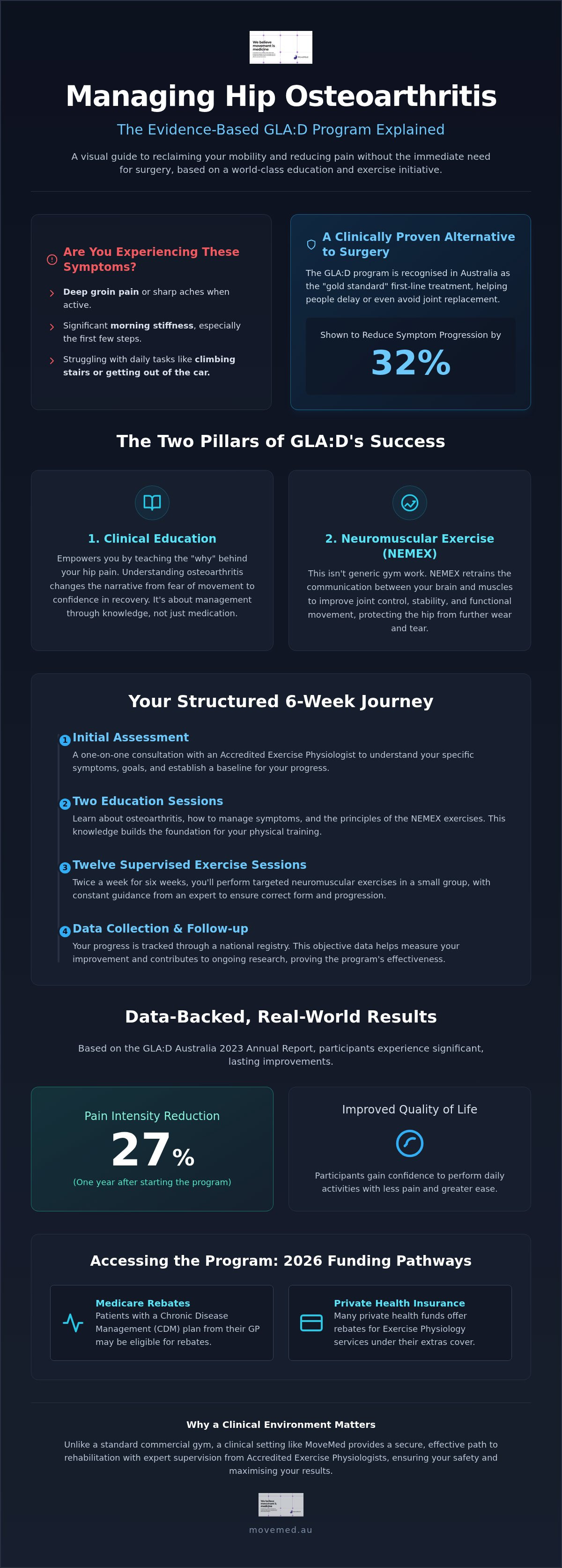
We understand that you want to feel confident in your body's ability to move again without relying on constant medication. Our accredited Exercise Physiologists guide you through a structured path that has been shown to reduce symptom progression by 32 percent, helping many Australians delay or avoid joint replacement altogether. This article explains how the program works, the latest 2026 Medicare and insurance rebate details, and how our local Templestowe clinic provides the expert support you need to get back to the activities you love.
Key Takeaways
- Understand how the GLA:D program for hip osteoarthritis uses clinical education and targeted movement to help you regain mobility without surgery.
- Learn about the structured six-week journey at our Templestowe centre, featuring supervised sessions led by Accredited Exercise Physiologists.
- Discover how evidence-based exercise can significantly reduce joint pain and improve your ability to perform daily activities like walking.
- Explore the various funding pathways available in 2026, including Medicare Chronic Disease Management plans and private health insurance rebates.
- Find out why a clinical environment tailored for rehabilitation offers a more secure and effective path than a standard commercial gym.
What is the GLA:D Program for Hip Osteoarthritis?
When you first receive a diagnosis of hip osteoarthritis, it's natural to feel a sense of uncertainty about your future. You might wonder if a total joint replacement is your only path forward. The GLA:D program for hip osteoarthritis offers a different, evidence-based direction. GLA:D, which stands for Good Life with osteoarthritis: Denmark, is a world-class education and exercise initiative that has transformed how we manage joint pain. It isn't a generic fitness class; it's a specific clinical pathway designed to bring international best-practice guidelines directly to our local community in Templestowe.
In Australia, this program is recognised as the "gold standard" for first-line treatment. Before considering invasive surgery or long-term medication, clinical guidelines recommend a combination of patient education and targeted exercise. The program focuses heavily on neuromuscular exercise, often referred to as NEMEX. Unlike traditional weightlifting that aims for bulk or general cardio that aims for fitness, NEMEX is designed to improve the way your brain communicates with your muscles to support your hip joint. By participating in the GLA:D program for hip osteoarthritis, you're choosing a path backed by years of clinical data.
The Core Philosophy: Education and Movement
Understanding What is Osteoarthritis? and how it affects your body is the first step toward reclaiming control. We find that many people are fearful of movement because they believe pain equals more damage. The education component of GLA:D changes this narrative. We teach you why your hip hurts and how to interpret those signals. When you understand the "why" behind your pain, the "how" of your recovery becomes much clearer. It's about empowerment rather than just management.
The movement side of the program focuses on "joint control." This means training your muscles to stabilise the hip in a way that prevents further wear and tear on the cartilage. Traditional physiotherapy might focus on isolated muscle strength; GLA:D trains your body to move as a functional unit. This neuromuscular approach is what makes the program so effective at reducing pain and improving your ability to navigate daily life. It's a journey we take together, ensuring you feel confident in every step.
Who is GLA:D for in Templestowe?
Are you finding it difficult to get out of the car or struggling with the first few steps after waking up? These are common signs that your hips need more support. Most of our participants report deep groin pain, significant morning stiffness, or a sharp ache when climbing stairs. You don't necessarily need a recent X-ray to begin your journey with us. If your symptoms align with clinical patterns of osteoarthritis, you can start the program immediately. We focus on the person, not just the scan.
If you're unsure whether your specific symptoms fit the criteria, we recommend reading our detailed resource on hip osteoarthritis exercise physiology Melbourne for a deeper analysis. This program is for anyone who wants to avoid surgery and get back to walking comfortably around the Manningham area. Whether your pain is a mild daily nuisance or a significant barrier to your independence, this structured approach provides the tools you need to move with confidence again.
The 6-Week GLA:D Journey: What to Expect
Embarking on a new clinical program often feels like a significant commitment. The GLA:D program for hip osteoarthritis is structured as a focused six-week block because that is the minimum time required to see genuine physiological shifts in how your muscles support your joints. You aren't just doing random exercises; you're following a protocol developed by GLA:D International that has been refined through years of clinical research. Every one of the 12 exercise sessions is guided by an Accredited Exercise Physiologist. This level of supervision is what separates a clinical program from a standard gym membership.
We also track your progress through a national registry. This isn't just for paperwork; it's about results. Data from the GLA:D Australia 2023 Annual Report shows that participants typically experience a 27 percent reduction in pain intensity one year after starting. This tracking gives you a clear, objective picture of your own improvement. It allows us to ensure the program stays effective for every Australian participant while providing you with tangible proof of your progress.
The Two Education Sessions
Before you even break a sweat, we sit down to discuss the science of your pain. These two initial sessions are arguably the most important part of the journey. We spend time debunking the common "wear and tear" myth. In reality, movement acts as "wear and repair" because controlled loading helps stimulate joint health. You will learn how to manage flare-ups at home without panicking, which is a vital skill for long-term independence. By the end of these sessions, you'll have a clear set of mobility goals for your 2026 recovery journey.
The Supervised Exercise Component
The core of the program involves twice-weekly sessions that focus on functional movements. We use the "NEMEX" framework, which consists of 10 specific exercises that we tailor to your current pain levels. These movements are designed to mimic the things you do every day, such as:
- Getting in and out of a chair with ease
- Stepping safely over a kerb or up a flight of stairs
- Maintaining balance while walking on uneven ground
There is a unique energy in our group sessions. You will be training alongside other Templestowe and Doncaster locals who understand exactly what you are going through. This social support makes the hard work much more enjoyable. If you're ready to see how this structure can work for you, the team at MoveMed is here to guide you through each step.
GLA:D vs. Hip Replacement Surgery: Making an Informed Choice
Deciding between clinical exercise and a surgical theatre is a major crossroad. Many people in Templestowe feel that once a diagnosis is confirmed, a hip replacement is the only logical conclusion. However, the GLA:D program for hip osteoarthritis offers a scientifically validated alternative that prioritises your body's natural resilience. Choosing exercise first isn't just about avoiding a hospital stay. It's about reducing the progression of your symptoms by 32 percent, a figure supported by the research shared by GLA:D Australia.
When we compare the two paths, the risk profiles are vastly different. Major surgery carries inherent risks such as infection, blood clots, or the eventual wearing out of the prosthetic joint. In contrast, the "risks" of a clinical exercise program are typically limited to temporary muscle soreness as your body adapts to new movement patterns. The recovery timelines are equally striking. While a hip replacement requires months of intensive post-operative rehabilitation, participants in the GLA:D journey often report functional improvements and pain reduction within the first few weeks of starting.
There is also the pragmatic side of health management in Victoria. Public hospital waitlists can be incredibly long, and the cost of private surgery can be a significant financial burden. Investing in a structured clinical program allows you to take immediate action rather than waiting in pain. It's a proactive choice that builds long-term joint health and keeps you in control of your own recovery timeline.
When is Surgery Actually Necessary?
While exercise is the recommended first-line treatment, there are instances where surgery is the right call. If you experience "red flags" like persistent night pain that stops you from sleeping or a total loss of joint space that prevents basic movement, a replacement might be necessary. Even in these cases, the GLA:D program serves as excellent "pre-hab." Entering a surgical procedure with stronger, better-coordinated muscles significantly speeds up your recovery on the other side. Our Exercise Physiologists can help you weigh these options during a clinical consultation.
The Evidence for Exercise-First Management
The data is clear. Participants often see a 25 percent reduction in pain intensity and a 30 percent improvement in their ability to stay active. By organising your movement patterns, we help distribute the load across your hip more evenly, which protects the remaining joint surface. This philosophy of using movement to treat chronic issues is something we also explore in our guide on clinical pilates for back pain. Whether it's your back or your hip, the goal remains the same: building a body that supports itself effectively.
Accessing GLA:D in Templestowe: Cost and Funding Options
Managing chronic pain is a long-term investment in your future quality of life. At MoveMed, we believe financial logistics should never be a barrier to accessing evidence-based care. We provide clear, transparent pathways for the GLA:D program for hip osteoarthritis, ensuring you can access the support you need through various Australian funding schemes. Whether you're using Medicare, private health insurance, or specialised government support, we handle the administrative side so you can focus entirely on your recovery.
Navigating these systems can feel overwhelming when you're already dealing with daily discomfort. Our team acts as your partner, helping you understand exactly what rebates you're entitled to and how to maximise your benefits. We work closely with local GPs across Templestowe, Doncaster, and Bulleen to ensure your referral process is seamless and your care is coordinated.
GP Referrals and Medicare
The most common way to access funding is through a Chronic Disease Management (CDM) plan, formerly known as an EPC. You'll need to speak with your GP to determine if you're eligible. As of 2026, these plans allow for a Medicare rebate of approximately $65.00 per session for up to five allied health sessions per calendar year. While this doesn't cover the full cost of the program, it significantly reduces your out-of-pocket expenses for the initial assessment or your exercise sessions. Once you have your referral, simply bring it to our Templestowe Lower clinic, and we'll take care of the rest.
Private Health Insurance
Most major Australian health funds provide rebates for Exercise Physiology under their "Extras" cover. In 2026, insurers like Bupa and HCF have expanded their support for the GLA:D program. Some HCF members with specific hospital cover may even be eligible for full reimbursement of the program costs as part of their chronic disease management benefits. We recommend calling your provider to ask about "Health Management" or "Exercise Physiology" rebates to see how much you can claim back.
DVA, TAC, and NDIS Support
We're proud to support our veterans and those navigating transport accident claims. For DVA and TAC clients in the Manningham region, we use specialised billing processes that often result in no out-of-pocket costs for the participant. If you're an NDIS participant, the GLA:D program can be written into your plan under goals related to physical independence and daily living. For those with work-related injuries, you might also find our guide on workcover hydrotherapy useful for understanding how different funded therapies can work together.
Ready to find the best pathway for your recovery? Contact our Templestowe team today to discuss your funding options and book your initial assessment.
Why MoveMed is the Home of GLA:D in Melbourne’s East
Selecting a provider for your GLA:D program for hip osteoarthritis is a decision that affects your long-term independence. At MoveMed, we've designed our Templestowe Lower centre to be a dedicated clinical sanctuary. Unlike a busy commercial gym where you might feel overlooked, our space is purpose-built for rehabilitation. We focus on creating a calm, optimistic environment where every clinical protocol is geared toward your specific joint health needs. We are deeply rooted in the Manningham community, serving residents from Doncaster, Bulleen, and Warrandyte with a level of care that goes beyond simple exercise prescription.
We see ourselves as your partners in health, guiding you through every step of your journey toward better movement. Our personality is that of a trusted local expert who will sit with you, explain the clinical details clearly, and handle the complicated paperwork so you don't have to. You aren't just a number in a class; you're a member of a community centre dedicated to helping you reclaim your confidence.
The MoveMed Clinical Advantage
Our sessions are led exclusively by Accredited Exercise Physiologists who specialise in chronic pain management and aged care. This expertise is vital, especially if you are managing multiple health conditions, known as comorbidities, alongside your hip pain. Our EPs have the deep clinical knowledge required to adjust the GLA:D program for hip osteoarthritis safely for your unique body. We keep our group sizes small to ensure you receive the individual attention your hip requires. This level of supervision ensures your technique remains precise, which is essential for effective neuromuscular training and long-term joint protection.
Beyond the 6-Week Program
We don't believe in "set and forget" therapy. Once you finish the initial six weeks, we help you transition to a long-term maintenance plan that fits your lifestyle. Many of our clients choose to integrate clinical reformer pilates Templestowe into their routine. This helps build the core and pelvic stability needed to protect your hips during daily activities like gardening or walking the dog. Alternatively, you might move into our hydrotherapy sessions to maintain joint range of motion in a low-impact, supportive environment.
Our ongoing support is designed to keep you moving through 2026 and well into the future. We'll coordinate with your GP and manage your funding requirements so you can focus on what matters most. Reclaiming your mobility and living your life without the constant shadow of hip pain is possible when you have the right local team behind you.
Your Path to Better Hip Health Starts Here
Living with persistent hip pain doesn't have to be your permanent reality. By choosing the GLA:D program for hip osteoarthritis, you're opting for a scientifically proven method to strengthen your joints and avoid the risks associated with major surgery. We've seen how this structured six-week journey helps you regain control over your daily life, whether that's walking through local parks or simply waking up without stiffness. As a registered GLA:D Australia provider, MoveMed is proud to have served the Manningham community for years. Our Accredited Exercise Physiologists are ready to partner with you, ensuring every movement is safe, effective, and tailored to your specific needs.
Don't let another year pass by in discomfort. We'll handle the referrals and funding details so you can focus entirely on your progress. Enquire about our next GLA:D intake at MoveMed Templestowe and discover how our clinical expertise can help you move with confidence again. Your body is capable of incredible resilience, and we're here to guide you every step of the way.
Frequently Asked Questions
Do I need a GP referral to start the GLA:D program at MoveMed?
You don't need a GP referral to book your initial assessment or participate in the sessions. However, if you're looking to claim Medicare rebates through a Chronic Disease Management plan, you'll need to have that paperwork organised by your doctor before we can process the claims. We're always happy to help you understand what you need to ask your GP during your next visit.
Is the GLA:D program covered by Medicare or private health insurance?
Yes, the GLA:D program for hip osteoarthritis is recognised by major Australian funding bodies. Medicare provides a rebate of approximately $65.00 per session for up to five sessions per year if you have a valid referral. Most private health funds also provide rebates under Exercise Physiology extras, and some insurers even offer full reimbursement for the program as a proactive health management initiative.
What happens if I find the exercises too difficult or painful?
We modify every movement to suit your specific pain levels and physical abilities. Our Exercise Physiologists use a clinical pain-monitoring scale to ensure you're working at a level that's effective but safe. If an exercise feels too challenging, we'll find a simpler version that still builds the necessary joint support without causing a flare-up.
Can I do the GLA:D program if I have already had a hip replacement on the other side?
You certainly can. In fact, strengthening the muscles around your remaining natural hip is one of the best ways to maintain your long-term independence. The program also focuses on improving your overall balance and walking patterns, which helps protect your prosthetic joint and reduces the strain on your lower back and knees.
How much does the full 6-week GLA:D program cost in Templestowe?
The total cost depends on your eligibility for various rebates and the specific funding pathway you're using. The program is a comprehensive package that includes your initial clinical assessment, two education seminars, and 12 supervised exercise sessions. For a detailed breakdown of our current 2026 session rates and how your insurance might apply, please get in touch with our Templestowe team.
What should I wear to my GLA:D exercise sessions?
Wear comfortable, loose-fitting clothing that allows you to move your hips and legs freely. Standard activewear, tracksuits, or even loose trousers and a t-shirt are perfectly fine. We also ask that you wear supportive, closed-toe shoes like runners to ensure you have a stable base while performing the movements.
How soon will I start to feel a reduction in my hip pain?
Many participants report a noticeable improvement in their mobility and a reduction in stiffness within the first six weeks of the GLA:D program for hip osteoarthritis. Clinical data shows that the benefits are long-lasting, with participants typically experiencing a 27 percent reduction in pain intensity one year after finishing the program. Consistency is the key to seeing these cumulative results.
Can I do the GLA:D program if I also have knee osteoarthritis?
Yes, the program was specifically developed to manage both hip and knee osteoarthritis. Because the exercises focus on the neuromuscular control of the entire leg, the movements you do for your hip will often provide significant relief for your knee joints as well. We'll tailor the session to address whichever joint is causing you the most trouble on any given day.


