

What if the biggest obstacle to your workplace recovery isn't your injury, but the simple force of gravity? For many Victorians, traditional land-based exercises often feel like an uphill battle against sharp pain and stiff joints. It is incredibly frustrating when you want to return to your pre-injury duties, but your body isn't ready for the impact of everyday movement. This is where workcover hydrotherapy serves as a high-performance clinical tool, providing a buoyant environment where you can rebuild strength and mobility without the usual discomfort.
We understand that navigating the WorkSafe system can feel overwhelming when you are already managing a painful condition. You might be worried about complex claim forms or why your progress feels stalled. This guide will help you learn how to access WorkCover-funded hydrotherapy to accelerate your recovery and return to work safely. We will walk you through the approval process, explain how we manage the necessary Allied Health Recovery Management Plan (AHRMP) paperwork on your behalf, and provide a clear roadmap for your journey back to independence and confidence.
Key Takeaways
- Understand why clinically supervised aquatic sessions are more effective than a casual swim for managing pain and reducing swelling (oedema).
- Learn how to access workcover hydrotherapy by following a simple two-step referral process through your General Practitioner.
- Discover how MoveMed handles the complex clinical paperwork, including the Allied Health Recovery Management Plan (AHRMP), to ensure your funding remains secure.
- Identify the specific WorkSafe Victoria criteria for "reasonable costs" and how to transition safely from the pool back to your regular work duties.
What is WorkCover Hydrotherapy and Who is it For?
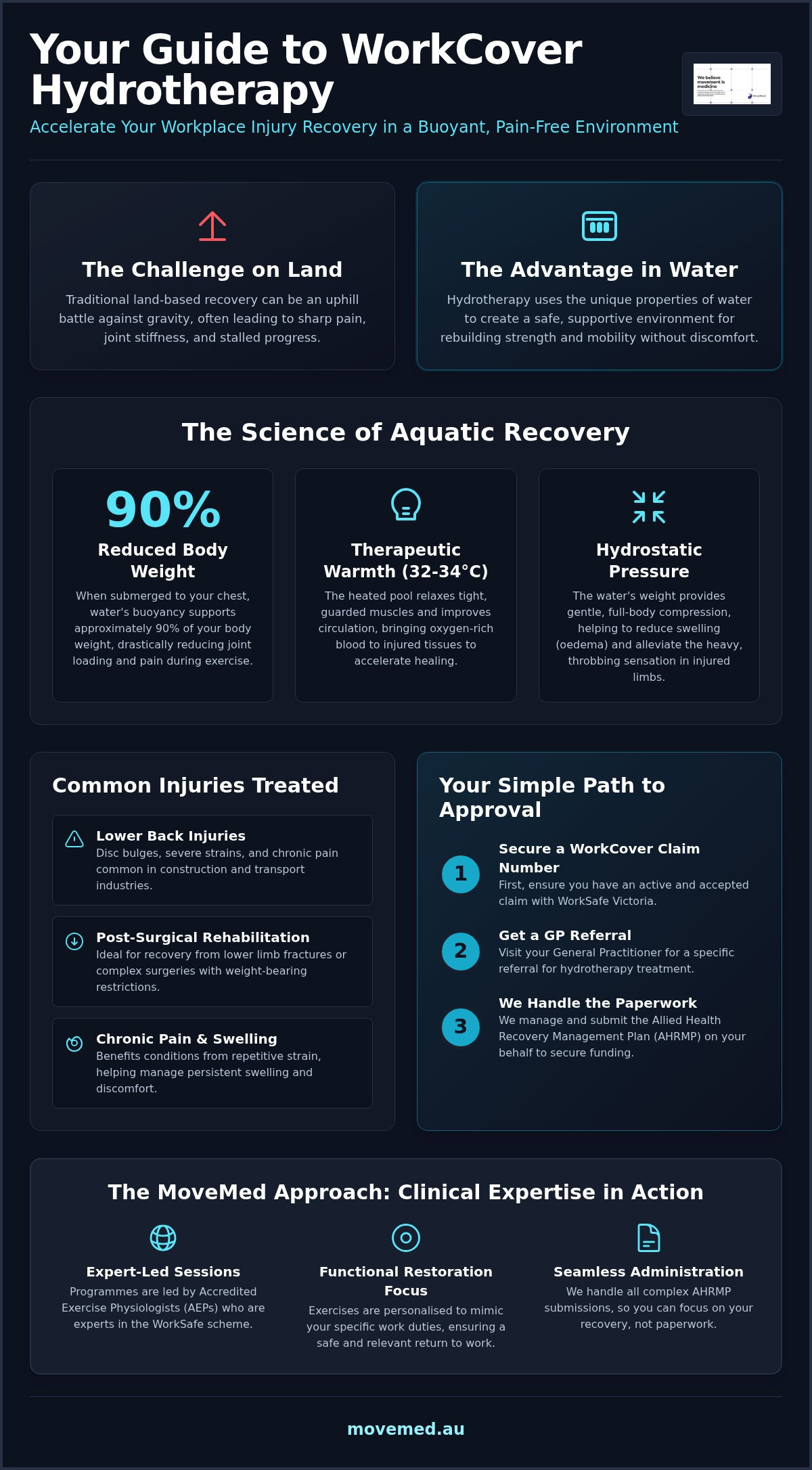
Workcover hydrotherapy is a specialised form of clinical rehabilitation that takes place in a purpose-built, heated pool, usually maintained between 32 and 34 degrees Celsius. It isn't just about "going for a swim" or doing laps at your local leisure centre. Unlike a general pool membership, these sessions are clinically supervised and specifically designed to address the physical limitations caused by your workplace injury. Aquatic therapy uses the unique properties of water to create a safe space for movement that might be impossible on land. The most significant factor is buoyancy. When you are submerged to your chest, the water supports about 90% of your body weight. This massive reduction in joint loading allows you to perform strengthening exercises without the sharp, stabbing pain that often accompanies weight-bearing activities.
To access this funded service, you need an active WorkCover claim number and a specific referral from your GP. It is a structured medical intervention rather than a recreational activity. This distinction is vital because WorkSafe Victoria focuses on "reasonable costs" that lead to functional restoration. They want to see that you are making measurable progress toward returning to your job. Because the environment is controlled and the exercises are prescriptive, workcover hydrotherapy often serves as the essential bridge between initial injury and returning to the gym or workplace.
Common Work Injuries Treated with Aquatic Therapy
We frequently see workers who are stuck in a cycle of pain and inactivity. Lower back injuries, such as disc bulges or severe strains common in the construction and transport industries, respond exceptionally well to the warmth of the water. The heat helps relax "guarded" muscles that have tightened up to protect an injury. We also support people recovering from lower limb fractures or complex surgeries where a surgeon has restricted weight-bearing. In the pool, we can start gait training (walking practice) much earlier than we could on a hard gym floor. Chronic pain conditions, often the result of years of repetitive workplace strain, also benefit from the hydrostatic pressure of the water, which can help manage persistent swelling in the limbs. For ongoing relief at home, many workers also find that using Elite Massage Chairs helps to maintain muscle relaxation between clinical appointments.
The MoveMed Approach to Aquatic Rehab
At MoveMed, your sessions are led by Accredited Exercise Physiologists (AEPs) who are experts in the clinical requirements of the WorkSafe scheme. We don't believe in generic "one size fits all" water aerobics. Every programme we design is personalised to your specific role, whether you need to get back to climbing ladders in Templestowe Lower or sitting at a desk in Doncaster. Our focus is always on functional restoration. This means we choose exercises that mimic the movements you need for work, using the water's resistance to build the resilience your body requires. We also take the weight off your shoulders by handling the Allied Health Recovery Management Plan (AHRMP) submissions, ensuring your funding is managed professionally while you focus on your movement.
The Clinical Benefits of Hydrotherapy for Workplace Injuries
The healing power of water goes far beyond simple relaxation. When you step into the pool for workcover hydrotherapy, your body immediately responds to hydrostatic pressure. This is the physical weight of the water pressing against your skin from every direction. For workers dealing with persistent swelling (oedema) after a surgery or a severe sprain, this pressure acts like a full-body compression garment. It helps move excess fluid away from the injured area and back into the circulatory system, which can significantly reduce that heavy, throbbing sensation in your limbs.
Therapeutic warmth is the second major clinical advantage. Because the water is kept at a consistent 32 to 34 degrees, it encourages your blood vessels to dilate. This increase in local circulation brings oxygen-rich blood to damaged tissues, speeding up the natural repair process. It also helps "unstick" guarded muscles that have tightened up to protect an injury. While the clinical results are the priority, understanding the administrative side is also important; you can find the specific billing details in WorkSafe Victoria's hydrotherapy fee schedule to see how these sessions are classified and funded.
Water also provides variable resistance. Because water is much denser than air, every movement you make is met with a gentle, consistent force. If you move slowly, the resistance is light. If you move faster, the resistance increases. This allows our Exercise Physiologists to challenge your strength without ever needing to pick up a heavy gym weight. Beyond the physical, the psychological impact of moving without pain is immense. For someone who has spent weeks struggling to walk across a room, the ability to move freely in the pool is a massive boost to recovery morale. It's a "win" that helps you stay committed to the longer journey of rehabilitation.
Reducing Pain and Muscle Spasms
Warm water environment works by stimulating sensory receptors in the skin, which actually helps block pain signals from reaching your brain. This "gate control" effect is why you often feel immediate relief the moment you submerge. Thermoregulation in aquatic therapy refers to the body's ability to maintain a stable internal temperature while absorbing external heat, which stimulates vasodilation to flush out inflammatory markers and soothe irritated nerves. Because of this soothing effect, hydrotherapy is often the very first step we recommend before moving on to more intensive Clinical Pilates or gym-based loading. Our team can help you determine if this is the right starting point for your specific injury.
Improving Mobility and Functional Strength
Achieving a full range of motion is much easier in the pool because you aren't fighting gravity. We use this opportunity to practice the reaching, bending, and lifting patterns you need for your job. We also focus heavily on core stability, which is the foundation of safe manual handling. Building this deep, internal strength in the water ensures your spine is protected once you return to land. This aquatic foundation makes the eventual transition to Clinical Pilates for Back Pain much smoother and more effective, as your body has already relearned how to move without fear.
Understanding WorkSafe Victoria Hydrotherapy Policies
Many injured workers assume that a WorkCover claim provides an open-ended pass for pool access. However, WorkSafe Victoria makes a clear distinction between "Supervised Hydrotherapy" and a general "Swim Membership". Supervised sessions involve an Accredited Exercise Physiologist (AEP) actively guiding your movements to ensure they are therapeutic and safe. A swim membership is usually for independent, unguided exercise. WorkSafe typically prioritises funding for supervised workcover hydrotherapy because it is a clinical intervention with specific, measurable goals aimed at getting you back to your job.
The concept of "reasonable costs" is the backbone of Victorian workplace legislation. WorkSafe only pays for treatments that directly assist in functional restoration. This means every session must help you regain the strength or mobility required for your specific work duties. To keep the process transparent for both providers and patients, the WorkSafe Victoria hydrotherapy fee schedule outlines the exact billing codes and maximum rates allowed. At MoveMed, we use these guidelines to ensure your treatment is fully compliant. We also organise direct billing with your WorkSafe agent, which means you aren't left out of pocket or waiting for reimbursements while you recover.
It is also vital to understand the "13-week rule". WorkCover agents generally review your progress every three months. They want to see that your rehabilitation is moving forward rather than just maintaining the status quo. If the pool sessions are no longer leading to functional improvements, the agent may suggest transitioning to a land-based programme. This is why our team focuses on a results-driven approach. We want to ensure that every minute you spend in the water is a step toward reclaiming your independence.
What WorkCover Will (and Won’t) Pay For
WorkSafe covers the professional fee for the Exercise Physiologist leading your session and your pool entry fee for that specific appointment. They won't, however, fund "maintenance" once your condition has stabilised and you can safely exercise on your own. Their objective is to support your recovery until you are capable of self-managing your health. Once you have reached that milestone, the responsibility for pool entry fees usually shifts back to the individual, as the clinical necessity for supervision has concluded.
The Importance of Functional Outcome Measures
To keep your funding secure, we track your progress using standardised clinical tests. For a lower back injury, we might use the Oswestry Disability Index; for knee or hip issues, we might use a timed walk test. These outcome measures provide the objective proof that workcover hydrotherapy is working. WorkSafe agents require this data to justify continued funding. By showing them clear evidence of your improved mobility and reduced pain, we help ensure your rehabilitation journey continues without administrative interruptions.
How to Get Your Hydrotherapy Sessions Approved
Securing funding for workcover hydrotherapy follows a specific clinical pathway designed to ensure the treatment is necessary for your recovery. It starts with a conversation. If you find that land-based exercises are too painful or that your progress has stalled, your first step is to visit your GP. They are the gatekeepers of your recovery journey and need to understand why the pool is a better environment for your current physical state.
When physical movement is restricted, accessing medical advice can be challenging; for those interested in alternative healthcare delivery, you might explore Per-visit medical service fees for house calls and mobile urgent care to see how mobile services can simplify the consultation process.
During your appointment, ask for a specific referral for "Exercise Physiology - Hydrotherapy". This clarity is essential for your insurer. Your GP will also update your Certificate of Capacity, which is the legal document that outlines what you can and cannot do at work. Once you have your referral, you can book an initial assessment with an Accredited Exercise Physiologist at MoveMed. We will then conduct a thorough evaluation of your injury and functional needs to build a strong case for funding.
After our assessment, we handle the heavy lifting of the paperwork. We prepare and submit the Allied Health Recovery Management Plan (AHRMP) directly to your WorkCover Case Manager. This plan outlines exactly how many sessions you need and what milestones we expect to reach. Once the Case Manager reviews the clinical evidence and approves the plan, you can begin your sessions without worrying about the cost.
The Role of Your GP and Case Manager
You are your own best advocate during this process. If land-based rehabilitation feels like it is doing more harm than good, explain this clearly to your GP. Mention that the buoyancy of the water would allow you to move with less pain. This clinical justification is what the Case Manager needs to see. We also work closely with your employer to ensure that the strength you gain in the pool translates to "suitable duties" at work. This collaborative approach ensures everyone is on the same page regarding your return-to-work timeline. If you are ready to start this conversation, you can book your initial WorkCover assessment here.
Navigating the AHRMP Process
The Allied Health Recovery Management Plan might sound like just another acronym, but it is actually a powerful tool for your recovery. It acts as a roadmap that defines your goals, the specific exercises we will use, and the timeframe for your return to work. The AHRMP is the primary communication tool between the clinician and the WorkCover agent. By providing clear, evidence-based data, we reduce the friction in the approval process. We focus on showing the insurer that workcover hydrotherapy is a strategic investment in your health that will ultimately reduce the long-term costs of your claim by getting you back to work sooner.
Start Your Recovery Journey at MoveMed Templestowe
Local workers in Templestowe, Doncaster, and Manningham choose MoveMed because we treat you as a person, not just a claim number. We understand that a workplace injury affects your whole life, from your ability to provide for your family to your confidence in your own body. Our team is dedicated to being your partner in this journey. We take the stress out of the process by handling the clinical paperwork and communicating directly with your insurer. This allows you to focus entirely on your movement and rehabilitation. Residents in our local community don't have to travel far for high-quality workcover hydrotherapy.
While workcover hydrotherapy is a powerful starting point, we always look toward your long-term health. Our goal is to move you beyond "just managing" your condition. By integrating aquatic sessions with other services like Clinical Pilates, we help you build a body that is stronger and more resilient than it was before the injury. For those looking to delve deeper into their biological health, Emagene Life offers a root-cause approach to mapping your health blueprint. Taking the first step is simple. You just need to book your initial WorkCover assessment with us to get the process started and reclaim your independence.
Expert Care in the Heart of Templestowe Lower
Being a local provider means we have a thorough understanding of the hydrotherapy facilities across the Manningham area. Our Accredited Exercise Physiologists (AEPs) are not just experts in human movement; they are specialists in the Victorian WorkSafe system. We have established relationships with local GPs and case managers, which helps streamline your approval process. If you want to understand the broader landscape of aquatic rehab, see our guide on Hydrotherapy in Melbourne for more context on how these services are delivered.
Your First Session: What to Bring and Expect
Preparing for your first session is straightforward. You will need to bring your swimwear, a towel, and any relevant medical imaging or reports. Most importantly, please have your WorkCover claim number ready. Your journey begins with a "dry" assessment at our Templestowe Lower clinic. This allows us to measure your current range of motion and strength on land so we can track your progress accurately. We don't just throw you in the deep end. We create a graded plan that eventually transitions you from the pool back to land-based strength exercises. This methodical approach ensures that when you do return to your pre-injury duties, your body is fully prepared for the load.
Reclaim Your Independence and Confidence
Your recovery shouldn't be defined by the pain you feel on land. By choosing workcover hydrotherapy, you are opting for a clinically proven environment where buoyancy and warmth work together to accelerate your healing. We have explored how this specialised therapy reduces swelling, relaxes guarded muscles, and provides a safe bridge back to your pre-injury duties. Remember, accessing this funded care is a structured process; it requires a clear GP referral and a professional management plan to ensure your WorkSafe agent sees the functional value of every session.
At MoveMed, we are more than just clinicians; we are your advocates in the Victorian WorkSafe system. As a WorkSafe Victoria Registered Provider and specialists in local Manningham injury rehab, our Accredited Exercise Physiologists handle the complex AHRMP paperwork so you can focus on getting better. You don't have to navigate this journey alone. Book Your WorkCover Assessment at MoveMed Templestowe today and take the first step toward moving without fear. We look forward to helping you return to the activities and work you love with renewed strength.
Frequently Asked Questions
Do I need a referral for WorkCover hydrotherapy?
Yes, you must obtain a referral from your General Practitioner to access funded sessions. This referral should specifically mention "Exercise Physiology - Hydrotherapy" and link the treatment to your workplace injury. This document is essential because it provides the clinical justification your WorkCover agent needs to approve the initial assessment and subsequent management plan.
How much does WorkCover pay for hydrotherapy sessions in Victoria?
WorkSafe Victoria covers the reasonable costs of your sessions according to a standardised fee schedule that is updated annually. This funding typically includes the professional fee for the Accredited Exercise Physiologist and your pool entry cost. At MoveMed, we bill the insurer directly using these official item codes, which ensures you aren't left with out-of-pocket expenses for approved clinical sessions.
Can I go to any pool for my WorkCover hydrotherapy?
No, you cannot simply use any local pool if you want the sessions to be funded under your claim. To qualify as workcover hydrotherapy, the exercises must be supervised by a registered provider at a facility that meets specific safety and temperature standards. We conduct our sessions at designated local pools in the Templestowe and Doncaster area that are specifically equipped for clinical rehabilitation.
What happens if my WorkCover claim is still pending?
If your claim hasn't been formally accepted yet, you may need to pay for your initial sessions and then seek reimbursement once approval is granted. However, some insurers provide "early intervention" funding for certain injuries to help you start your recovery sooner. It is best to speak with your case manager or employer to see if they will cover these costs while your claim is being processed.
Is hydrotherapy better than physiotherapy for work injuries?
Neither is objectively better, but hydrotherapy is often more appropriate when your pain levels make land-based movement impossible. It is a specialised tool used by Exercise Physiologists to help you rebuild strength without the stress of gravity. For many workers, the pool is the necessary first step that allows them to eventually progress back to traditional physiotherapy or gym-based programmes.
How long does it take for WorkCover to approve hydrotherapy?
Approval generally takes between five and ten business days once we have submitted your Allied Health Recovery Management Plan (AHRMP). This timeframe allows your case manager to review our proposed goals and ensure the treatment aligns with your return-to-work journey. We handle all the communication with your agent to make this transition as smooth and fast as possible.
What if I am not a good swimmer?
You don't need any swimming skills to participate in aquatic rehabilitation. Almost all workcover hydrotherapy exercises are performed while standing in chest-deep water with your feet securely on the pool floor. Our clinicians are always nearby to provide support, and the focus is on controlled, functional movements rather than swimming laps or being in deep water.
How many sessions of hydrotherapy will WorkCover fund?
The number of sessions depends entirely on your specific injury and the functional goals outlined in your management plan. WorkSafe typically approves treatment in blocks and reviews your progress every 13 weeks. As long as we can provide objective evidence that the water-based sessions are improving your ability to work, funding can continue until you are ready to transition to land-based exercise.


