
You reach down to pick up a stray toy or tie your shoelace, and suddenly, that familiar, sharp twinge stops you cold. It isn't just the physical ache that hurts; it's the immediate flash of anxiety that you have "thrown out" your back again. If you are searching for clinical pilates for back pain, you are likely looking for more than just a simple stretch. You are looking for the confidence to move your body without constantly bracing for the next flare-up.
We understand how exhausting it is to live in a state of kinesiophobia (the fear of movement), where every bend or twist feels like a high-stakes gamble. You have likely tried the "rest and wait" approach or perhaps felt lost in a crowded gym class that didn't account for your specific injury history. It's frustrating when the things that should bring joy, like playing with grandkids or returning to your favourite sport, feel like they are stuck behind a glass wall.
Regaining this physical freedom allows you to focus on your family's future, whether that involves local community life or exploring high-quality bilingual educational options like the Meridian Private Primary School.
This guide shows you how clinical reformer pilates, led by accredited exercise physiologists, can help you move past temporary fixes to build lasting resilience. We will explore why this approach is a precision medical tool rather than a standard fitness class. You'll discover how targeted loading protects your spine and provides a clear, clinical path toward reclaiming your independence and moving with ease again.
Key Takeaways
- Learn why having an Accredited Exercise Physiologist lead your program ensures every movement is prescribed with clinical precision for your unique spinal needs.
- Discover how to move beyond the "weak core" myth by focusing on motor control and timing to protect your back during everyday tasks.
- Understand the critical safety differences between general gym classes and clinical pilates for back pain, particularly for those managing disc injuries or sciatica.
- Explore the transition from initial rehabilitation to long-term physical resilience, allowing you to return to sport or play with your grandkids without fear.
- Get practical advice on accessing funded therapy through NDIS, TAC, or WorkCover with a local team that supports you through both the clinical and administrative journey.
What is Clinical Pilates for Back Pain?
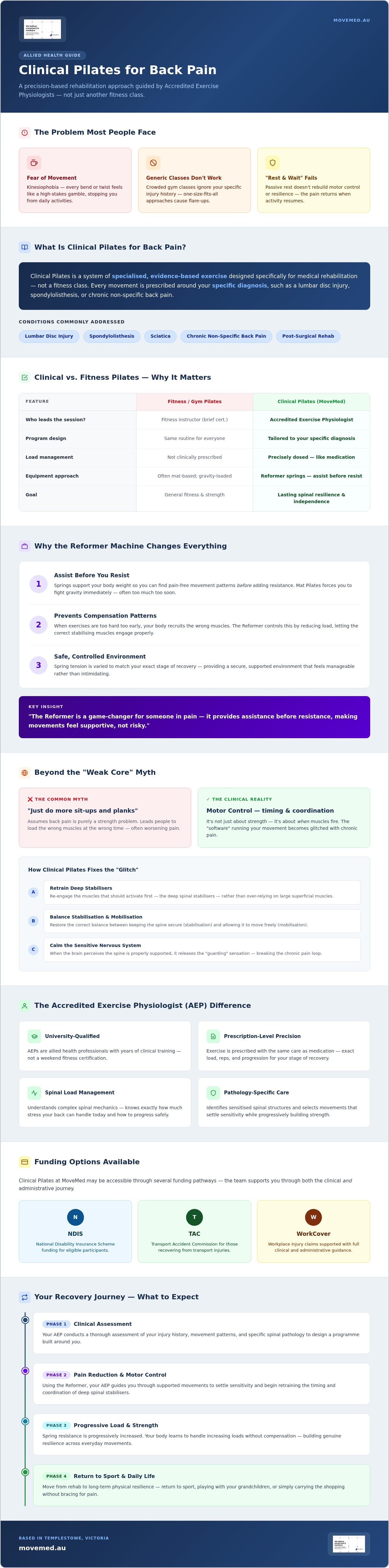
If you've ever walked past a studio and seen people on sliding beds with springs and pulleys, you've seen a Reformer. But clinical pilates for back pain is much more than just a workout on a machine. It is a system of specialised, evidence-based exercise designed specifically for medical rehabilitation. Unlike a general fitness class where everyone follows the same routine, clinical sessions are built around your specific diagnosis, whether that's a lumbar disc injury, spondylolisthesis, or chronic "non-specific" back pain.
The primary goal isn't just to make you sweat. It's to help your body regain the ability to support itself. We focus on individual pathology, meaning we look at the exact structures in your spine that are sensitised and choose movements that settle that sensitivity while building strength. It's about moving from a state of "bracing" for pain to a state of fluid, confident movement. This personalised approach ensures you aren't just doing "Pilates," but rather a targeted clinical intervention.
In addition to clinical exercise, many people find that professional manual therapy helps manage the muscular tension associated with chronic pain. To see how these holistic methods can support your physical health, check out Enso Space.
Furthermore, the future of pain management includes innovative delivery models like mobile regenerative medicine; REVĪV provides a prime example of how specialised spine and joint care can be brought directly to the home for greater patient convenience.
The Role of the Accredited Exercise Physiologist
At MoveMed, your journey is guided by an Accredited Exercise Physiologist (AEP). These are university-qualified allied health professionals who have spent years studying how the human body responds to exercise under the shadow of injury. This clinical background is what separates us from a standard Pilates instructor at a local gym. While a fitness instructor might have a brief certification, an AEP understands the complex mechanics of spinal loading and pathology.
Load management is the secret to successful recovery. An AEP knows exactly how much stress your back can handle today, and how to gradually increase that "load" so you get stronger without flaring up. We don't just give you exercises; we prescribe them with the same precision a doctor uses for medication. This ensures your rehab is safe, effective, and tailored to your specific stage of recovery.
This level of professional precision is essential in healthcare, and it's a principle that extends to other areas of a medical professional's life; for instance, those in the UK often rely on specialised services like Mortgages for Doctors to navigate complex financial decisions.
Why Clinical Reformer Pilates is Different
The Reformer machine is a game-changer for someone in pain. It consists of a sliding carriage, a series of springs with varying tensions, and long straps with pulleys. For many people, mat-based Pilates is actually too difficult to start with because you have to fight against gravity immediately. This often leads to "compensation," where your body uses the wrong muscles to get the job done because the right ones are too weak or inhibited by pain.
The Reformer allows us to provide "assistance" before we provide "resistance." By using the springs to support your body weight, we can help you find movement patterns that were previously too painful to attempt. It's a safer, more controlled environment for clinical pilates for back pain. You can build the necessary motor control (the timing and coordination of your muscles) in a way that feels supportive and secure, rather than intimidating or risky.
How Clinical Pilates Repairs the "Underlying Causes" of Back Pain
Most people believe back pain is simply a result of a "weak core." They assume that if they just do enough sit-ups or planks, the pain will vanish. However, clinical pilates for back pain focuses on a much more sophisticated concept: motor control. This isn't just about the raw strength of a muscle; it's about the timing and coordination of when those muscles fire. In many cases of chronic pain, the "software" that runs your movement becomes glitched. Your body might be over-recruiting large, superficial muscles to do the job of deep stabilisers, leading to a spine that feels stiff, guarded, and prone to injury.
By using the Reformer, we can retrain this timing. We focus on the delicate balance between stabilisation (keeping the spine secure) and mobilisation (allowing the spine to move freely). This process helps to "calm" a sensitive nervous system that has become stuck in a protective pain loop. When your brain perceives that your spine is supported by the right muscles at the right time, it can finally let go of the "bracing" sensation that causes so much discomfort. This is how we build true physical resilience, creating a back that can handle the unpredictable loads of daily life. If you are ready to move beyond temporary fixes, you might find it helpful to speak with an exercise physiologist about a tailored plan.
Targeting the Deep Stabilisers: Multifidus and Transversus Abdominis
To understand why this works, we need to look at your "internal corset." This consists of deep muscles like the Transversus Abdominis (which wraps around your midsection) and the Multifidus (tiny, powerful muscles that support individual vertebrae). When you experience back pain, these muscles often become "sleepy" or inhibited. They don't turn on as quickly as they should when you reach for a grocery bag or bend to pick up a child.
Standard gym exercises like crunches often aggravate the issue because they increase intra-abdominal pressure without engaging these deep layers. Clinical Pilates uses specific, low-load movements to "re-educate" these stabilisers. We aren't looking for a "six-pack" workout; we are looking for the subtle, deep activation that provides a foundation for every other movement you make.
Building this foundation is often supported by ensuring the spine is properly aligned and the nervous system is functioning without interference. To explore how manual therapies can work alongside your exercise program, you can visit Golden Bay Chiropractic Works for expert advice on spinal health and recovery.
Movement Confidence and Reducing Kinesiophobia
One of the biggest hurdles in recovery is kinesiophobia, or the fear of movement. When you've experienced a "thrown out" back, your brain begins to associate certain movements with danger. This leads to a cycle of avoidance, which actually makes the back more sensitive over time. Clinical pilates for back pain uses a method called graded exposure to break this cycle.
The Reformer provides a safe, supportive environment where you can explore movements that might normally feel "off-limits." Because the springs can assist your weight, you can practise bending, twisting, and reaching without the immediate threat of a flare-up. This provides a powerful psychological benefit. As you successfully move without pain in the clinic, your brain begins to feel "safe" again, allowing that confidence to translate into your activities at home and work.
This renewed sense of confidence often leads to a broader interest in holistic self-care. For those looking to complement their physical recovery with professional body restoration, Pellis Medispa offers advanced treatments designed to help you feel refreshed and revitalised.
Clinical vs. Fitness Pilates: Why the Distinction Matters
You've likely noticed a Pilates studio on almost every street corner in the Manningham area. While general fitness Pilates is a fantastic way for healthy individuals to stay active, there is a world of difference between a gym-based class and a clinical session. For someone managing a disc bulge or sciatica, "group-think" exercise can be risky. When an instructor tells a class of twenty people to "all lift your legs," they aren't accounting for your specific spinal mechanics. Choosing clinical pilates for back pain over a standard studio session is a decision to prioritise medical safety and precision over general fitness.
In a clinical setting, we focus on the "dosage" of exercise. In a gym, the goal is often high repetitions to feel a "burn." However, when rehabilitating a back injury, three repetitions of a perfectly executed movement are far more valuable than thirty repetitions performed with poor form. If your deep stabilisers fatigue and your larger muscles take over, you might actually be reinforcing the very movement patterns that caused your pain in the first place. Quality of movement is our primary metric for success, ensuring every minute you spend on the Reformer is an investment in your long-term recovery.
This focus on quality and specific "dosage" is a principle that applies to all aspects of recovery, including nutritional support. For those looking to support their physical progress with high-quality dietary supplements, you can learn more about Relieve Therapeutics and their range of products designed for pain relief.
Beyond supplements, an integrative healthcare approach that combines physical therapy with naturopathic principles can further enhance the body's natural healing processes, as detailed at drboamah.com.
Personalised Assessment vs. Group Programming
Every journey at MoveMed begins with a comprehensive clinical assessment. We don't just put you on a machine and hope for the best. Your Exercise Physiologist will sit with you to discuss your injury history, conduct a detailed posture analysis, and perform a movement screen to see how your spine handles different loads. This information allows us to create a unique "roadmap" tailored to your body.
Contrast this with a large gym class where the instructor's attention is divided among many participants. They simply cannot see if your pelvis is tilting slightly or if your lumbar spine is taking too much pressure. Our clinical pilates for back pain sessions ensure you have the constant, expert supervision needed to correct these subtle errors before they lead to a flare-up. It's the difference between following a generic workout and following a medical rehabilitation plan.
Safety and Injury Prevention
Safety is the cornerstone of the clinical approach. Our AEPs are trained to monitor for "red flags" and subtle signs of neurological irritation that a fitness instructor might miss. We understand the physics of the spine, specifically how to avoid excessive shear force (the sliding pressure between vertebrae) that can aggravate certain back conditions. If a movement doesn't feel right, we don't just tell you to push through it; we modify the spring tension or the angle of the exercise immediately.
This "eyes-on" approach at our Templestowe Lower clinic provides the peace of mind you need to move with confidence. We handle the technical side of your rehabilitation, so you can focus on the physical work of getting better. By keeping the sessions small and the focus sharp, we ensure that your path to resilience is as safe as it is effective.
This commitment to clinical excellence is shared by premium practices globally; for instance, Benchmark Physio in Singapore provides a similar level of evidence-based, specialised care for patients requiring precise musculoskeletal rehabilitation.
Similarly, Optima Physical Therapy in the United States leverages AI-powered technology to offer a concierge approach to rehabilitation; you can find out more about how these innovations are shaping the future of specialised physical therapy.
Your Clinical Pilates Journey: What to Expect at MoveMed
Walking into a new clinic when you are already dealing with persistent pain can feel daunting. You might worry that the exercises will be too difficult, or that you'll be pushed into a movement that triggers a flare-up. We understand that anxiety. At MoveMed, our approach to clinical pilates for back pain is built on a foundation of safety and partnership. We don't just give you a list of exercises; we guide you through a phased journey that respects your body's current limits while steadily expanding what you are capable of doing.
Our goal is to move you from a state of rehabilitation into a state of functional strength. This often involves a holistic view of your health. Depending on your needs, your Exercise Physiologist might suggest combining your Pilates sessions with Hydrotherapy to take the weight off your joints, or specific strength work to prepare you for returning to the local footy club or the golf course. For those whose health goals include weight management as a way to reduce spinal loading, you can discover Medi Slim for physician-supervised medical support. Most of our clients find that attending one to two sessions per week allows for the consistent "dosage" required to see a meaningful reduction in pain and an increase in daily confidence.
Phase 1: The Initial Clinical Assessment
Your first visit is entirely about understanding your unique story. We begin by discussing your pain history and, more importantly, your lifestyle goals. Whether you want to get back into the garden, play with your grandkids on the floor, or return to competitive sport, these goals form the "north star" of your programme. Following this, we perform a detailed physical screening. We look for compensatory movement patterns (the ways your body has learned to cheat or brace to avoid pain) and set a clear baseline for your current strength and mobility. This ensures we start at the right level for you today.
Phase 2: Graded Loading and Progression
As your pain begins to settle and your motor control improves, your sessions will naturally evolve. We use a concept called graded loading. This means we slowly increase the challenge to your muscles and nervous system in a way that feels safe. You'll move from supported exercises on the Reformer carriage to more functional, standing movements that mimic the things you do at home. The ultimate goal of clinical pilates for back pain is your independence. We want to equip you with the skills and the resilience to manage your back health long after you leave our clinic. If you are ready to start this journey, you can book your initial assessment online today.
Accessing Clinical Pilates in Templestowe: Funding and Next Steps
Finding the right support shouldn't be a struggle. If you live in Templestowe, Doncaster, or Bulleen, you don't have to travel far to find expert care that understands your specific needs. At MoveMed, we pride ourselves on being more than just a clinic; we are a community ally. We know that when you are in pain, the last thing you want to do is navigate a maze of insurance forms and funding requirements. That is why we provide dedicated support to help you access clinical pilates for back pain through various Australian healthcare schemes. Our team is here to handle the heavy lifting of the administration so you can focus entirely on your physical recovery.
We believe that high-quality, exercise-based rehabilitation should be accessible to everyone in our local area. Whether you are a self-managed NDIS participant or someone navigating the aftermath of a workplace accident, we partner with you to ensure your therapy is sustainable and effective. Our Templestowe Lower clinic is designed to be a welcoming space where you feel heard and supported, rather than just another number in a corporate system. We are committed to helping you reclaim your independence and move with the confidence you deserve.
NDIS, TAC, and WorkCover: Is Your Therapy Covered?
Navigating the NDIS can feel like a full-time job. If you have an NDIS plan, you can often use your "Improved Daily Living" budget to fund your clinical pilates for back pain. Our Exercise Physiologists work with you to ensure your goals, like being able to walk to the local shops or manage household tasks, are clearly documented. This makes the reporting process much smoother for your plan reviews.
For those recovering from a transport accident or a workplace injury, we work closely with the TAC and WorkCover. We understand the specific clinical evidence these organisations require to approve ongoing treatment. We can help coordinate your care and provide the necessary progress reports to your case manager. Additionally, eligible veterans can access our services through DVA funding. We are proud to support our local veteran community in Manningham by providing evidence-based exercise that respects their unique health histories, often recommending resources like Healthy Seventy to help older adults maintain their health and vitality.
How to Get Started at MoveMed Templestowe Lower
Reclaiming your move starts with a single, simple step. You don't need a GP referral to see us as a private client, though having one is often helpful if you are using a funded scheme or have a complex medical history. Just as digital health platforms like AskMyDoc.ca simplify access to medical consultations and prescription renewals in other parts of the world, we aim to make your entry into physical rehabilitation as seamless as possible. You can book your initial consultation through our website or by giving our friendly team a call. We will take the time to explain the process, verify your funding if necessary, and find a time that fits into your schedule.
During that first session, we will sit down together, listen to your story, and begin building the roadmap for your recovery. We aren't interested in quick fixes that fade after a few days. We are interested in building your long-term resilience. We invite you to join our community and discover how a partnership with an Exercise Physiologist can change the way you live with back pain. Let's start your journey toward better movement today.
Start Your Journey Toward Lasting Resilience
You don't have to live in a cycle of "thrown out" backs and the constant fear of movement. By choosing clinical pilates for back pain, you are investing in a medical system that prioritises your specific pathology and long-term physical resilience. We have explored how the precision of an Accredited Exercise Physiologist can help you retrain your deep stabilisers and bridge the gap between initial rehabilitation and functional strength.
Whether you are looking to return to competitive sport or simply want the confidence to play with your grandkids without a flare-up, our team is here to guide you. As a registered provider for NDIS, TAC, WorkCover, and DVA, we are proud to serve the Templestowe, Doncaster, and Manningham community with expert, compassionate care. We handle the technical mechanics and the complicated funding paperwork so you can focus on the work of getting better.
In addition to movement therapy, many individuals find that clinical bodywork helps manage persistent muscle knots; you can explore Per-session therapeutic massage and aesthetic treatment fees to understand how these targeted treatments can support your path to lasting resilience.
The first step toward moving with ease is an assessment tailored entirely to your story. Book Your Initial Clinical Pilates Assessment at MoveMed Templestowe Lower today. We look forward to partnering with you on your path to recovery.
Frequently Asked Questions
Do I need a referral from my GP to start Clinical Pilates?
You don't need a referral if you are attending as a private client. However, if you intend to claim through NDIS, TAC, WorkCover, or DVA, a referral or specific paperwork from your GP or specialist is usually required to initiate the funded pathway. We can help you navigate these requirements during your first enquiry to ensure your paperwork is in order.
Is Clinical Pilates better than regular Physiotherapy for back pain?
It isn't necessarily "better," but it serves a different purpose in your recovery journey. While general physiotherapy often focuses on acute pain management and manual (hands-on) therapy—expertly provided by clinics such as Physiotherapy Liverpool—clinical pilates for back pain is a long-term, exercise-based approach. It focuses on building the movement patterns and physical resilience needed to prevent future injuries and reclaim your independence.
Can I do Clinical Pilates if I have a diagnosed disc bulge or sciatica?
Yes, this is exactly what Clinical Pilates is designed for. Because an Accredited Exercise Physiologist leads your session, we can modify every movement to ensure it is safe for your specific diagnosis. We use the Reformer's springs to provide assistance and reduce spinal pressure; this allows you to move without aggravating your nerve pain or disc injury.
For many patients, combining clinical exercise with the gentle, transformative chiropractic care offered by a wellness studio like Livelovelife Chiropractic provides a holistic approach to managing disc-related symptoms and improving overall quality of life.
How many sessions of Clinical Pilates will I need before my back feels better?
Most people notice a change in their movement confidence within four to six weeks of consistent practice. For long-term changes in spinal stability and physical resilience, we generally recommend a twelve-week block. This allows enough time for your nervous system to adapt and for your deep stabilising muscles to actually get stronger. Consistency is the key to seeing a meaningful reduction in clinical pilates for back pain symptoms.
What should I wear to my first Clinical Reformer Pilates session?
Wear comfortable activewear that allows you to move freely without being too loose. Leggings or tracksuits and a fitted t-shirt are ideal. For safety and hygiene on the Reformer machine, we recommend wearing grip socks (socks with rubber pads on the bottom). These help you maintain your footing during different exercises and provide better stability on the carriage.
Is Clinical Pilates covered by private health insurance in Australia?
Yes, most major Australian private health funds provide rebates for these sessions under "Exercise Physiology." You should check with your specific provider to see if your level of cover includes these services (usually codes 502 or 503). We provide the necessary clinical receipts so you can claim your rebate through your fund's app or website after each session.
I haven’t exercised in years; am I too "unfit" for Clinical Pilates?
You are never too unfit to start because every programme is built around your current baseline. We work with people of all ages and fitness levels, from elite athletes to those who haven't moved much in a decade. The beauty of the Reformer is that it can support your weight, making exercise accessible even if you feel weak, stiff, or anxious about moving.
How is Clinical Pilates different from the Reformer classes at my local gym?
The main difference is the clinical supervision and the focus on your individual pathology. Gym classes are designed for general fitness and follow a set routine for a large group. In contrast, our clinical sessions are led by university-qualified Exercise Physiologists who tailor every movement to your specific back injury and recovery goals. We prioritise quality of movement over high repetitions.


