

What if you could leave the heavy burden of joint pain at the water's edge and move with a freedom that feels impossible on solid ground? For many locals seeking hydrotherapy Templestowe Lower, the fear of falling or the sharp sting of weight-bearing exercise often makes traditional rehabilitation feel like an uphill battle. It's a frustrating cycle where you know you need to stay active to recover, yet every step on land feels like a risk to your progress.
We recognise that living with restricted mobility is both physically exhausting and mentally draining. This article explains how hydrotherapy uses the clinical power of warm water and buoyancy (the upward force that supports your weight) to bypass the limitations of gravity. This approach allows you to fast-track your recovery in a safe, supportive environment. You'll discover the specific ways aquatic therapy reduces pain and improves your range of motion. We also provide a clear preview of how our expert-led sessions help you reclaim your independence and return to the daily activities you enjoy most.
Key Takeaways
- Learn why clinical hydrotherapy is more than just a swim, focusing on specific water temperatures that relax muscles and soothe stiff joints.
- Understand the science of buoyancy and how it creates "relative weightlessness" to protect your joints while improving circulation and reducing swelling.
- Discover how hydrotherapy Templestowe Lower supports recovery for various conditions, including hip replacements, ACL repairs, and neurological support for Multiple Sclerosis.
- Get clear guidance on navigating funding through the NDIS, TAC, and DVA to ensure you can access the professional care you need.
- See how MoveMed uses the water as a therapeutic bridge to help you regain the confidence and strength required for land-based activities.
Understanding Hydrotherapy: More Than Just a Swim
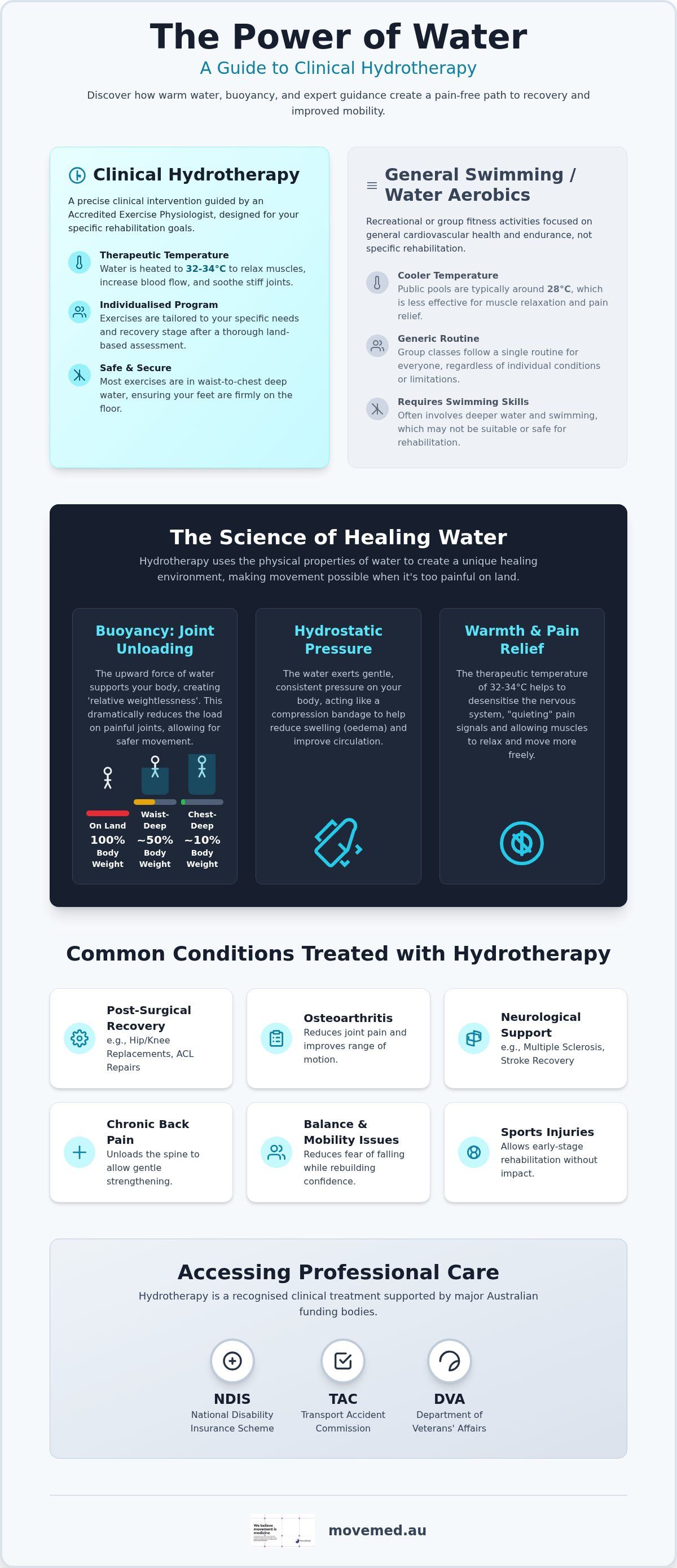
Many people think hydrotherapy is just a gentle swim or a local water aerobics class. It isn't. When we talk about hydrotherapy Templestowe Lower, we're describing a precise clinical intervention. It takes place in a purpose-built pool heated to between 32 and 34 degrees Celsius. This specific range is warmer than your average public pool, which is usually around 28 degrees. That extra warmth is vital; it helps your muscles relax, increases blood flow, and makes movement feel significantly easier than it does on land.
Unlike a group fitness class where everyone follows the same routine, clinical sessions are designed specifically for your body and your goals. We focus on individualised outcomes, whether that's reducing chronic back pain or recovering from a recent surgery. You don't even need to be a swimmer to participate. Most of our exercises happen in water that is only waist-to-chest deep, so you'll always have your feet firmly on the pool floor. This provides a sense of security for those who might feel anxious about their balance or have a fear of falling.
The Role of the Exercise Physiologist
Having an Accredited Exercise Physiologist (AEP) guide you is what makes this therapy "clinical." While you might be familiar with general physiotherapy, an AEP specialises in using movement as a primary tool for rehabilitation. They understand the physics of water and how to adjust your program to match your specific stage of recovery. Before you ever get into the pool, we conduct a thorough land-based assessment at our clinic. This allows us to measure your current range of motion and identify any specific restrictions. We don't just guess; we use this data to ensure every minute in the water is purposeful and safe.
Aquatic Therapy vs. Hydrotherapy
You might hear different terms used across the Australian healthcare system. While "aquatic therapy" is a broad umbrella, "hydrotherapy" is the term most doctors and insurers use for clinical rehabilitation. Understanding Hydrotherapy involves knowing that the environment is just as important as the exercises themselves. The temperature-controlled water acts as a natural analgesic, which is a clinical way of saying it helps kill pain. It allows us to work on complex movements that might be too painful to attempt in a gym or at home. By reducing the effects of gravity, we can focus on rebuilding your movement patterns without the usual "flare-ups" that often stall progress. It's about using the water as a tool to get you back to your best.
The Science of Buoyancy: How Water Accelerates Recovery
When you step into the heated pool for hydrotherapy Templestowe Lower, you're entering a unique physical environment that behaves very differently from the world on land. This isn't just about feeling weightless; it's about using the laws of physics to trick your nervous system into allowing movement that would otherwise be too painful. This state of "relative weightlessness" is the foundation of aquatic healing. It allows your body to perform essential rehabilitation exercises without the harsh impact of gravity pushing down on your sensitive joints.
Beyond buoyancy, the water provides hydrostatic pressure. Think of this as a gentle, uniform compression sleeve that wraps around your entire submerged body. This pressure is incredibly effective at reducing oedema (swelling) and helping your circulatory system move fluid away from injured areas. For those living with chronic pain, the consistent warmth of the water also plays a vital role. It helps to desensitise the nervous system, essentially "quieting" the pain signals that usually prevent you from exercising. By calming these signals, we can introduce movement much earlier in your recovery journey than land-based therapy might allow.
Buoyancy and Joint Unloading
To understand the impact of buoyancy, imagine standing in water that reaches your chest. In this position, the upward force of the water supports roughly 90% of your body weight. This means a person who weighs 80 kilograms on land only "weighs" about 8 kilograms in the pool. This massive reduction in joint loading is a game-changer for people managing severe osteoarthritis or those with strict post-surgical weight-bearing restrictions. It removes the psychological barrier of fearing pain with every step. When the fear of pain is removed, your muscles can finally let go of protective guarding (tightness), allowing for a smoother and more natural range of motion. If you're ready to see how this weightless environment can help you, reclaiming your movement starts with a personalised plan in the water.
Resistance Without Impact
While water supports you, it also challenges you. Water is approximately 800 times denser than air, which means it provides natural resistance in every direction you move. Unlike gym weights that only pull downwards, aquatic resistance is "isokinetic," meaning the harder you push, the more the water pushes back. This makes it an incredibly safe environment for strength training. You can control the intensity of your workout simply by changing the speed of your movements. We often use specialised equipment like paddles or foam noodles to further customise this resistance. This allows us to target Common Conditions Treated with Hydrotherapy, such as fibromyalgia or muscle weakness, without the risk of falling or causing further injury. In the safety of the pool, your progress is limited only by your effort, not by the fragility of your joints.
Common Conditions Treated with Hydrotherapy in Melbourne
Because water acts as such a versatile medium, we use it to treat a diverse range of physical challenges. For residents seeking hydrotherapy Templestowe Lower, the pool becomes a sanctuary where standard rehabilitation goals are met with far less strain. We see many clients transitioning from acute hospital care back to their daily lives using these sessions as a vital bridge. It's about more than just recovery; it's about finding a way to move that feels safe and productive from day one.
Orthopaedic conditions are perhaps the most common reason people seek our help. Whether you're recovering from an ACL repair, a hip or knee replacement, or a complex fracture, the pool allows you to begin movement much sooner than land-based therapy. This early intervention is crucial for preventing muscle wastage (atrophy) and joint stiffness. By starting your rehab in the water, you're effectively getting a head start on your recovery timeline.
This clinical efficacy is mirrored in other advanced medical fields; for example, Streatham Hill Veterinary Surgery utilises these same principles of buoyancy and warmth to manage orthopaedic recovery in their multi-award-winning practice.
Seniors also benefit immensely from the safety of the water. It's the perfect environment for balance training and falls prevention. In the pool, a loss of balance results in a gentle splash rather than a painful fall. This builds the psychological confidence needed to stay active and independent. For those managing chronic pain like Fibromyalgia or Complex Regional Pain Syndrome (CRPS), the heated environment helps dampen hypersensitive pain signals. This allows for gentle movement that builds resilience without the "boom-and-bust" cycle of pain that often happens in a traditional gym.
Hydrotherapy for Back and Joint Pain
Persistent back pain can make every movement feel like a chore. In the water, your spine experiences natural decompression as the buoyancy lifts your torso and creates space between the vertebrae. This often provides immediate relief from the "crushing" sensation of disc issues or sciatica. While the pool is excellent for initial relief and mobility, we often recommend clinical pilates for back pain as a land-based partner to your recovery. Combining these two approaches ensures you're building the long-term core strength required to protect your spine in your everyday life.
Neurological and Disability Support
For those living with neurological conditions like Multiple Sclerosis, Parkinson’s disease, or recovering from a stroke, the water offers a level of support that land cannot match. It's an ideal space for gait (walking) practice. The viscosity of the water provides a "buffer" that slows down movements, giving the brain more time to process and coordinate steps. We also work closely with NDIS participants who have sensory processing disorders or autism. The consistent hydrostatic pressure of the water provides a calming sensory input that can reduce anxiety and improve focus. This aquatic freedom isn't just about physical gains; it's about the emotional empowerment of moving without restriction.
Navigating Funding: NDIS, TAC, and DVA Hydrotherapy
Accessing hydrotherapy Templestowe Lower shouldn't feel like a bureaucratic maze. We understand that navigating the paperwork of various funding schemes can be just as exhausting as managing the injury itself. Our team is here to help you understand which pathway fits your situation, ensuring you can focus on your recovery rather than the administrative burden. There are several ways to fund your clinical sessions, and we are experienced in working with all major Australian schemes.
NDIS Hydrotherapy in Melbourne’s East
Most participants access funding through the "Capacity Building" category of their NDIS plan. This specific funding is designed to help you build the skills and physical strength needed for more independent living. For a detailed breakdown of the steps involved, you can view our NDIS hydrotherapy guide. We take goal-setting seriously; every exercise we prescribe is linked to the functional outcomes you want to achieve. We also handle the clinical reporting required for your plan reviews, providing the clear evidence needed to show how aquatic therapy is making a tangible difference in your life.
TAC and WorkCover Recovery
If you've been injured in a transport accident or a workplace incident, early intervention is the key to a successful "Return to Health." Hydrotherapy is often approved by TAC and WorkCover case managers because it allows for movement in the early stages of recovery when land-based exercise might be too risky. This builds on the principles of buoyancy we discussed earlier, allowing you to start moving without straining your healing tissues. We work directly with your case manager to streamline the approval process, focusing on the strength and mobility you need to return to your job and daily routine safely.
For our veteran community, the Department of Veterans’ Affairs (DVA) provides support for both Gold and White card holders. This often covers the cost of clinical sessions led by an Exercise Physiologist. Additionally, if you have a chronic condition, your GP may provide a Medicare Chronic Disease Management Plan. This plan offers a rebate for a set number of sessions per year. Most private health insurers also provide rebates for hydrotherapy, though we recommend checking your specific level of "extras" cover first. If you need help determining which funding pathway applies to you, you can book your initial assessment today and we can discuss your options together.
Getting Started with MoveMed: Your Local Hydrotherapy Partner
At MoveMed, our philosophy is built on the idea that movement is medicine. However, we also recognise that when you're in significant pain, movement on land can feel like a daunting task. We view hydrotherapy Templestowe Lower as a vital bridge. It's a temporary, supportive environment that allows you to build the strength, confidence, and range of motion required to eventually thrive in your daily life on solid ground. Our goal isn't just to keep you in the pool; it's to use the water as a clinical tool to fast-track your return to the activities you love.
Every journey begins with a comprehensive land-based assessment at our clinic. This initial consultation is where we sit down with you to understand your history, your pain points, and your specific goals. We don't believe in "one size fits all" programs. Instead, we tailor every aquatic session to your unique lifestyle and home environment. If your goal is to walk to the local shops or play with your grandkids in the park, your pool program will reflect the specific movements needed for those tasks. We're proud to be a part of the Templestowe community, helping our neighbours reclaim their independence one step at a time.
What to Bring to Your First Session
Preparing for your first session should be stress-free. To make the most of your time in the water, please bring along the following items:
- Comfortable swimwear (or clean shorts and a t-shirt if preferred)
- A large towel and a change of warm clothes
- A water bottle to stay hydrated in the heated environment
- Any recent scans or letters from your specialist or GP
We conduct our sessions at local aquatic centres chosen for their high standards of care. It's worth noting that pool entry fees are typically separate from our clinical fee, though this can vary depending on your funding scheme. We prioritise facilities with excellent accessibility, including hoist availability and spacious change-rooms, so you can feel completely supported from the moment you arrive at the centre.
Booking Your Initial Assessment
Taking the first step toward recovery is often the hardest part. If you're a private client, you don't need a referral from a doctor to start your journey with us. We've made the process as simple as possible for residents in Templestowe Lower and the surrounding suburbs. Our team is ready to sit with you, handle the complicated funding paperwork, and design a path forward that feels achievable. You can book your initial land-based assessment through our online portal or by calling our clinic directly. We look forward to partnering with you on your journey back to effortless movement.
Reclaiming Your Movement in the Water
Moving through recovery doesn't have to be a battle against gravity. By choosing hydrotherapy Templestowe Lower, you're opting for a clinical approach that respects your pain while actively working to resolve it. We've explored how the physics of buoyancy and the warmth of the pool can unlock movement that feels impossible on land. Whether you're navigating an NDIS plan, recovering from a TAC incident, or simply looking to manage chronic joint stiffness, the right support makes all the difference.
As an NDIS Registered Provider, our expert Exercise Physiologists are dedicated to serving the Templestowe community with evidence-based care. We handle the complex clinical reporting and tailored programming so you can focus on your progress. You don't have to manage this journey alone. Our team is here to guide you through every splash and every step towards independence.
If you're ready to leave the weight of persistent pain behind, Book your hydrotherapy assessment with MoveMed today. Let's work together to bridge the gap between where you are now and the active lifestyle you deserve.
Frequently Asked Questions
Do I need to be a strong swimmer to do hydrotherapy?
You don't need to be a swimmer at all to participate. Most sessions take place in water that is only waist-to-chest deep, so your feet remain firmly on the pool floor at all times. Our Exercise Physiologists are right there in the water with you to ensure your safety and comfort. This makes it an ideal option for people who feel unsteady on their feet or have a fear of falling.
How is hydrotherapy different from a regular swimming pool?
The primary differences are the temperature and the clinical supervision. Hydrotherapy pools are kept at a much warmer 32 to 34 degrees Celsius, which is specifically designed to relax tight muscles and ease joint stiffness. Unlike a regular public pool where you might just swim laps, these sessions involve a tailored program led by an Accredited Exercise Physiologist. This ensures every movement is purposeful and safe for your specific injury.
Can I get NDIS funding for hydrotherapy sessions?
Yes, NDIS funding is commonly used for hydrotherapy Templestowe Lower under the "Capacity Building" category. As a registered provider, MoveMed works with participants to link their aquatic goals to their broader plan outcomes. We also take care of the necessary clinical reporting for your plan reviews. This documentation helps demonstrate the progress you're making toward your independence and functional goals.
How many sessions of hydrotherapy will I need to see results?
The number of sessions required varies depending on your specific condition and goals. Many clients experience immediate relief from pain and stiffness after just one or two sessions due to the warmth and buoyancy. However, for long-term functional changes like improved strength or better balance, we typically recommend a consistent program over six to twelve weeks. We'll regularly review your progress to ensure the treatment remains effective for your needs.
Is hydrotherapy safe after I have had a joint replacement surgery?
Hydrotherapy is exceptionally safe and effective following a hip or knee replacement. It's often the preferred way to start rehabilitation because the water supports your weight, protecting the new joint while you rebuild strength. You can generally start once your surgeon has confirmed your surgical incision is fully healed and closed. This early, low-impact movement helps prevent the stiffness that often follows major orthopaedic surgery.
What should I wear to a hydrotherapy session if I am self-conscious?
You should wear whatever makes you feel most comfortable and secure. While traditional swimwear is common, many of our clients prefer to wear a clean t-shirt and shorts over their bathers. The most important thing is that your clothing allows you to move freely without restriction. We use facilities with accessible change-rooms and private cubicles to ensure your dignity and comfort are maintained throughout your visit.
Do I need a GP referral to see an Exercise Physiologist for hydrotherapy?
You don't need a GP referral to start as a private client. You can simply book an assessment and begin your journey toward better movement immediately. However, if you're seeking to claim through DVA or a Medicare Chronic Disease Management Plan, you'll need a specific referral from your doctor. We're happy to discuss these requirements with you and help you navigate the necessary paperwork for your specific funding scheme.


