
Imagine finishing your final physiotherapy session only to realise that the thought of a Saturday morning walk around Westerfolds Park still feels daunting. You've moved past the initial crisis, but that nagging fear of re-injury remains, leaving you stuck in a frustrating limbo. This gap between clinical treatment and true physical freedom is exactly why effective injury rehabilitation Templestowe Lower residents can rely on requires more than just short-term symptom management. It requires a transition to active, expert-led movement that rebuilds your confidence alongside your strength.
We understand that the path back to your best self is often cluttered with more than just physical hurdles. Whether you're feeling overwhelmed by the complex paperwork of a TAC, NDIS, or WorkCover claim, or you're simply tired of lingering pain that won't shift, it's completely normal to feel stuck. This article will show you how personalised exercise physiology and clinical rehab can bridge the gap to long-term recovery. We'll explore how to navigate funded therapy schemes successfully and outline a clear, evidence-based roadmap to help you return to the local sports and Manningham community activities you love.
Key Takeaways
- Learn why transitioning from passive therapy to Accredited Exercise Physiology is essential for bridging the gap between initial injury and long-term physical freedom.
- Discover how specialised injury rehabilitation Templestowe Lower programs address the specific health priorities of the Manningham community, from sports recovery to fall prevention.
- Understand how to choose between low-impact Hydrotherapy and targeted Clinical Reformer Pilates based on your specific injury type and weight-bearing needs.
- Gain a clear roadmap for navigating TAC, WorkCover, and NDIS funding schemes so you can focus on your recovery instead of the paperwork.
- Explore the MoveMed assessment process and how a personalised clinical plan helps you return to local activities like walking at Westerfolds Park with confidence.
Why Local Injury Rehabilitation in Templestowe Lower Requires a Clinical Approach
Recovering from an injury is a journey that often starts with a crisis but ends with a choice. Many people find themselves stuck in a loop of managing symptoms rather than actually rehabilitating the underlying cause. While a quick fix might settle a flare-up, it rarely addresses why the injury occurred or how to stop it from returning. High-quality injury rehabilitation Templestowe Lower residents can rely on moves beyond temporary relief. It focuses on building long-term resilience and restoring the physical capacity you need for daily life.
Choosing to "wait and see" is a common response to a new strain or persistent ache. However, the human body is an expert at compensating. If a hip is weak, the lower back or knee will inevitably take the extra load. Over time, these compensation patterns become deeply ingrained in your movement, leading to chronic issues that are far more complex to resolve later. Following an evidence-based management plan in the early stages of recovery ensures you are loading your body safely. This proactive approach prevents the development of secondary pains and keeps your recovery on a predictable track.
The Gap Between Acute Treatment and Full Function
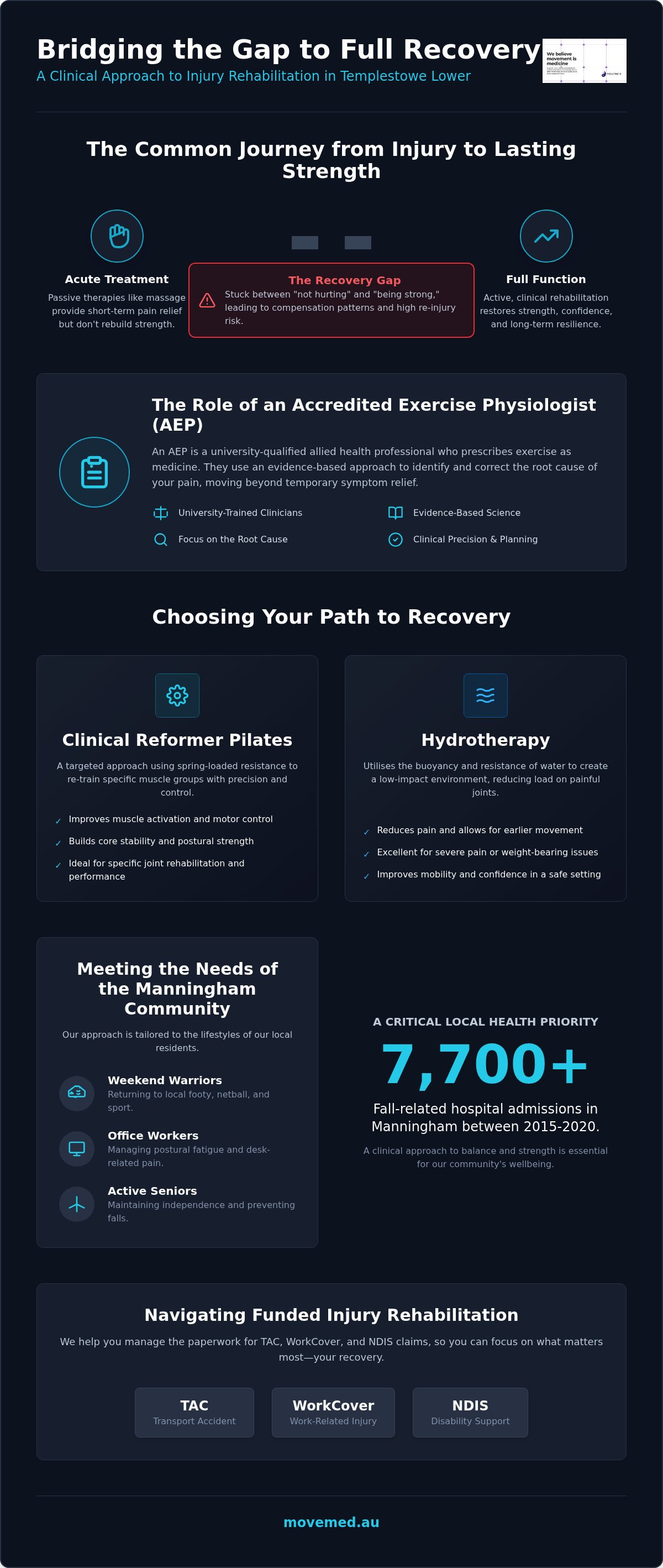
Passive treatments like massage or heat packs are often the first step in a larger journey. They are excellent for settling the initial "alarm bells" of pain and making you feel more comfortable in the short term. But there is a clear tipping point where passive care stops being a solution and starts becoming a hurdle. If you aren't eventually challenging your muscles and joints through Exercise physiology, you aren't truly rehabilitating the injury. Real physical freedom only comes when you bridge the gap between "not hurting" and "being strong." Without restoring specific strength and mobility, the risk of re-injury remains high because your body isn't yet prepared for the unpredictable demands of sport or work.
Meeting the Needs of the Manningham Community
Our local community has diverse physical needs that require a tailored clinical perspective. We work with weekend warriors eager to get back to local footy or netball clubs, office workers managing postural fatigue, and active seniors who value their independence. Whether your goal is walking the Main Yarra Trail without discomfort or returning to competitive sport, your rehab must be specific to your lifestyle. In Manningham, where falls led to over 7,700 hospital admissions between 2015 and 2020, a clinical approach to balance and strength is essential. A local rehabilitation centre provides the consistent, accessible care needed to turn these health goals into reality, ensuring you can continue to enjoy everything our vibrant area has to offer.
The Role of an Exercise Physiologist in Professional Injury Recovery
What makes an Accredited Exercise Physiologist (AEP) different from a gym trainer? While both work with physical activity, an AEP is a university-trained clinician who understands the complex relationship between movement and medical conditions. Exercise Physiology is a university-qualified allied health profession specialising in clinical exercise interventions. For anyone seeking high-quality injury rehabilitation Templestowe Lower services, this distinction is vital. It means your recovery is guided by someone who can interpret surgical reports and manage complex musculoskeletal pathology with clinical precision.
AEPs use evidence-based science to prescribe specific movements as a form of medicine. Instead of a general workout, they conduct a detailed assessment of your movement mechanics to identify why a joint is failing or why pain persists. They look for the root cause, such as a subtle muscle imbalance or poor motor control, and design interventions to correct it. This methodical approach ensures that every repetition you perform in the clinic brings you closer to your physical goals, rather than just tiring you out.
Exercise Physiology vs. General Physiotherapy
Many people start their recovery journey with manual therapy like massage or joint mobilisation. This is typically the domain of general physiotherapy and is excellent for reducing acute pain. However, as your symptoms settle, the focus must shift toward movement-based rehabilitation to prevent the pain from returning. Our AEPs work closely with local Manningham GPs and surgeons to ensure this transition is seamless. You might see an EP when you are ready to rebuild strength after surgery, manage chronic back pain, or improve your mobility while living with a complex condition. If you are ready to take the next step, you can learn more about our clinical approach to active recovery.
Personalised Management Plans
At MoveMed, we don't believe in one-size-fits-all exercises. Every recovery journey begins with a comprehensive clinical assessment to map your current capacity and identify your specific needs. We then build a personalised plan that balances your long-term goals with safe, sustainable progression. We use data and specific milestones to track your recovery, ensuring you can see the tangible results of your hard work. This structured approach helps you regain confidence in your body, knowing that your program is designed specifically for your lifestyle and the unique demands of your injury rehabilitation Templestowe Lower journey.
Comparing Rehab Modalities: Clinical Reformer Pilates vs. Hydrotherapy
Choosing the right environment is a critical decision in your injury rehabilitation Templestowe Lower journey. Not every injury responds best to a traditional gym setting, especially in the early stages of recovery. The physical environment where you perform your exercises can fundamentally change how your body heals. While some conditions require the supportive embrace of water, others benefit from the mechanical precision of a reformer machine. The choice isn't about which modality is better, but which one matches your current weight-bearing status and clinical needs.
Hydrotherapy: Low-Impact Recovery in Manningham
For many residents, hydrotherapy is the gold standard for early-stage post-op rehab. Water changes the rules of physics. Buoyancy reduces the effective weight on your joints, allowing you to walk or perform movements that would be impossible on land. Hydrostatic pressure (the pressure water exerts on the body) helps manage persistent swelling, while the warmth of the pool relaxes guarded muscles. It's an ideal setting if you have strict weight-bearing restrictions or high pain levels. By reducing joint stress, you can maintain your cardiovascular health and muscle tone without risking the integrity of a healing injury. We help you find the right hydrotherapy centre near Templestowe Lower to ensure your aquatic sessions are safe and clinically supervised.
Clinical Reformer Pilates for Targeted Strength
As your tolerance for weight-bearing exercise increases, the focus often shifts toward building core stability and alignment. Clinical Reformer Pilates Templestowe residents use involves a specialised machine that uses springs for adjustable resistance. This setup is incredibly effective for eccentric loading (strengthening a muscle as it lengthens), which is a key component in treating chronic tendon issues. The reformer also provides immediate feedback to your brain, improving your proprioception (body awareness) and preventing the compensation patterns mentioned earlier.
Consider a case of lower back or hip rehabilitation. On a reformer, an Exercise Physiologist can isolate the deep stabilising muscles while the carriage supports your spine. This allows for a level of precision that general gym equipment simply can't match. You build strength exactly where it's needed, ensuring your return to daily activities is supported by a stable and resilient core. Using these different modalities allows us to tailor your journey, moving from the supportive water of a pool to the targeted resistance of the reformer as your body becomes ready for more challenge.
- Choose Hydrotherapy if: You are early post-surgery, have severe joint pain, or are restricted from full weight-bearing.
- Choose Clinical Pilates if: You need to improve posture, build core stability, or address specific muscle imbalances during your recovery.
Navigating Funded Injury Rehab: TAC, WorkCover, and NDIS in Manningham
Accessing funded support for injury rehabilitation Templestowe Lower residents shouldn't feel like a second job. When you're already dealing with pain and restricted movement, the last thing you need is a mountain of paperwork. MoveMed is an experienced provider for NDIS, TAC, and WorkCover clients in Melbourne’s east. We take the stress out of the administrative process by working directly with your case manager to ensure your therapy is approved and your progress is clearly documented. This advocacy ensures you can focus entirely on your recovery while we handle the clinical reporting required by these schemes.
TAC and WorkCover: Returning to Life and Work
Following a transport accident or workplace injury, early clinical intervention is the most effective way to prevent long-term disability. We focus on building your functional capacity, which is your actual ability to perform daily tasks and work duties safely. Our Exercise Physiologists design return-to-work programs that bridge the gap between initial recovery and the physical demands of your specific job. Whether you're an office worker needing postural support or a tradesperson requiring heavy lifting capacity, we tailor the load to your needs. By providing regular, data-driven reports to WorkSafe or the TAC, we help maintain your funding and keep your recovery on track. This consistent communication ensures there are no gaps in your care during the critical early months of rehab.
NDIS and DVA: Long-Term Support for Independence
For NDIS participants, Exercise Physiology falls under the "Capacity Building" category. Our goal is to use movement to improve your independence and community participation. This might involve building the strength to navigate local Manningham shops or the stamina for social outings. We also provide DVA-funded therapy for veterans, focusing on chronic pain management and health through movement. We've streamlined the referral process for Manningham residents to make starting your journey as simple as possible. Often, all that is required is a referral from your GP or NDIS coordinator to begin your clinical assessment.
- TAC: Specialised rehab for road accident survivors focused on returning to daily activities and community life.
- WorkCover: Targeted strength training to meet the physical requirements of your specific workplace.
- NDIS: Improving daily living skills, balance, and mobility through personalised clinical exercise.
- DVA: Supporting veterans with evidence-based programs for chronic health conditions and physical resilience.
If you're unsure how to start your claim or what your entitlements are, you can book a consultation with our team to discuss your funding options and clear the path to your recovery.
Your Recovery Journey at MoveMed: Personalised Care for Templestowe Residents
At MoveMed, we believe that successful injury rehabilitation Templestowe Lower residents deserve starts with a conversation, not just a clinical report. We often see clients who feel reduced to a set of symptoms or a line on an MRI scan. While clinical data is essential, it doesn't tell the whole story of how your injury affects your ability to play with your grandchildren or return to your professional life. Our commitment is to treat the person sitting in front of us. We combine our clinical authority with a genuine community focus to ensure you feel heard, supported, and empowered throughout your entire recovery journey.
The MoveMed difference lies in our balance of warmth and expertise. We understand that being in pain is exhausting and navigating the health system can be confusing. We position ourselves as your trusted local guide, helping you move from a place of anxiety and restriction to one of confidence and agency. Every interaction is designed to be a step toward reclaiming your independence, rather than just another appointment on your calendar.
Step-by-Step to Your First Appointment
Starting something new can feel daunting, especially when you're managing a persistent injury. We've designed our intake process to be as low-friction as possible. When you're ready to begin, you can book your session easily online or via a quick phone call. For your first visit, we recommend wearing comfortable clothes you can move in. If you have any relevant referrals, surgical reports, or recent scans, please bring them along so your Accredited Exercise Physiologist (AEP) can review them.
The initial consultation is where we lay the foundation for your success. We'll spend significant time discussing your injury history, your current limitations, and, most importantly, your personal goals. Once we understand what you want to achieve, we perform a clinical movement assessment to identify your current physical capacity. By the end of this first session, you'll have a preliminary roadmap and a home exercise program, giving you a clear path forward from day one.
Ongoing Support and Advocacy
Recovery is rarely a straight line. Your body will change as you get stronger, and your program needs to evolve with it. We conduct regular reviews to adjust your resistance levels, refine your technique, or introduce new modalities like Clinical Pilates. This methodical progression ensures you are always moving forward at a pace that is safe and sustainable for your specific condition.
We also act as your dedicated health advocates within the Manningham community. If you're navigating a complex TAC, WorkCover, or NDIS claim, we handle the clinical communication with your GP, specialist, or case manager. This unified approach ensures everyone on your care team is aligned with your recovery goals. Our role is to handle the complicated paperwork and clinical reporting so you can focus entirely on the physical work of getting better. Taking that first step is often the hardest part of the process, but it's the most important one for reclaiming your physical freedom and returning to the activities you love.
Book your injury rehabilitation assessment at MoveMed today and let's start building your path back to independence together.
Reclaim Your Physical Freedom and Confidence
True recovery is about more than just the absence of pain. It's about returning to the life you love with absolute confidence in your body's ability to move. We've explored how transitioning from passive treatment to active, expert-led movement is the essential bridge to long-term success. By choosing the right clinical path, whether that's the supportive environment of hydrotherapy or the targeted precision of clinical reformer pilates, you ensure your body is genuinely prepared for the daily demands of the Manningham lifestyle.
You don't have to navigate the complexities of TAC, NDIS, or WorkCover funding alone. Our Accredited Exercise Physiologists provide the personalised clinical care and advocacy needed to simplify your journey. High-quality injury rehabilitation Templestowe Lower residents can rely on prioritises the person, not just the diagnosis. It's time to move past temporary fixes and start building lasting resilience. Book your injury rehabilitation assessment at MoveMed Templestowe Lower today. We look forward to partnering with you as you take this vital step toward reclaiming your independence and physical freedom.
Frequently Asked Questions
Do I need a GP referral for injury rehabilitation in Templestowe Lower?
You don't necessarily need a GP referral to begin your journey as a private client. However, if you're seeking rebates through Medicare via a Chronic Disease Management plan, or if you're a DVA or WorkCover client, a referral from your doctor is required. We recommend checking with your GP or insurer first to ensure your sessions are correctly categorised for funding.
How much does exercise physiology cost under a TAC or WorkCover claim?
Under an approved TAC or WorkCover claim, the cost of your clinical sessions is typically covered by the insurer. We bill these organisations directly, which means there's often no out-of-pocket expense for you once your claim is accepted and your treatment plan is authorised. We handle the reporting and administrative work so you can focus entirely on your injury rehabilitation Templestowe Lower journey.
What is the difference between clinical pilates and a regular pilates class?
Clinical Pilates is a targeted, evidence-based intervention led by an Accredited Exercise Physiologist, whereas regular classes are usually general fitness-focused. In a clinical setting, we tailor every movement to your specific injury and pathology. It's about correcting your unique movement patterns and addressing muscle imbalances rather than following a standard sequence designed for a large group.
Can hydrotherapy help with post-surgical rehabilitation for knee and hip replacements?
Yes, hydrotherapy is an excellent choice for post-surgical recovery following knee or hip replacements. The buoyancy of the water supports your body weight, which allows you to practice walking and strengthening exercises much earlier than you could on land. The warm water also helps to reduce post-operative swelling and muscle guarding, making your early-stage rehab significantly more comfortable.
How long does a typical injury rehabilitation program last at MoveMed?
The duration of your program depends entirely on the nature of your injury and your personal goals. Most musculoskeletal injuries require a structured 8 to 12-week program to ensure full tissue healing and strength restoration. We focus on long-term resilience, so we'll regularly review your progress and adjust the timeline based on how your body is responding to the clinical interventions.
Is MoveMed an NDIS provider for exercise physiology?
Yes, MoveMed provides accredited exercise physiology services for NDIS participants under the Capacity Building category. We work with self-managed, plan-managed, and NDIA-managed clients to help them achieve their independence and mobility goals. Our team is experienced in providing the clinical documentation and progress reports required for NDIS plan reviews and ongoing funding applications.
What should I wear to my first exercise physiology or clinical pilates session?
You should wear comfortable, breathable clothing that allows you to move freely, such as leggings, tracksuits, or shorts. For Clinical Pilates sessions, we recommend wearing grip socks for safety and hygiene on the reformer machines. There's no need for specialised gym gear. Just choose something that makes you feel confident and comfortable during your initial clinical assessment.
Do you offer injury rehab for seniors in the Manningham area?
We certainly do. We specialise in supporting the Manningham senior community through falls prevention programs and aged care funded therapy. Our programs focus on maintaining bone density, improving balance, and managing chronic conditions like osteoarthritis. We're committed to helping local seniors stay active and independent, ensuring they can continue to enjoy local activities across Templestowe Lower safely.


