
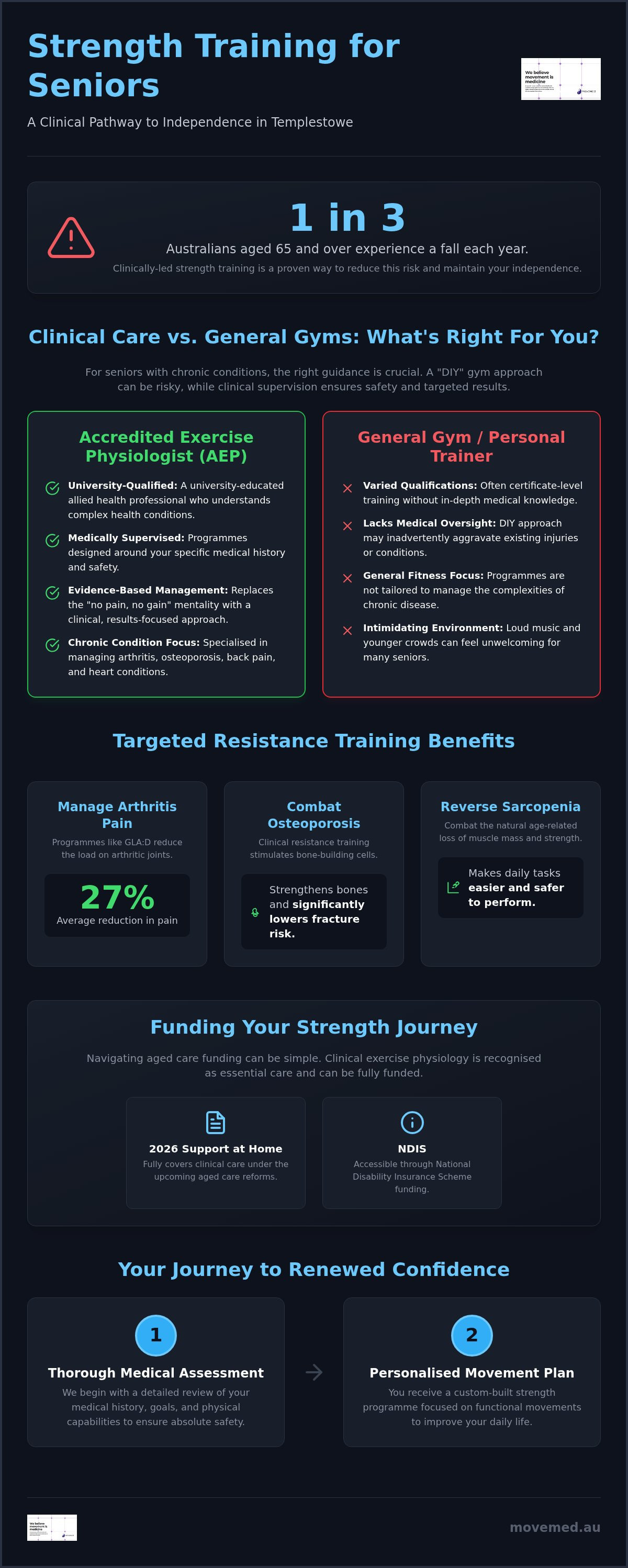
Did you know that one in three Australians aged 65 and over experience a fall every year? It is a sobering statistic, but it doesn't have to be your reality. Finding the right approach to strength training for seniors Templestowe can feel intimidating when you are dealing with chronic joint pain or the nagging worry of a trip. You might worry that pushing yourself will lead to injury rather than improvement, especially when your goal is simply to walk to the Templestowe Village shops or play with your grandkids without discomfort.
This guide shows you how clinically-led movement provides a safe, evidence-based pathway to regain your independence and manage conditions like arthritis or back pain. Under the guidance of an Accredited Exercise Physiologist, you can transform exercise from a source of anxiety into a tool for resilience. We will explain how the 2026 Support at Home funding fully covers clinical care, explore how programs like GLA:D can reduce arthritic pain by an average of 27 per cent, and outline how a personalised movement plan helps you stay active and confident in our local community.
Key Takeaways
- Understand how clinical resistance training combats sarcopenia (the natural loss of muscle mass) so it is easier to perform daily tasks with ease.
- Recognise the vital difference between a general gym and an Accredited Exercise Physiologist who provides medically supervised care for your specific medical history.
- Learn how targeted strength training for seniors Templestowe reduces the load on arthritic joints and strengthens bones to significantly lower your risk of fractures.
- Navigate the latest 2026 aged care funding reforms to access fully funded clinical support through the Support at Home program or NDIS.
- Discover the simple steps to start your journey at MoveMed, beginning with a thorough medical assessment to ensure your safety and progress.
Why Strength Training is the Key to Independence for Templestowe Seniors
Losing the ability to do the things we love often feels like losing a piece of ourselves. Whether it is the slight hesitation before standing up from a low couch or the worry that a trip might lead to a hospital stay, these moments can chip away at your sense of freedom. What is strength training? In a clinical context, it is the use of resistance, such as weights, bands, or even your own body weight, to challenge your muscles. This process forces your body to adapt and grow more resilient. For seniors in our local community, this isn't about bodybuilding; it's about functional capacity. It's about ensuring your legs have the power to lift you out of a chair and your core has the stability to keep you upright on an uneven footpath.
The link between muscle and safety is direct and undeniable. Research from the AIHW shows that one in three Australians over the age of 65 experience a fall each year, and many of these incidents occur within the home. By focusing on strength training for seniors Templestowe, we specifically target the lower limb muscles, like the quadriceps and calves, which act as your body's primary shock absorbers. When these muscles are strong, your body can react more quickly to a slip or a loss of balance, often preventing a tumble before it happens. This physical "safety net" allows you to move through your day with a lower risk of injury.
The Science of Ageing and Muscle Resilience
As we age, our bodies undergo physiological changes that can feel out of our control. Sarcopenia is the medical term for the age-related loss of muscle mass and strength. This process typically accelerates after the age of 60, but it is not inevitable. Clinical resistance training stimulates bone-building cells, which is essential for managing osteoporosis and reducing the risk of fractures. Beyond bone health, maintaining muscle mass provides significant metabolic benefits. Muscles act as efficient "sponges" for glucose, helping to regulate blood sugar levels and improving your overall metabolic health. Sarcopenia is the age-related loss of muscle mass and strength.
Maintaining Your Lifestyle in Manningham
We want you to stay connected to the places and people that make Templestowe special. Whether you are walking the winding trails at Westerfolds Park or navigating the busy aisles at the Pines Shopping Centre, your body needs to be a reliable partner. Strength training for seniors Templestowe focuses on the practical movements that preserve your freedom. Improved grip strength makes it easier to hold a steering wheel or open a stubborn jar, while better core stability means you can spend an afternoon in the garden without a week of back pain afterwards.
Perhaps the most significant benefit is the quiet confidence that returns when you trust your body again. You stop scanning the ground for hazards and start looking ahead at the path. That mental shift, from fear to agency, is the true goal of a clinical exercise programme. It allows you to participate fully in local life, from grocery shopping to playing with grandkids, without the constant shadow of physical limitation.
Clinical Exercise Physiology vs. General Gyms: Which is Right for You?
Many seniors feel out of place in a typical commercial gym. The loud music, heavy weights, and younger crowds can be off-putting, but the real concern is safety. For those seeking strength training for seniors Templestowe, a standard gym often lacks the medical oversight needed to manage existing health conditions. A "DIY" approach might inadvertently aggravate a hip injury or put undue stress on a heart condition. When you are managing chronic pain, the last thing you need is a programme that makes the problem worse.
This is where an Accredited Exercise Physiologist (AEP) differs from a standard personal trainer. An AEP is a university-qualified health professional who understands the complex interplay between exercise and chronic disease. They move away from the "no pain, no gain" mentality, replacing it with evidence-based management. This approach prioritises your safety while ensuring you still reap the benefits of resistance training. It is a partnership where your goals are the priority, and every movement is chosen for a specific clinical reason.
Why Medical History Matters in Exercise
Every clinical programme begins with a detailed screening. We look at cardiovascular risks and joint instability to ensure your heart and bones can handle the load. Exercise is like medicine; the "dosage" must be precise. Too much can lead to injury, while too little won't help you regain your independence. Unlike a "one size fits all" gym class, a clinical programme is tailored to your specific physical baseline. This individualised attention ensures you are working at the right intensity to see progress without crossing into the danger zone of overexertion.
The MoveMed Environment: A Different Kind of Centre
Our clinic in Templestowe is designed to be a calm, non-intimidating alternative to local leisure centres. We use specialised equipment like Clinical Reformer Pilates in Templestowe: Expert-Led Rehab & Strength, which offers low-impact resistance that is gentle on your joints. By working in small groups or one-on-one, you receive the constant attention required to perfect your form. If you are ready to start a programme designed for your safety, you might consider an Exercise Physiology Consultation to discuss your unique health journey.
The focus here is on progress, not performance. You won't find mirrors or intimidating equipment. Instead, you will find a supportive community and experts who understand exactly how to help you move better. It is about building a body that allows you to live your life in Manningham with confidence and ease.
Managing Arthritis, Osteoporosis, and Balance Through Targeted Resistance
Living with chronic joint pain or a diagnosis of low bone density often makes you feel like your world is shrinking. Every staircase or walk to the letterbox becomes a calculation of risk and potential discomfort. However, Managing arthritis with exercise is one of the most effective ways to reclaim your comfort and mobility. By strengthening the muscles that surround a joint, such as the quadriceps for the knee or the gluteals for the hip, you create a natural "brace" that absorbs impact. This reduces the mechanical load placed directly on the joint surfaces, which can significantly ease the grinding sensation often associated with osteoarthritis.
For those managing osteoporosis, the goal of strength training for seniors Templestowe is to build bone resilience. Bones are living tissue that respond to the "good stress" of resistance. When you engage in weight-bearing exercises, you signal to your body to maintain or even improve bone mineral density. This is your most powerful defence against the fractures that can occur from minor trips. Similarly, chronic lower back issues often stem from a lack of support for the spine. Building deep core stability provides your vertebrae with the structural integrity they need to handle daily life. To understand how we specifically target these issues, you can read our Clinical Pilates for Back Pain: Long-Term Relief Guide.
The GLA:D® Approach and Targeted Hip/Knee Care
Evidence-based programmes like the GLA:D® Program have revolutionised how we treat joint pain. These sessions focus on "functional" movements, which are the essential mechanics of daily life. We don't use abstract gym machines; instead, we perfect the art of sitting to standing or stepping up safely. By training these specific patterns, your body learns to move with better alignment, which reduces wear and tear on your joints during your normal routine in Templestowe.
Falls Prevention: More Than Just Balance
Many people think balance is just about standing still on one leg. In a clinical setting, we know that preventing a fall actually requires "power". Power is the ability of your brain and muscles to react fast enough to catch a trip. As we age, we often lose "fast-twitch" muscle fibres, which are the ones responsible for those quick, reflexive movements. We train these fibres specifically so that if you do stumble on an uneven footpath, your body has the speed and strength to stabilise itself before you hit the ground.
How do you know if you need a clinical assessment? Consider this checklist of common signs:
- You find yourself "furniture walking" (holding onto tables or walls) for stability at home.
- Getting out of a car or a low armchair has become a significant struggle.
- You have had a "near miss" or a minor trip in the last six months.
- A fear of falling is stopping you from visiting friends or the local shops.
If any of these sound familiar, your body is likely telling you that its "safety margin" has narrowed. Clinical strength training is the most reliable way to widen that margin and restore your confidence.
Funding Your Strength Journey: Home Care Packages and NDIS in Manningham
Accessing high-quality clinical care shouldn't be a financial burden. Many people in Manningham are unaware that strength training for seniors Templestowe is often fully covered by various government funding schemes. Since the introduction of the "Support at Home" program on November 1, 2025, which replaced the previous Home Care Package levels, clinical care services like Exercise Physiology are 100 per cent government-funded. This means there are no out-of-pocket costs for recipients accessing these essential services to maintain their physical function and safety at home.
For those under the age of 65, NDIS pathways provide a vital route to improved health. Exercise Physiology is a recognised service under the "Capacity Building" category of NDIS plans, designed specifically to help you manage chronic conditions and improve your mobility. We also work closely with the Department of Veterans' Affairs (DVA) to support local veterans in Templestowe. If you do not qualify for these larger schemes, your GP can often provide a Medicare Chronic Disease Management plan (formerly known as an EPC). This provides a subsidy for a specific number of sessions, making expert-led care more accessible for everyone in our community.
Navigating the Paperwork with MoveMed
We know that the administrative side of healthcare can feel overwhelming. Our team acts as your advocate, handling the complicated paperwork and provider liaison required to get your funding approved. Whether your NDIS funds are self-managed or plan-managed, we help you understand how to allocate your budget effectively to achieve your strength goals. When you visit your GP or Case Manager, simply mention that you would like a referral for "functional strength and falls prevention." We are here to help you organise your first appointment and streamline the entire process.
Local Access for Templestowe and Surrounding Suburbs
Our clinic is conveniently located to serve residents across Templestowe, Doncaster, Bulleen, and Warrandyte. We believe that everyone deserves a pathway to better movement, regardless of their current physical baseline. For some, land-based exercises may feel too taxing initially due to severe joint pain or limited mobility. In these cases, we often suggest Hydrotherapy: The Complete Guide to Water-Based Recovery in Melbourne as a funded alternative. This water-based approach allows you to build strength in a buoyant environment, reducing the stress on your joints while you work toward your goals.
By combining these funding options with our clinical expertise, we ensure that cost is not a barrier to your independence. Our goal is to see you back on your feet, enjoying everything the Manningham area has to offer.
Expert-Led Strength Programmes at MoveMed Templestowe
MoveMed stands as a trusted local expert for senior health in the Manningham area. We understand that starting a new physical routine can be daunting, especially if you haven't exercised in years or are currently managing pain. Our approach to strength training for seniors Templestowe is built on clinical precision and a genuine partnership between you and your Exercise Physiologist. We don't just give you a list of movements; we provide a structured, medically-backed pathway to help you reclaim your independence.
To ensure your safety and success, we track your progress using objective data. This includes specific strength tests and balance scores that show exactly how much you are improving over time. This evidence-based approach takes the guesswork out of your recovery. Seeing tangible results from your hard work builds the confidence needed to stay active in our local community, whether that means walking to the shops or keeping up with family.
Your First Appointment: What to Expect
Day one is about understanding your unique story and physical baseline. You don't need to worry about wearing lycra or lifting heavy weights immediately. We begin by listening to your medical history and conducting a thorough physical assessment to identify your strengths and areas for improvement. This allows us to create a partnered plan that respects your current limits while nudging you toward progress. A typical session flow involves a gentle warm-up, followed by movements designed to improve your functional stability, and ends with a clear review of your goals.
Join the MoveMed Community
There is a significant social benefit to training alongside peers who are on a similar journey. In our clinical setting, you will find a supportive, non-intimidating atmosphere where everyone is working toward a more resilient future. We are committed to your long-term health, moving away from quick fixes in favour of sustainable change that lasts. It is about building a physical foundation that serves you for years to come. We handle the complicated paperwork for your funding so you can focus entirely on your movement.
If you are ready to move with more ease and less fear, the first step is simple. Organise your initial senior strength assessment at MoveMed Templestowe today and let us help you stay active, independent, and confident in the heart of our community.
Reclaim Your Confidence and Independence
Choosing to prioritise your physical health is the most effective way to protect your lifestyle in Manningham. We have explored how clinically-led strength training for seniors Templestowe is not just about muscle; it is about the freedom to enjoy your local community without the constant fear of a fall or chronic pain. By partnering with an Accredited Exercise Physiologist, you move beyond generic fitness and into a world of personalised, evidence-based care that respects your medical history and current physical baseline.
With the latest 2026 Support at Home reforms and NDIS pathways, expert support is more accessible than ever before. You don't have to navigate the complicated funding paperwork or the physical challenges of ageing alone. Our team is here to handle the administrative burden so you can focus entirely on your journey toward a more resilient, active future. It's time to stop worrying about what you might lose and start focusing on what you can regain.
Ready to take the first step? Book Your Initial Senior Strength Assessment at MoveMed Templestowe and begin your partnership with our dedicated clinical team. We look forward to helping you move with confidence again.
Frequently Asked Questions
Is strength training safe for someone with severe arthritis?
Yes, strength training is not only safe but highly recommended for managing severe arthritis. By building the muscles around your affected joints, you create a natural support system that reduces the mechanical load on the joint itself. Our Accredited Exercise Physiologists use low-impact, evidence-based movements to ensure you progress safely. This targeted approach helps to reduce pain and improve your ability to perform daily tasks with far less discomfort.
Do I need a GP referral to start exercise physiology at MoveMed?
You don't strictly need a GP referral to start as a private client at MoveMed. However, if you wish to access Medicare rebates through a Chronic Disease Management plan, a referral from your doctor is essential. This also applies to DVA, TAC, or Workcover funded therapy. We recommend chatting with your GP about your eligibility for these subsidised pathways to help manage the costs of your clinical care and long-term health journey.
Can I use my NDIS funding for strength training sessions?
Yes, you can certainly use your NDIS funding for strength training for seniors Templestowe. Exercise Physiology is a recognised service funded under the "Capacity Building" category of your plan. We partner with self-managed, plan-managed, and NDIA-managed participants to help them achieve their specific mobility and independence goals. Our team handles the administrative requirements and paperwork to ensure your funding is utilised effectively for your physical progress and wellbeing.
How often should a senior perform strength training exercises?
Performing strength training for seniors Templestowe two to three times per week is the clinical standard for seeing meaningful improvements in muscle mass and bone density. This frequency provides the necessary stimulus for your body to grow stronger while allowing for adequate recovery between sessions. We will help you establish a sustainable rhythm that fits into your lifestyle, ensuring you see consistent progress in your physical function without the risk of overexertion.
What should I wear to my first clinical exercise session?
Please wear comfortable, loose-fitting clothing that allows you to move freely during your assessment and exercises. You don't need specialised gym gear or lycra; simple trousers or shorts and a breathable shirt are perfectly fine. It is important to wear sturdy, closed-toe shoes like runners to provide adequate grip and support. This helps you stay safe and stable while we work together on your balance and strength movements in the clinic.
Can strength training help if I have already had a hip or knee replacement?
Strength training is a vital part of the recovery process after a hip or knee replacement. It helps to stabilise the new joint and ensures your walking pattern returns to a natural, efficient state. We design your programme to respect any surgical precautions while focusing on the muscles that support your prosthesis. This clinical oversight is essential for ensuring the long-term success of your surgery and the longevity of your joint replacement.
How long does it take to see improvements in balance and strength?
Most clients notice improvements in their balance and confidence within the first two to four weeks. These initial gains are due to your nervous system becoming more efficient at activating your existing muscles. Physical changes in muscle strength and mass usually take between eight and twelve weeks of consistent training. We track these changes using objective tests so you can see the clear return on the investment you are making in your health.
Is exercise physiology covered by private health insurance in Australia?
Yes, Exercise Physiology is covered by most major Australian private health insurers under their "Extras" policies. The rebate amount you receive will depend on your specific fund and your level of cover. We recommend contacting your insurer to confirm your benefits for Exercise Physiology Consultations before your first visit. This ensures you understand your coverage and any potential out-of-pocket costs before starting your journey toward better movement and independence with us.


