

What if the most effective way to get back on your feet was to spend more time off them? For many residents in Templestowe Lower, the thought of traditional gym-based rehab after a transport accident feels daunting, or even impossible, due to severe weight-bearing pain. It is a common frustration to feel stuck between the clinical need to move and the genuine fear of re-injury. We know that navigating the complex paperwork and approval timelines for tac funded hydrotherapy can feel just as overwhelming as the physical recovery itself. You likely want to focus on healing, not on whether you can afford the next session or if you are filling out the right forms.
This guide will help you discover how to access aquatic therapy to fast-track your recovery without the stress of out-of-pocket expenses. We will walk you through the current TAC rates, the 90-day initial treatment window, and how our expert Exercise Physiologists at the local Aquarena centre help you transition from the water back to your daily life. By the end of this article, you will have a clear, step-by-step path to reclaiming your independence through a program that prioritises both your safety and your long-term progress.
Key Takeaways
- Learn how the natural buoyancy of water offloads up to 90% of your body weight, allowing you to move freely and without the sharp pain often felt during land-based exercises.
- Understand the 90-day initial treatment window for tac funded hydrotherapy and how to navigate the approval process for long-term clinical support.
- Discover the essential role of aquatic therapy in reducing post-accident swelling and oedema through the gentle, consistent effect of hydrostatic pressure.
- Identify the clear pathway to transition from the pool to land-based recovery, ensuring you build the functional strength needed for your daily life in Templestowe.
- Find out how partnering with an Accredited Exercise Physiologist simplifies your recovery by managing the complex TAC billing and paperwork on your behalf.
What is TAC Funded Hydrotherapy and How Does it Work?
Recovery after a transport accident often feels like an uphill battle against your own body. If you are finding land-based movements painful or restrictive, understanding What is Hydrotherapy can be a turning point. At its core, hydrotherapy is a clinical exercise programme conducted in a purpose-built heated pool. It isn't just about floating; it's a structured approach where the water's warmth and buoyancy are used to rebuild strength and mobility. For Victorian road users, the Transport Accident Commission (TAC) provides a pathway to access these services, ensuring that drivers, passengers, pedestrians, and cyclists can get the help they need without the immediate burden of cost.
Accessing tac funded hydrotherapy is designed to be straightforward during the early stages of your claim. The TAC recognises that early intervention is vital for long-term health. Because of this, they often cover the costs of these sessions for anyone involved in a transport accident in Victoria, provided the treatment relates directly to the injuries sustained. This financial support allows you to focus on your rehabilitation journey rather than worrying about the logistics of billing.
The 90-Day Rule for TAC Clients
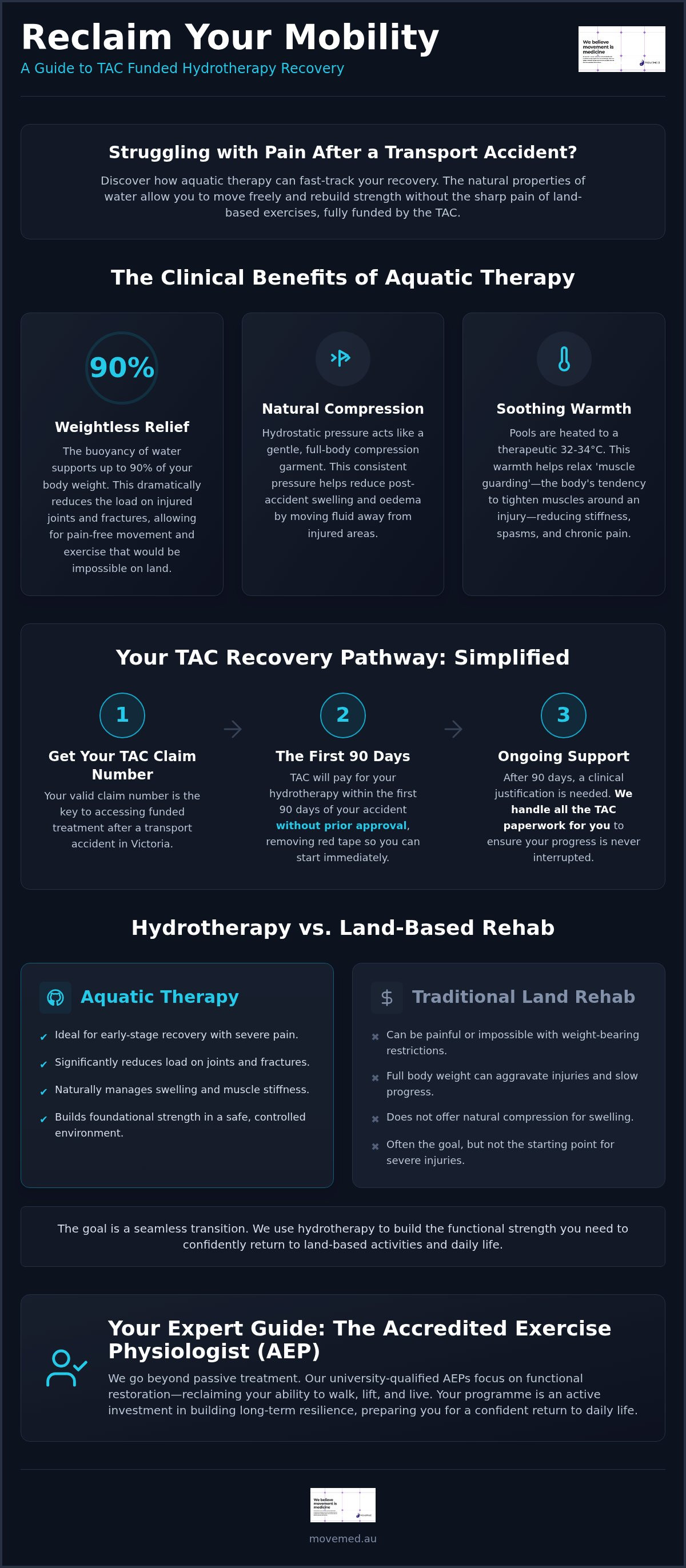
The first few months after an accident are critical. The TAC operates under a policy where they will pay for hydrotherapy services within the first 90 days of your accident without requiring prior approval. This means if you have a valid TAC claim number, you can start your sessions almost immediately. It's a proactive system designed to remove the red tape that often slows down recovery. However, it's important to have your claim number ready when you contact us, as this is the key to direct billing.
What happens once those three months pass? After the 90-day mark, or if it has been more than six months since your last treatment, the TAC requires a clinical justification. This is simply a report from your provider explaining why ongoing aquatic therapy is necessary for your recovery. We partner with you to handle this paperwork, ensuring the transition is seamless and your progress isn't interrupted by administrative delays.
Exercise Physiology vs. Physiotherapy in the Pool
While many people associate pool rehab with traditional physiotherapy, MoveMed utilises the expertise of Accredited Exercise Physiologists (AEPs). An AEP is a university-qualified health professional specialising in clinical exercise prescription. In the pool, our focus shifts from passive treatment to functional restoration. We don't just want to manage your pain; we want to help you reclaim the ability to walk, lift, and move in your daily life. By choosing an exercise-led approach for your tac funded hydrotherapy, you are investing in a programme that builds resilience and prepares your body for the eventual return to land-based activities.
The Clinical Benefits of Aquatic Therapy for Accident Injuries
Gravity is often the greatest obstacle during the early stages of accident recovery. When you are struggling with a fracture or severe soft tissue damage, the simple act of standing can trigger intense pain. This is where tac funded hydrotherapy becomes an invaluable tool. By utilising the unique physics of water, we can bypass the limitations of land-based rehab. Buoyancy is the primary driver here; when submerged to chest height, the water supports up to 90 per cent of your body weight. This dramatic reduction in load allows you to perform movements, like squats or lunges, that would otherwise be too painful to attempt on a gym floor.
The benefits extend beyond just weight-bearing relief. Hydrostatic pressure, the pressure exerted by the water on your body, acts like a gentle, uniform compression garment. This helps to move fluid away from injured areas, effectively reducing post-accident swelling and oedema. Combined with therapeutic heat (typically maintained between 32 and 34 degrees Celsius), the pool environment becomes a sanctuary for mental and physical recovery after trauma. The warmth works to relax "muscle guarding", which is the body's natural tendency to tighten muscles around an injury site to protect it. While this guarding is a useful short-term reflex, it often leads to chronic stiffness and spasms if not addressed early.
Water density also provides a form of variable resistance that is safer than heavy weights. Because water is roughly 800 times denser than air, every movement you make is met with resistance. The faster you move, the harder the water pushes back. This allows our Exercise Physiologists to precisely calibrate your strength training without the risk of high-impact jars or sudden strains. If you're ready to see how these principles apply to your specific injuries, you can book a clinical assessment with our team to get started.
Managing Whiplash and Spinal Trauma
Neck and back injuries are common after transport accidents, often leaving clients with a deep-seated fear of movement, also known as kinesiophobia. While psychological support from services like The Health Continuum can help manage the emotional side of trauma, the pool is the safest physical environment to break this cycle. Vertical water exercises allow for gentle spinal decompression, using the water's upward force to create space between the vertebrae. This offloads the sensitive discs and nerves in the spine, making it much easier to perform the core stabilisation and postural exercises necessary for long-term whiplash recovery. It's about building confidence in your body's ability to move again without the constant threat of a "flare-up".
For those recovering from foot, ankle, or leg fractures, the transition back to walking is a major milestone. We use tac funded hydrotherapy to begin gait retraining (walking practice) much earlier than would be possible on land. Even before a surgeon clears you for full weight-bearing, you can often begin walking in the water. The warmth of the pool also plays a clinical role in modulating nerve pain. It provides a soothing sensory input that can "dampen" the overactive pain signals often associated with complex regional pain or nerve impingement. This environment allows us to focus on rebuilding glute and calf strength, ensuring your land-based walking is stable and symmetrical when you finally return to it.
Hydrotherapy vs. Land-Based Rehab: Which is Right for You?
Deciding where to begin your recovery journey shouldn't feel like a guessing game. While land-based exercise is the ultimate goal for functional independence, it isn't always the right starting point for every injury. If you are experiencing acute pain, high levels of sensitivity, or have strict weight-bearing restrictions from your surgeon, the pool is often the most logical first step. Using tac funded hydrotherapy allows you to maintain your muscle mass and joint mobility without the harsh impact of gravity that often makes gym-based work impossible in the early weeks.
As your pain settles and your strength improves, we begin the transition phase. This is where we move from the support of the water to more gravity-dependent movements. A common and highly effective next step is Clinical Reformer Pilates. This modality offers a middle ground, using spring resistance to support your limbs while you build the core stability and control needed for everyday life. Many of our clients find that combining both therapies works best; they might use the pool for mobility and "loosening up" while using land-based sessions to improve bone density and functional power. The best part is that the TAC often covers both modalities under the same claim, meaning your recovery isn't limited by which room the equipment is in.
The MoveMed Integrated Approach
We view hydrotherapy as a clinical bridge, not a permanent destination. Our goal is to move you toward land-based independence as soon as it's safe and effective. To ensure this happens at the right pace, we monitor your progress using objective clinical measures. This might include tracking your pain-free range of motion or your ability to bear weight on a single leg. We don't believe in keeping you in the pool longer than is clinically necessary. Once you've reached the milestones that allow for safe land-based training, we'll guide you through that transition with confidence.
Is Hydrotherapy Suitable for Non-Swimmers?
It's completely normal to feel a sense of hesitation if you aren't a confident swimmer or if you have a fear of deep water. However, clinical aquatic therapy is very different from swimming laps. All our tac funded hydrotherapy sessions are conducted in water that is typically waist-to-chest deep. You'll always be able to keep your feet firmly on the pool floor. Safety is our absolute priority, which is why an Accredited Exercise Physiologist provides constant supervision throughout the session. You don't need to know how to swim to reap the rewards of the water; you just need to be willing to take that first step in with us.
How to Access TAC Hydrotherapy in Templestowe and Manningham
Starting the process of accessing tac funded hydrotherapy shouldn't be the hardest part of your day. We understand that after a transport accident, your energy is best spent on healing rather than deciphering complex administrative requirements. To help you get moving again, we have refined the pathway into four clear steps:
- Step 1: Visit your GP. Discuss your injuries and request a referral for Exercise Physiology. It is essential that your doctor mentions the transport accident and your specific injuries on the referral to ensure smooth processing with the TAC.
- Step 2: Book your assessment. Contact MoveMed to arrange your initial land-based assessment. This session allows us to safely evaluate your movement patterns and establish clear recovery goals before you enter the water.
- Step 3: Clinical Coordination. We take the lead on the logistics. Our team coordinates with the TAC and local facilities, such as the Aquarena Aquatic and Leisure Centre in Templestowe Lower, to ensure all billing and pool access is organised.
- Step 4: Begin your sessions. You will meet your Accredited Exercise Physiologist at the pool for your tailored aquatic sessions, focusing on the specific movements needed for your recovery.
By following this structured approach, we ensure that your transition into the water is safe, professionally supervised, and fully supported by your funding. If you are ready to stop navigating the system alone and start your recovery, contact our Templestowe team today to book your initial assessment.
Referral Requirements and Paperwork
Your GP's referral is the foundation of your claim. It needs to clearly link your need for aquatic therapy to the injuries sustained in your accident. We often help clients understand the TAC "Medical Excess", which is an initial amount you might need to pay before the TAC starts covering costs. This excess does not apply to everyone; for instance, if you were an inpatient at a hospital after your accident, the excess is usually waived. If your recovery requires more than the initial 90-day window of treatment, we handle the clinical justification reports needed to secure extended funding for tac funded hydrotherapy.
Our Local Service Area
We are proud to be a local fixture in the Manningham community. Our team serves clients throughout Templestowe Lower, Doncaster, and Bulleen, providing convenient access to high-quality heated pools that meet clinical standards. If you are managing multiple health conditions alongside your accident injuries, you might also find our Medicare funding guide useful for understanding how different streams of support can work together to improve your long-term health outcomes.
Why Choose MoveMed for Your TAC Recovery Journey?
Choosing a recovery partner is about more than just finding a pool. It is about finding a team that understands the nuances of TAC exercise physiology and the specific challenges of complex injury management. At MoveMed, we don't just see you as a claim number. We see you as a member of our Manningham community who deserves a clear, supported path back to health. Our focus is on empowerment; we want to give you the tools and confidence to take control of your recovery journey from the very first session.
One of the biggest hurdles in accident recovery is the administrative burden. We aim to remove that stress by offering direct billing to the TAC whenever possible. This minimises your out-of-pocket expenses and allows you to focus your energy where it matters most: on your physical progress. By handling the paperwork and maintaining open communication with your claim manager, we ensure your tac funded hydrotherapy remains a seamless part of your rehabilitation. We believe that your focus should be on movement, not on managing invoices.
Accredited Exercise Physiologists Who Care
There is a significant difference between a generic fitness trainer and an Accredited Exercise Physiologist (AEP). An AEP is a university-qualified health professional who understands the clinical pathology of your injuries. We don't guess; we use evidence-based practice to design every movement in your programme. This clinical rigour includes regular reporting to the TAC to ensure your funding continues as you reach your milestones. Ultimately, our goal is your long-term health, not just short-term relief.
Beyond the Pool: Your Future Health
Recovery is a journey that often extends beyond the water. For some clients, this involves integrating with our DVA and veteran services if they hold multiple coverages. Whether you are preparing to return to work, getting back onto the sporting field, or simply wanting to walk through the local park without pain, we are here to guide you. We prepare your body for the demands of daily life by transitioning your strength from the pool to the gym, ensuring you have the resilience to stay active long after your TAC claim has closed.
You don't have to navigate this alone. If you are ready to start a recovery programme that prioritises your independence and clinical outcomes, the first step is simple. Book your initial land-based assessment with our team today to discuss how we can tailor a plan specifically for your needs. We look forward to partnering with you on your journey back to full health.
Take the Next Step in Your Recovery Journey
Recovery after a transport accident is a marathon, not a sprint, but you don't have to navigate the path alone. We've explored how the unique properties of water, such as buoyancy and hydrostatic pressure, provide a safe environment to rebuild your strength when land-based exercise feels impossible. By accessing tac funded hydrotherapy, you can prioritise your physical rehabilitation without the added weight of financial stress or complex paperwork. Our team of Accredited Exercise Physiologists is here to bridge the gap between your initial injury and your return to the activities you love.
As local Templestowe experts, we are committed to providing evidence-based care that focuses on your long-term independence. Whether we are coordinating your direct TAC billing or guiding your transition to land-based Clinical Pilates, our priority is always your progress. It's time to move beyond the limitations of your injury and rediscover what your body can do. We invite you to Book Your TAC Hydrotherapy Assessment at MoveMed today. Let's work together to turn your recovery goals into reality; your journey back to health starts with a single splash.
Frequently Asked Questions
Do I need a referral from my doctor for TAC hydrotherapy?
Yes, you generally need a GP referral to access tac funded hydrotherapy through an Exercise Physiologist. This document ensures the TAC understands how the aquatic sessions directly relate to your transport accident injuries. While you can start some treatments within the first 90 days, having a clear referral from your doctor helps us establish a clinical pathway and ensures all paperwork is in order for direct billing.
Does the TAC cover the full cost of the pool entry and the session?
The TAC pays a scheduled fee for hydrotherapy sessions, which includes the pool entry cost. Effective July 1, 2026, the maximum individual rate is $67.71. It's important to remember that if a provider charges above this set rate, you might need to pay a small gap payment. We always review your claim details first to provide clarity on any potential out-of-pocket costs before you begin your recovery programme.
How many sessions of hydrotherapy will the TAC pay for?
There is no fixed limit on the number of sessions, as the TAC funds treatment based on what is reasonable and necessary for your recovery. During the initial 90-day window after your accident, access is typically streamlined. After this period, your Exercise Physiologist will submit a clinical justification report to the TAC. This report outlines your progress and explains why continued aquatic therapy is essential for reaching your functional goals.
What should I bring to my first hydrotherapy session?
You should bring comfortable swimwear, a towel, and a water bottle to stay hydrated during your session. It is also helpful to pack a change of warm clothes for after you leave the heated pool. If you use any specific mobility aids or have recent medical imaging reports related to your accident, please bring those along to your initial assessment so your Exercise Physiologist can tailor your programme safely and effectively.
Can I do hydrotherapy if I have a fear of water or cannot swim?
You can absolutely participate in hydrotherapy even if you cannot swim or feel anxious around water. Our sessions are conducted in waist-to-chest deep water, meaning your feet remain firmly on the pool floor at all times. You are never left alone; an Accredited Exercise Physiologist provides constant, one-on-one supervision. We focus on gentle movements and building your confidence at a pace that feels safe and supportive for your needs.
How soon after my car accident can I start aquatic therapy?
You can often start aquatic therapy as soon as your doctor clears you for light exercise after your accident. The TAC typically covers tac funded hydrotherapy within the first 90 days without needing prior approval, provided you have a valid claim number. Early intervention is often key to managing swelling and preventing chronic stiffness, so we encourage you to reach out once you feel ready to begin gentle, supported movement.
What if my 90 days of automatic TAC coverage has already expired?
You can often start aquatic therapy as soon as your doctor clears you for light exercise after your accident. The TAC typically covers tac funded hydrotherapy within the first 90 days without needing prior approval, provided you have a valid claim number. Early intervention is often key to managing swelling and preventing chronic stiffness, so we encourage you to reach out once you feel ready to begin gentle, supported movement. If your vehicle was also written off in the accident, Melbourne Car Removal can help with professional disposal while you focus on your health.
Yes, you have the right to choose the type of allied health professional that best suits your recovery goals. Many clients switch to Exercise Physiology when they want to move from passive treatment to active, functional restoration. The TAC supports this transition as long as the provider is registered and the treatment is related to your accident. We can help you manage this change and ensure your clinical records are transferred correctly.


