

Imagine standing on the edge of a pool, knowing that the moment you step into the heated water, the weight of your injury will finally lift. For many Melburnians recovering from a workplace accident, traditional gym exercises often feel like an uphill battle against gravity and persistent pain. You want to get back to your job and your life, but the frustration of slow progress and the complexity of WorkSafe Victoria paperwork can make the road to recovery feel incredibly lonely. We understand that you aren't just managing a claim; you're trying to reclaim your independence and confidence.
Accessing workcover hydrotherapy can be the genuine turning point in your rehabilitation journey. This guide explains how water-based therapy reduces joint loading to allow for pain-free movement, while our Accredited Exercise Physiologists handle the clinical reporting and AHRMP submissions your agent requires. You'll learn exactly how to secure approval for aquatic sessions, why the specific warmth of a clinical pool environment accelerates tissue healing, and how we partner with you to build the functional strength needed to return to your work duties safely.
Key Takeaways
- Learn why the 32–34°C warmth of a clinical pool is essential for reducing pain and improving mobility compared to standard gym environments.
- Understand how an Exercise Physiologist uses an "exercise-as-medicine" approach to bridge the gap between acute injury and returning to your physical work duties.
- Discover the exact steps to secure approval for workcover hydrotherapy, including the specific referrals and forms required by your WorkSafe Agent.
- Find out how water resistance allows you to build strength and cardiovascular fitness without the impact or fall risks of traditional land-based rehabilitation.
- See how professional clinical reporting and AHRMP submissions take the stress out of managing your claim while you focus on your recovery journey.
Why WorkCover Hydrotherapy is Essential for Workplace Recovery
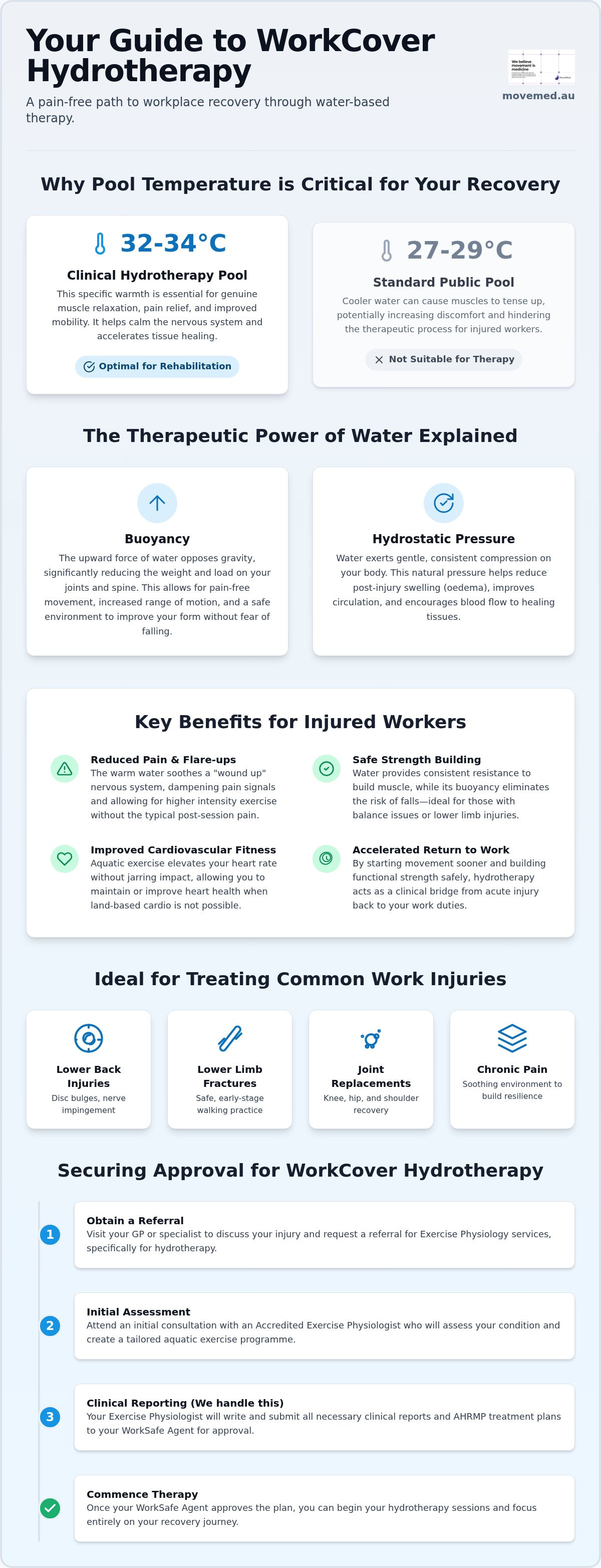
If you've ever felt that traditional rehabilitation is just too painful to bear, you aren't alone. Many injured workers find that standard gym exercises put too much stress on their healing tissues, leading to frustration and a fear of re-injury. To understand what hydrotherapy is, we look at it as a clinical exercise programme performed in a specialised heated pool, usually kept between 32 and 34 degrees Celsius. In Melbourne, you'll often hear people talk about "WorkCover" and "WorkSafe Victoria" in the same breath. While WorkCover refers to the insurance system itself, WorkSafe Victoria is the statutory authority overseeing your claim and recovery. Using workcover hydrotherapy provides a gentle, supportive environment that acts as a clinical bridge. It allows you to start moving much sooner than you could on dry land, helping you maintain your momentum even when land-based exercises feel out of reach.
The Science of Water: Buoyancy and Hydrostatic Pressure
The therapeutic power of water isn't magic; it's physics. Buoyancy is the upward force that opposes gravity, which significantly reduces the weight-bearing load on your joints and spine. When you're in the water, your range of motion increases because your muscles don't have to fight as hard to stay upright. This makes it much easier to organise your movements and focus on correct form without the fear of a stumble. At the same time, hydrostatic pressure provides a gentle, consistent compression against your body from all sides. This is particularly helpful for managing post-surgical or post-injury swelling, also known as oedema. Hydrostatic pressure serves as a natural tool for circulatory support, encouraging fluid drainage and improving blood flow to injured tissues during your recovery journey.
Common Work Injuries Treated in the Pool
Aquatic therapy is particularly effective for injuries that make weight-bearing difficult or painful. We frequently work with tradespeople and office workers suffering from lower back injuries, including disc bulges and nerve impingement. The water's buoyancy allows the spine to gently decompress, creating space and reducing the pressure that causes sharp, radiating pain. For workers recovering from lower limb fractures or complex joint replacements, the pool provides a safe space to practice walking and balance without the risk of a fall. We also find that clients with chronic pain conditions thrive in the heated water. The warmth helps to soothe the nervous system, allowing for a higher intensity of exercise without the typical flare-up that can occur in a traditional gym setting. It's about building resilience and reclaiming your confidence, one session at a time.
The Clinical Benefits of Aquatic Therapy for Injured Workers
Workplace injuries often leave you feeling trapped in a cycle of pain and inactivity. When land-based exercises trigger flare-ups, your progress stalls, leading to anxiety about your future at work. This is where the clinical environment of the pool changes the game. By using water as a medium for exercise, we can begin building muscle strength through gentle, consistent resistance. Because the water supports your body, there is virtually zero risk of falls, which is a common fear for those with balance issues or lower limb injuries. You can push your physical limits safely, knowing the water acts as a protective cushion.
Beyond strength, maintaining your heart health during recovery is vital. Traditional cardio might be impossible if you can't run or cycle, but aquatic therapy allows you to improve your cardiovascular fitness early in the piece. Moving against the water's density gets your heart rate up without the jarring impact on your joints. There is also a profound neurological effect at play. The warm water helps to calm a "wound up" nervous system, effectively dampening pain signals and allowing you to move with more ease. This physical freedom leads to a significant psychological boost; as you realise you can move without the expected sharp pain, your confidence in your body's ability to heal begins to return.
Pain Management and Temperature
The temperature of the water is a clinical tool in itself. To achieve true muscle relaxation and pain relief, a hydrotherapy pool must be maintained between 32 and 34 degrees Celsius. Standard public swimming pools are typically kept much cooler, often around 27 to 29 degrees, which can actually cause muscles to tense up and increase your discomfort. This specific warmth is a core component of our Hydrotherapy: The Complete Guide to Water-Based Recovery in Melbourne, ensuring that every movement you make is supported by therapeutic heat. It's the difference between a simple swim and a targeted clinical intervention.
Functional Restoration: Getting Back to the Job
The ultimate goal of workcover hydrotherapy is to prepare you for the realities of your workplace. We don't just focus on general fitness; we simulate the specific tasks you need to perform daily. This might involve practicing lifting mechanics, reaching overhead, or stepping onto uneven surfaces, all while the water provides support. By doing this, we build the "functional capacity" that your case manager needs to see. According to WorkSafe Victoria's guidelines, demonstrating this tangible progress is essential for a successful return-to-work plan. Water resistance can be precisely graded by our Exercise Physiologists to match the specific physical demands of your job, ensuring you are truly ready for your first day back. If you're ready to see how aquatic movement can accelerate your progress, our team is here to partner with you on your recovery.
Exercise Physiology vs Physiotherapy for WorkSafe Hydrotherapy
With 146,700 serious workers' compensation claims recorded across Australia in 2023-24 (Safe Work Australia), the demand for effective rehabilitation has never been higher. Choosing between a physiotherapist and an Accredited Exercise Physiologist (AEP) for your workcover hydrotherapy can be confusing. Both professionals play a vital role in the Victorian health system, yet their approaches differ significantly. Physiotherapists are generally your first port of call after an injury; they focus on diagnosis, acute pain management, and manual "hands-on" therapy. In contrast, Exercise Physiologists specialise in "exercise-as-medicine". We focus on active rehabilitation, strength building, and long-term functional improvement. If you've previously looked at how these roles differ in other contexts, you might find our guide on Exercise Physiology vs Physiotherapy: Choosing the Right NDIS Support in 2026 helpful, as the core clinical differences remain the same.
The Role of the Accredited Exercise Physiologist (AEP)
The right choice usually depends on where you are in your recovery. If your injury is fresh and you require a specific diagnosis or manual mobilisation, a physiotherapist is the logical starting point. However, once you move into the active rehabilitation phase, an Exercise Physiologist becomes the preferred choice for many long-term WorkCover programmes. We specialise in building the robust physical capacity needed for sustained employment. This transition is supported by a clinical review of hydrotherapy effectiveness, which highlights how aquatic therapy bridges the gap between initial injury and returning to full duties. At MoveMed, we provide tailored Exercise Physiology services that focus on these active outcomes. Our expertise lies in handling complex, long-term claims where a generic exercise plan simply won't cut it. We partner with you to ensure your return to work is not just a goal, but a sustainable reality.
How to Get Approval for Hydrotherapy in Victoria
Navigating the administrative side of a workplace injury can often feel as heavy as the physical recovery itself. For many workers, engaging with an occupational health specialist like Persona Health for injury management can simplify the transition between medical assessments and active rehabilitation. Getting your workcover hydrotherapy approved doesn't have to be a source of anxiety if you follow a methodical path. The process begins with a visit to your GP or specialist to obtain a referral. It's helpful to ensure the referral specifically mentions "Exercise Physiology Hydrotherapy", as this directs you toward the active, exercise-based rehabilitation that WorkSafe Victoria prioritises. Once you have this referral, your next step is to partner with a registered WorkSafe provider in Melbourne. At MoveMed, we act as your local guide in Templestowe, ensuring every clinical requirement is met from day one.
Your journey continues with a comprehensive initial assessment where we determine your current physical limits and your specific return-to-work goals. From this session, we create the Allied Health Recovery Management Plan (AHRMP). This document is the formal communication between your clinical team and the WorkSafe Agent. We submit this plan to request an initial block of sessions, and you can typically expect a response from the agent within 10 working days. This structured approach ensures that your treatment is both clinically justified and administratively sound.
The AHRMP is the key to maintaining your funding and ensuring your recovery stays on track. It's not just a checklist; it's a strategic document that outlines your "Outcome Measures". These are concrete, measurable milestones that prove you're getting stronger and more mobile. For instance, we might document that you can now walk for 15 minutes without a pain flare-up or that you've regained the ability to lift a 5kg weight with correct mechanics. By focusing on these functional improvements, we provide the evidence your agent needs to justify continued support. We handle the reporting and paperwork on your behalf, reducing the stress of the claim so you can focus on your movement.
WorkSafe Victoria Funding Cycles
WorkSafe typically approves gym and swimming programmes in three-month blocks. This window is designed to give you enough time to make tangible progress while allowing for regular clinical reviews. As you reach the end of each three-month cycle, we conduct a formal review to demonstrate your functional gains. To ensure continued funding, we must show "demonstrated progress" toward your work goals. Eventually, as your strength and confidence return, the focus shifts toward self-management. This transition ensures you have the skills to maintain your health independently, which is the ultimate goal of any successful rehabilitation journey. If you're ready to start your journey back to health, book your initial assessment with us today and let our experts handle the paperwork for you.
MoveMed: Your Local WorkCover Hydrotherapy Experts in Templestowe
Recovery shouldn't happen in a vacuum. At MoveMed, we position ourselves as your local partner in health, serving the communities of Templestowe Lower, Doncaster, and the surrounding North-East suburbs. We understand that your journey back to work requires more than just a pool; it needs a clear, clinical strategy. Our approach to workcover hydrotherapy is deeply personalised. We offer one-on-one or small group sessions led exclusively by Accredited Exercise Physiologists (AEPs). By using high-quality local hydrotherapy pools with easy access, we ensure that your rehabilitation is convenient and sustainable. We take the lead in communicating with your GP and WorkSafe Agent, streamlining the reporting process so you can dedicate your energy to getting better.
Our team understands the local landscape and the specific facilities available in Melbourne's North-East. We don't believe in generic exercise sheets or unsupervised pool time. Every session is an opportunity to refine your movement, build strength, and gain the confidence needed to return to your physical work duties. By choosing a local expert, you're choosing someone who will sit with you, explain the clinical reasoning behind every exercise, and ensure your WorkSafe Agent has the data they need to support your claim. We are here to act as your advocate throughout the entire process.
The MoveMed Difference in Melbourne’s North-East
What sets us apart is our commitment to clinical excellence across all funded schemes. Our extensive expertise in providing NDIS exercise physiology services VIC ensures that the same level of rigour and evidence-based care is applied to your WorkCover claim. We don't just look at the surface-level symptoms of your injury. Instead, we focus on identifying and treating the underlying cause, whether that is a postural imbalance, muscle weakness, or a movement compensation pattern. As a community-focused clinic, we act as your ally. We are genuinely invested in your success because you are our neighbour, not just a claim number on a screen. This quiet confidence in our methods allows us to advocate for your right to high-quality, accessible care.
Booking Your Initial WorkSafe Assessment
Taking the first step toward aquatic recovery is simple. Your initial assessment is a dedicated time for us to sit with you, listen to your story, and understand your physical goals. To make the most of this session, please bring your WorkSafe claim number, your GP referral for Exercise Physiology, and a list of any current medications. We will perform a thorough movement assessment to see how your body handles different tasks and discuss what a successful return to work looks like for you. This is where we set the foundation for your recovery plan and begin the process of reclaiming your independence. If you're ready to move beyond pain and start your recovery, enquire about WorkCover Hydrotherapy at MoveMed today. We will handle the complicated paperwork so you can focus on the water.
Reclaiming Your Confidence in the Water
Your recovery journey doesn't have to be defined by pain or the stress of navigating complex insurance systems. We've explored how water-based rehabilitation provides a unique environment where gravity is lifted and your mobility is restored. By choosing workcover hydrotherapy, you aren't just getting pool time; you're accessing a clinical programme designed to bridge the gap between your injury and a safe return to work. Our Accredited Exercise Physiologists are experts in managing the necessary WorkSafe Victoria reporting; they ensure your progress is documented through clear functional outcomes at every stage.
Whether you're in Templestowe Lower or Doncaster, you deserve a recovery partner who understands both the science of movement and the local community. As a WorkSafe Victoria Registered Provider, we specialise in Melbourne North-East recovery and are ready to help you reclaim your independence. Take the first step toward a pain-free future today. Book your WorkCover Hydrotherapy Assessment at MoveMed Templestowe and let's begin this journey together. You've got the strength to get back to work; we're just here to help you find it again.
Frequently Asked Questions
Does WorkCover pay for hydrotherapy in Victoria?
Yes, WorkSafe Victoria covers workcover hydrotherapy when it's delivered as part of a clinical rehabilitation programme. For workers with an accepted claim, physiotherapy sessions can often start without prior approval. However, for exercise physiology led programmes, an AHRMP must be submitted by your provider. This document outlines your specific goals. It ensures the agent understands why aquatic therapy is necessary for your particular workplace injury and return to work journey. We handle this for you.
How many hydrotherapy sessions will WorkSafe fund?
WorkSafe does not set a rigid limit on the total number of sessions you can receive. Instead, funding is typically approved in three month blocks based on your demonstrated progress. Your Exercise Physiologist will regularly assess your functional gains, such as improved lifting capacity or walking distance. If these outcome measures show that the therapy is effectively helping you return to work, the agent will generally approve continued sessions to support your ongoing recovery and health.
Do I need a referral for WorkCover hydrotherapy?
You definitely need a referral from your treating GP or medical specialist to access hydrotherapy through an Exercise Physiologist. This referral should specifically mention "Exercise Physiology". It ensures alignment with WorkSafe's billing requirements. Having this paperwork ready for your initial assessment allows us to start the approval process immediately. It also provides a clear clinical link between your injury and the targeted aquatic exercises we'll use to help you heal and recover.
What is the difference between a swimming membership and clinical hydrotherapy?
Clinical hydrotherapy is a supervised medical treatment. A swimming membership is for independent, self managed exercise. WorkSafe Victoria has specific policies for each. Clinical sessions are led by an Accredited Exercise Physiologist who designs exercises to treat your specific injury. A swimming membership is generally requested later in your recovery journey once you've gained enough strength. WorkSafe requires a specific request form for these memberships to be approved. We can help you navigate this transition.
Can I choose my own hydrotherapy provider in Melbourne?
You absolutely have the freedom to choose your own registered WorkSafe provider in Melbourne. You aren't required to use a clinic suggested by your employer or insurance agent. Many workers prefer to find a local expert. Choosing a provider that handles all the clinical reporting and paperwork can significantly reduce your stress. This allows you to focus entirely on your physical rehabilitation. We partner with you to ensure your transition back to work is seamless.
What happens if my WorkCover claim is still pending?
If your claim is still pending, you're generally responsible for the costs of your treatment in the interim. Some workers choose to pay upfront or use their private health insurance to avoid delaying their recovery. If your claim is eventually accepted, you can submit your receipts to the WorkSafe Agent for reimbursement. It's a good idea to keep detailed records of all sessions and referrals during this period to make the claim process much easier later.
Will I have to pay a gap fee for hydrotherapy sessions?
Many registered providers bill WorkSafe Victoria directly at the set fee schedule, meaning there's often no out of pocket cost for you. However, some clinics may charge a gap fee if their clinical rates are higher than the standard WorkSafe reimbursement. At MoveMed, we aim to make workcover hydrotherapy as accessible as possible. We recommend confirming the billing arrangements during your first assessment so you've got full clarity on any potential costs before starting your programme.
Can I combine hydrotherapy with Clinical Pilates for my recovery?
Combining different types of therapy is often the fastest way to build the functional capacity needed for work. Your Exercise Physiologist can integrate aquatic sessions with Clinical Pilates to address different aspects of your recovery. We don't just use the pool for low impact movement; we use Pilates for the core stability required for your specific job tasks. This multi faceted approach ensures you're physically prepared for all your daily duties and long term health.


