
The obvious choice for physical support isn't always the most effective one for your long-term NDIS goals. You might assume a physiotherapist is the only professional who can help you manage a physical disability, but for many participants in Templestowe, an Exercise Physiologist is the missing piece of the puzzle. It's common to feel overwhelmed by allied health jargon and the fear of mismanaging your limited plan budget. You want to ensure every dollar of your funding is an investment in your long-term independence, not just a temporary fix. This guide will unlock the confusion surrounding exercise physiology vs physiotherapy ndis supports so you can choose the right provider for your health goals in 2026.
We'll break down the clinical differences between these two roles, explain how they fit into your Improved Daily Living budget, and show you how to start your journey toward better mobility right here in the Manningham area. By understanding which professional treats which symptoms, you can move forward with confidence. Whether you need hydrotherapy, Clinical Pilates, or a tailored strength program, we'll help you navigate the new planning framework with ease. It's time to stop worrying about line items and start focusing on the progress you're capable of making together.
Key Takeaways
- Understand the clinical split between manual "hands-on" therapy and movement-based "hands-off" therapy to better manage your physical recovery.
- Navigate the 2026 NDIS Price Guide by identifying which services fall under the "Improved Daily Living" and "Improved Health and Wellbeing" categories.
- Resolve the exercise physiology vs physiotherapy ndis debate by matching your provider to your current stage of recovery, whether it's acute pain or long-term strength building.
- Discover how a multidisciplinary approach allows a physiotherapist to "pass the baton" to an Exercise Physiologist for sustainable health outcomes and increased independence.
- Learn how local Templestowe supports like Clinical Pilates and hydrotherapy can be integrated into your NDIS plan to help you reach your functional goals.
Understanding the Core Differences: NDIS Physio vs Exercise Physiology
Choosing between these two professions often feels like a coin toss, but their clinical approaches are distinct. Both require a university degree and rigorous accreditation, yet they occupy different stages of your health journey. The primary distinction lies in the "hands-on" versus "hands-off" nature of the treatment. While a physiotherapist might use their hands to adjust your body, an Accredited Exercise Physiologist (AEP) uses movement to help you adjust your own. Understanding the nuances of exercise physiology vs physiotherapy ndis funding ensures you don't waste precious plan hours on the wrong type of care.
The "Hands-On" Factor in Physiotherapy
When you visit an NDIS physio, the focus is often on immediate pain relief and restoring joint function. This is achieved through manual therapy, which includes techniques like joint mobilisation, soft tissue massage, and passive stretching. If you've recently had surgery or suffered an acute injury, a physio is usually your first port of call. They assess your biomechanical alignment and use physical manipulation to reduce inflammation or "unlock" restricted movement. It's a vital phase for those who are in too much pain to exercise independently. They essentially prepare the body so that it is capable of moving again without significant distress.
The "Movement-Based" Focus of Exercise Physiology
Exercise physiology is the science of how the body responds and adapts to physical activity. Instead of using manual manipulation, AEPs prescribe specific, clinical exercises to treat the underlying causes of disability and chronic disease. This "hands-off" approach is designed to build long-term resilience and systemic health. When comparing exercise physiology vs physiotherapy ndis supports, think of the AEP as the expert in lifestyle medicine. They don't just look at a sore knee. They look at your cardiovascular health, metabolic function, and how your nervous system coordinates movement to ensure your body functions as a unified whole.
This systemic focus makes EPs indispensable for managing conditions like type 2 diabetes, heart disease, or neurological disorders alongside a primary disability. By teaching you the "why" behind every movement, they empower you to take charge of your own recovery. It's less about someone "fixing" you and more about gaining the strength to navigate your world with confidence. In the Manningham community, this transition from passive treatment to active movement is often the key to reclaiming independence. While the physio addresses the "here and now" of pain, the EP builds the foundation for your future health.
Navigating Your NDIS Plan: Funding Categories for Allied Health
Deciphering an NDIS plan often feels like learning a new language. When you're trying to decide between exercise physiology vs physiotherapy ndis supports, the first step is looking at your Capacity Building budget. This section of your plan is designed to build the skills you need for a more independent life. Most allied health services live here, but they are often tucked away in different sub-categories that can be confusing at first glance. It's not just about having the funding; it's about knowing which "bucket" of money to tap into.
The "Improved Health and Wellbeing" category is the primary home for Exercise Physiology. It's specifically allocated for physical activity, diet, and lifestyle management. However, you'll also find both EPs and physiotherapists under the "Improved Daily Living" category. This is where "Therapeutic Supports" are funded. Understanding NDIS funding for therapy supports is essential because it allows you to see how your budget can be used flexibly to meet your physical needs. Identifying these allocations early ensures your funding supports your long-term health rather than just short-term fixes.
Capacity Building vs. Core Supports
Allied health usually falls under Capacity Building because the goal is long-term skill development. It's about giving you the tools to manage your condition better over time. As of the July 2026 pricing update, remember that provider travel and NDIA-requested reports are now billed as separate line items. This means your therapy budget needs to be managed carefully to ensure you have enough hours for actual sessions. If your Capacity Building budget is exhausted, you might wonder if you can dip into your Core Supports. While Core funding is generally for daily activities, there are instances where it can be used for therapy if it's deemed a flexible support. A Support Coordinator can help justify these services to the NDIA by showing how the therapy is "reasonable and necessary" for your functional maintenance.
Goal Setting for NDIS Participants
When weighing up exercise physiology vs physiotherapy ndis requirements, look at the pillars of independence and community participation. The NDIA doesn't just fund sessions; they fund progress toward specific goals. To ensure you get the right support, your goals need to be functional. Instead of a broad goal like "improving mobility", try phrasing it as "improving my walking distance to reach the local Templestowe shops independently". This clarity makes it much easier for the NDIA to approve funding for an Exercise Physiologist. EPs are particularly skilled at reporting on these functional outcomes using data to track your progress for plan reviews. If you're feeling stuck on how to align your funding with your life goals, our team can help you organise your NDIS supports to ensure every session counts toward your future.
When to Choose Which: A Practical Guide for Manningham Residents
Deciding which professional to see first depends entirely on your current physical state. Are you in an "unstable" phase, where pain is high and movement is restricted by a recent event? Or are you in a "stable" phase, looking to improve your overall function and quality of life? Understanding this distinction is the secret to resolving the exercise physiology vs physiotherapy ndis dilemma. While their skills overlap, their timing is what matters most for your recovery trajectory.
You should generally prioritise physiotherapy if you are dealing with acute pain, recent fractures, or severe mobility limitations that require hands-on intervention. Conversely, Exercise Physiology is the superior choice for chronic condition management, building systemic strength, and driving long-term lifestyle changes. For many Manningham residents living with permanent disabilities like Cerebral Palsy or Multiple Sclerosis (MS), both professionals play a vital role. The physio might manage a sudden flare-up of spasticity, while the EP works on the underlying cardiovascular fitness needed to keep you moving throughout the day.
Scenario: Recovering from an Acute Incident
The first six weeks following an injury or surgery are often the most critical. During this "red zone," the primary goal is pain reduction and tissue healing. An ndis physio is essential here because they can use manual techniques to settle inflamed joints and restore basic range of motion. Consider a Templestowe resident who has recently suffered a fall. For the first month, they might need a physio to manage the immediate trauma and ensure their gait is safe for short distances. However, there is always a transition point. Once the acute pain subsides, the focus must shift from "fixing" the damage to "strengthening" the body to prevent a second fall. This is where the baton is passed to an Exercise Physiologist to begin active rehabilitation.
Scenario: Managing Long-Term Disability and Independence
When it comes to the "long-haul" of an NDIS journey, EPs are your most valuable partners. Their work is focused on building the physical capacity you need to perform daily tasks without exhaustion. This might mean the grip strength required to carry grocery bags from the car or the core stability needed to shower independently. By engaging with ndis exercise physiology, many participants find they can gradually reduce their reliance on daily carers. It's about shifting from being a passive recipient of care to an active participant in your own life. This increased independence isn't just a physical win; it's a significant boost to your confidence and social agency within the local community.
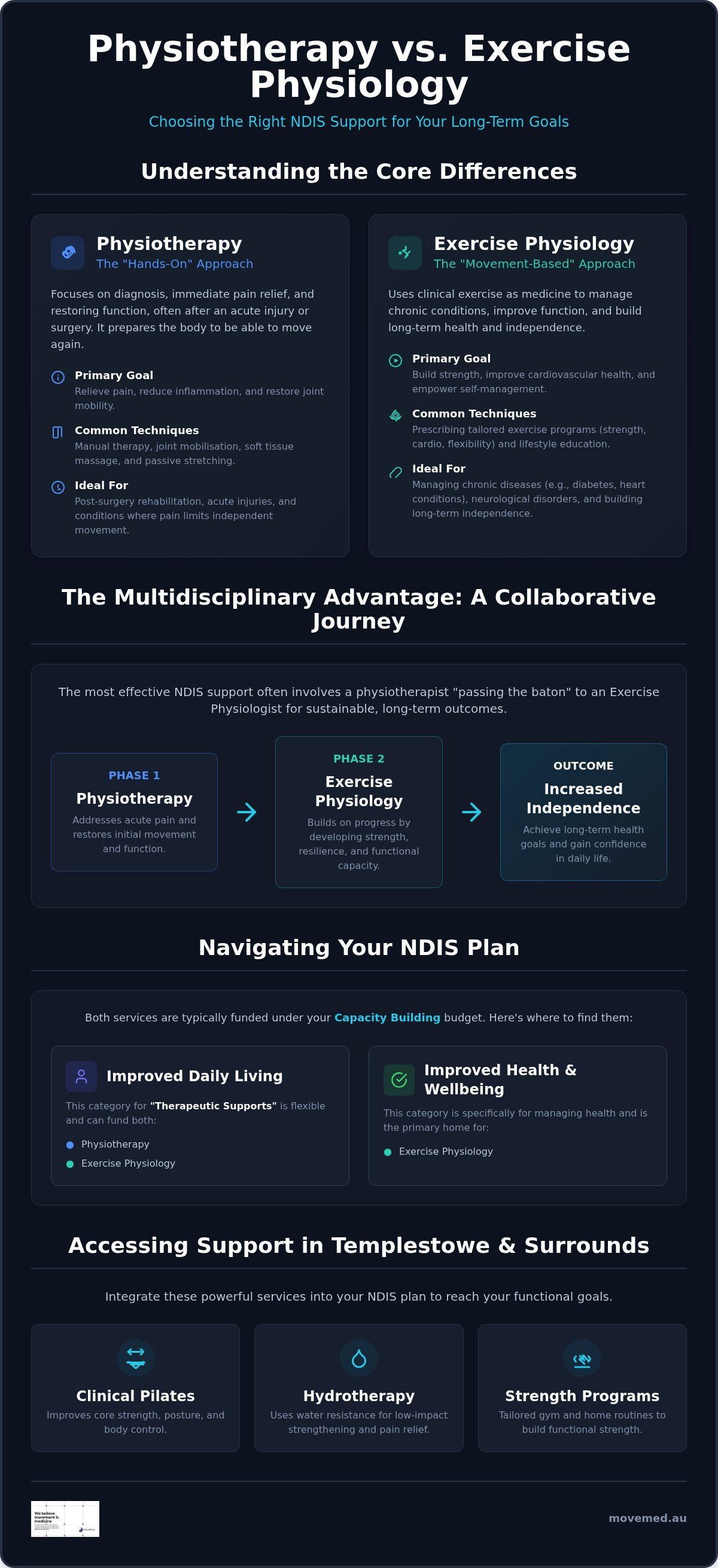
The Multidisciplinary Advantage: Why EPs and Physios Work Best Together
This teamwork is particularly effective for complex conditions. For example, managing Autism-related low muscle tone requires a sensitive, team-based approach. While a physio might assess structural alignment, an EP focuses on functional strength through sensory-aware movement. Individuals accessing ndis autism supports often find that the EP's environment is less clinical and more empowering. Regular communication between your providers ensures that the exercise programme respects your sensory needs while still driving physical progress. It's about creating a safe, predictable space where you can push your physical boundaries without feeling overwhelmed.
Maximising Your Plan Value
Strategically splitting your budget between these two services is the best way to ensure your NDIS funding lasts the full year. You might use your "Improved Daily Living" budget for a block of physiotherapy to manage a specific flare-up, while using your "Improved Health and Wellbeing" funds for weekly Exercise Physiology sessions. Avoiding "doubling up" on identical goals is vital for your plan's longevity. If one provider is already working on your walking gait, the other should focus on a different functional outcome, like upper body strength or cardiovascular health. At MoveMed, we specialise in the EP side of the equation. We don't try to replace your physio; we complement their work by focusing on the long-term recovery and systemic health they've prepared your body for. If you already have a trusted physio, we can work together to bridge the gap between pain relief and long-term physical power.
Accessing NDIS Exercise Physiology in Templestowe and Surrounds
Deciding on exercise physiology vs physiotherapy ndis support is easier when you have a local team to guide you through the transition from acute care to long-term health. At MoveMed, we don't operate like a standard commercial gym. Our clinical gym in Templestowe Lower is specifically designed for rehabilitation and disability support, providing a calm, focused environment that avoids the noise and crowds of traditional fitness centres. We understand that for many Manningham residents, including those in Doncaster East and surrounding suburbs, having a specialist facility close to home is the key to maintaining a consistent therapy schedule.
Our Accredited Exercise Physiologists (AEPs) use clinical-grade equipment that is adaptable for various mobility levels. Unlike a public gym where you might feel like just another member, our clinic treats you as a partner in a health journey. We focus on the underlying causes of your physical challenges, ensuring that every session is a purposeful step toward the goals outlined in your NDIS plan. Whether you are managing a neurological condition or recovering from a long-term illness, our space is built to empower your progress.
Specialist Services: Hydrotherapy and Clinical Pilates
For participants dealing with high pain levels or significant weight-bearing restrictions, hydrotherapy is often a game-changer. The buoyancy of warm water reduces the stress on your joints, allowing you to perform movements that might be too painful on land. This water-based recovery is led by our AEPs to ensure every exercise is safe and clinically targeted. Additionally, ndis clinical pilates Templestowe offers a sophisticated way to build core stability and postural control. By using specialised reformers and equipment, we can isolate specific muscle groups to improve your functional strength without overstraining your body.
Next Steps for Manningham NDIS Participants
Starting your journey with us is a straightforward, supportive process. We begin with a comprehensive functional capacity assessment. During this initial session, we'll sit with you to discuss your medical history, review your NDIS goals, and understand what independence looks like for you. It's helpful to bring your current plan details and any relevant reports from your doctor or specialist. We'll then create a tailored roadmap that shows exactly how movement therapy will help you reach your milestones. If you're ready to move away from temporary fixes and toward lasting health, Book your NDIS Exercise Physiology consultation at MoveMed today. We are here to handle the clinical complexities so you can focus on reclaiming your confidence and movement.
Moving Toward Your Long-Term Independence
Choosing the right physical support shouldn't be a source of stress. By understanding the clinical nuances of exercise physiology vs physiotherapy ndis funding, you can ensure your plan supports both immediate pain relief and your future strength. Whether you need the hands-on care of a physio or the clinical movement prescription of an AEP, the goal is always your long-term independence. At MoveMed, our Accredited Exercise Physiologists are trusted by local Manningham families and Support Coordinators to provide expert, evidence-based guidance. With our specialised Clinical Pilates and hydrotherapy facilities in Templestowe, we help you bridge the gap between simply managing a condition and truly thriving in your community. It's about reclaiming your agency and moving with confidence again. Your journey to better health is a partnership; we're ready to walk it with you. Ready to reach your NDIS goals? Book a consultation with a MoveMed Exercise Physiologist today. We look forward to helping you build the resilience and mobility you deserve.
Frequently Asked Questions
Can I see both a physio and an exercise physiologist under my NDIS plan?
Yes, you can. Many participants use both as part of a multidisciplinary team. A physio often manages acute pain or joint mobilisation, while an EP focuses on functional strength. Understanding the balance of exercise physiology vs physiotherapy ndis support is key to a holistic recovery. We often communicate with local Manningham physios to coordinate your care and ensure your recovery is seamless. This teamwork ensures all aspects of your physical health are addressed.
Do I need a GP referral to see an NDIS exercise physiologist at MoveMed?
No, you don't need a GP referral to access our services as an NDIS participant. You can contact us directly to organise an initial assessment. However, having a summary of your medical history or a letter from your specialist can be very helpful. This information allows our AEPs to design a safer and more effective programme that aligns with your specific clinical needs and the functional goals outlined in your NDIS plan.
Which NDIS funding category covers Exercise Physiology sessions?
Exercise Physiology is primarily funded under the Capacity Building category. Specifically, you'll find it within Improved Health and Wellbeing or Improved Daily Living. When comparing exercise physiology vs physiotherapy ndis allocations, physio is also usually under Improved Daily Living. Check your plan for these specific line items, or speak with your Support Coordinator to see how your budget is currently structured for the 2026 financial year. This ensures you use the correct funding.
Is Exercise Physiology better than Physiotherapy for chronic pain?
It's not necessarily better, but the approach is different. Physiotherapy often uses manual therapy to settle flare-ups. Exercise Physiology focuses on active movement to change how your nervous system processes pain signals. For chronic conditions, building systemic strength and endurance is often the key to long-term relief. Many of our Templestowe clients find that a movement-based approach helps them reclaim their independence more effectively than relying solely on passive treatments for their pain.
How does an Exercise Physiologist help with NDIS plan reviews?
We provide detailed progress reports that track your functional outcomes against your stated goals. Our AEPs use objective data, such as improvements in strength, balance, or walking distance, to show the NDIA exactly how your funding is making a difference. These reports are vital for justifying continued support during your plan review. We make sure the language used aligns with NDIS requirements to help the process run smoothly for you and your family.
Can Exercise Physiology help with neurological conditions like MS or Parkinson’s?
Absolutely. We specialise in clinical exercise prescription for neurological conditions. For MS or Parkinson's, we focus on neuroplasticity, balance, and maintaining muscle mass to manage symptoms like tremors or fatigue. Our sessions are led by Accredited Exercise Physiologists who understand the unique challenges of these conditions. We use evidence-based movement to help you maintain your function and slow the progression of physical limitations in a safe, controlled environment at our Templestowe centre.
Does MoveMed provide mobile NDIS services in Doncaster or Bulleen?
While we primarily see participants at our Templestowe Lower clinic to utilise our specialised equipment, we encourage you to contact our team to discuss specific home-based requirements in surrounding Manningham suburbs like Doncaster or Bulleen. Home visits can be beneficial for practicing daily tasks in your own environment. We can review your NDIS budget to see if travel and community-based sessions are a feasible option for your current plan and individual mobility needs.
What is the difference between an Exercise Physiologist and a Personal Trainer?
The difference lies in university education and clinical expertise. An Accredited Exercise Physiologist (AEP) completes a four-year university degree and is a recognised allied health professional. Unlike a personal trainer, an AEP is trained to prescribe exercise for people with complex medical conditions and disabilities. They understand the clinical implications of your diagnosis, ensuring your programme is safe, effective, and compliant with NDIS quality and safety standards for the best possible long-term outcomes.


