
You're halfway down a flight of stairs or a steep walking track when it hits: a sharp, biting sensation right in the crease behind your knee that makes you hesitate before the next step. It's incredibly frustrating when the muscle back knee area feels tight or "locked," especially when it stops you from enjoying a simple morning stroll around Doncaster or Templestowe. You might feel like your joint is physically stuck; perhaps you're even struggling to fully straighten your leg without a wince. It's an unsettling feeling that often leads to worry about long-term damage or the potential need for surgery.
The good news is that this discomfort usually stems from the popliteus, a small but essential muscle that acts as the "key" to unlocking your knee joint. In this guide, you'll discover why this specific muscle is so vital for your mobility and how clinical exercise can help you reclaim your stride without relying on heavy medication. We'll break down the anatomy of the posterior knee, explain why certain movements trigger your pain, and outline a clear, movement-based path to recovery that gets you back to the sports and walks you love.
Key Takeaways
- Identify the popliteus as the essential "key" that unlocks your joint to allow for comfortable bending and straightening.
- Learn why sharp pain in the muscle back knee region often results from downhill walking or sudden pivoting rather than simple wear and tear.
- Understand why clinical exercise and "Optimal Loading" provide a faster, more sustainable recovery path than traditional total rest.
- Discover how hydrotherapy and Clinical Pilates can strengthen your knee without the high-impact stress of traditional gym workouts.
- See how working with an Accredited Exercise Physiologist can help you navigate recovery through funded schemes like the NDIS, TAC, or WorkCover.
What is the Muscle at the Back of the Knee? (The Popliteus Explained)
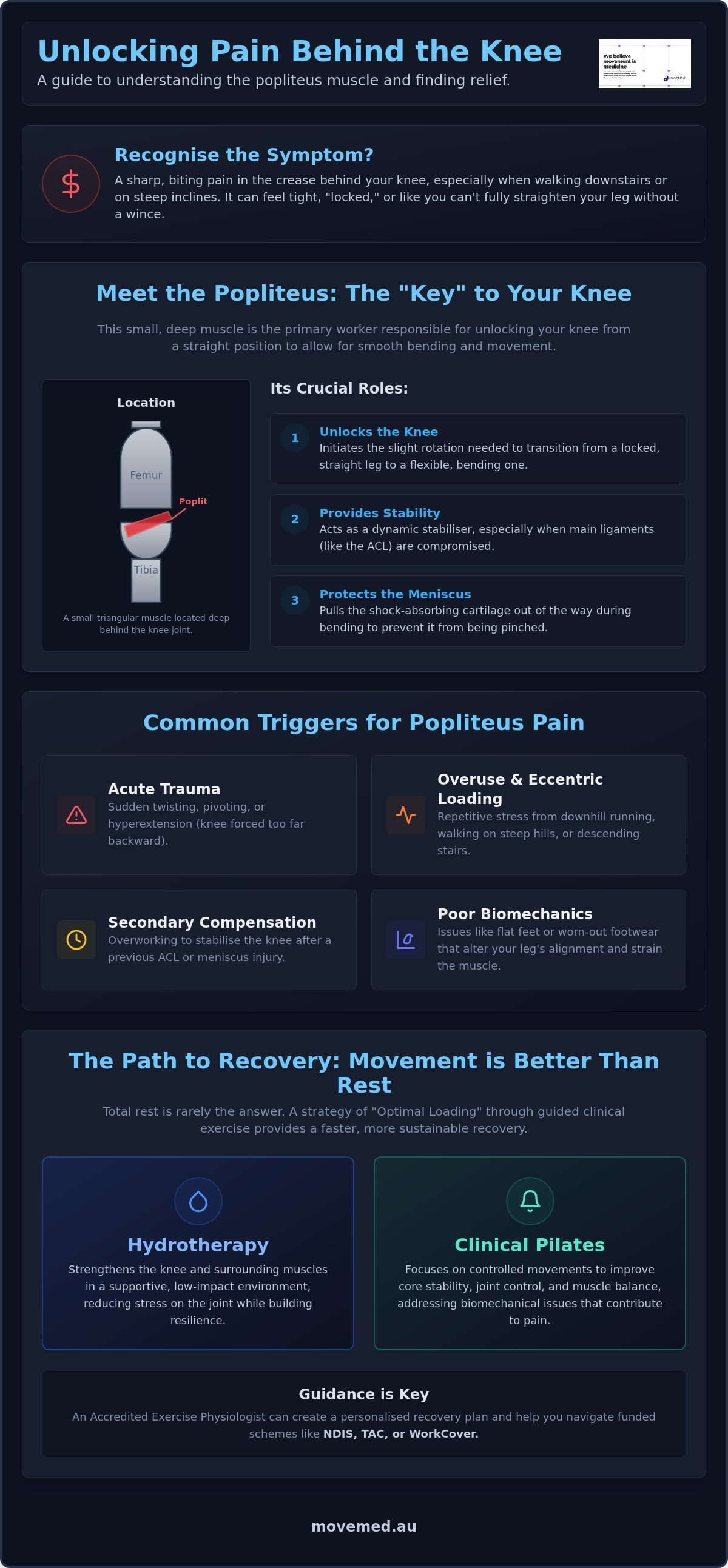
The popliteus is a small, triangular muscle located deep in the posterior knee (the back of the joint). While it doesn't have the fame of the hamstrings or the quadriceps, it's arguably one of the most hardworking structures in your lower limb. The popliteus is the primary internal rotator of the tibia on the femur during the start of knee flexion. In simpler terms, it's the muscle that gets the bending movement started. Tucked away behind the larger superficial structures, it acts as a quiet guardian for your joint's overall health.
Clinicians often call it the "key" to the knee. Why? Because when you stand with your legs straight, your knee joint "locks" into place to provide a stable, energy-efficient base. To take a step or sit down, that lock must be released. The popliteus performs this essential task, initiating the slight rotation needed to transition from a rigid, straight leg to a flexible, bending one. Without this tiny muscle, back knee function would feel clunky, restricted, or even physically stuck.
Unlike the larger hamstrings, which are designed for power and propulsion, the popliteus provides critical joint stability and protects the meniscus from being pinched. It acts as a dynamic stabiliser, pulling the lateral meniscus (the shock-absorbing cartilage on the outer side) out of the way as the knee bends. This clever mechanism prevents the cartilage from being trapped between the bones, which is a common cause of sharp, sudden pain during deep squats or lunges.
The Crucial Role of the Popliteus in Daily Movement
Think about your typical day. Whether you're navigating the different levels of the Doncaster Shopping Centre or enjoying a weekend hike along the local Yarra trails, your popliteus is working overtime. It helps you "unlock" your knee every time you transition from standing still to taking a stride. Its most demanding job occurs during "eccentric" loading; this is when the muscle lengthens under tension, such as when you're walking down a steep hill or descending stairs. This is often why the muscle back knee area feels most vulnerable or sore during these specific activities.
Is it a Muscle Strain or Something Else?
Because it's tucked away so deeply, popliteus pain is frequently misidentified. It often mimics the symptoms of a hamstring or calf strain, leading many people to stretch the wrong area without finding any real relief. It's also important to distinguish this from a Baker’s cyst, which involves swelling and fluid accumulation in a small sac behind the knee. While a cyst usually feels like a dull, full pressure, a popliteus issue is typically sharper and more movement-dependent. There's also a strong connection between popliteus discomfort and common ligament injuries, such as tears to the ACL or PCL. If the main ligaments are compromised, the popliteus often tries to compensate, leading to secondary soreness and fatigue.
Common Causes of Discomfort and Soreness in the Back of the Knee
Understanding why the muscle back knee area starts to ache is the first step towards reclaiming your mobility. While the popliteus is small, it's incredibly sensitive to changes in how you move. Pain in this region typically doesn't happen in isolation. It's often the result of specific physical stresses or the body's attempt to protect itself from a different injury. Common triggers include:
- Acute trauma: This occurs during sudden twisting or pivoting. Hyperextension, which is when the knee is forced too far backward, is a primary culprit for sudden popliteus strains.
- Overuse: Repetitive stress from walking on the uneven footpaths or steep hills around Templestowe Lower can strain the muscle over time.
- Secondary compensation: If you've had a previous ACL or meniscus tear, the popliteus often works double time to provide the stability those structures can no longer offer.
- Poor biomechanics: Issues like flat feet or worn-out footwear change the angle of your leg. This forces this tiny muscle to shoulder more weight than it was designed for.
If you're unsure which of these factors is causing your stiffness, our team can help you identify the root cause during a clinical assessment.
The Downhill Running Connection
The popliteus acts as a vital "brake" for your leg. When you descend a hill or a flight of stairs, the muscle undergoes eccentric loading. This means the muscle is trying to control your movement while it's being stretched out. If you're frequently hiking local trails or running downhill, the repetitive strain can lead to popliteus tendinopathy, which is a form of chronic irritation. You'll know it's an overuse issue if the pain in your muscle back knee builds gradually during your walk rather than hitting you all at once like a sudden sprain.
Knee Osteoarthritis and the Popliteus
Knee osteoarthritis (OA) doesn't just affect the bone and cartilage; it changes the entire environment of the joint. As the alignment of the knee shifts due to OA, the surrounding muscles often become tight as they try to protect the joint. This is a common reason why people with "bone-on-bone" sensations also feel significant tightness in the back of the knee. Managing this requires more than just rest. It requires a structured approach to strengthening. We often recommend a targeted knee OA management programme like GLA:D® to help stabilise the joint. By strengthening the muscles around the knee, you give the popliteus the support it needs to function without constant soreness.
Recovery Strategies: Why Movement Beats Total Rest for Knee Pain
When your knee hurts, your first instinct is often to stop moving entirely. For decades, the "RICE" method (Rest, Ice, Compression, Elevation) was the standard advice for almost any soft tissue injury. However, modern clinical research has shifted. While rest might calm initial inflammation, it does very little to actually repair the muscle or tendon. In fact, prolonged rest can lead to muscle weakness and joint stiffness, making your eventual return to walking even more difficult. Your body needs a signal to heal, and that signal comes through movement.
This is why we focus on the concept of "Optimal Loading." Instead of avoiding activity, we use specific, clinical exercises to stimulate tissue repair. For a strained popliteus, this means applying just enough physical stress to the muscle to encourage the fibres to realign and strengthen without causing further damage. An Accredited Exercise Physiologist (AEP) acts as your partner in this journey, creating a tailored programme that re-trains the muscle back knee area to handle weight and rotation again safely.
If you rely solely on rest, you risk developing "compensatory movements." This happens when your body subconsciously changes how you walk or stand to protect the sore area. You might start overusing your hip flexors or shifting your weight to the opposite leg. Over time, this "protection" can lead to secondary pain in your hips or lower back. By choosing a movement-based recovery, you address the root cause before it creates a ripple effect of discomfort through the rest of your body.
Gradual Loading and Strengthening
Recovery usually begins with isometric holds. These involve activating the muscle without actually moving the joint, which is a highly effective way to reduce pain and build initial confidence. As you improve, we progress to eccentric exercises. These focus on the lengthening phase of the movement, which directly improves the "braking" capacity your knee needs for descending stairs or hills. "The goal of rehabilitation is not just to stop the pain, but to build a knee resilient enough to handle your favourite Melbourne walking tracks." This level of resilience is equally vital for those returning to high-impact sports like martial arts at UMF Academy; you can find out more about their Muay Thai grading system to see how they manage safe progression through different intensity levels.
While strength is vital, we must also address the surrounding structures. Chronic tightness in your calves and hamstrings can create a constant tugging sensation on the posterior knee, forcing the popliteus to work harder than it should. Gentle mobility drills help restore the natural "unlocking" rotation of the joint. Be cautious with self-prescribed stretching, though; if you stretch a strained popliteus too aggressively, you can actually aggravate the injury. A guided approach ensures you are lengthening the right tissues at the right time.
Clinical Modalities for Knee Rehabilitation: Hydrotherapy and Pilates
Recovery is rarely a straight line, and when you're dealing with a sensitive area like the muscle back knee region, the right environment makes all the difference. While traditional gym exercises are a vital part of the later stages of rehab, we often start with specialised modalities that allow for movement without the heavy burden of gravity. By using tools like hydrotherapy and reformer-based exercise, we can begin the "Optimal Loading" process even when the joint feels too irritable for a standard walk or squat.
Hydrotherapy: Low-Impact Recovery
Hydrotherapy is often the first step for clients who find that walking or standing for long periods triggers that "locked" sensation behind the knee. The warmth of the water is more than just a comfort; it helps to relax "muscle guarding," which is when your body keeps the popliteus and hamstrings tight to protect the joint. Within the water, buoyancy reduces the stress on your knee, allowing you to work through a full range of motion that might be too painful on land. We use the water's natural resistance to gently strengthen the rotators of the knee, helping the popliteus regain its "unlocking" function in a safe, controlled environment. You can read more about how we use water-based movement in our Hydrotherapy guide.
Clinical Reformer Pilates for Knee Stability
Once you are ready for land-based work, Clinical Pilates offers a level of precision that general fitness classes cannot match. It's important to distinguish between "gym pilates" and Clinical Reformer Pilates in Templestowe led by an Accredited Exercise Physiologist. In a clinical setting, your programme is designed specifically for your injury. We use the reformer’s springs to provide either assistance or resistance, which is perfect for re-training the muscle back knee area without excessive sheer force. This modality focuses heavily on foot and ankle alignment to ensure your knee "tracks" correctly during every movement. By improving your core and hip stability, we reduce the overall load your posterior knee has to manage, making your daily movements feel lighter and more supported.
A multi-modal approach that combines water-based therapy with reformer work often leads to the fastest and most sustainable recovery. It allows us to address your pain from multiple angles, ensuring your joint is stable, your muscles are resilient, and your movement patterns are efficient. If you're ready to move beyond managing pain and start your journey toward long-term knee health, you can book a consultation with our clinical team today.
Personalised Knee Recovery at MoveMed Templestowe Lower
At MoveMed, we understand that pain behind the joint is more than just a clinical symptom. It's the hesitation you feel before stepping off a kerb and the frustration of missing out on your weekend routine. Our Accredited Exercise Physiologists (AEPs) serve as your expert guides, moving beyond surface-level fixes to find exactly why your muscle back knee area is causing grief. We don't just look at the knee in isolation. We assess how your entire body moves, from the way your foot strikes the pavement to how your hips support your weight during a stride.
Your journey begins with a comprehensive clinical consultation. We'll sit with you to discuss your history, perform specific movement tests, and create a roadmap that fits your lifestyle. This isn't a generic gym programme. It's a precise, evidence-based plan designed to restore the "unlocking" function of your popliteus and build long-term resilience. We're here to handle the complicated side of rehab, allowing you to focus entirely on your progress and reclaiming your independence. To better understand the typical investment for specialised support, you may explore per-session clinical treatment fees at Therapeutic Streams Sport Rehab as a benchmark for professional integrated care.
Navigating the healthcare system can feel intimidating, but you don't have to do it alone. We have extensive experience working within various Australian funding schemes to ensure high-quality care is accessible to our local community. Whether you're a veteran looking for DVA funded exercise physiology or an NDIS participant seeking improved health and independence, we tailor our approach to meet the specific requirements of your plan. For those recovering from workplace or road accidents, we also partner with TAC and WorkCover clients, providing the structured rehabilitation needed to return to work or sport safely and confidently.
Book Your Assessment at MoveMed
Our clinic is a dedicated space for recovery, serving residents across Bulleen, Doncaster, Warrandyte, and the surrounding suburbs. We've built our reputation on being a trusted local ally rather than a corporate health chain. Our AEP-led approach differs from a standard gym because every movement is prescribed with clinical intent. We're committed to helping you understand your body, so you leave each session feeling empowered rather than just "managed." If you're ready to stop worrying about that muscle back knee pain and start moving with confidence again, it's time to take the first step. Partner with MoveMed to reclaim your movement today.
Step Forward with Confidence in Your Recovery
Understanding that the small muscle back knee area is actually the "key" to your mobility is the first step toward reclaiming your active lifestyle. While the stiffness and sharp pain of a popliteus injury can feel overwhelming, it is a condition that responds exceptionally well to the right movement-based approach. By moving away from total rest and embracing optimal loading, you give your joint the signal it needs to repair and strengthen for the long term.
Our Accredited Exercise Physiologists are here to partner with you, offering expert-led Clinical Reformer Pilates and Hydrotherapy to support your journey. As a registered provider for NDIS, DVA, TAC, and WorkCover, we handle the clinical complexities so you can focus on your progress. You don't have to navigate this journey alone; we are here to ensure you return to the stairs, hills, and trails of Melbourne's east with total confidence. Book your initial Exercise Physiology consultation at MoveMed Templestowe Lower today and let's get you moving again.
Frequently Asked Questions
Is pain behind the knee serious?
While most pain in the muscle back knee area isn't a medical emergency, it shouldn't be ignored. If you experience sudden swelling, an inability to bear weight, or a "locked" sensation that prevents you from moving your leg, a clinical assessment is essential. These symptoms often point to a mechanical issue like a popliteus strain or meniscus involvement. Early intervention prevents compensatory patterns from affecting your hips and back.
Can I walk with a popliteus strain?
You can usually continue walking with a mild popliteus strain, provided you listen to your body's signals. It's often best to stick to flat, even surfaces while the muscle is sensitive. Avoid steep descents or uneven trails around Templestowe for the first few days. If walking causes sharp, biting pain, it's a sign that the load is too high. Our Exercise Physiologists can help you find your "optimal load" for a safe return.
How long does a muscle in the back of the knee take to heal?
A standard popliteus strain typically takes between four to eight weeks to heal fully. This timeline depends on the severity of the initial injury and how consistently you follow a structured loading programme. While the initial sharp pain might fade within a fortnight, the tissue needs more time to regain its full "braking" strength. Skipping the final stages of rehab often leads to the injury recurring during your next hike or run.
Does NDIS cover exercise physiology for knee problems?
Yes, the NDIS covers Exercise Physiology when it's deemed reasonable and necessary to help you achieve your goals. This usually falls under the "Improved Health and Wellbeing" or "Improved Daily Living" categories of your plan. For participants with chronic knee issues, working with an AEP focuses on improving mobility, reducing falls risk, and increasing independence. We handle the necessary reporting and paperwork to ensure your therapy aligns with your NDIS budget.
What is the difference between a popliteus strain and a Baker’s cyst?
A popliteus strain is a mechanical injury to the muscle or tendon, usually causing sharp pain during specific movements like walking downhill. In contrast, a Baker’s cyst is a fluid-filled sac that forms due to joint inflammation. A cyst often feels like a dull, constant pressure or "fullness" behind the knee, making it difficult to fully bend the joint. While they can occur together, the treatment for each condition is quite different.
Should I use heat or ice for pain behind the knee?
We generally recommend ice for the first 48 hours following an acute injury to help manage swelling and numb sharp pain. Once the initial "angry" phase has passed, heat is often more beneficial for relaxing the muscle back knee area. Applying heat can help ease the "muscle guarding" or protective tightness that often develops in the hamstrings and popliteus. This warmth makes it easier to begin gentle mobility exercises and restore your range of motion.
Can Clinical Pilates help with chronic knee pain?
Clinical Pilates is highly effective for chronic knee pain because it focuses on the underlying biomechanics of the joint. Unlike general fitness classes, our AEP-led sessions use the reformer to improve how your knee "tracks" during movement. This targeted approach strengthens the stabilising muscles around the joint, which reduces the sheer force on your cartilage and tendons. It's a low-impact way to build the resilience needed for daily activities and long-term joint health.
Do I need a GP referral to see an Exercise Physiologist at MoveMed?
You don't need a GP referral to see us as a private client. You can simply book an appointment and we'll begin your assessment. However, a referral is required if you are seeking treatment through specific funded schemes. This includes DVA, WorkCover, TAC, or if you are accessing Medicare rebates through a Chronic Disease Management plan. If you're unsure which pathway applies to you, our team can guide you through the process during your first call.


