
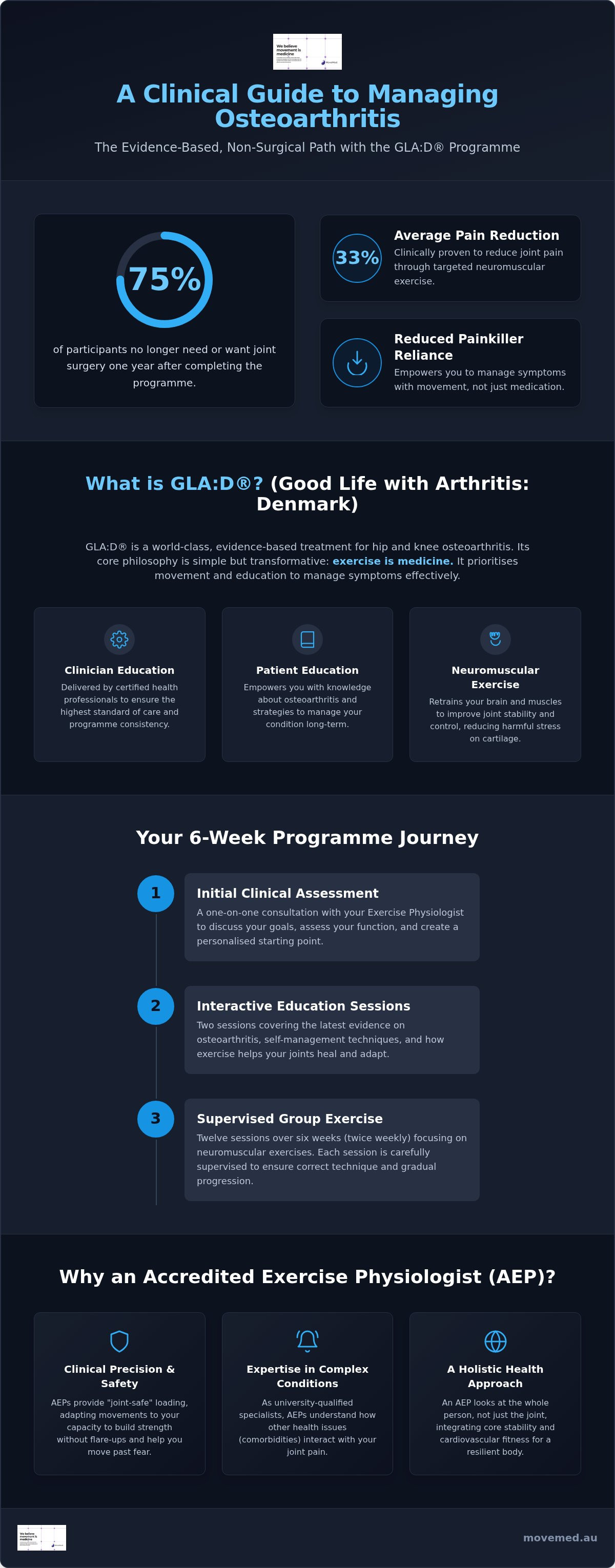
Did you know that 75% of people who complete the GLA:D® program find they no longer need or want joint surgery a year after finishing? It's exhausting to live with the constant ache of hip or knee osteoarthritis, especially when it stops you from enjoying your garden or walking through the local park. You might feel like a joint replacement is your only remaining option, or perhaps you're worried that movement will only make "bone-on-bone" pain worse. Working with a gla d program exercise physiologist allows you to move safely, addressing these fears with clinical expertise tailored to your specific needs.
The good news is that movement, when prescribed correctly, is the most powerful tool for joint health. This evidence-based approach has been shown to reduce pain by an average of 33% and significantly cut reliance on painkillers. By retraining how your brain and muscles support your joints, you can reclaim your confidence and move with less fear. In this clinical guide, we'll explain how the program works and how you can build a clear, non-surgical plan to regain your independence and get back to the activities you love.
Key Takeaways
- Learn why the evidence-based GLA:D® program is considered the international gold standard for managing hip and knee osteoarthritis without immediate surgery.
- Discover how a gla d program exercise physiologist uses neuromuscular retraining to reduce joint pain and improve your confidence in daily movement.
- Understand the clinical evidence showing that targeted exercise can help you avoid or delay joint replacement while reducing reliance on painkillers.
- Get a clear breakdown of the 6-week program structure, from the initial clinical assessment to interactive education and supervised group sessions.
- Find out how our Templestowe Lower centre supports your journey through a personalised approach that can integrate hydrotherapy or clinical pilates.
What Is the GLA:D® Program and How Does It Work?
GLA:D® stands for Good Life with Arthritis: Denmark. It's a world-class, evidence-based treatment specifically for people living with hip and knee Osteoarthritis. The core philosophy is simple but transformative: exercise is medicine. Instead of viewing surgery as the first port of call, this approach prioritises movement and education as the primary way to manage symptoms. To ensure every participant gets the best results, the program is built on three mandatory pillars: clinician education, patient education, and neuromuscular exercise. By keeping the program standardised across Australia, we ensure that the clinical outcomes remain high no matter where you start your journey.
The Science of Neuromuscular Exercise
Many people think "exercise" just means getting stronger at the gym. While strength is important, the GLA:D® approach focuses on neuromuscular exercise, which is about joint control and stability. It's essentially a way of retraining your brain to align your joints correctly during everyday tasks. When you work with a gla d program exercise physiologist, you're learning how to move in a way that reduces the mechanical stress on your cartilage. This data-driven approach is backed by the GLA:D® Australia registry, which tracks long-term patient success to prove that these movements actually change lives. It's not about lifting the heaviest weight; it's about moving with better quality and control.
Who Is the Program Designed For?
Is this for you? If you experience persistent joint pain, morning stiffness, or find your mobility is starting to slip, the answer is likely yes. One of the most empowering aspects of this program is that you don't need a formal X-ray or "bone-on-bone" diagnosis to begin. Clinical guidelines suggest that if your symptoms align with osteoarthritis, you can start your recovery immediately. This applies to everyone, from younger individuals with early-onset symptoms to seniors looking to stay active in their retirement. Partnering with a gla d program exercise physiologist ensures that whether you're 45 or 85, the movements are adapted to your current level of function and your personal goals.
Why Choose an Exercise Physiologist for Your GLA:D® Journey?
While the program's structure is standardised, the clinical expertise of the person leading it makes a significant difference to your recovery. Accredited Exercise Physiologists (AEPs) are university-qualified allied health professionals who specialise in clinical exercise prescription for complex conditions. Choosing a gla d program exercise physiologist means you're working with an expert who understands how chronic disease and other health issues, known as comorbidities, might interact with your joint pain. They don't simply hand you a list of movements; they adapt the GLA:D Australia protocol to your specific pain levels and physical capacity on any given day.
Clinical Precision in Movement
Beyond the Knee: A Holistic Health Approach
Osteoarthritis rarely exists in a vacuum. You might also be managing high blood pressure, balance issues, or a decline in general cardiovascular fitness. An AEP looks at the whole person rather than just the isolated joint. They often collaborate with your GP to ensure your exercise plan aligns with your broader medical history and health goals. For many of our clients, this journey involves integrating clinical reformer pilates to build the core stability and pelvic control that supports the lower limbs. This holistic focus ensures you aren't just treating a knee; you're building a more resilient and capable body. If you're looking for a partner in your recovery, our team can help you navigate the right path for your specific needs.
GLA:D® vs. Surgery: Understanding Your Treatment Options
Facing the prospect of a joint replacement is a significant moment. It's natural to feel that once your joints are described as "bone-on-bone," surgery is the only path left. However, current Australian clinical guidelines recommend that every patient should have access to high-quality education and exercise before considering a total joint replacement. While surgery can be life-changing for some, it isn't always the first or best answer. When you work with a gla d program exercise physiologist, you're exploring a path that prioritises your body's natural ability to adapt and strengthen.
The difference in recovery timelines is striking. A standard GLA:D® journey involves 6 weeks of structured education and exercise. In contrast, post-surgical rehabilitation often stretches over many months and involves significant downtime. Even if you eventually decide that surgery is necessary, the program serves as excellent "pre-hab." By strengthening the muscles around the joint now, you make your future post-operative recovery much faster and less complicated. It's about building a foundation of resilience, regardless of the eventual outcome.
What the Research Tells Us
The data supporting this non-surgical approach is compelling. Participants in the program experience an average pain reduction of 33%, which often leads to a 47% decrease in the use of pain relief medication. These aren't just numbers; they represent people who can finally walk to the shops without reaching for a pill. Research also shows that 75% of participants either avoided or were no longer interested in surgery 12 months after completing the program. Choosing active management over a "wait and see" approach prevents the muscle wasting and loss of confidence that often make osteoarthritis symptoms feel worse over time. This shift towards proactive wellness is mirrored globally, with an increasing number of professionals seeking out health coach training UK to better support patients through long-term lifestyle changes.
Cost and Accessibility Considerations
Conservative management is also a pragmatic financial choice. The costs associated with surgical gaps, hospital stays, and extensive time off work can be substantial. In contrast, access to a gla d program exercise physiologist is often supported by various funding streams. Many participants utilise Medicare Chronic Disease Management plans, which provide subsidised sessions for those with a GP referral. For those with long-term disability needs, NDIS exercise physiology funding can often be used to support your participation, ensuring that high-quality care remains accessible and affordable.
What to Expect: The 6-Week GLA:D® Program Structure
The GLA:D® journey is a structured roadmap designed to take you from pain-filled uncertainty to confident movement. This isn't a "one-and-done" appointment; it's a comprehensive six-week commitment to your joint health. Every step is overseen by a gla d program exercise physiologist, ensuring your progress is safe, measurable, and sustainable. By following a clear, evidence-based timeline, we remove the guesswork from your recovery and replace it with clinical certainty.
The process follows four clear stages:
- Step 1: Initial Clinical Assessment. We begin by measuring your baseline function, strength, and pain levels. This data serves as our starting point and allows us to tailor the exercises to your current capacity.
- Step 2: Interactive Education. You'll attend two dedicated sessions to understand the pathology of osteoarthritis and learn the latest evidence-based strategies for self-management.
- Step 3: Neuromuscular Exercise. This is the core of the program: twelve supervised group sessions held twice weekly over six weeks.
- Step 4: Three-Month Follow-Up. We reconvene to track your progress, re-test your physical function, and plan your long-term maintenance strategy.
Inside a GLA:D® Exercise Session
Sessions at our Templestowe Lower clinic are far from your typical gym class. We use a circuit-style setup that focuses specifically on the alignment of your core, hips, knees, and feet. Because the groups are kept small, your gla d program exercise physiologist can provide individualised feedback on every repetition, ensuring you're loading your joints safely. You'll find that the social support from others on a similar journey is just as valuable as the physical work. For your first session, simply wear comfortable clothing you can move in, supportive closed-toe shoes, and bring a water bottle and a small towel.
Learning to Self-Manage
The education component is the secret to the program's long-term success. Understanding why your joints ache helps remove the fear that often stops people from moving. We provide practical tips for managing "flares" (temporary increases in pain) at home, so you don't panic when symptoms fluctuate. This might include adjusting your activity levels or using specific recovery techniques. The ultimate goal is to help you develop a lifelong habit of movement that lasts well beyond the initial six weeks. By the end of the program, you'll have the tools to be the expert in your own joint health. If you're ready to take the first step, you can book your initial assessment at MoveMed to begin your journey.
Enrolling in GLA:D® at MoveMed Templestowe
Choosing where to begin your recovery is a personal decision. At MoveMed, our Templestowe Lower clinic is designed to be a sanctuary for those who might feel intimidated by traditional gym environments. We understand that walking through the door while in chronic pain takes courage. That's why our gla d program exercise physiologist focuses on creating a warm, community-focused space where every fitness level is welcomed and respected. You aren't just another number here; you're a member of a local community working together to reclaim their independence.
We often find that a multi-layered approach works best for complex joint issues. For participants who find weight-bearing exercise particularly challenging at the start, we can integrate your program with hydrotherapy. This water-based therapy allows you to build initial confidence and movement range in a buoyant environment before transitioning fully to the clinical circuit. This flexibility ensures that your journey is always paced to your comfort levels, never pushing you beyond what your joints can handle.
Accessing high-quality care should be straightforward. If you're a private client, no GP referral is necessary to get started. However, we work closely with local doctors and welcome referrals for Medicare Chronic Disease Management plans, which can help subsidise your sessions. We also take great pride in providing DVA funded exercise physiology for our local veteran community, ensuring those who served have access to the best evidence-based osteoarthritis care available.
Local Manningham Referral Pathways
We've built strong partnerships with GPs across Doncaster, Templestowe, and Bulleen to ensure your care is coordinated and seamless. If you currently receive a Home Care Package (Aged Care funding), you may be able to use these funds to cover your enrolment. When you call to book your initial assessment, simply mention your funding type so our team can handle the necessary paperwork for you. We aim to make the administrative side of health as stress-free as the physical side.
Your Journey to Better Mobility Starts Here
The MoveMed promise is to provide personalised care that treats the root cause of your pain rather than just masking the symptoms. Our centre on Hender St offers easy on-site parking and full accessibility features, making it easy to visit even on days when your mobility feels limited. This is your invitation to stop managing your pain and start changing it. Reclaiming your weekend gardening, walking the dog through Westerfolds Park, or simply moving without fear is within reach. Working with a gla d program exercise physiologist is the first step toward that future.
Reclaiming Your Active Lifestyle in Templestowe
Living with osteoarthritis doesn't have to mean a slow withdrawal from the activities you love. By choosing an evidence-based pathway, you're investing in your long-term mobility and resilience. You've discovered how the GLA:D® program uses neuromuscular retraining to reduce pain and why a gla d program exercise physiologist is the ideal partner to guide your progress. Whether your goal is to walk through Westerfolds Park without discomfort or to avoid the long road of surgical recovery, this program provides a clinically proven alternative.
Our Accredited Exercise Physiologists at MoveMed are dedicated to providing high-quality, evidence-based management within a supportive community setting. We take the time to understand your unique journey and adapt every movement to your specific needs. You don't have to navigate chronic joint pain alone.
Book your GLA:D® initial assessment at MoveMed Templestowe today and take the first step toward a more confident, pain-free future. We look forward to helping you reclaim your independence and move with ease once again.
Frequently Asked Questions
Do I need a GP referral to join the GLA:D program at MoveMed?
No, you don't need a formal referral to start the program as a private client. However, many people visit their GP first to obtain a Chronic Disease Management plan. This plan allows you to access Medicare rebates for your sessions with a gla d program exercise physiologist. We also accept referrals for DVA, NDIS, and WorkCover, so it's always best to check your eligibility for these funding streams before your initial assessment.
Is the GLA:D program covered by private health insurance?
Yes, most major Australian private health funds provide rebates for the program. Since the sessions are led by an Accredited Exercise Physiologist, you can typically claim under your "extras" cover for Exercise Physiology. Some high-level plans may even cover a significant portion of the cost. We recommend contacting your insurer directly to confirm your specific level of cover and any annual limits that might apply to your policy.
I have "bone-on-bone" osteoarthritis; is it safe for me to exercise?
Yes, it is safe and often highly recommended. While the term "bone-on-bone" sounds alarming, research shows that strengthening the muscles around the joint actually reduces the pressure on the remaining cartilage. Your gla d program exercise physiologist will carefully monitor your movements to ensure you are loading the joint safely. Exercise is the gold-standard treatment for osteoarthritis, helping to improve stability and reduce the pain associated with advanced joint changes.
What happens if I miss a session during the 6-week block?
We understand that life happens and you might occasionally miss a scheduled session. If this occurs, we encourage you to let us know as soon as possible so we can discuss catch-up options. Consistency is key to the program's success, so we may provide you with specific exercises to perform at home. This ensures you don't lose momentum and continue building the neuromuscular control needed for long-term joint health.
Can I do the GLA:D program if I have already had a joint replacement on one side?
Absolutely, the program is excellent for individuals who have already undergone a joint replacement. It helps strengthen the muscles around the new joint while also protecting the other "natural" side from further wear. Many participants find that the education and exercises improve their overall gait and balance. This holistic approach reduces the strain on your body and helps you get the most out of your surgical outcome.
How much does the GLA:D program cost at your Templestowe clinic?
The cost of the program varies depending on your eligibility for different funding schemes. We don't provide a single flat rate because many of our clients access the program through NDIS, DVA, or Aged Care Home Care Packages. Others utilise Medicare rebates or private health insurance to offset the investment. During your initial clinical assessment, we will provide a clear breakdown of the costs and help you navigate the available payment options.
What is the difference between GLA:D and standard physiotherapy?
GLA:D® is a specific, standardised program backed by global research, whereas standard physiotherapy is often more general. While a physio might focus on manual therapy or varied exercises, this program follows a strict, proven protocol of education and neuromuscular training. It is designed to be delivered in a group setting, which provides social support and motivation that you might not get in a one-on-one physiotherapy consultation.
How soon will I start to feel a reduction in my hip or knee pain?
Most participants begin to notice a positive shift in their symptoms within the six-week program block. While everyone's journey is unique, the initial reduction in pain is often due to improved joint stability and muscle engagement. By the time you reach your three-month follow-up, the cumulative effects of the neuromuscular retraining usually result in significant improvements in your walking ability and your confidence during daily activities.


