

What if the most effective way to rebuild your back after a transport accident didn't involve lifting a single weight or stepping foot in a traditional gym? For many Victorians, the thought of land-based exercise is daunting when every movement feels like it is aggravating a spinal injury. You likely want to move again but fear that traditional rehabilitation will only worsen your chronic stiffness. We understand that navigating the compensation system while in pain is exhausting, especially with the pressure of the 90-day TAC approval window. Accessing TAC funded hydrotherapy for back pain is often the turning point for recovery, as standing in waist-deep water can reduce weight-bearing by 50 per cent.
This guide provides a clear roadmap to help you secure your sessions and understand the 2026 funding rules without the stress. We'll show you how to transition from injury to independence using expert-led sessions in our heated Melbourne facilities. You will discover the exact steps to manage your claim, how our Exercise Physiologists handle the clinical paperwork, and why aquatic therapy is a clinically proven tool for spinal decompression. By the end of this article, you'll have the confidence to start your journey back to movement with the full support of the Victorian compensation system.
Key Takeaways
- Understand the TAC 'Early Access' period, which allows you to begin your recovery within the first 90 days of your accident without needing prior approval.
- Discover how TAC funded hydrotherapy for back pain uses water buoyancy to reduce weight-bearing by up to 50 per cent, allowing for comfortable spinal movement.
- Learn why an Accredited Exercise Physiologist is the ideal partner for long-term recovery, focusing on active exercise rather than passive, hands-on treatment.
- Explore the clinical benefits of hydrostatic pressure, which acts like a natural compression sleeve to support your core and reduce swelling around the spine.
- Get a clear roadmap for your first assessment at our Templestowe Lower facility, where we handle the clinical justification and paperwork on your behalf.
TAC Funding for Hydrotherapy: What Back Pain Sufferers Need to Know
After a transport accident, even the simplest movements can feel like a mountain to climb. TAC funded hydrotherapy for back pain isn't just about getting in a pool; it's a clinically supervised aquatic exercise programme designed to restore your mobility. The Transport Accident Commission (TAC) recognises these sessions as a "reasonable and necessary" treatment. This means if your back injury was sustained in a transport accident, the system is designed to support your access to water-based rehab. It's an evidence-based approach that helps you move without the jarring impact of land-based exercise.
It's vital to understand what the funding actually covers. The TAC isn't just paying for your pool entry. They are investing in the expertise of a university-qualified clinician who guides every movement to ensure you don't flare up your symptoms. Since back pain affects at least 1 in 6 Australians, it has become one of the most frequent reasons for aquatic referrals in the Victorian compensation system. We see many clients who find that the warmth and support of the water is the only place they feel truly comfortable in the weeks following an accident.
Eligibility Criteria for Victorian Accident Claims
To access these services, you'll need to meet a few straightforward requirements. We've broken down the essentials below:
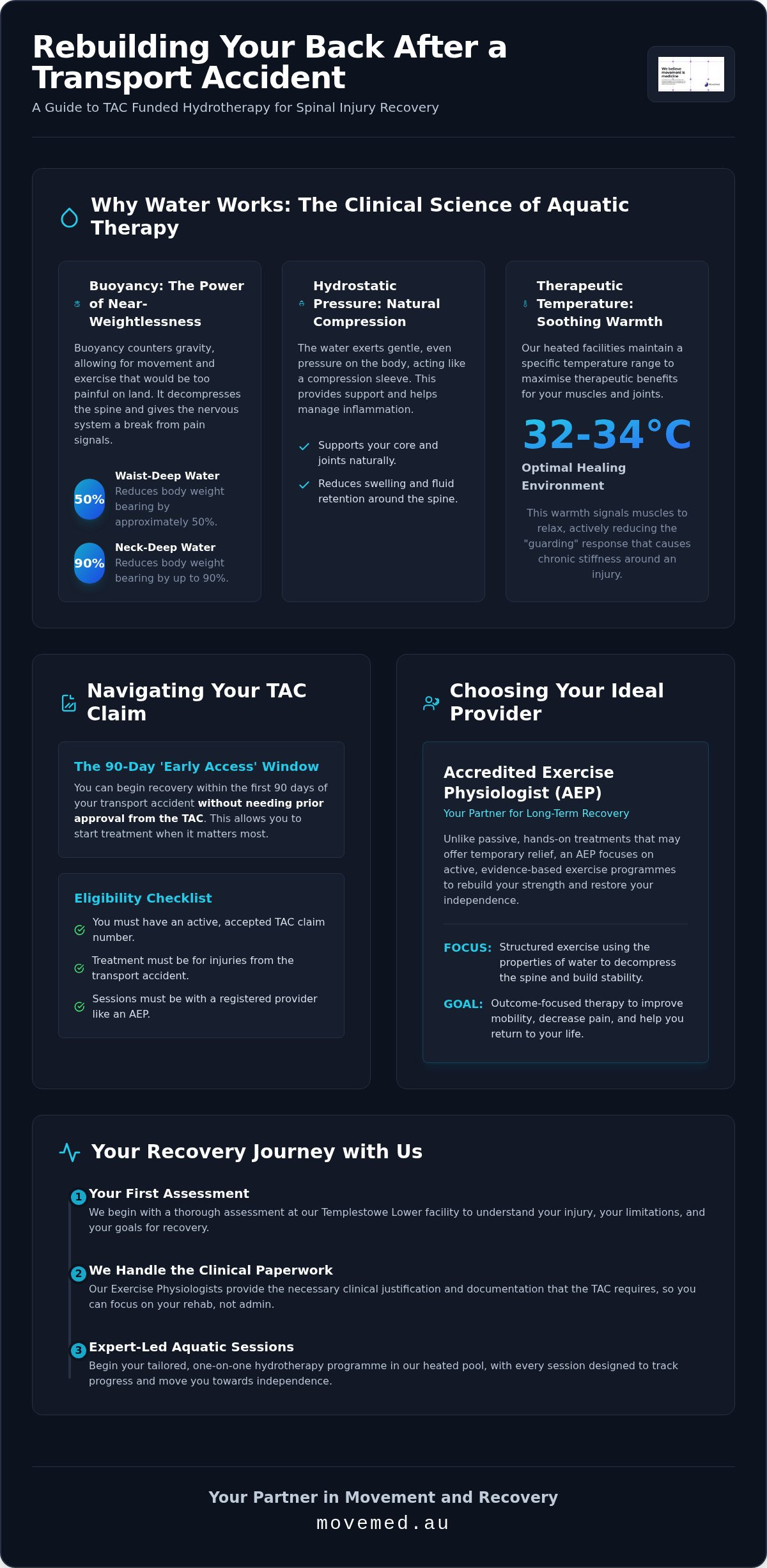
- Active Claim Number: You must have a current, accepted TAC claim number.
- Injury Link: The hydrotherapy must be specifically for treating injuries sustained in your transport accident.
- Registered Provider: Your sessions must be delivered by a registered health professional, such as an Accredited Exercise Physiologist (AEP).
At MoveMed, we act as your partner in this process. We help you understand these criteria so you can focus on your physical recovery rather than get lost in the paperwork.
The Difference Between Passive Soaking and Clinical Hydrotherapy
Is there a difference between "going for a swim" and clinical hydrotherapy? Absolutely. While a warm soak feels pleasant, it doesn't offer the targeted resistance needed to rebuild spinal stability. The Clinical Science of Hydrotherapy shows that structured exercise in water uses specific properties like buoyancy and resistance to decompress the spine. This is why a "dip in the pool" isn't a substitute for a tailored programme.
A structured programme at MoveMed is entirely outcome-focused. We provide the clinical justification the TAC requires to continue funding your care. This involves documenting your progress and measuring how your pain has decreased and your mobility has improved. This professional oversight is what transforms a simple pool session into a powerful tool for long-term back recovery and independence.
Why Water Works: The Clinical Science of Hydrotherapy for Spinal Injuries
Why does the pool feel like a sanctuary for a damaged spine? It isn't just the soothing warmth. It's the unique physical properties of water that create a "low-load" environment for your recovery. When you're struggling with chronic stiffness, the hardest part of rehab is often the pain caused by gravity. This is where the science of the aquatic environment changes the game for your recovery journey.
Buoyancy is the primary reason why TAC funded hydrotherapy for back pain is so effective. Research indicates that standing in waist-deep water reduces your body weight by approximately 50 per cent. If you submerge to your neck, that weight-bearing load drops by up to 90 per cent. This near-weightlessness allows you to perform stretches and strengthening exercises that would be excruciating on land. It gives your nervous system a "break" from pain signals, letting you focus on movement quality.
Hydrostatic pressure acts like an invisible, gentle compression garment around your body. It supports your joints and helps move fluid away from swollen tissues around the spine. Combined with our facility's therapeutic temperature of 32-34°C, this environment actively reduces muscle guarding. Guarding is your body's natural response to "lock up" muscles around an injury to prevent movement. Warm water signals those muscles to finally let go, allowing for a deeper, more comfortable range of motion. This relaxation can be further enhanced by wellness practices like float therapy or infrared saunas, such as those found at City Cave Clyde North, which provide a sanctuary for physical and mental recovery.
Water also provides constant, 360-degree resistance. Unlike lifting heavy weights in a gym, where the resistance is only vertical, water pushes back against you in every direction. This builds resilience and strength without the "jolt" or impact that often triggers back spasms. If you're ready to feel the relief of weightless movement, you can book a TAC assessment with our team to start your personalised programme.
Spinal Decompression in the Aquatic Environment
When you are vertically suspended or performing specific movements in water, gravity's grip on your spine is released. This creates subtle space between your vertebrae, which is particularly beneficial if you are managing bulging or herniated discs from a car accident. On land, gravity constantly compresses these sensitive areas. In the pool, we can achieve natural spinal decompression that is far safer than traditional gym equipment. Unloading the spine in this way allows you to start moving much earlier in your recovery cycle than land-based therapy would permit.
Retraining Core Stability Without the "Jolt"
Your core isn't just your "six-pack" muscles. It's a complex system of deep muscles, like the multifidus and transverse abdominis, that act as your spine's internal brace. Water provides total support for these muscles, allowing us to retrain them through gentle resistance. This foundational work is essential for long-term stability. Many of our clients find that mastering these movements in the pool prepares them perfectly for Clinical Pilates for Back Pain as they transition back to land-based activities.
Navigating the TAC 90-Day Rule for Early Access to Aquatic Therapy
Dealing with the TAC system shouldn't be another source of pain. The 90-day 'Early Access' window is a vital period where you can start TAC funded hydrotherapy for back pain without waiting for formal approval from a claims officer. This rule exists because the TAC knows that early intervention leads to better long-term outcomes for spinal injuries. If your accident was recent, you have a direct path to the pool that skips the usual red tape.
To get started, follow these four simple steps:
- Step 1: Visit your GP or specialist to obtain a referral. Ensure it specifically mentions 'Exercise Physiology' or 'Hydrotherapy' to avoid any administrative delays.
- Step 2: Find an accredited provider like MoveMed in Templestowe Lower. We are specialists in the Victorian compensation system and accept TAC scheduled fees.
- Step 3: Book your initial assessment and bring your TAC claim number and the date of your accident.
- Step 4: Your clinician will then handle the rest. We submit the Allied Health Treatment Plan (AHTP) to the TAC to justify and secure your ongoing funding.
What Happens After the First 90 Days?
Once you pass the three-month mark, the TAC requires a Treatment and Recovery Plan to continue paying for your sessions. This is where clinical justification becomes essential. Our Accredited Exercise Physiologists document your functional improvements, such as increased range of motion or reduced reliance on medication. We also help you understand how TAC scheduled fees work and whether any gap payments might apply to your specific case. By providing clear evidence of your progress, we make it easier for the TAC to say 'yes' to your continued care.
Seeking Approval for Chronic Back Pain Cases
If your accident occurred more than six months ago, or if you haven't had treatment for a while, the process is slightly different. The TAC will evaluate your request based on 'Reasonable and Necessary' criteria. They want to see that the therapy will help you return to work, improve your daily activities, or manage your injury independently. For a deeper look at how these funding streams work across Melbourne, see our Hydrotherapy: The Complete Guide. We've helped many clients with long-term back pain successfully re-enter the system and find relief in the water.
Accredited Exercise Physiologists vs. General Physio: Choosing Your TAC Provider
Choosing the right provider is just as important as the treatment itself. While many people start their journey with a physiotherapist for an initial diagnosis, an Accredited Exercise Physiologist (AEP) is often the missing piece for long-term recovery. AEPs are university-qualified allied health professionals who specialise in clinical exercise prescription. They don't just treat the symptoms; they use movement as medicine to rebuild your body's resilience. For those seeking TAC funded hydrotherapy for back pain, the distinction between a passive, hands-on approach and an active approach is crucial for reclaiming independence.
Physiotherapy often focuses on manual therapies, such as massage or joint manipulation, to settle acute pain. In contrast, an AEP focuses on active rehabilitation. The TAC highly values this approach because it aligns with their core goal of functional independence. By learning how to move correctly in the water, you are actively participating in your own recovery. This shift from being treated to training is what eventually leads to a successful return to work and daily life. At MoveMed, our AEPs specialise in spinal rehabilitation, ensuring that every aquatic session is tailored to the specific mechanics of your back injury.
The AEP Advantage for Long-Term Back Health
Our goal isn't just to get you through the next 90 days. We want to address the root cause of your spinal stiffness. This involves prescribing specific aquatic exercises that target deep stabilising muscles. Once you've built a foundation of strength in the pool, we help you transition to land-based options like Clinical Reformer Pilates. This progression ensures your back is ready for the demands of the real world. We also provide education on self-management, giving you the tools to avoid future flare-ups without needing constant clinical intervention.
Why a Local Melbourne Clinic Matters for Your Claim
Navigating the Victorian compensation system is easier when your clinician knows the local landscape. We understand the specific requirements of TAC claims and have established relationships with local medical centres. Being based in Templestowe Lower means we have expert knowledge of the best TAC-approved facilities in the area, serving the Doncaster and Bulleen communities. For more details on our local services, you can read our guide to Hydrotherapy in Templestowe Lower. If you are ready to move from passive treatment to active recovery, book your initial AEP consultation with MoveMed today to start your journey.
Starting Your Recovery Journey at MoveMed Templestowe Lower
Recovery is rarely a straight line, but having the right guide makes the path much clearer. At MoveMed, we believe that your rehabilitation should be as unique as your injury. We aren't a corporate health chain. We are a community-focused clinic where empathy meets clinical excellence. Our team understands that chronic back pain doesn't just limit your movement; it limits your life in Doncaster, Bulleen, and Warrandyte. We've built our Templestowe Lower centre to be a place where you feel heard, supported, and empowered to take the next step toward independence.
One of the biggest hurdles in the Victorian compensation system is the administrative burden. We believe your energy should be spent on healing, not on chasing paperwork. This is why we take a proactive role in managing your claim's clinical requirements. Our Accredited Exercise Physiologists are experts at translating your physical progress into the specific metrics the TAC requires. By handling the clinical reporting and justification on your behalf, we ensure that your access to TAC funded hydrotherapy for back pain remains seamless and stress-free.
Your First Session: A Roadmap to Relief
Your journey begins with a comprehensive initial assessment at our clinic. During this session, we don't just look at your scans; we look at your life. We'll review your TAC claim details and medical history while discussing the specific challenges you face daily. Are you struggling to return to work? Is your back pain preventing you from picking up your kids or enjoying a walk through the local park? These functional goals become the North Star of your recovery.
Once we understand your objectives, we create a bespoke aquatic exercise programme. This plan is carefully calibrated to your current pain levels and physical capacity. You won't be given a generic list of exercises. Instead, you'll receive a targeted strategy designed to decompress your spine and rebuild your core strength in the safety of the water. This roadmap ensures that every minute you spend in the pool is a direct investment in your long-term health.
Book Your TAC Hydrotherapy Assessment Today
You don't have to navigate the weight of chronic pain alone. Our multidisciplinary team is here to partner with you from your very first splash in the pool to your eventual return to land-based activities. Beyond our work with the TAC, we also provide specialised support for other funding schemes, including NDIS Hydrotherapy Melbourne. This broad expertise allows us to support a wide range of needs within our local community.
Reclaiming your independence starts with a single conversation. Whether you are within your first 90 days or managing a long-term spinal injury, we are ready to help you find relief. Contact MoveMed today to book your TAC assessment and discover how our expert-led aquatic programmes can change the way you move and feel.
Take the First Step Toward Weightless Recovery
You don't have to carry the burden of spinal stiffness alone. We have explored how the unique properties of water can decompress your spine and how the TAC 90-day rule allows you to start treatment without administrative delay. By choosing an Accredited Exercise Physiologist, you are investing in an active recovery that focuses on long-term functional goals rather than just temporary relief. Accessing TAC funded hydrotherapy for back pain is a proven way to reclaim your mobility in a safe, heated environment.
Our team at MoveMed is ready to handle the clinical reporting and justification so you can focus entirely on your physical progress. Whether you are in Templestowe Lower, Doncaster, or Bulleen, we are here to partner with you on this journey. You deserve a recovery plan that is as resilient as you are. We specialise in expert spinal rehabilitation and provide the specialist care needed for TAC and WorkCover claims.
Book Your TAC Hydrotherapy Assessment at MoveMed and let's start rebuilding your confidence together. Your path to a more mobile life is closer than it feels.
Frequently Asked Questions
Does TAC pay for hydrotherapy for back pain?
Yes, the TAC covers hydrotherapy when it's deemed a reasonable and necessary treatment for your transport accident injuries. This funding typically includes the professional fees of an Accredited Exercise Physiologist who supervises your programme. Because back injuries are common in road accidents, TAC funded hydrotherapy for back pain is a standard rehabilitation pathway designed to help you return to your pre-accident activities without the strain of land-based exercise.
Do I need a GP referral for TAC hydrotherapy?
You generally need a referral from your GP or a medical specialist to access exercise physiology services under the TAC. This referral ensures that the treatment is medically recommended for your specific injury. Once you have this document, you can bring it to your initial assessment at MoveMed. We then use this to communicate with your claims officer and ensure your funding is correctly organised from the very first session.
How many hydrotherapy sessions will TAC approve?
There is no fixed cap on the number of sessions, as the TAC approves treatment based on your individual recovery needs. During the first 90 days after your accident, you can often access sessions quite easily. After this period, we submit an Allied Health Treatment Plan that outlines your progress. The TAC continues to approve sessions as long as we can demonstrate that the therapy is helping you achieve your functional goals.
Will I have to pay a gap for hydrotherapy at MoveMed?
MoveMed aims to keep our services accessible, but there may be a small gap payment depending on the current TAC scheduled fees and our clinic's operational costs. We believe in transparency and will always discuss any potential out-of-pocket expenses with you before you begin your programme. Our focus is on providing high-quality, EP-led care that delivers long-term value for your health, mobility, and independence.
Can I do hydrotherapy if I can’t swim?
You absolutely don't need to be a swimmer to benefit from hydrotherapy. Most of our exercises are performed while standing in waist-deep or chest-deep water, where you can keep your feet firmly on the pool floor. The water provides a safe, supportive environment where you can move with confidence. Our clinicians are always in or beside the pool to guide you through every movement safely and comfortably.
How long after a car accident can I start hydrotherapy?
You can often start hydrotherapy as soon as your GP or specialist clears you for light exercise, which can be within the first few weeks of your accident. Early intervention is often key to preventing chronic stiffness. Starting TAC funded hydrotherapy for back pain early in your recovery journey allows you to maintain mobility and muscle tone while your spinal tissues are still healing, without the risk of high-impact injury.
What should I bring to my first TAC hydrotherapy session?
For your first session, please bring your swimwear, a towel, a water bottle, and any relevant medical imaging or reports. It's also essential to have your TAC claim number and your doctor's referral ready. We'll conduct a thorough land-based assessment first to understand your physical limits before we ever get into the water. This ensures your aquatic programme is perfectly tailored to your current stage of recovery.
Is hydrotherapy better than physiotherapy for back pain?
Neither is strictly better, as they often serve different purposes in your recovery journey. Physiotherapy is excellent for early-stage diagnosis and hands-on treatment to reduce acute pain. Hydrotherapy, led by an Exercise Physiologist, focuses on active movement and long-term strengthening. Many clients find the best results come from using physiotherapy to settle their initial symptoms and then transitioning to the pool to rebuild their functional strength and independence.


