

What makes hydrotherapy useful is not simply being in the water, but having a clinician guide how you move. If land-based exercise feels uncomfortable or you’re unsure what a session involves, it’s understandable to want clear answers before taking the next step. Supervised hydrotherapy Doncaster sessions offer a supported way to explore water-based movement, with exercises shaped around your needs and goals.
Clinical hydrotherapy is different from swimming laps or exercising alone. An Accredited Exercise Physiologist guides and adjusts movement to suit your abilities, helping you work within your comfort and build confidence with exercise. MoveMed’s personalised, evidence-based management plans connect hydrotherapy to your health and movement goals. The clinic supports people in Doncaster and nearby Templestowe Lower, Templestowe, Doncaster East, Bulleen, Warrandyte, Lower Plenty, Balwyn North and Box Hill.
In this article, you’ll learn how clinical supervision connects exercises to your goals, what to expect before and during a session, and how suitability and funding may be considered. The aim is to help you understand your options and feel prepared to take a practical next step towards supported movement.
Key Takeaways
- Understand how supervised hydrotherapy Doncaster sessions use clinician-guided movement to work towards your individual health goals.
- Know the key stages of a session, from discussing your goals to practising exercises and reviewing how you respond.
- Compare clinical hydrotherapy with recreational swimming to see how their purpose, exercise choices and guidance differ.
- Prepare for a session by noting your goals, symptoms and any movement concerns you’d like to discuss.
- Explore how MoveMed’s tailored hydrotherapy can support your movement and wellbeing goals.
What supervised hydrotherapy in Doncaster means for your recovery
When pain or limited mobility affects everyday tasks, movement can start to feel uncertain. You might wonder whether exercise will aggravate symptoms or how to begin safely. Supervised hydrotherapy is water-based exercise guided by a clinician towards your individual health and movement goals. The focus is not on pushing through discomfort. It is on choosing relevant movements and adapting them to your needs.
Hydrotherapy is a broad term for using water in approaches to health and treatment. Hydrotherapy, also known as water cure, involves using water for pain relief and treatment. Clinical hydrotherapy is more specific: exercises are selected and guided as part of a structured programme. It is not unsupervised swimming or open pool access. MoveMed provides tailored hydrotherapy guided by Accredited Exercise Physiologists for people in Doncaster, Doncaster East, Bulleen and surrounding suburbs.
How supervised hydrotherapy differs from swimming
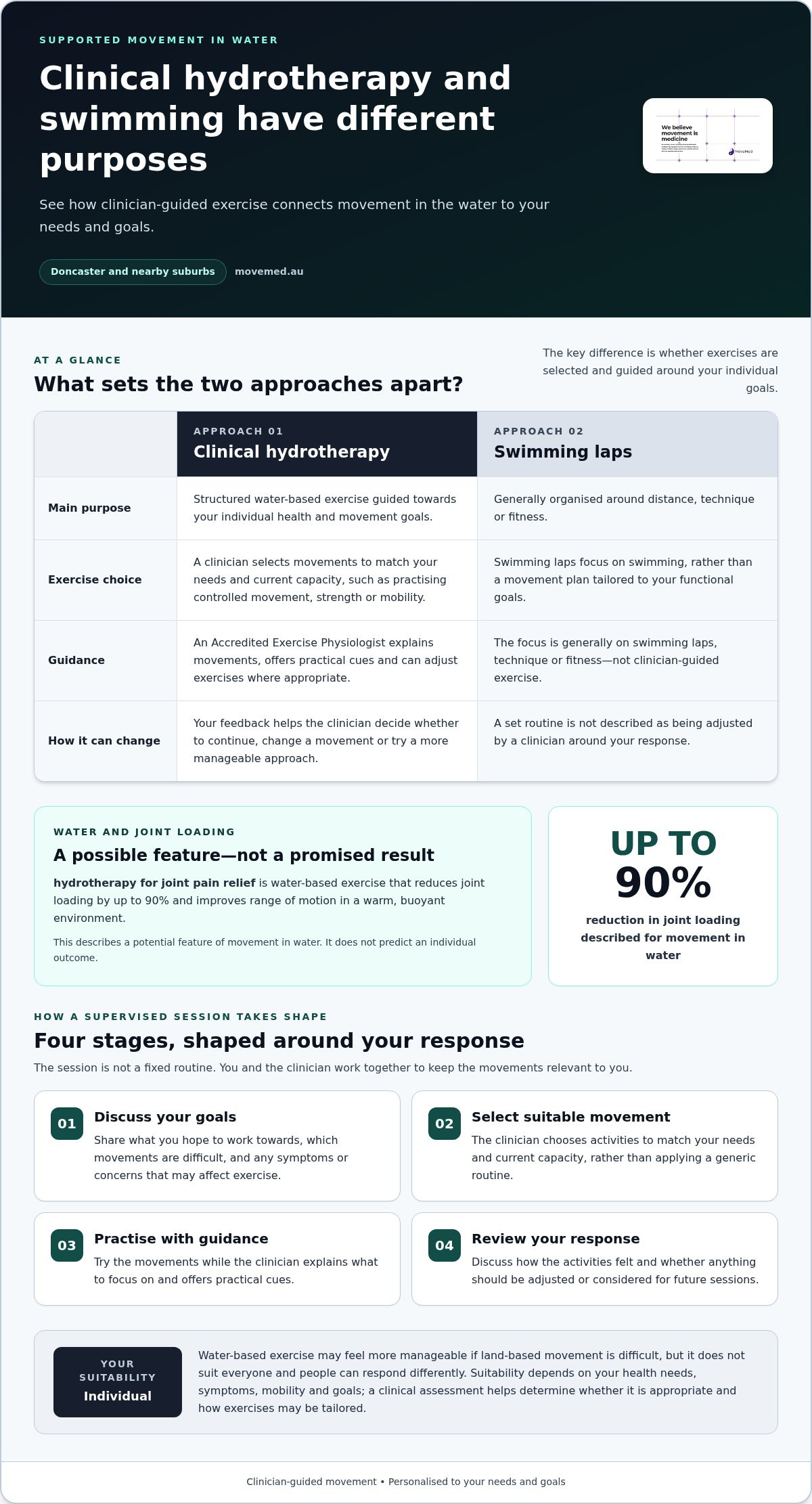
Swimming laps is generally organised around distance, technique or fitness. In supervised hydrotherapy, the clinician selects exercises that relate to your functional goals, such as practising controlled movement or working on strength and mobility. Your exercise plan is guided by your needs rather than a set routine intended for everyone.
Supervision means having a qualified professional explain the purpose of each movement, offer cues and adapt the exercise where appropriate. It does not necessarily mean constant hands-on assistance. You can ask questions and describe how a movement feels, helping the clinician keep the session relevant to you.
Who may consider supervised water-based exercise?
You may be interested in water-based exercise if land-based movement feels difficult or you’d prefer support while exploring ways to stay active. The buoyancy of water can reduce the load your body bears during movement, which may make some exercises feel more manageable. This does not mean hydrotherapy suits everyone or that each person will respond in the same way.
hydrotherapy for joint pain relief means water-based exercise that reduces joint loading by up to 90 % and improves range of motion in a warm, buoyant environment. This describes a potential feature of movement in water, not a promised outcome for an individual. Your suitability depends on your health needs, symptoms, mobility and goals. A clinical assessment helps determine whether this approach is appropriate and how exercises may be tailored.
Before discussing a programme, consider which activities you’d like to make easier, such as moving around at home or feeling more confident with exercise. Sharing these priorities gives your clinician a practical starting point for setting goals with you.
How clinical supervision shapes a hydrotherapy session in Doncaster
A supervised session is shaped by your goals, how you move and how your body responds. Rather than following a fixed routine, you and the clinician work together to make exercise relevant to your needs. Accredited Exercise Physiologists are university-qualified allied health professionals who design, deliver and evaluate safe and effective exercise interventions.
Clinical supervision connects each exercise to your goals, guides you as you practise and helps shape the next step around your response.
A typical clinical process has four stages:
- Discuss your goals: Share what you hope to work towards, which movements you find difficult and any symptoms or concerns that may affect exercise.
- Select suitable movement: The clinician chooses activities that match your needs and current capacity, rather than applying a generic routine.
- Practise with guidance: You try the movements while the clinician explains what to focus on and offers practical cues.
- Review your response: Discuss how the activities felt and whether anything should be adjusted or considered for future sessions.
From goals to a personalised movement plan
Your priorities give the programme direction. You might want to practise a movement that matters in daily life or find an approach that feels more manageable than exercising on land. The clinician considers your aims alongside your symptoms and function, meaning how you manage everyday activities, to select relevant exercises.
People can have different needs even when they share a similar goal. An activity may suit one person but need adapting for another. Your plan is developed around your circumstances, not based on the assumption that one routine suits everyone.
Guidance, feedback and progression in the water
As you practise, the clinician can observe how you move and give clear cues, such as how to control a movement or adjust your position. You can share what feels comfortable, challenging or uncertain. That feedback helps guide decisions about whether to continue, change the movement or try a more manageable approach.
Adaptation is part of personalised care. If your comfort or movement needs change during an activity, the clinician can adjust the exercise. Progression is considered individually and reviewed over time. It is not automatic, and a particular result cannot be assumed. Your feedback is an active part of the session, not an afterthought.
If you’re considering supervised hydrotherapy Doncaster residents can access through MoveMed, understanding this collaborative process can help you decide whether it aligns with your priorities. Explore MoveMed’s tailored hydrotherapy service for clinician-guided movement.
Supervised hydrotherapy or swimming: which approach fits your goals?
Both supervised hydrotherapy and swimming involve moving in water, but they serve different purposes. Swimming can be a way to enjoy the water or work on general fitness. Clinical hydrotherapy is structured around individual health and movement goals, with exercise choices and feedback guided by a clinician. Neither approach is automatically right for everyone. Consider what you want the activity to help you do and how much guidance you’re looking for.
| What to compare | Supervised hydrotherapy | Recreational swimming |
|---|---|---|
| Purpose | Work towards personal movement or health goals. | Enjoy swimming or take part in general physical activity. |
| Exercise choice | Activities are selected with your needs and capacity in mind. | You choose how you swim or move in the water. |
| Guidance | A clinician provides exercise guidance and considers your feedback. | You usually direct your own activity. |
| Progress | Your response and goals help inform how activities are reviewed. | You decide what progress means for your swimming or fitness. |
What the water changes during therapeutic movement
Buoyancy supports your body in water and can reduce the load experienced by your joints during suitable exercise. The amount varies with the activity and the person, but joint loading can be reduced by up to 90%. Water also provides resistance, so moving through it creates a different physical challenge from moving on land. The clinician considers how these qualities relate to your goals rather than assuming the same exercises will suit everyone.
Some activities may also focus on joint stability, meaning the ability of muscles and ligaments to help keep a joint properly aligned during movement. The specific focus depends on your individual plan.
When clinical guidance adds value
Guidance can help if you’re uncertain which movements feel manageable or how to adapt activity to your current capacity. The clinician can link exercise choices to your aims, observe how you move and give practical feedback. You can describe what feels comfortable or difficult, helping inform adjustments during the session.
That feedback supports considered decisions, not a promise of faster recovery. Progress is individual and may be reviewed as your needs and response become clearer. If you want a clinician-guided programme, supervised hydrotherapy Doncaster offers a different kind of water-based activity from swimming on your own. If you’re seeking recreation or general swimming, swimming may better match that purpose. Your goals and the support you want can help you choose between them.
Preparing for supervised hydrotherapy near Doncaster
A little preparation can make it easier to explain what you need and what you’re unsure about. Before supervised hydrotherapy in Doncaster, think about the activities you’d like to manage more comfortably and the concerns you want your clinician to understand. You don’t need to arrive with a complete plan. Clear, practical information helps shape a useful conversation.
Before your appointment, it may help to jot down:
- Your movement goals: Note everyday activities you’d like to work towards, such as moving around the house or feeling more confident with exercise.
- Your symptoms: Describe what you notice, when it tends to occur and whether anything has changed recently.
- Movement concerns: Mention movements you find difficult, activities you’re worried may be uncomfortable, or questions about exercising in water.
- Relevant health information: Bring details that may help the clinician understand your needs and tailor exercise appropriately.
- Funding or referral details: If you’re using a plan or support scheme, have relevant information available to discuss how it relates to your therapy.
What to discuss before beginning
Be open about what you hope to achieve and what feels uncertain, including any concerns about moving in water. Share relevant health information and changes in your symptoms, even if they seem small. This gives the clinician useful context when planning exercises. Use the discussion to ask questions and work together on a starting point that reflects your priorities.
You don’t need to decide in advance which exercises you should do. The clinician can use the information you share to guide that choice. If you’re reading beforehand, MoveMed’s hydrotherapy guide for Melbourne recovery offers broader background on water-based therapy.
Understanding therapy funding and support
MoveMed supports clients through NDIS, DVA, TAC, Aged Care, WorkCover and Medicare services. Funding for therapy depends on your circumstances and the relevant scheme or plan requirements. Share your funding context during the discussion so it can be considered alongside your therapy goals.
If you’re exploring NDIS support, the NDIS Exercise Physiology guide explains related considerations. You can also take the next step with MoveMed’s tailored hydrotherapy and discuss how clinician-guided movement fits your goals.
Take the next step towards supervised hydrotherapy with MoveMed
Choosing a water-based programme starts with a simple question: does clinician-guided movement fit what you want to work towards? You may be looking for a supported way to exercise, hoping to build confidence with movement or wanting to focus on activities that matter in daily life. Your priorities are a useful place to begin. Hydrotherapy is a structured option to consider with professional guidance, not a guaranteed result.
What a supportive next step can look like
Think about one or two everyday movements you’d like to make easier. Perhaps you want to feel more at ease when moving around at home, or you’d like guidance to help you approach exercise with greater confidence. You don’t need a complete list or to know which exercises might help. Sharing what matters to you gives the clinician a practical starting point for planning care together.
MoveMed’s Accredited Exercise Physiologists develop personalised, evidence-based management plans. They consider your goals and needs when guiding your care, rather than relying on a routine that assumes everyone should move in the same way. As you discuss your priorities, raise any questions or concerns that might affect your comfort with water-based exercise.
It can help to reflect on what you’d like support with, what you’re uncertain about and what information you want the clinician to understand. Your experience and feedback contribute to decisions about relevant movement. This gives you an opportunity to understand the approach and consider how it aligns with your needs.
Start a conversation with MoveMed in Doncaster
MoveMed provides supervised hydrotherapy in Doncaster and nearby Templestowe Lower, Templestowe, Doncaster East, Bulleen, Warrandyte, Lower Plenty, Balwyn North and Box Hill. Accredited Exercise Physiologists guide tailored movement with your goals and physical wellbeing in mind. Discuss what you hope to work on and how a supported programme may fit into your plans.
You can begin with a conversation about your goals, concerns and questions. You don’t need to arrive knowing exactly what you need. A clinician can help you explore how supervised hydrotherapy relates to your circumstances.
For people considering supervised hydrotherapy Doncaster, the decision is not about choosing water-based exercise at any cost. It’s about whether guided movement suits your priorities and whether you’re ready to explore it with clinical support. MoveMed’s tailored approach gives you a practical place to begin, with your goals at the centre of the discussion.
Talk with MoveMed about starting supervised hydrotherapy and take a considered step towards supported movement.
Make your next move with confidence
You don’t need to have every detail worked out before exploring water-based exercise. Start with one movement or daily activity you’d like support with, and use that goal to guide a conversation about whether clinician-led hydrotherapy feels right for you. This can turn an uncertain first step into a practical discussion about your priorities and the support you’re looking for.
MoveMed provides hydrotherapy for people in Doncaster and surrounding suburbs. Accredited Exercise Physiologists develop personalised, evidence-based management plans, keeping your goals central as you consider your options. If you’re ready to explore whether supervised hydrotherapy Doncaster may suit your needs, take the next step at a pace that feels right for you.
Explore supervised hydrotherapy with MoveMed and start a conversation about supported movement. Your goals can be the starting point for a thoughtful plan, developed together.
Frequently Asked Questions
Do I need to know how to swim to attend supervised hydrotherapy?
Not necessarily: supervised hydrotherapy involves planned water-based exercises, not a requirement to swim laps. Whether you can swim is one part of discussing suitability; your comfort in water, planned movements and clinical needs also matter. Tell the clinician if you feel uneasy about entering, standing or changing position in water. You can talk through these concerns together so the proposed approach reflects your experience.
What should I wear to a hydrotherapy session?
Comfortable swimwear and a towel are practical basics. Choose clothing that feels secure and allows you to move without restriction, and consider how easy it is to change in and out of it. If you use a mobility aid or have particular access needs, mention these when planning the session. This gives the clinician relevant context about your needs.
How often should I attend supervised hydrotherapy?
There’s no universal attendance schedule for everyone. Your clinician can discuss frequency in light of the activities you want to support, your other commitments and your overall exercise plan. It may also help to consider how you’ll manage movement between appointments, rather than viewing sessions in isolation. Review the arrangement together if your routine or circumstances change. A fixed weekly pattern is not necessary or proof of progress.
Can supervised hydrotherapy be suitable if I have a long-term health condition?
Possibly, but a long-term condition doesn’t automatically make hydrotherapy suitable or unsuitable. Before discussing exercise, note day-to-day effects that are easy to overlook, such as needing rest after certain tasks, fluctuations in energy or limits on standing. Sharing these details makes the conversation more specific to your experience. Your clinician can consider them alongside relevant health information, without assuming the same approach applies to everyone with that condition.
Can I start hydrotherapy while recovering from an injury or surgery?
Possibly, but timing depends on your recovery, symptoms and advice from your treating team. There’s no universal waiting period. Bring or summarise any instructions you’ve received about movement, weight-bearing or activities to avoid. Hydrotherapy shouldn’t replace post-operative directions. Your clinician can discuss how your current capacity and goals relate to exercise, and whether it makes sense to consider water-based movement at this stage.
Is supervised hydrotherapy the same as having a personal trainer in a pool?
No. A personal trainer is a fitness professional who works with generally healthy individuals to achieve fitness or weight-loss goals, and is not qualified to prescribe clinical exercise for chronic conditions. By contrast, Accredited Exercise Physiologists are university-qualified allied health professionals who design, deliver and evaluate safe and effective exercise interventions. The distinction is about scope and purpose, not a judgement about either profession.
What if I feel uncomfortable or more sore during an exercise?
Pause rather than trying to push through discomfort, and let the clinician know what you noticed, when it began and whether it persists after stopping. A brief note after the session can help you describe patterns at a later review. If symptoms are concerning or change significantly, seek appropriate clinical guidance instead of guessing at the cause. A clinician can help you decide what information is relevant before further exercise.


