

What if exercise could be shaped around what feels familiar and manageable, rather than asking a person living with dementia to keep up with a fixed routine? If you’re considering an aged care exercise program for dementia care Warrandyte, it’s understandable to wonder whether sessions will suit your loved one as their needs change. Individual guidance allows movement to be adapted to their abilities, comfort and meaningful daily goals.
Exercise isn’t a cure for dementia, and no program can promise the same results for everyone. Supervised, personalised exercise physiology can focus on physical needs such as strength, balance and mobility, while keeping the person’s safety and preferences in view. MoveMed’s Accredited Exercise Physiologists develop evidence-based plans around each person and adjust the approach to their capacity and goals.
This article explains what individualised exercise may involve, what information can help shape a suitable program, and how aged care funded therapy fits into practical planning. It also offers ways to consider whether a program feels appropriate for the person you care for.
Key Takeaways
- A suitable exercise program starts with the person’s current abilities, comfort and everyday goals, then adapts as their needs change.
- Supervised exercise physiology can focus on physical function, such as strength, balance and mobility, without promising changes to dementia or cognition.
- Consider safety, preferences and how movement could support activities that matter to the person when assessing whether a program is a good fit.
- For an aged care exercise program for dementia care Warrandyte, details about the person’s health, daily routine and funding arrangements can help guide care planning.
- MoveMed provides personalised exercise physiology and aged care funded therapy in Warrandyte, with Accredited Exercise Physiologists developing evidence-based plans around individual capacity and goals.
Aged Care Exercise for Dementia in Warrandyte?
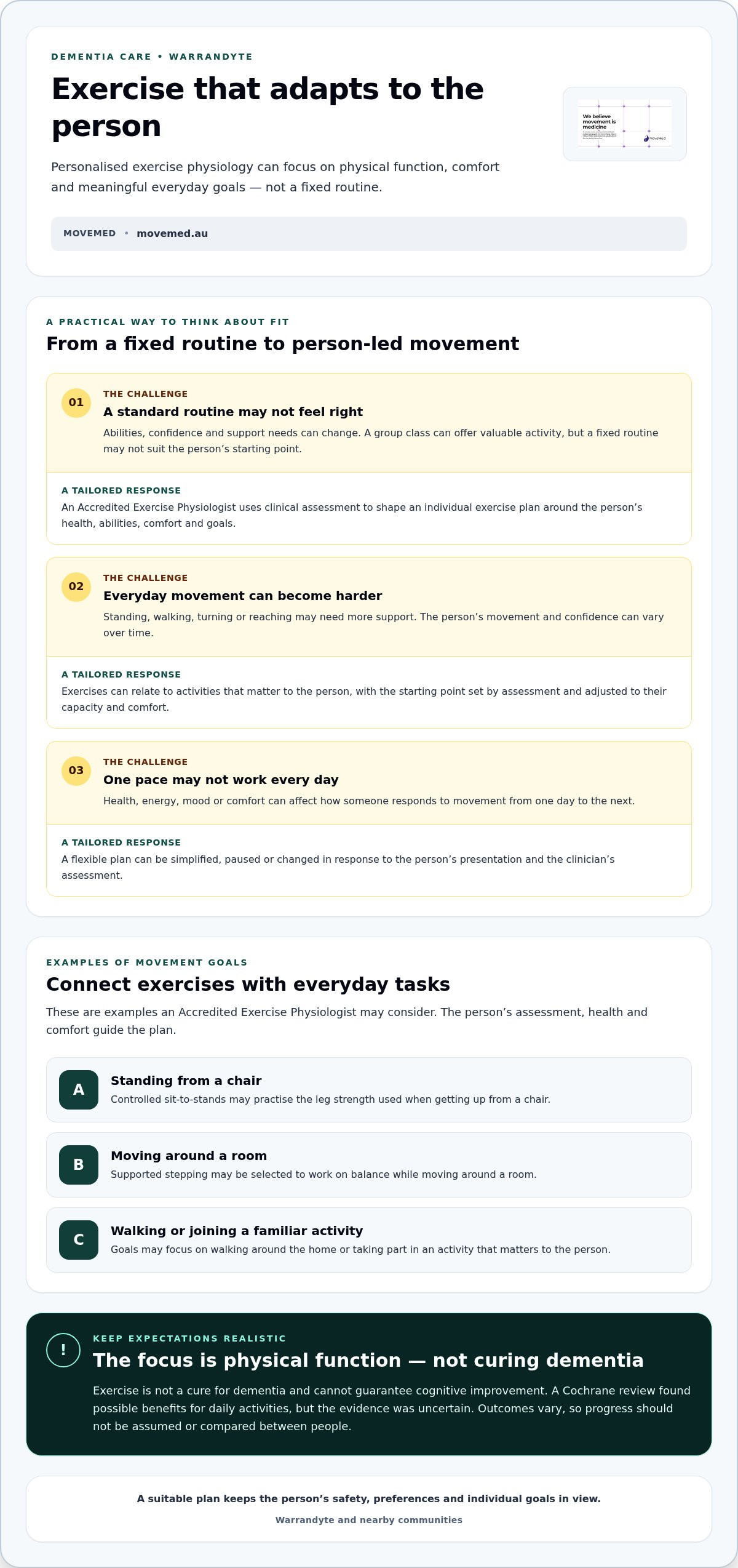
It can be difficult to know whether exercise is suitable when someone you care for is living with dementia. Their abilities, confidence and support needs may change, and a standard class may not feel like the right starting point. A personalised approach begins with the person, rather than a fixed routine.
An aged care exercise program for dementia care is supervised, tailored exercise designed to support a person’s physical function and participation in activities that matter to them. An Accredited Exercise Physiologist may select and adapt movements that practise strength, balance and mobility after considering the person’s health, abilities and goals.
Exercise physiology differs from a general fitness class. A class can provide valuable group activity, while exercise physiology involves clinical assessment and an exercise plan shaped around an individual’s needs. It isn’t a treatment to cure dementia and cannot guarantee cognitive improvement. The focus is on realistic physical goals, with care and attention to how the person responds.
What does exercise physiology mean in dementia care?
An Accredited Exercise Physiologist considers how a person moves and what they would like or need to do more comfortably. This may include standing from a chair, walking, turning, reaching or maintaining balance. These observations help shape relevant exercises that can be adjusted to the person’s starting capacity and comfort.
Clinical exercise is movement prescribed for a health or functional goal, rather than exercise selected only for general fitness. For example, supported sit-to-stands may practise the leg strength used to rise from a chair. Simple stepping activities may address balance and coordination. These exercises can relate to everyday tasks, but progress varies and should not be assumed to result in greater independence.
Physical activity is discussed in broader health guidance, including the Benefits of Physical Activity for Dementia. For a person living with dementia, a practical program should focus on their individual physical needs. Exercise should not be presented as reversing dementia or as a reliable way to improve memory.
Who might consider a local program in Warrandyte?
You might be a family member, carer or aged care decision-maker looking for movement support that respects the person’s preferences. People living with dementia have varied abilities and support needs. One person may enjoy practising a familiar movement, while another may need more guidance, rest or a simpler activity. The right starting point depends on the individual, not the diagnosis alone.
MoveMed provides personalised exercise physiology and aged care funded therapy in Warrandyte and nearby communities, including Templestowe Lower, Templestowe, Doncaster, Doncaster East, Bulleen, Lower Plenty, Balwyn North and Box Hill. If you’re considering an aged care exercise program for dementia care Warrandyte, the person’s daily routines, movement concerns and goals are useful starting points for planning appropriate support.
How personalised exercise can support function as dementia changes
As dementia progresses, a person’s movement, health and confidence may vary. Exercise goals can change too. Instead of following a fixed routine, an individual plan can focus on specific physical tasks that matter to the person and those supporting them. The plan can then be reviewed as their circumstances evolve.
The focus is physical function and participation, not reversing dementia. A Cochrane review of exercise programs for people with dementia found possible benefits for daily activities, but the evidence was uncertain. Any benefit is a possibility, not a guaranteed outcome for an individual.
What goals can an exercise plan address?
An Accredited Exercise Physiologist can consider strength, balance and mobility alongside the person’s health, preferences and support needs. Goals might relate to standing from a chair, moving between a bed and a chair, walking around the home or taking part in a familiar activity. These examples can help make a plan relevant, but they aren’t a promise that a task will become easier.
For instance, practising controlled sit-to-stands may address the leg strength used when getting up from a chair. Supported stepping may be selected to work on balance while moving around a room. The starting point and exercises depend on assessment, including how the person moves, what feels comfortable and whether other health concerns need to be considered.
Confidence can also be a meaningful goal. A person may feel more at ease attempting a familiar movement when it is broken into manageable steps and appropriately supervised. The aim is to support participation where possible, not to pressure someone to perform a task or compare their progress with another person.
Why does the program need to adapt over time?
A person’s capacity may vary from one day to the next. Changes in health, energy, mood or comfort can affect how they respond to movement. A flexible plan accounts for these differences: an activity may be simplified, paused or changed, depending on the person’s presentation and the clinician’s assessment.
Clear instructions, a comfortable pace and familiar activities may make a session easier to follow, although what works differs between people. Carers can share useful observations, such as which movements seem comfortable, when the person tends to tire, or which daily tasks they value. This information can guide decisions without assuming that every change is caused by dementia.
Review is part of adapting the plan. An Accredited Exercise Physiologist can reassess movement and adjust exercises as needs or goals shift. Progression should follow the person’s response, not an arbitrary timetable. If you’re considering an aged care exercise program for dementia care Warrandyte, MoveMed offers personalised exercise physiology support shaped around individual physical priorities.
How to judge whether a dementia care exercise program is a good fit
There’s no single answer about whether an exercise program is suitable based on a dementia diagnosis alone. Fit depends on individual assessment, health, movement abilities, preferences and available support. A simple decision framework can help you share useful information and understand how a program could be shaped.
- Describe what movement looks like now. Note what the person can do comfortably, where they need assistance and what has become difficult. This might include getting up from a chair, walking across a room, turning or managing fatigue. Include changes you’ve observed, while recognising that their abilities may vary from day to day.
- Share relevant health and support information. Tell the Accredited Exercise Physiologist about health considerations that may affect movement, the assistance the person usually needs and what helps them feel comfortable. You can also describe their communication preferences, such as whether short instructions, demonstrations or extra time are helpful. This context helps inform suitable exercises and supervision.
- Identify goals that matter to the person. Think beyond a general aim such as “get stronger”. A more useful goal might be to practise standing from a chair, move more comfortably around a familiar space or take part in a valued daily activity. The person’s preferences should guide priorities, with family or carer observations adding context where helpful.
- Discuss how the plan will be adjusted. Assessment helps determine appropriate exercises and a suitable starting level. A person-centred approach also allows for changes in comfort, energy or ability. You should understand why activities are included and how they relate to the person’s needs, rather than being expected to follow a routine that feels unsuitable.
These steps are prompts for a practical conversation, not a pass-or-fail checklist. MoveMed’s guide to strength training for Templestowe seniors explains how strength work can relate to everyday movement. For someone living with dementia, activities and the level of support still need to reflect that person’s assessment and preferences.
What to look for in a person-centred approach
A suitable program connects exercise with the person’s routines, priorities and current capacity. It should adapt communication and exercise demands to their needs, and treat family and carer input as useful information for collaborative planning. You can help by sharing what the person enjoys, what feels challenging and what they would like to keep doing.
If you’re considering an aged care exercise program for dementia care Warrandyte, these details help MoveMed’s Accredited Exercise Physiologists understand the person’s goals and tailor an evidence-based plan. Discuss personalised exercise physiology with MoveMed as you consider appropriate support.
Aged care funding and practical planning for Warrandyte families
Funding questions can make planning feel harder, particularly when you’re balancing care needs with the person’s wish to remain at home. It helps to separate two decisions: whether exercise physiology is clinically suitable, and whether a funding arrangement can contribute to it. A funding pathway doesn’t automatically establish clinical suitability or guarantee that a service will be covered.
How might exercise physiology fit into an aged care plan?
Home Care Packages (HCP) were government-funded support that could include exercise physiology services to help seniors remain independent at home. The program was replaced by Support at Home on 1 November 2025. Under Support at Home, approved services can include allied health such as exercise physiology, with support shaped by an assessment of a person’s care needs. The person’s plan and circumstances determine what funding may apply, so don’t assume a particular service or cost is covered.
For practical planning, review the current documents describing the person’s care goals, available funding and approved supports. Note whether the plan prioritises movement, maintaining daily activities or support at home. If their arrangements still use older Home Care Packages terminology, refer to current information relevant to their circumstances rather than relying on an outdated package description.
Clinical fit remains a separate question. An Accredited Exercise Physiologist considers the person’s health, movement and goals when shaping exercise. Funding information can help clarify the practical pathway, but it doesn’t replace an assessment of whether particular exercises are appropriate.
What information helps make the first conversation useful?
You don’t need to prepare a perfect file. A few clear notes can make the discussion more focused. Consider recording:
- What the person would like to keep doing or find easier in daily life.
- How they move around at home and what support they currently need.
- Relevant health information and any movement or comfort concerns.
- Their usual routines, preferences and what helps them engage with activity.
- Details of their current aged care plan and any funding or service information available to you.
These details can connect the person’s goals with clinical planning and the practical funding conversation. MoveMed provides personalised exercise physiology and aged care funded therapy, with plans shaped around individual needs and care goals.
If movement in a pool seems relevant to the person’s comfort or preferences, read about hydrotherapy and water-based recovery as another exercise context. The right option depends on individual assessment and circumstances.
For families considering an aged care exercise program for dementia care Warrandyte, gathering the person’s goals and current plan information is a practical first step. Explore MoveMed’s aged care therapy for personalised support for an older person living with dementia.
How MoveMed supports aged care exercise in and around Warrandyte
Once you’ve considered the person’s goals, movement needs and care arrangements, the next step is to connect those details with a clinically guided plan. MoveMed provides personalised exercise physiology and aged care funded therapy in Warrandyte and nearby communities. The focus is on understanding the person’s needs and developing an appropriate approach, rather than fitting them into a standard routine.
What can you expect from MoveMed’s exercise physiology approach?
MoveMed’s Accredited Exercise Physiologists develop evidence-based management plans shaped around each individual. They consider the person’s physical capacity and goals, with attention to long-term physical wellbeing. In practice, this means planning exercise that relates to the person’s needs and can be adjusted to suit their circumstances.
Goals can be discussed with the person and, where appropriate, their family or support network. You might share which daily activities matter to them, what movement concerns you’ve noticed and what helps them feel at ease. This information gives the Exercise Physiologist useful context for planning. The aim is to prescribe exercise thoughtfully and safely, while recognising that dementia-related needs and physical responses vary from person to person.
An individual plan is not a promise of a particular result. It provides a structured way to work towards relevant physical goals and consider how exercise may support participation. As needs or comfort change, the plan can be reviewed in light of the person’s circumstances. The focus remains on suitable exercise and physical wellbeing, not on claiming that exercise treats or reverses dementia.
What is a practical next step for families near Warrandyte?
A first conversation can be straightforward. Share the person’s priorities, current movement concerns, relevant health information and the support they receive. Aged care plan details can help frame a discussion about therapy needs and funding arrangements. Clinical suitability and funding are separate considerations, and both need to be understood in the context of the person’s situation.
You don’t need every answer before starting the conversation. A short list of questions or observations can help you explain what matters most, whether that is maintaining a valued routine or getting guidance on appropriate movement. MoveMed’s personalised exercise physiology and aged care funded therapy are tailored to individual needs and care goals.
If you’re exploring an aged care exercise program for dementia care Warrandyte, MoveMed can be a local partner as you consider support. Share the person’s goals and care needs, then work through the options together at a manageable pace. Talk with MoveMed about aged care therapy.
Take the next step at your own pace
Supporting someone through dementia often means making thoughtful decisions without knowing exactly how their needs may change. Take time to consider what feels comfortable for the person and revisit choices as circumstances evolve. You don’t need to have every detail settled today.
If an aged care exercise program for dementia care Warrandyte feels worth considering, start with a calm conversation rather than a commitment to a particular outcome. The aim is to find an approach that respects the person and feels manageable for you as a family member or carer.
Talk with MoveMed about aged care exercise physiology to discuss the person’s goals and care needs. A considered conversation can help clarify a practical next step.
Frequently Asked Questions
Can exercise help someone living with dementia?
Exercise may be worth exploring as part of a person’s routine, but research doesn’t support promising a particular result. A Cochrane review of exercise programs for people with dementia found the evidence for effects on daily activities uncertain. Keep expectations grounded by agreeing on a small, observable aim, such as taking part in a chosen activity, then consider whether the person is comfortable and willing to continue.
Is exercise safe for a person with dementia?
Safety can change if the person’s health or comfort changes. If they seem unusually tired, distressed or uncomfortable during an activity, pause and share what you noticed with their Accredited Exercise Physiologist so the approach can be reconsidered. Tell the clinician about new symptoms or recent health changes before continuing. This practical feedback helps guide decisions, but it isn’t a substitute for individual clinical advice.
What exercises may be included in a dementia care exercise program?
Depending on the person, activities might include seated reaching, light resistance movements or simple movements set to a familiar rhythm. These are examples to discuss, not exercises to start without considering the person’s circumstances. An Accredited Exercise Physiologist can select and adjust activities in response to the person’s needs and preferences. Share which kinds of movement they enjoy or tend to avoid.
How often should an older person with dementia exercise?
There’s no universal schedule that’s right for every older person. The treating professional can guide frequency and duration in line with the person’s circumstances. A brief note after activities, recording when they took part and how they seemed afterwards, can help you discuss what feels manageable. Use those observations to guide a conversation about a suitable routine, rather than setting a target independently.
Can aged care funding pay for exercise physiology?
It may be possible, depending on the person’s current funding arrangements and plan. Review their written plan and service information for details about available supports, any stated contributions and how allied health is addressed. Funding rules and eligibility can change, so avoid assuming exercise physiology will be covered for a particular person. If the documents are unclear, note the specific points that need explanation before making plans.
Where can Warrandyte families access aged care exercise physiology?
MoveMed provides exercise physiology and aged care funded therapy in Warrandyte and nearby communities. For a useful first discussion, note the person’s preferred times of day for activity, what helps them feel at ease and any practical barriers to taking part. Share these alongside your questions about care arrangements. This gives you and MoveMed a grounded starting point for discussing the person’s support needs.


