
What if exercise support could be shaped around what matters in your day, rather than asking you to follow a generic programme? If you’re unsure whether exercise feels manageable or connects with your NDIS plan, NDIS exercise physiology Templestowe can turn your goals into practical movement to work on with a clinician.
It’s understandable to have questions about whether exercise physiology fits your goals, what sessions involve and how funding works. Exercise can be adapted to your current capacity, so you can work at a suitable pace and focus on everyday activities such as moving around more confidently or building strength for daily tasks.
MoveMed’s Accredited Exercise Physiologists create personalised, evidence-based support and involve you in planning and reviewing progress. This guide explains how NDIS support categories and funding types relate to exercise physiology, and what information to consider before getting started. Whether you’re in Templestowe Lower, Templestowe, Doncaster, Doncaster East, Bulleen, Warrandyte, Lower Plenty, Balwyn North or Box Hill, you can use these steps to consider a practical next move towards your goals.
Key Takeaways
- NDIS exercise physiology Templestowe connects your plan goals with practical, individualised movement support.
- An Accredited Exercise Physiologist can shape an evidence-based plan around your needs, abilities and priorities.
- Learn how NDIS support categories, including Improved Daily Living and Improved Health and Wellbeing, relate to exercise physiology.
- Understand how NDIA-managed, plan-managed and self-managed funding types differ, and why your plan details matter.
- Prepare for a conversation with MoveMed by identifying your goals and reviewing your plan information.
NDIS exercise physiology in Templestowe: what support can it provide?
If movement feels difficult, tiring or uncertain, exercise doesn’t have to mean following a standard fitness routine. NDIS exercise physiology is clinical exercise support tailored to a participant’s goals, needs and capacity. Activities are selected and adjusted to build physical skills that matter in everyday life.
NDIS exercise physiology uses clinically prescribed exercise to help participants work towards personal goals for movement, function and participation. The National Disability Insurance Scheme (NDIS) provides support for eligible Australians with disability. In exercise physiology, capacity building means developing skills and physical capacity that may help you take part in daily activities. The focus is movement that connects with what you want to do, not exercise for its own sake.
How exercise physiology can relate to NDIS goals
Your goals should reflect your priorities and the outcomes in your NDIS plan. You might want to work on balance when moving around your home, strength for everyday tasks, mobility in your community or functional skills that support greater participation. These are examples to discuss with your clinician, not guaranteed results or automatic reasons for funding.
An Accredited Exercise Physiologist considers your capacity when prescribing exercise. They can select activities and adjust the difficulty, pace or level of support to suit your needs. If an activity feels too challenging or uncomfortable, share that feedback so the plan can be adapted. This keeps exercise relevant and manageable, with your goals guiding the discussion.
- Balance: practising movements related to steadiness during everyday activities.
- Strength: working on physical capacity linked to tasks you want to manage.
- Mobility: focusing on movement that helps you get around at home or in the community.
Who may consider NDIS exercise physiology in Templestowe?
You may consider this support if movement, physical capacity or everyday function is important to your NDIS goals. The right focus depends on your circumstances, what you want to work towards and how exercise can be adapted for you. A diagnosis alone doesn’t determine whether the support is suitable or funded; your plan goals and individual needs matter.
Accredited Exercise Physiologists are university-qualified allied health professionals who design, deliver and evaluate safe and effective exercise interventions. A personal trainer generally works with healthy individuals on fitness or weight-loss goals, rather than prescribing clinical exercise for chronic conditions. The roles have different focuses: an Exercise Physiologist brings clinical expertise to exercise planning for individual health and functional needs.
MoveMed provides NDIS exercise physiology in Templestowe and supports people in nearby suburbs. Start by identifying the movement or daily activity that matters most to you. That priority can guide a conversation about how a personalised exercise plan may fit your goals.
How MoveMed turns your NDIS goals into a personalised exercise plan
A useful exercise plan starts with what you want to do, not a standard set of exercises. For NDIS exercise physiology in Templestowe, MoveMed’s Accredited Exercise Physiologists work with you to understand your priorities, consider your current abilities and develop an evidence-based plan that can be reviewed and adapted over time.
The process is collaborative. Share what matters in daily life, what feels difficult and what you’d like to work towards. Your clinician uses this information and their clinical expertise to guide exercise choices and discuss how the plan is working. Your feedback helps shape the plan from the start.
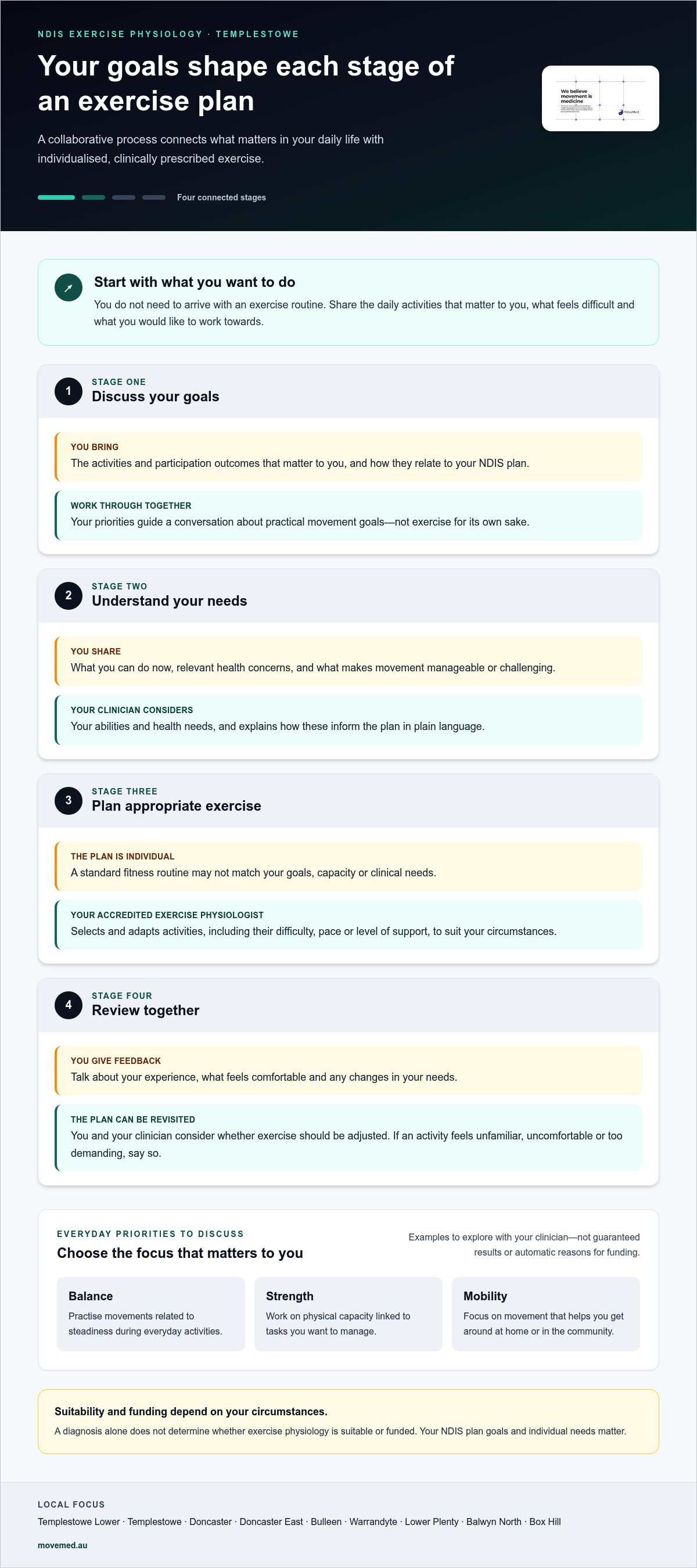
- Discuss your goals: Talk about the activities and participation outcomes that matter to you, and how they relate to your NDIS plan.
- Understand your needs: Consider your current abilities, relevant health concerns and what makes movement manageable or challenging.
- Plan appropriate exercise: Select and adapt activities to suit your goals, capacity and clinical needs.
- Review together: Discuss your experience and any changes in your needs, then consider whether the programme should be adjusted.
Starting with your priorities and current abilities
Your perspective helps set the starting point. Explain which daily activities you want to approach differently, what support feels comfortable and any concerns you have about exercise. Your clinician can consider this alongside relevant information about your abilities and health. They can explain their findings in plain language, so you understand how these inform the plan and can take part in decisions about next steps.
You don’t need to arrive with an exercise routine in mind. A conversation can help clarify what you want to work towards and which practical steps may suit you. If an activity feels unfamiliar, uncomfortable or too demanding, tell your Exercise Physiologist so they can consider an appropriate adjustment.
Building and reviewing a structured exercise programme
Exercise selection is individual. Your plan may include activities chosen to address the goals you’ve discussed, with the level of challenge shaped around your capacity and clinical needs. Accredited Exercise Physiologists are university-qualified allied health professionals who design, deliver and evaluate safe and effective exercise interventions. MoveMed develops personalised, evidence-based plans rather than generic fitness programmes.
Progress can be discussed in terms that connect with your goals: how an activity feels, whether it remains appropriate and what you’d like to focus on next. There’s no fixed timeline or guaranteed result. Your preferences and changing needs can inform adjustments, helping keep the plan relevant and workable.
The official NDIS website provides information about the scheme and its supports. To learn more about MoveMed’s approach, explore MoveMed’s NDIS support.
NDIS funding for exercise physiology: categories and plan types
Understanding how a service connects with your plan can make funding easier to navigate. NDIS support categories are classifications within an NDIS plan, such as ‘Improved Health and Wellbeing’ or ‘Improved Daily Living Skills’, under which services like Exercise Physiology are funded. Whether exercise physiology can be funded depends on your individual plan, its goals and budgets, and current NDIS guidance. A category name alone doesn’t confirm that a particular service is covered.
Which NDIS support categories may relate to exercise physiology?
The capacity building support category includes Improved Daily Living and Improved Health and Wellbeing, and is used to fund allied health services like exercise physiology. These categories can help you understand how a support relates to your plan, but they don’t guarantee that a particular plan covers a service.
Improved Daily Living is an NDIS support category that funds activities aimed at building functional skills such as balance, strength and mobility. Improved Health and Wellbeing is also named within the capacity building support category. Your plan and current NDIS guidance determine which funding arrangements apply to you.
MoveMed’s Accredited Exercise Physiologists provide clinical exercise support. You can find professional information through Exercise & Sports Science Australia (ESSA). For more on how an exercise plan may relate to personal goals, read the NDIS exercise physiology guide.
What to understand about your NDIS funding type
NDIS funding types describe how your plan is managed. This affects how providers are paid and what steps you take to arrange support. The broad differences are:
| Funding type | What to understand |
|---|---|
| NDIA-managed | The NDIA manages the funding. You generally use NDIS-registered providers for supports paid from this funding. |
| Plan-managed | A plan manager helps manage payments and budgets. Check how to organise invoices and confirm the support fits your plan. |
| Self-managed | You manage the funding and payments yourself, following the requirements that apply to your plan. |
These arrangements aren’t interchangeable, and the details affect how you organise exercise physiology. Before making plans, review your goals, relevant budgets and management arrangement. If you’re unsure how a support is treated, use your plan information and current NDIS guidance to understand your options.
For local NDIS exercise physiology in Templestowe, bring these details into a discussion with MoveMed. They can help you talk through how your goals and funding arrangements fit together, with your priorities guiding the next steps.
What progress can look like in everyday life around Templestowe
Progress in exercise physiology isn’t only measured by how much exercise you can do. It can also mean working towards an activity that matters to you, such as preparing a meal, getting ready to leave home or taking part in something with family or friends. Your goals give exercise a practical purpose, while your experience helps shape how progress is understood.
Functional goals make progress meaningful because they connect exercise with the everyday activities and participation that matter to you. The steps will differ from person to person. You might practise movements related to a task at home or work towards joining a community activity in Templestowe, Doncaster or nearby. These are examples to discuss, not promises of a particular result.
Connecting exercise with the activities that matter to you
Start with an activity you value. If you’d like to take part in a local outing, for example, you and your Exercise Physiologist might discuss which parts feel challenging and what movement skills are relevant. If spending time in the garden matters to you, the conversation could focus on the positions and movements involved. Your exercise plan can then reflect your priorities and clinical needs.
Progress may be gradual and won’t follow a guaranteed timeline. You might notice that an activity feels different, or decide your priorities have changed. Share what feels achievable, tiring or uncomfortable so your clinician has useful information to consider when reviewing the plan. Your feedback helps keep exercise connected to real life rather than treating the programme as fixed.
Working alongside your existing support team
You may already have people supporting different parts of your NDIS goals. If relevant, explain how exercise fits with those priorities and share information that helps keep your aims in view. A support coordinator or another clinician may be part of the conversation if you choose. Your preferences lead: you decide what matters to discuss and what feels useful.
To reflect on progress, consider what you want to do, what currently gets in the way and what changes you notice over time. Brief notes after activities or examples to discuss with your Exercise Physiologist can help you describe your experience and decide whether a goal still feels right. These observations can also help you choose what to focus on next.
With NDIS exercise physiology Templestowe support, the purpose is to connect clinical exercise with your priorities, not impose a standard idea of success. Progress might mean continuing with a goal, adjusting it or recognising that another daily activity matters more now. Each step can inform a plan that responds to you, your capacity and the life you want to take part in.
To read more about MoveMed’s approach, explore NDIS exercise physiology support with MoveMed.
Taking the next step with MoveMed’s NDIS exercise physiology in Templestowe
Starting a conversation doesn’t mean you need to have every funding detail worked out. If you’re considering NDIS exercise physiology in Templestowe, a few simple steps can help you explain what matters and explore how this support may fit your goals.
- Identify a priority: Think about a daily activity or movement goal you’d like support with. It could be something at home or an activity in your community.
- Review your plan information: If available, look over your goals, relevant support category, budget and funding management type. These details can help frame funding questions.
- Talk with MoveMed: Share your priorities and questions about NDIS exercise physiology. You can discuss your circumstances in clear, supportive language without having every answer beforehand.
What to have in mind before getting in touch
It may help to jot down what you want to work towards, which everyday activities feel challenging and what you’d like an exercise plan to take into account. You can also have relevant NDIS plan information nearby. These details offer a starting point for discussion, not a checklist of required documents or a promise of funding approval.
Questions are welcome. You might want to understand how your goals relate to exercise physiology, what a personalised approach involves or how your plan’s funding arrangement affects the next steps. If you’re unsure about a category or plan detail, raise it during your conversation. This can help clarify what you know and what you still need to understand.
Finding local support from Templestowe Lower
MoveMed provides NDIS exercise physiology in the Templestowe area, including support for people in Templestowe Lower, Templestowe, Doncaster, Doncaster East, Bulleen, Warrandyte, Lower Plenty, Balwyn North and Box Hill. You can discuss your goals with Accredited Exercise Physiologists and consider how clinical exercise may relate to your individual needs.
MoveMed’s NDIS exercise physiology guide offers more information about this type of support. You can review it alongside your plan and note any questions you’d like to discuss.
You don’t need a perfectly worded goal to begin. Start with what you’d like daily life to make room for, then take it from there. Talk with MoveMed about NDIS exercise physiology and discuss a practical next step together.
Take a practical step towards your goals
Your next step doesn’t need to be a complete plan. Start with one priority you’d like support with, then consider how movement could fit into everyday life. A conversation can help you explore your questions and decide what feels right for you.
MoveMed is an NDIS-registered provider and follows the NDIS Practice Standards. Its Accredited Exercise Physiologists develop personalised, evidence-based management plans, keeping your goals and individual needs central to the support. With NDIS exercise physiology Templestowe, you can start by sharing what you’d like to work towards and take the discussion from there.
You deserve support that listens to your priorities and treats you as an active partner in your care. Talk with MoveMed about NDIS exercise physiology and take a considered first step towards movement that matters to you.
Frequently Asked Questions
Can I use NDIS funding for exercise physiology?
You may be able to use NDIS funding for exercise physiology if the support aligns with your plan goals and available funding. It isn’t automatic for every participant, so review the goals and budgets in your plan and how your funding is managed. For example, if your plan includes a goal related to physical capacity, consider how exercise support might connect with it and discuss any uncertainties.
What NDIS support category does exercise physiology come under?
Exercise physiology may relate to capacity building support, including Improved Daily Living or Improved Health and Wellbeing, depending on your plan. These categories organise supports by purpose, but the category name alone doesn’t confirm that a service can be funded from your budget. Review your plan wording and consider whether the support connects with a stated goal. Current NDIS guidance can help you understand how your plan is structured.
Do I need a referral for NDIS exercise physiology?
Whether you need a referral can depend on your funding arrangements and the requirements that apply to your plan. Don’t assume every participant follows the same process. Before arranging support, review your plan information and current NDIS guidance, particularly if you’re unsure about the steps for your funding type.
What happens during an NDIS exercise physiology session?
An NDIS exercise physiology session focuses on your needs and the goals you want to work towards. You can discuss how movement feels, which activities are challenging and what you’d like to practise. Your Exercise Physiologist can explain the purpose of selected exercises and adapt them to your capacity and clinical needs. Ask questions, share feedback and discuss whether the activities feel relevant to everyday life.
Can NDIS exercise physiology help with mobility and independence?
Exercise physiology can support work towards mobility and everyday function, though results vary between people and aren’t guaranteed. Your plan might focus on movement skills related to changing position, moving through your home or taking part in an activity outside it. With NDIS exercise physiology Templestowe, goals are considered individually, so you can discuss what independence means to you and which daily activities you’d like your exercise plan to address.
Does MoveMed provide NDIS exercise physiology near Doncaster?
Yes. MoveMed provides NDIS exercise physiology in the local area, including Doncaster and Doncaster East. You can discuss your goals and plan information with the team and consider how clinical exercise support relates to your needs. It may help to note the daily activities or movement priorities you’d like support with.
How is an Accredited Exercise Physiologist different from a personal trainer?
An Accredited Exercise Physiologist is a university-qualified allied health professional who can design and evaluate clinical exercise interventions. A personal trainer generally supports fitness goals for healthy individuals. If you need exercise adapted around health needs or functional goals, an Exercise Physiologist’s clinical expertise can inform the programme. Personal training has a different focus, and both roles can be useful in the right context.


