

Could a TAC-funded gym membership help you exercise independently, rather than receive supervised rehabilitation? If you’re looking into a TAC funded gym program for rehabilitation Templestowe Lower, it’s understandable to wonder what TAC may cover and whether a gym or pool membership suits your injury and recovery goals.
A gym or pool membership supports independent exercise at a facility. Exercise Physiology is different: an Accredited Exercise Physiologist assesses your needs and prescribes an individual programme to support your recovery. Understanding the distinction can help you choose an approach that matches your goals.
This guide explains what to clarify about your treatment plan and TAC pathway. MoveMed provides TAC-funded Exercise Physiology at its Templestowe clinic, including an individual assessment and evidence-based planning. MoveMed accepts all compensable schemes, and you don’t need a GP referral to book with an exercise physiologist. MoveMed serves clients from Templestowe Lower, Templestowe, Doncaster, Doncaster East, Bulleen, Warrandyte, Lower Plenty, Balwyn North and Box Hill.
Key Takeaways
- A TAC funded gym program for rehabilitation Templestowe Lower may support independent exercise, while supervised Exercise Physiology provides clinician-led guidance.
- Gym or pool membership isn’t automatic: a treating professional must request it, and TAC makes the funding decision.
- Clarify how your exercise goals relate to your transport accident injuries and current treatment plan before choosing a pathway.
- Prepare for a rehabilitation discussion by noting movement challenges, recovery priorities and questions for your treating professional.
- MoveMed’s TAC-funded Exercise Physiology in Templestowe includes an in-clinic assessment, a personalised treatment plan and your first exercise programme.
TAC-funded gym rehabilitation near Templestowe Lower: what does the programme mean?
Recovering from an injury can be challenging without having to untangle exercise and funding options. If you’re considering a TAC funded gym program for rehabilitation Templestowe Lower, first consider whether you need independent access to a facility or clinician-led exercise care.
A TAC gym or pool membership can support an independent exercise-based rehabilitation programme developed and monitored by a health professional. It differs from treatment during a supervised appointment, and TAC decides whether it will fund the membership. For general context about the scheme, read this overview of the Transport Accident Commission (TAC).
What does a TAC gym or pool membership support?
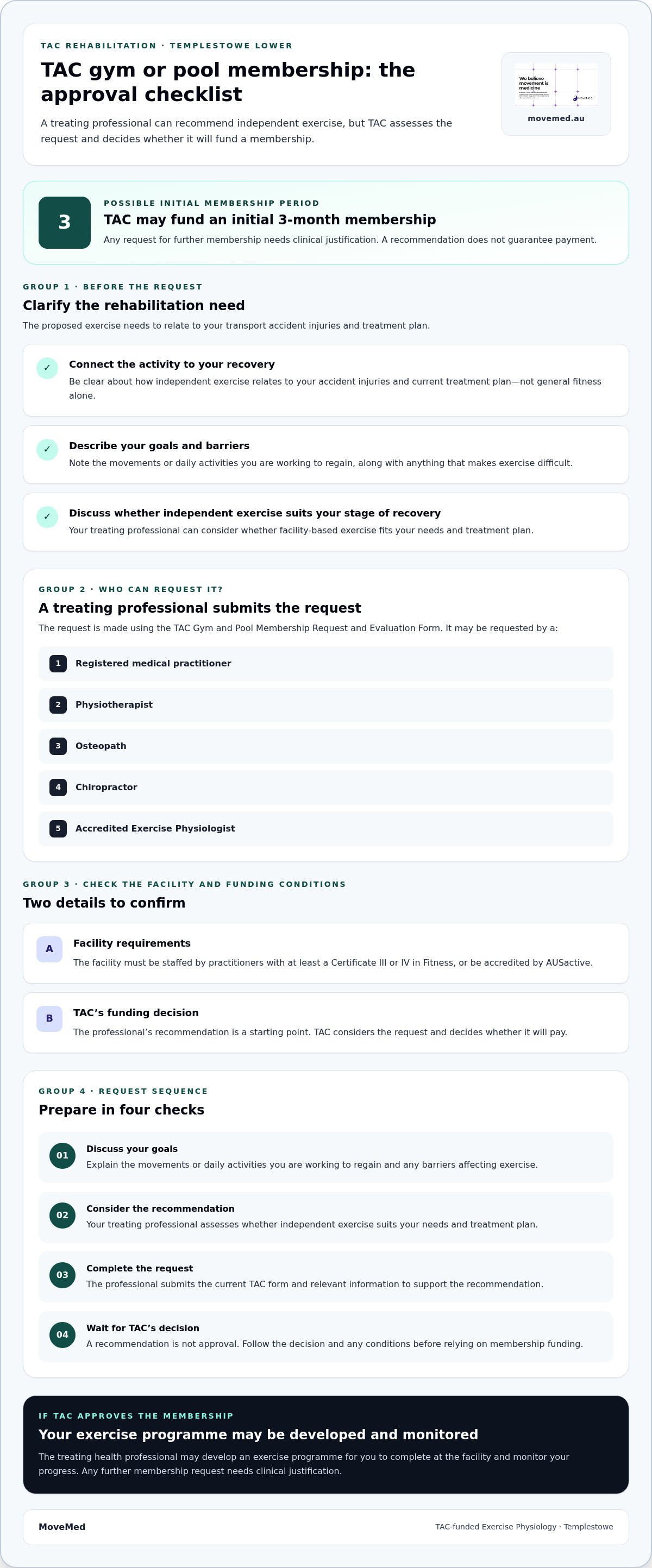
A treating professional may recommend a membership when independent exercise is appropriate for your recovery plan. A registered medical practitioner, physiotherapist, osteopath, chiropractor or Accredited Exercise Physiologist can request it using the TAC Gym and Pool Membership Request and Evaluation Form. TAC may fund an initial three-month membership; any further membership needs clinical justification. The facility must be staffed by practitioners with at least a Certificate III or IV in Fitness, or be accredited by AUSactive.
A recommendation does not guarantee payment. TAC considers the request, and the exercise must relate to your transport accident injuries and treatment plan. The purpose is to help you carry out prescribed exercise independently, potentially supporting a transition from provider-based care towards self-management. A gym or pool membership provides access to an exercise setting; it is not a substitute for every type of clinical care.
How is supervised Exercise Physiology different?
With Exercise Physiology, an Accredited Exercise Physiologist assesses your needs and prescribes exercises suited to your injury, abilities and rehabilitation goals. The programme is guided by clinical assessment, rather than a general fitness routine. At MoveMed’s Templestowe clinic, each programme follows a one-on-one assessment, so the exercise plan is shaped around your circumstances and treatment goals.
A gym or pool membership gives you a place to exercise independently. Supervised Exercise Physiology provides an individually prescribed rehabilitation programme guided by an Accredited Exercise Physiologist.
These options can sit within different compensable-scheme pathways, and funding decisions depend on the relevant scheme and your circumstances. MoveMed accepts all compensable schemes. For a related overview, see its guidance on TAC and WorkCover exercise physiology.
As you consider your next step, focus on the support you need to exercise safely and consistently. If you’re weighing up independent facility-based exercise and supervised care, discussing the difference with your treating professional can help clarify which pathway fits your current recovery goals.
How TAC gym or pool membership approval works for Templestowe residents
Understanding the process can make rehabilitation funding feel more manageable. For a TAC funded gym program for rehabilitation Templestowe Lower, the request needs to explain why independent exercise is suitable and how it relates to your recovery from a transport accident. A recommendation is a starting point, not a guarantee of funding.
TAC guidance describes a request made by an eligible health professional using the Gym and Pool Membership Request and Evaluation Form. TAC assesses the request and decides whether it will pay. Visit the Official Transport Accident Commission (TAC) Website for current forms and policy details, as requirements can change.
What information may be needed for a TAC membership request?
Your treating professional’s recommendation should connect the proposed activity with your accident-related rehabilitation goals. Before submitting a request, discuss what you’re working towards, why independent exercise may suit your current recovery stage, and how the activity fits your treatment plan. The form asks the professional to evaluate the request; TAC makes the funding decision.
Use this practical sequence to prepare:
- Discuss your goals. Describe the movements or daily activities you’re working to regain, and any barriers affecting exercise.
- Consider the recommendation. Your treating professional can assess whether independent exercise suits your needs and treatment plan.
- Complete the request. The professional submits the current TAC form and relevant information to support the recommendation.
- Wait for TAC’s decision. A recommendation is not approval. Follow the decision and any conditions before relying on membership funding.
Keep the focus on a specific rehabilitation need, rather than access to exercise for general fitness. Clear information can show how the proposed programme relates to your transport accident injuries and planned recovery.
What happens after TAC approves a membership?
If TAC approves the request, the treating health professional may develop an exercise programme for you to complete at the facility and monitor your progress. TAC’s guidance allows for an initial membership period, while any request for further membership needs clinical justification. Follow the decision and current guidance for the approved arrangements; ongoing membership is not automatic.
Approval depends on TAC’s assessment of the request and the documented rehabilitation need. A membership decision is separate from payment arrangements for clinical Exercise Physiology. MoveMed provides TAC-funded Exercise Physiology in Templestowe, with programmes prescribed after a one-on-one assessment. You can book an Exercise Physiology appointment with MoveMed.
TAC gym membership or supervised rehabilitation: which fits your recovery?
There isn’t one exercise pathway that suits everyone after a transport accident. If you’re weighing up a TAC funded gym program for rehabilitation Templestowe Lower and supervised care, start with what your recovery plan calls for: independent exercise, clinical guidance, or a combination at different stages. Your treating professional can help match the approach to your injury-related needs and current capacity.
The key difference is who guides your exercise and how the programme is developed. This comparison can help you frame the discussion.
- Purpose: A gym or pool membership can support independent exercise as part of rehabilitation. Supervised Exercise Physiology provides clinician-led care.
- Supervision: With membership, you generally complete the programme on your own at the facility. In Exercise Physiology, an Accredited Exercise Physiologist assesses and guides your programme.
- Programme design: A health professional may recommend exercises for you to perform independently. MoveMed’s Exercise Physiology programme is prescribed after a one-on-one assessment and tailored to your needs.
- TAC pathway: TAC decides whether it will fund a membership request. Exercise Physiology is a separate clinical service, with its own TAC funding arrangements.
Membership isn’t a replacement for every form of clinical care. It may suit you when independent exercise aligns with your treatment plan. A supervised approach may be more relevant when your programme needs individual clinical assessment and guidance. The right option depends on your circumstances, not simply on whether a gym or pool is nearby.
When might independent gym or pool exercise suit your plan?
Self-directed exercise may fit when your treating professional considers you ready to follow a programme independently and recommends facility-based activity for your accident-related rehabilitation. TAC approval and facility requirements still apply, so check current TAC guidance before making decisions based on membership funding. The recommendation should reflect your rehabilitation goals, rather than general fitness alone.
When might supervised Exercise Physiology be relevant?
Supervised Exercise Physiology may be useful when your exercise needs to account for injury-related limitations, movement challenges or changing capacity. An Accredited Exercise Physiologist assesses your needs and prescribes an individual programme, providing clinical direction rather than simply access to equipment. It doesn’t guarantee a particular result, but gives you a plan shaped around your assessment and rehabilitation goals.
If your funding pathway is the NDIS rather than TAC, the relevant arrangements differ. MoveMed’s NDIS Exercise Physiology and funding options explains that pathway. For TAC clients, bring your goals and questions to your treating professional so you can decide together which exercise support best fits your recovery now.
Getting started with TAC rehabilitation around Templestowe Lower
Taking a few notes before arranging care can make your next rehabilitation conversation clearer. Whether you’re considering independent exercise or clinician-led support, start with what you want to do more comfortably and what your TAC pathway needs to support.
What should you prepare before discussing your exercise plan?
Describe the activities you’re working towards, such as walking for longer, lifting everyday items or returning to a particular task. Note what feels difficult, which movements bring on symptoms and how your ability has changed. These details give your treating professional a practical picture of your goals and challenges.
It can help to bring relevant TAC correspondence and treatment-plan information to your appointment. You could also write down questions such as:
- Does my current plan recommend independent exercise, supervised Exercise Physiology, or another approach?
- How does the proposed exercise relate to my transport accident injuries?
- What information or next steps are needed for the pathway being considered?
You don’t need to arrive with every answer. The aim is to have a useful discussion and understand what action follows. If you’re seeking a TAC funded gym program for rehabilitation Templestowe Lower, distinguish a request for facility membership from arrangements for clinical treatment.
What should you clarify about funding and payment?
Membership approval and funded clinical care are separate matters. TAC decides whether to pay for a gym or pool membership request; a recommendation does not mean the membership is approved. For Exercise Physiology, clarify how your TAC claim and treatment plan relate to the clinical service, and what payment arrangements apply to your care.
MoveMed accepts all compensable schemes, and eligible plans and schemes are bulk-billed. Different services and memberships can follow different funding processes, so keep the decision or correspondence for each pathway clear. If a document is unclear, note the question and raise it with the relevant treating professional or TAC contact.
A simple preparation sequence can keep things manageable:
- Clarify your priorities. Write down the activities you hope to return to and the movement challenges you’re experiencing.
- Discuss the options. Talk through which exercise pathway fits your goals and current treatment plan.
- Gather relevant information. Keep TAC correspondence and treatment-plan details together for your discussion.
- Arrange the next step. Follow the recommended pathway, keeping any TAC decision separate from your clinical appointment arrangements.
MoveMed provides TAC-funded Exercise Physiology at its Templestowe clinic. You can book online through the Book an Appointment button, with no GP referral required. If clinician-led exercise is the right next step, book an appointment with MoveMed.
MoveMed TAC-funded Exercise Physiology in Templestowe: what care includes
Choosing your next step after an accident can feel easier when you know what the care involves. MoveMed provides TAC-funded Exercise Physiology at its Templestowe clinic. This is clinician-led rehabilitation, not a gym or pool membership: an Accredited Exercise Physiologist first assesses you one-on-one, then develops an individual programme around your needs and treatment goals.
The standard service includes an initial in-clinic assessment, a personalised treatment plan and your first exercise programme. The assessment helps the clinician understand your needs, the plan sets out the exercise approach, and the programme gives you structured activities to work on. Your plan reflects your circumstances, rather than a general fitness routine.
What happens during a MoveMed Exercise Physiology assessment?
Your Accredited Exercise Physiologist discusses your injury, movement challenges and rehabilitation priorities during a one-on-one assessment. This helps identify what you can do now and what you’re working towards. The clinician then prescribes an individual exercise programme suited to your needs and capacity, with the treatment plan providing direction for your care.
Accredited Exercise Physiologists are university-qualified allied health professionals trained to design, deliver and evaluate exercise interventions. MoveMed’s approach is evidence-based: exercise choices are guided by clinical assessment and your rehabilitation goals. The purpose is to give you a considered plan, not to promise a particular recovery result.
Your first programme is included in the standard service, alongside the assessment and personalised treatment plan. It gives you a structured starting point for exercise related to your injury and everyday movement needs. If your TAC pathway involves a gym membership request, its approval remains separate from arranging clinical Exercise Physiology.
How can local TAC clients take the next step?
If you live in Templestowe Lower, Templestowe, Doncaster, Doncaster East, Bulleen, Warrandyte, Lower Plenty, Balwyn North or Box Hill, MoveMed’s Templestowe clinic offers a local option for TAC-funded Exercise Physiology. Book online through the Book an Appointment button. MoveMed has a 5.0 ★★★★★ rating from 20 Google reviews.
Before your appointment, it may help to have your TAC claim information and relevant treatment-plan correspondence available. You can also note the movements or daily activities you want your programme to address. These details can help you explain what matters most to your recovery and take an active role in planning your care.
MoveMed accepts all compensable schemes. If individual, clinician-led exercise feels like the right next step, Book an Appointment with MoveMed to begin your TAC-funded Exercise Physiology care in Templestowe.
Take your next step with confidence
Your next move doesn’t need to settle every funding question at once. Start by deciding what you need from exercise at this stage of recovery: greater independence with a prescribed routine, or clinical guidance to shape your approach. That clarity can make your next conversation more focused and help you take part in decisions about your care.
If you’re considering a TAC funded gym program for rehabilitation Templestowe Lower, keep your rehabilitation goals at the centre of the discussion. Write down what you hope to return to, what feels difficult now and what support would help you take a manageable step forward. Your treating professional can help relate those priorities to an appropriate pathway and treatment plan.
When you’re ready to explore clinician-led exercise care, take the next step at a pace that feels right for you. Book an Appointment with MoveMed to discuss your rehabilitation needs and begin TAC-funded Exercise Physiology care in Templestowe.
Frequently Asked Questions
Does TAC pay for a gym membership after a transport accident?
TAC may pay for a gym membership if it approves the request. If you’re considering a TAC funded gym program for rehabilitation Templestowe Lower, don’t commit to membership costs based on a recommendation alone. Read the TAC decision carefully before enrolling, including any conditions it sets out, and keep a copy with your claim documents.
What is the difference between a TAC gym membership and Exercise Physiology?
A membership funds facility access for independent exercise, while Exercise Physiology is a clinical service. Consider what you need help with: access to a place to carry out an established routine, or professional input to plan exercise around your health needs. You can also clarify how changes to your symptoms or abilities would be addressed.
How do I request a TAC-funded gym or pool membership?
A treating health professional submits the TAC Gym and Pool Membership Request and Evaluation Form. To make the recommendation specific, prepare an example of an activity you’re working towards, such as managing stairs or walking to local shops, and describe what currently makes it difficult. This gives the professional practical information to relate the proposed exercise to your rehabilitation aims.
Can I use a TAC-funded gym membership for any injury or fitness goal?
No. The request needs to relate to rehabilitation for injuries from a transport accident, not an unrelated fitness aim. For example, wanting to build general strength is different from explaining how a particular exercise supports an accident-related functional goal. Describe the link between the activity and your recovery, rather than relying on a broad goal such as getting fitter.
Do I need a GP referral for Exercise Physiology at MoveMed?
No, a GP referral isn’t required. You can book directly. If you already have documents about your claim or treatment, keep them accessible so you can refer to relevant details during your care. This can help you explain your circumstances without making a referral a barrier to arranging an appointment.
Does MoveMed accept TAC-funded Exercise Physiology clients in Templestowe?
Yes, MoveMed provides TAC-funded Exercise Physiology at its Templestowe clinic. To arrange an appointment, use the online Book an Appointment button. You can note what you’d like support with so you’re ready to discuss your rehabilitation priorities during your appointment.
Can TAC fund both a gym membership and supervised rehabilitation?
It may be possible for both options to be considered, but approval of one does not automatically cover the other. Treat them as separate funding questions and understand what each decision authorises before proceeding. If both are being considered, discuss how each option relates to your goals and fits into your rehabilitation plan.


