
Water can make movement easier without making it effortless. Water therapy uses buoyancy, warmth and resistance to support exercise, reduce stress on joints and ease stiffness. For arthritis and joint pain, moving in water may feel more comfortable; for COPD, aquatic exercise may form part of a tailored activity plan.
If pain, stiffness or breathlessness makes land-based exercise difficult, it’s understandable to look for a gentler way to keep moving. Water-based exercise can support movement while still asking your muscles to work. The right approach depends on your symptoms and goals.
This article explains how hydrotherapy works, what it may offer for arthritis, joint pain and COPD, and what to consider for safety. You’ll also learn how water-based exercise can be adapted to your needs, and when guidance from an Accredited Exercise Physiologist can help you move forward with confidence.
Key Takeaways
- Buoyancy and water resistance can support movement while still giving your muscles useful work to do.
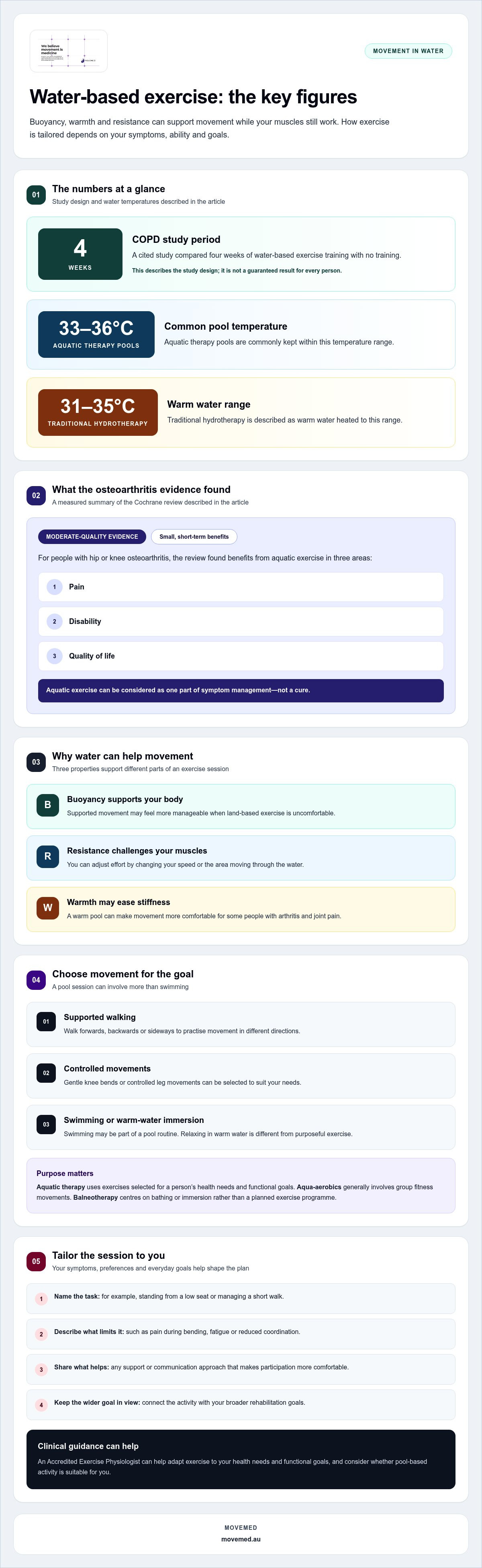
- For COPD, aquatic exercise may form part of a tailored activity plan; a study compared four weeks of training with no training.
- Warm water can ease stiffness, while reduced joint loading may make movement more comfortable for people with arthritis and joint pain.
- Health conditions, recent surgery and changes in symptoms can affect whether pool-based exercise is suitable and how it should be adapted.
- An Accredited Exercise Physiologist can help match aquatic and land-based exercise to your needs, goals and health considerations.
Aquatic exercise for COPD and musculoskeletal conditions
Hydrotherapy uses water to support movement, while aquatic exercise is the planned activity itself. In a therapy pool, buoyancy supports your body and water resistance challenges your muscles. Walking forwards, backwards and sideways, for example, works differently from swimming laps or relaxing in warm water.
For people with COPD, aquatic exercise can offer a way to practise movement while managing breathlessness and effort. A cited study compared four weeks of water-based exercise training with no training. That describes the study design, not a guaranteed result for every person.
A musculoskeletal condition affects muscles, bones, joints, tendons or ligaments. Water supports your body during activities such as gentle knee bends or walking, which can make movement more manageable when land-based exercise is uncomfortable. Water resistance also lets you adjust effort by changing your speed or the area moving through the water.
Aquatic therapy differs from aqua-aerobics in its purpose and how it is tailored. Aqua-aerobics generally involves group fitness movements, while aquatic therapy uses exercises selected for a person’s health needs and functional goals. Swimming can be part of a pool routine, but it isn’t the only option: supported walking and controlled leg movements can also build activity.
Evidence for osteoarthritis is encouraging but measured. A Cochrane review found moderate-quality evidence of small, short-term clinically relevant benefits from aquatic exercise for pain, disability and quality of life in people with hip or knee osteoarthritis. This supports considering pool exercise as one part of symptom management, not as a cure.
Balneotherapy differs from aquatic exercise: it centres on bathing or immersion, often for relaxation, rather than completing a planned exercise programme. Hydrotherapy may include relaxing in warm water, but its exercise component involves purposeful movement. The distinction matters when you’re considering whether your goal is comfort during immersion, improved movement or both.
Medicare and private health insurance coverage depends on eligibility and policy terms; hydrotherapy isn’t universally covered. Check the relevant benefit criteria before assuming a session will attract a rebate or insurance payment.
For clinically tailored exercise, look for an Accredited Exercise Physiologist. Accredited Exercise Physiologists are university-trained allied health professionals who design, deliver and evaluate safe, effective exercise interventions. Their expertise supports adapting movement to conditions such as COPD or osteoarthritis, rather than relying on a general pool-fitness routine.
Aquatic therapy pools are usually shallow, so you can exercise at a depth suited to your needs. Pools are commonly kept at 33-36ºC; traditional hydrotherapy is described as warm water heated to 31-35 degrees. Your comfortable depth and the movement being prescribed help shape the session.
Conditions and circumstances that may affect suitability
Suitability depends on the activity you want to do and the barriers you face. If dressing or getting out of a chair is difficult, for example, those tasks can help define a useful movement goal. Your current ability, symptoms and preferences also shape what feels manageable. A clear goal gives exercise a practical purpose beyond simply spending time in a pool.
Different health needs call for different session priorities. If pain makes repeated bending difficult, the focus might be practising a smaller, controlled range of movement. If fatigue limits daily activities, pacing and rest periods may matter more than increasing effort. These examples show why a programme should reflect how your condition affects daily function, rather than rely on a standard set of exercises.
Neurological conditions can affect coordination, sensation, communication or the ability to plan a movement. Someone who finds it difficult to change direction, for instance, may need clear instructions and a simple sequence. A person with altered sensation may benefit from discussing how to recognise discomfort. The right adjustment depends on which symptoms affect participation and which everyday tasks the person wants to practise.
Injuries vary in how they affect movement. A shoulder injury may limit reaching, while an ankle injury may make stepping challenging. The injury’s location, movements that bring on symptoms and your current abilities all help define an appropriate exercise focus. Describing a specific difficulty, such as reaching a shelf or stepping onto a kerb, makes the goal easier to discuss.
Before planning activity, consider what you want to improve and what makes that task difficult. Useful details include:
- The everyday movement you want to practise, such as standing from a low seat.
- The symptoms that affect it, such as pain during bending or reduced coordination.
- Any support or communication approach that helps you participate comfortably.
- How the activity fits with your broader rehabilitation goals.
These details turn a general wish to exercise into a focused plan. If your goal is to manage a short walk more comfortably, for example, discuss what currently limits that walk and what progress would look like in daily life. The plan can then centre on your priorities and abilities, with adjustments as your needs change.
If you’d like help connecting your health needs with an exercise goal, individualised exercise guidance can be a useful next step.
Hydrotherapy for arthritis and joint pain
Arthritis can make everyday movement uncomfortable, especially when stiffness affects routine tasks. In a pool-based programme, the focus can be on practising relevant movements at a manageable pace.
Arthritis and Joint Pain
For arthritis, hydrotherapy offers a setting to practise movement, while warm water may help ease stiffness and joint pain. Depending on what feels difficult, you might practise bending your knees, moving your hips or reaching with your arms. Linking each exercise to a daily task, such as getting dressed or standing from a chair, keeps the activity relevant to your goals.
Identify what you want to do more comfortably before choosing movements. Is it walking around the shops, getting in and out of a car, or preparing a meal while standing? Each goal involves different actions. A programme can be shaped around those actions and adjusted if a movement causes discomfort. The aim is to practise useful movement, not push through pain or treat pool exercise as a cure.
Warm water is one feature to consider, but your aims matter too. Someone troubled mainly by morning stiffness may want to practise a different sequence from someone whose main difficulty is bending to put on shoes. Describe when the problem occurs and what it stops you doing. This helps connect the exercise plan with your routine.
Buoyancy and Hydrostatic Pressure
For joint pain, consider how the pool setting can support a comfortable, purposeful session. Exercise choices can reflect which joints are affected and which movements you want to practise. Rather than focusing only on technical terms, consider whether the activity helps you work towards a specific function, such as reaching, stepping or turning.
Pregnancy and labour are separate contexts from arthritis-focused exercise. Using water during labour is not the same as following a programme for joint pain, so information about arthritis sessions should not be treated as guidance for pregnancy. The aim, activity and personal circumstances differ. Keep those questions separate when discussing water-based care.
If you live in Templestowe, Doncaster or nearby suburbs, consider how a pool-based programme would fit into your local routine. Its practical value may depend on whether the movements relate to activities you want to resume at home or in your community. A clear goal keeps the focus on function, rather than simply spending time in water.
Contraindications and safety considerations
Hydrotherapy can make some movements easier to practise than on land, but the pool setting doesn’t suit every exercise or person. Its main advantage is that movement can be approached with reduced joint loading. Land-based therapy, by contrast, practises movement under everyday weight-bearing conditions. The choice depends on your goals, symptoms and the task you need to work on.
A useful safety discussion starts with why you want to exercise. Explain what movement you want to improve, what limits it now and what you hope to do in the water. If you want to practise turning, for example, describe where turning feels difficult in daily life. This helps shape the session around a functional goal rather than a generic pool routine.
An initial assessment can cover your health history, current symptoms, movement abilities and comfort in water. Mention anything that could affect participation, including difficulty following instructions or entering and leaving the pool. These details help the clinician decide which movements and level of support fit the session. Share changes in your abilities as the programme progresses so activities remain relevant.
Before exercise begins, a safety induction should explain the pool environment and planned activity. Make sure you understand how to enter and exit, where the session will take place and how to communicate if you need to pause. If you’re uncertain about swimming or feel uneasy in water, say so. Confidence in swimming and comfort with a supervised exercise task are not the same thing.
During an aquatic therapy session, follow the agreed movement plan rather than copying others in the pool. An exercise that suits another participant may not match your health needs or current ability. Ask for an explanation if a movement feels unclear, and tell the supervising professional if you need to change pace or movement. Clear communication helps keep the session aligned with your purpose.
Before you begin, consider these practical points:
- Can you describe the everyday goal you want the session to support?
- Have you shared health details that could affect exercise participation?
- Do you understand the pool entry, exit and activity plan?
- Are you comfortable communicating if you need to pause or ask for help?
These questions help you take an active role in planning and compare aquatic with land-based options. Pool exercise may suit movements that feel difficult under full weight-bearing, while land practice can address tasks performed on your feet. A balanced plan can use the setting that best supports each movement goal.
Water-based physical therapy
Water-based therapy uses buoyancy, pressure, warmth and resistance to shape therapeutic movement. These properties can help you practise mobility and strength in a pool, then connect that work with rehabilitation goals on land.
A systematic review and meta-analysis reported an aquatic high-intensity interval training aerobic-performance effect size of SMD 0.69, with a 95% confidence interval from 0.39 to 0.98, across 191 participants, according to Authors of the cited systematic review and meta-analysis. This finding relates to aerobic performance in the reviewed participants, not every pool programme or health condition.
Depth changes the support water provides. Standing in waist-deep water supports 50% of a person’s body weight, while neck-deep water supports 90% of a person’s body weight. That difference can alter how demanding standing, stepping or walking feels. A clinician can use depth to adjust the amount of support during a movement task.
Water also provides resistance, with effort increasing as you move faster or more of your body moves through the water. Pushing your arms through the water, for example, creates more resistance than keeping them close to your body. This allows an exercise programme to adjust the challenge through movement choices, rather than relying only on weights or land-based equipment.
During rehabilitation after injury or surgery, pool exercises can help you practise movement with less joint loading. Someone working on walking might start with supported steps, then practise changing direction as control improves. Aquatic exercise can also address coordination and muscle function. After surgery, however, returning to pool activity requires medical guidance because immersion may increase infection risk.
Pool temperature varies by setting and purpose. Traditional hydrotherapy is described as physical therapy in warm water heated to 31-35 degrees, while aquatic therapy pools are usually kept at 33-36ºC. Warm water can help reduce stiffness, but temperature alone doesn’t define a therapy session. The exercise plan, depth and movement demands shape the physical work.
A physiotherapist may recommend a course of five or six aquatic therapy sessions, and a session may last 30 minutes. The number and duration describe possible arrangements, not a fixed prescription for every person. The aim is to select movements that relate to practical tasks, such as rising from a chair or walking with better control.
Water’s properties can change the support and resistance your body experiences, making it possible to grade exercise differently from land-based training. Progress can involve changing movement speed, direction, depth or arm position. These choices help connect pool activity with the function you want to practise during recovery.
Explore exercise support for your rehabilitation goals.
MoveMed: Exercise Physiology Consultations
MoveMed can help you turn the evidence on aquatic exercise into a plan that fits your health needs and everyday goals. Exercise Physiology Consultations use personalised, evidence-based management plans to address the factors affecting your movement, strength and independence.
If joint pain, COPD or another chronic condition makes exercise difficult, MoveMed’s Accredited Exercise Physiologists can guide you through appropriate activity options, including Hydrotherapy. Aged Care Funded Therapy and NDIS Funded Therapy may also support eligible people seeking help to maintain function and participate in daily life.
Consider an appointment when you need guidance adapting exercise to your symptoms, building a routine or working towards a practical goal, such as walking more comfortably. Book an appointment online or call MoveMed to discuss the next step for your needs.
Choose a next step that fits your goals
Living with pain, stiffness or breathlessness can make exercise feel like another challenge. You don’t need to start with a demanding routine. Begin by identifying one movement or daily task you’d like to make easier, such as walking to the shops, standing from a chair or reaching overhead. That goal can guide a practical conversation about whether aquatic exercise, land-based movement or a combination suits your needs.
Water therapy is one option in a broader approach to building movement and function. MoveMed offers Exercise Physiology Consultations and Hydrotherapy, including Aged Care Funded Therapy for eligible clients. An Accredited Exercise Physiologist can connect your health needs with meaningful activity, so your plan reflects what matters in everyday life.
Take the next step at your pace. Contact MoveMed to discuss your options and explore a path towards moving with greater confidence.
Frequently Asked Questions
What is hydrotherapy?
Hydrotherapy is planned activity or treatment in water that supports a health or movement goal. It differs from recreational swimming: a session might practise stepping, reaching or controlled leg movements. Think about a task you want to make easier, such as standing from a chair. That goal can help guide a conversation about whether pool-based activity fits alongside your broader care plan.
Can therapy be adapted for higher support needs?
Yes. Exercise can be tailored to your movement, health needs and functional goals. Before a session, explain what makes participation difficult, such as entering the pool, maintaining balance or following movement instructions. This gives the clinician useful context for planning suitable activities and support. MoveMed creates personalised, evidence-based management plans around individual needs, rather than relying on one routine for everyone.
HOW DOES WATER THERAPY WORK?
Water therapy works by changing how your body moves and bears load. Buoyancy supports your body, while water resistance challenges your muscles as you move. Walking faster or sweeping your arms through the water, for example, increases resistance. Warmth can also ease stiffness. These features help shape exercise, while movements and effort should match your health circumstances and goals.
What is water-based therapy and how does it work?
Hydrotherapy is a broad term for using water as part of care or exercise. A structured session has a purpose, such as practising balance or improving a particular movement. It isn’t the same as bathing or recreational swimming. A clinician can adjust the activity’s depth, speed and direction to suit the task you’re practising and connect exercise with everyday movement.
What conditions can aquatic exercise help address?
Aquatic exercise can support movement and function for people with arthritis, COPD and other musculoskeletal conditions. Activities can also be tailored around neurological conditions, including Parkinson’s disease or recovery after stroke, with goals such as practising balance or controlled stepping. It can form part of a broader care plan, but doesn’t replace treatment for the underlying condition.
What are the risks and contraindications of water therapy?
Health circumstances can affect whether pool exercise is appropriate. Cardiovascular conditions need consideration because immersion affects blood pressure. After surgery, ask your surgeon or healthcare provider before resuming activity, as pools, tanks and tubs can increase infection risk. Don’t replace prescribed treatment or medication with hydrotherapy, and avoid claims that water treatments remove toxins or cure disease. Report new or worsening symptoms promptly.
Where can I find hydrotherapy pools and services in Australia?
Look for supervised hydrotherapy connected to a health or movement goal. MoveMed provides Hydrotherapy from Templestowe for people in Templestowe Lower, Doncaster, Doncaster East, Bulleen, Warrandyte, Lower Plenty, Balwyn North and Box Hill. The service uses a warm-water pool for low-impact rehabilitation. It is guided care rather than open pool access, so the activity is planned around your needs.
What should I expect at a first hydrotherapy session?
Expect an initial in-clinic assessment, a personalised treatment plan and a first exercise programme. Your clinician can use your goals and health needs to guide the movements selected for the warm-water pool. If walking is a priority, for example, the programme can focus on movements related to that task. Share relevant symptoms and concerns before starting so they can inform the session.


