

Clinical hydrotherapy is not just a warm soak; it is an exact medical dosage of movement designed to rebuild your strength safely. If you are searching for a trusted melbourne hydrotherapy centre, you are likely looking for reliable relief from persistent pain or a controlled space to recover after an injury. Walking on hard surfaces can send sharp jolts through sensitive knees and hips, while the noise and slip hazards of a standard public gym often make independent exercise feel risky. When you also have to decipher complex NDIS or TAC funding rules on your own, knowing where to turn becomes overwhelming.
Discover how clinical hydrotherapy in Melbourne’s eastern suburbs can accelerate your recovery, manage chronic pain, and restore your independence. In this guide, we will explore how buoyant warm water dramatically reduces joint loading, why targeted rehabilitation led by Accredited Exercise Physiologists keeps you safe, and how you can put your funding plans to work without the stress of confusing paperwork.
Key Takeaways
- Discover how water buoyancy unloads painful joints so you can perform functional movements without fear of injury.
- Learn why clinical guidance from Accredited Exercise Physiologists ensures your pool program targets underlying causes rather than short-term symptoms.
- Find out how to fund your sessions through Victorian schemes like the NDIS, TAC, or WorkCover with dedicated administrative support.
- Identify the essential accessibility and climate features to look for when choosing a quality melbourne hydrotherapy centre.
- See how a structured progression from warm-water therapy to land-based strength training restores long-term physical independence.
Understanding the Role of a Melbourne Hydrotherapy Centre
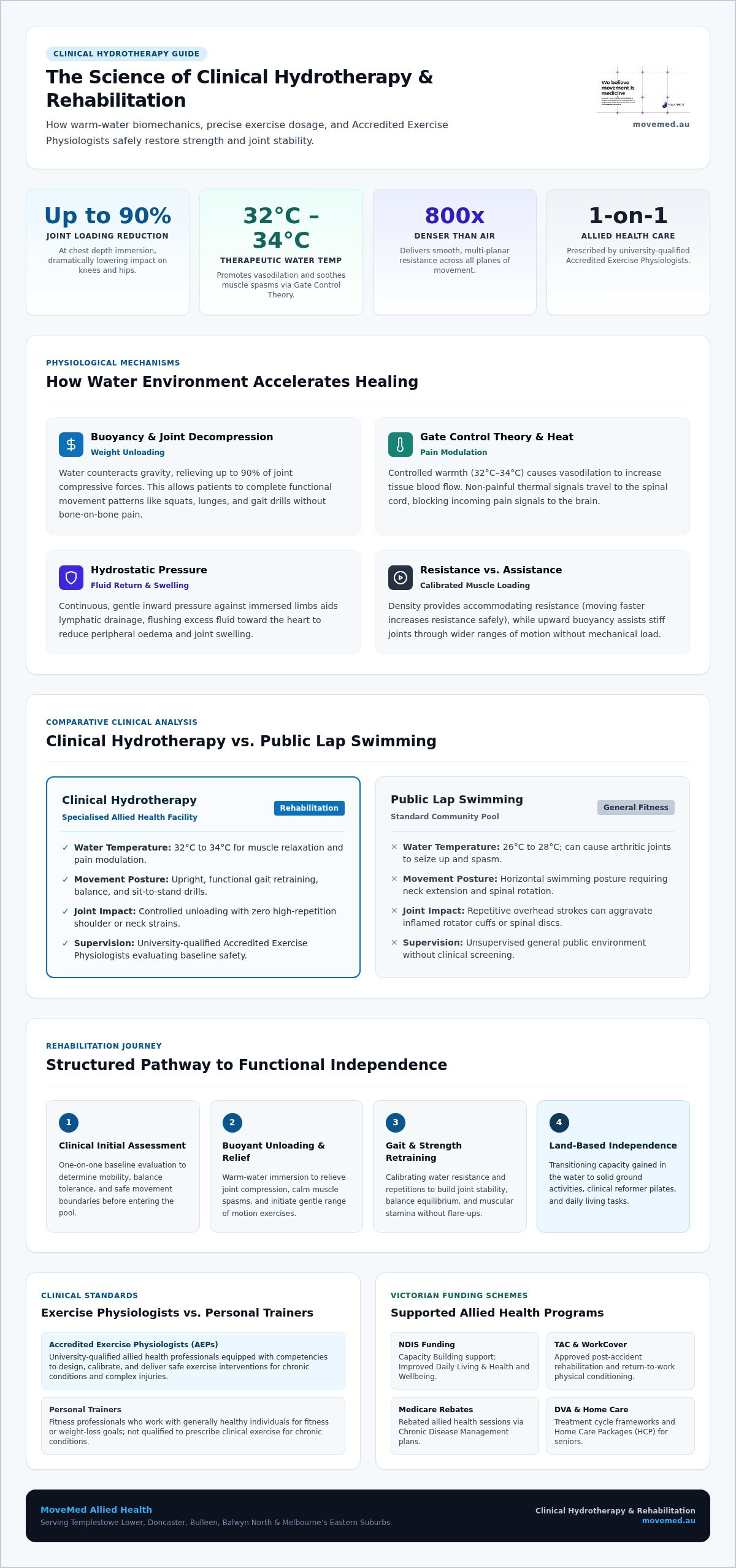
Stepping into a heated clinical pool offers an immediate sensation of relief. Clinical hydrotherapy uses the physical properties of water within a purpose-built environment to accelerate physical recovery and manage persistent conditions. Unlike a standard community swimming pool, a dedicated melbourne hydrotherapy centre maintains water temperatures strictly between 32°C and 34°C. This specific temperature promotes vasodilation (the widening of blood vessels), which increases blood flow to tense muscles and calms an overactive nervous system through Gate Control Theory, where soothing warmth blocks incoming pain signals to the brain.
The primary therapeutic benefit lies in the buoyancy factor. Immersing yourself to chest depth unloads up to 90% of your body weight. This dramatic reduction in joint loading creates a window of opportunity to perform functional movements, such as squats or lunges, without the painful compression felt on solid ground. In a clinical facility, you are not simply soaking; you are completing targeted rehabilitation under the direct care of an allied health professional.
The Science of Aquatic Therapy
Water offers physical characteristics that land-based clinics cannot replicate:
- Hydrostatic pressure: The continuous, gentle pressure exerted by water against your lower limbs helps flush fluid toward the heart, naturally reducing swelling and peripheral oedema.
- Resistance vs. assistance: Water is roughly 800 times denser than air. Pushing against water provides natural resistance across every plane of movement, while upward buoyancy assists stiff joints through wider ranges of motion without heavy weights.
- Thermoregulation: Stable 34°C water prevents the muscle spasms and flare-ups often triggered by cold environments, creating an ideal setting for conditions like Hydrotherapy for Fibromyalgia.
Hydrotherapy vs. Swimming
Many people ask why they cannot simply swim laps at their local aquatic centre. Swimming requires sustained horizontal alignment, repetitive overhead shoulder motions, and neck extension, movements that can irritate sensitive spinal discs or inflamed rotator cuffs. Lap pools are also kept much cooler (typically 26°C to 28°C) to prevent lap swimmers from overheating, which can cause arthritic joints to seize up.
In contrast, clinical hydrotherapy focuses on upright, functional movements. Under the direction of Accredited Exercise Physiologists, your sessions target balance, gait retraining, and joint stability. Water allows you to practise the real-world movement patterns needed for daily life, such as stepping up or standing from a chair, while eliminating the fear of falling on a hard surface.
Why Allied Health Supervision is Critical for Your Recovery
Entering an aquatic rehab program without proper clinical screening can quickly turn a therapeutic experience into an aggravated flare-up. Water removes gravity, but moving against water resistance still places significant demands on your muscles and tendons. Before you set foot in the pool at a melbourne hydrotherapy centre, a detailed initial assessment establishes your baseline mobility, balance tolerances, and movement boundaries. This one-on-one evaluation prevents post-session fatigue and ensures every movement strengthens your body without exceeding tissue capacity.
Supervision provides an essential layer of safety, particularly for individuals managing balance deficits or a heightened risk of falling. With university-trained clinicians monitoring your gait mechanics from the poolside or within the water, you can challenge your equilibrium safely. The end goal of aquatic rehab is rarely to keep you in the water indefinitely. Instead, we use buoyant unloading to build initial capacity, then transition you onto land-based movement like clinical reformer pilates to restore full functional independence on solid ground.
Exercise Physiology: The Long-Term Advantage
Exercise Physiology is a university-qualified allied health profession specialising in clinical exercise interventions for chronic health conditions and complex physical injuries. Unlike a personal trainer who works with healthy individuals on general fitness, Accredited Exercise Physiologists apply strict principles of exercise dosage. For conditions like osteoarthritis and type 2 diabetes, your AEP carefully calibrates water resistance, repetition volume, and resting intervals. This structured prescription builds muscular endurance and joint stability safely, adapting as your physical stamina improves over time.
Conditions That Thrive in the Water
Targeted aquatic rehabilitation is especially beneficial across three core patient presentations:
- Post-operative recovery: Following hip or knee replacements, warm water unloads sensitive surgical sites, allowing early restoration of normal gait patterns without severe pain.
- Neurological management: Through specialised Exercise Physiology for Neurological Conditions, individuals managing Parkinson's disease or Multiple Sclerosis experience fluid movement without the fear of falling on hard ground.
- Complex support plans: Clients managing long-term physical challenges can access pool rehab to alleviate persistent symptoms associated with NDIS-related disabilities.
Aligning with clinical guidelines like the WorkSafe Victoria hydrotherapy policy, structured water sessions must produce measurable functional improvements. If you want to move with confidence again, you can partner with MoveMed to create an aquatic rehab program tailored to your physical recovery goals.
Navigating NDIS, TAC, and WorkCover Funding in Victoria
Securing third-party coverage for aquatic rehab can feel like an administrative maze. Whether you are dealing with a workplace incident, a road trauma claim, or an ongoing disability plan, accessing a melbourne hydrotherapy centre should not be stalled by paperwork. In Victoria, several statutory frameworks fund structured exercise interventions when prescribed by allied health professionals to build physical capacity.
Medicare also offers pathways for those managing a chronic musculoskeletal condition. Through a Chronic Disease Management (CDM) plan arranged by your GP, eligible individuals can access Medicare rebates for up to five allied health consultations per calendar year. Local veterans in Templestowe and Doncaster can access treatment under the Department of Veterans' Affairs (DVA) framework. DVA covers clinically necessary exercise under a standard treatment cycle, which provides up to 12 sessions or 12 months of targeted care per GP referral.
NDIS Hydrotherapy in Melbourne’s East
To fund aquatic sessions under the National Disability Insurance Scheme, hydrotherapy must meet the criteria of being a 'reasonable and necessary' support. Funding sits within your capacity building support category, specifically under NDIS support categories such as Improved Daily Living or Improved Health and Wellbeing.
Your therapy cannot simply be passive leisure; it must directly link to functional, real-world goals, such as transferring out of a chair independently or improving walking stamina. MoveMed works alongside plan managers, support coordinators, and self-managed participants across all NDIS funding types. We manage the clinical progress reports and objective functional measures required by the NDIA to prove that your pool-based program delivers measurable improvements in daily mobility.
TAC and WorkCover Claims
Recovering from transport or workplace trauma requires a clear pathway back to pre-injury function. According to findings on evidence-based aquatic physiotherapy and exercise, water provides an ideal environment to restore joint mobility before the body can safely handle heavy ground forces:
- The referral pathway: Your GP or treating specialist recommends aquatic rehabilitation, providing a medical referral to an Accredited Exercise Physiologist.
- Approval and plans: For TAC claims extending past initial thresholds, or WorkCover cases requiring ongoing physical conditioning, your provider submits an Allied Health Treatment and Recovery Plan directly to the insurer.
- Early intervention benefits: Initiating gentle, active movement in warm water reduces secondary complications like muscle wasting and joint stiffness, paving the way for a faster, safer return to work.
Navigating these compensation schemes does not have to be an isolating chore. If you are an eligible veteran or war widow, explore our DVA Exercise Physiology Guide to understand referral requirements and see how aquatic therapy can fit into your broader care plan.
What to Look for in a Quality Melbourne Hydrotherapy Facility
Selecting the right facility directly influences how comfortable and confident you feel during aquatic rehabilitation. Public aquatic centres often feature slippery tiled concourses, loud acoustic echoes, and chilly air drafts that can trigger joint pain and anxiety. A clinical melbourne hydrotherapy centre is built from the ground up to eliminate physical barriers, ensuring you feel supported from the moment you leave your vehicle.
When assessing a potential pool, look for these non-negotiable features:
- Accessible water entry: Gradual sloped ramps with continuous grab rails, waterproof wheelchairs, and hydraulic pool hoists allow dignified, zero-gravity entry regardless of your baseline mobility.
- Regulated climate: Water temperatures must sit reliably between 32°C and 34°C, accompanied by heated ambient room air to prevent shivering and muscle tightness when exiting the water.
- Private, accessible amenities: Dedicated accessible change rooms must feature roll-in showers, sturdy grab bars, and ample clearance for walkers, wheelchairs, and support workers.
- Rehabilitation tools: A clinical setting relies on underwater dumbbells, resistance fins, and hydro-belts designed to alter buoyancy and fluid resistance systematically.
Location Matters: Finding Hydrotherapy Near Templestowe
Physical recovery requires weekly consistency. If you live in Melbourne's eastern suburbs, spending forty minutes sitting in stop-start traffic after a warm-water session quickly causes muscles to seize up again. Choosing a location close to your community makes attendance sustainable. MoveMed supports residents across Templestowe Lower, Doncaster, Bulleen, Warrandyte, and Lower Plenty. Prioritise venues that provide off-street, flat parking directly adjacent to the main entrance so your walk to the pool deck is short and safe.
Staff Qualifications
A heated pool is simply a container of water; the clinical value comes from the professional standing beside you. While pool lifeguards supervise water safety, they do not possess clinical diagnostic training. You should always ensure your program is designed by an Accredited Exercise Physiologist with current ESSA accreditation (Exercise & Sports Science Australia). When selecting a melbourne hydrotherapy centre, ask directly about the practitioner's background in managing your specific condition. If you want structured, evidence-based care tailored to your recovery, book an initial assessment with MoveMed to speak with an accredited clinician today.
The MoveMed Approach: Personalised Hydrotherapy in Templestowe Lower
Travelling into inner Melbourne or across the city for specialised treatment is draining when you are in daily pain. Residents across Doncaster, Bulleen, and Box Hill need local, expert-led aquatic rehabilitation close to home. At MoveMed, we do not believe in generic pool sheets or unsupervised swimming. We guide you through a structured, clinical journey designed to uncover the root causes of your symptoms and build lasting physical resilience.
Our clinical approach follows a clear four-step pathway:
- Step 1: Clinical assessment: We conduct a thorough land-based consultation to assess your range of movement, joint stability, and cardiovascular health before any pool work begins.
- Step 2: Goal setting: We outline clear, objective targets, whether your aim is walking around Ruffey Lake Park pain-free or returning to work safely.
- Step 3: Pool induction: Your Accredited Exercise Physiologist accompanies you into the 34°C water, guiding your initial movements and ensuring absolute safety during entry and exit.
- Step 4: Objective progression: As your joint confidence grows, we layer aquatic exercises with land-based strength training for seniors, helping you maintain functional independence over the long term.
Every milestone is measured. We track your joint angles, functional mobility scores, and pain levels so you have verifiable data to share with your GP, TAC case manager, or NDIS support coordinator during plan reviews.
Your First Session: What to Bring
Packing for your initial appointment is straightforward. Bring comfortable swimwear or clean activewear suitable for pool use, a dry towel, a water bottle, and any walking aids you rely on daily. During your initial consultation, we discuss your medical history, perform baseline functional tests, and walk you through pool access procedures. If you feel nervous about entering the water, rest assured that your clinician is beside you at every step, providing close supervision to ensure you feel secure.
Booking Your Assessment
Starting aquatic rehab does not need to be complicated. Private self-funded clients do not require a GP referral to begin consultations with our exercise physiology team, and private health insurance rebates can be claimed on the spot depending on your policy cover. For participants using NDIS funding, TAC support, or WorkCover, our administration team works directly with your coordinators and insurers to manage service agreements and progress reporting. Take the first step toward lasting, comfortable movement: Book your initial clinical assessment at MoveMed today.
Restore Your Freedom of Movement Today
Living with chronic joint stiffness or recovering from a significant injury can feel exhausting, but you don't have to navigate rehabilitation on your own. Heated aquatic exercise relieves painful joint compression while helping you rebuild genuine functional capacity. With the right clinical support, water becomes the stepping stone toward improved balance, greater walking tolerance, and lasting physical confidence on land.
At MoveMed, our university-qualified Accredited Exercise Physiologists deliver personalised care designed around your individual recovery goals. As a dedicated eastern suburbs clinic and an experienced NDIS and TAC registered provider, we handle the complex administrative reporting while guiding you safely through every pool session. Choosing the right melbourne hydrotherapy centre is an investment in your long-term independence. Book your hydrotherapy assessment at MoveMed Templestowe Lower today and experience how supported movement can transform your daily life.
Frequently Asked Questions
Do I need to be a strong swimmer to do hydrotherapy?
No, swimming skills are completely unnecessary. Clinical hydrotherapy takes place in shallow water where you can stand comfortably with your feet on the pool floor. Your Accredited Exercise Physiologist stays right by your side throughout your session, guiding you through gentle walking drills, balance exercises, and supported mobility work. Flotation aids and parallel grab rails are always available, giving you complete peace of mind while you move.
Is hydrotherapy covered by my private health insurance in Melbourne?
Yes, many private health funds provide rebates for hydrotherapy when conducted by an Accredited Exercise Physiologist under exercise physiology extras cover. Because rebate levels differ depending on your insurer and policy tier, it's best to check your specific coverage for exercise physiology consultations. Following each session, our administration team provides an itemised clinical receipt so you can claim your rebate directly with your health fund.
What should I wear to a hydrotherapy session if I have mobility issues?
Wear clean, comfortable swimwear or lightweight activewear that does not restrict your movement when wet. Many clients find swim shirts, rash vests, and chlorine-resistant shorts much easier to put on and take off than traditional one-piece bathers. Non-slip aqua shoes are also recommended to give you extra grip on pool ramps and concourses. Accessible change rooms are available to ensure changing remains private, dignified, and safe.
Can I use my NDIS funding for hydrotherapy sessions at MoveMed?
Yes, you can access hydrotherapy using NDIS funding under your capacity building support category, specifically Improved Daily Living or Improved Health and Wellbeing. Because our university-qualified Accredited Exercise Physiologists design clinical programs linked directly to functional everyday goals, our sessions meet NDIA guidelines. We support self-managed, plan-managed, and NDIA-managed participants across Templestowe Lower and surrounding eastern suburbs, handling the necessary progress reporting to keep your plan running smoothly.
How many hydrotherapy sessions will I need before I see results?
Most clients experience noticeable relief from joint stiffness and muscular tension after their very first session in the heated water. Lasting physical gains, such as increased walking endurance, reduced flare-ups, and improved balance, typically develop across a structured block of six to twelve weeks. Your clinician tracks your physical measurements continuously, progressing your exercises each week to ensure your aquatic gains translate effectively into daily activities on solid ground.
Is hydrotherapy better than physiotherapy for chronic back pain?
Both therapies offer distinct clinical benefits, but hydrotherapy is especially useful if standing or walking on hard ground triggers sharp back spasms. While traditional clinic care often relies on passive manual techniques, our hydrotherapy programs focus on active, unloaded movement prescribed by Accredited Exercise Physiologists. Warm water takes the crushing compressive force off your lumbar spine, allowing you to strengthen core stabilisers and restore spinal movement without aggravating sensitive nerves.
What is the difference between a hydrotherapy pool and a regular heated pool?
Standard heated leisure pools are kept around 26°C to 28°C for lap swimmers, whereas a clinical melbourne hydrotherapy centre maintains water temperatures strictly between 32°C and 34°C. This specific warmth promotes deep muscle relaxation, increases circulation, and dampens pain receptor signals. Clinical facilities also feature purpose-built accessibility ramps, hydraulic hoists, and continuous handrails, providing a calm, therapeutic environment without the splashing, noise, or chaos of public swimming pools.
Do I need a GP referral to visit a Melbourne hydrotherapy centre?
You do not need a GP referral to attend a melbourne hydrotherapy centre as a private, self-funded client. You can simply book an assessment and begin your aquatic recovery immediately. However, if you plan to fund your sessions through Medicare Chronic Disease Management plans, the DVA treatment cycle, TAC, or WorkCover, an official referral from your GP or treating medical specialist is required so our clinic can process your claims accurately.


