
What if resting on the couch is actually making that tight, aching sensation behind your leg worse? Experiencing persistent soreness in back of knee tissues can be deeply frustrating, especially when walking downstairs, squatting, or working in the garden brings on sharp discomfort. You might find yourself wondering whether you have pulled a hamstring, developed a Baker's cyst, or triggered joint wear, while worrying that staying active will only cause further damage.
The reassuring reality is that posterior knee pain rarely means your joint is wearing out. More often, it simply highlights an underlying mechanical imbalance that needs better muscular support. You will discover what causes soreness behind your knee and how targeted movement restores lasting joint stability. We will clear up common recovery myths, explain why gentle loading protects your cartilage, and guide you through safe, evidence-based ways to move so you can regain mobility and return to your favourite daily activities with confidence.
Key Takeaways
- Pinpoint the underlying driver: persistent soreness in back of knee tissues often stems from tendon overload, meniscus irritation, or fluid buildup in the popliteal space rather than irreversible damage.
- Understand Baker's cysts: these posterior swellings are rarely isolated issues, but rather clear signals of joint irritation that settle when you address overall joint mechanics.
- Recognise critical warning signs: simple self-checks help you distinguish workable mechanical stiffness from red flags that require prompt medical evaluation.
- Replace passive rest with active recovery: progressive, guided movement nourishes cartilage and rebuilds joint stability far more effectively than bed rest.
- Access structured clinical care: targeted exercise programs guided by Accredited Exercise Physiologists, such as the GLA:D program, offer lasting relief and restore confidence in your daily movement.
Understanding the Popliteal Space: What Causes Soreness in the Back of the Knee?
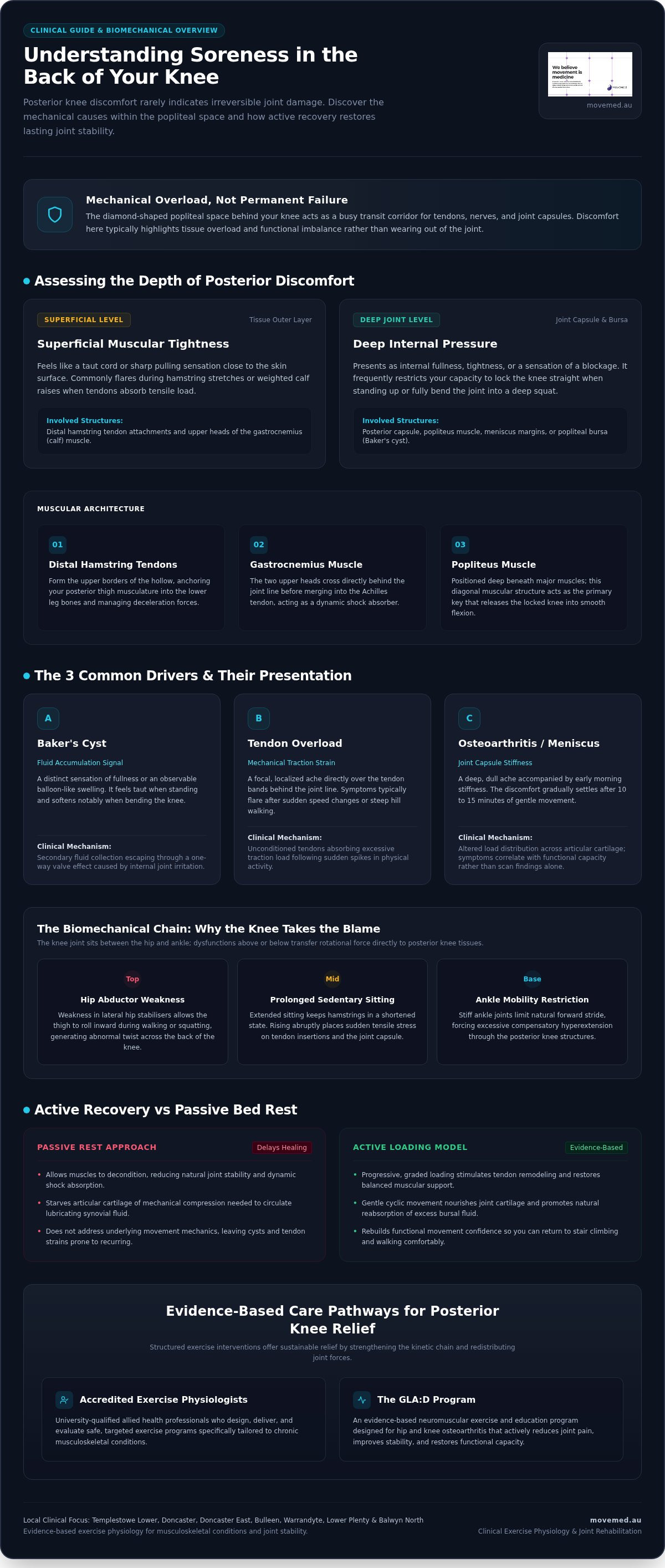
That persistent ache behind your knee is rarely a sign of permanent structural failure. The diamond-shaped shallow depression behind your joint, clinically known as the Popliteal fossa, serves as a busy transit corridor for major tendons, nerves, blood vessels, and the posterior joint capsule. Because so many working tissues converge in this tight space, soreness in back of knee tissues usually reflects tissue overload rather than irreversible joint damage.
Understanding what you feel starts with identifying the depth of your symptoms:
- Superficial muscular tightness: Often feels like a taut band or pulling sensation close to the skin surface, typically flaring during hamstring stretches or calf raises.
- Deep internal pressure: Feels like an internal fullness or blockage, making it difficult to fully bend or lock the knee straight when standing up from a chair.
The Anatomy of the Posterior Knee
Three primary muscular structures dictate how forces travel across this space. The distal hamstring tendons border the upper half of the hollow, anchoring your thigh muscles into the lower leg bones. Below them, the two heads of your gastrocnemius (calf) muscle cross directly behind the joint line before merging into the Achilles tendon. Tucked deep beneath these larger muscles sits the popliteus, a small, diagonal muscle that acts as the primary key to unlock your knee joint when moving from a straight leg into a bend.
How Mechanical Load Affects Knee Tissues
Muscles and tendons adapt steadily to the demands you place on them. When you rapidly spike your walking volume, tackle steep hills, or spend hours kneeling in the garden, unconditioned tendons absorb excessive traction force. Similarly, prolonged sitting leaves your hamstrings in a shortened position; standing up abruptly then places sudden tensile stress on both the tendon insertions and the posterior capsule.
Your knee also does not work in isolation. If weakness in your hip abductors allows your thigh to roll inward, or if stiff ankles limit your natural forward stride, rotational torque transfers directly into the back of the knee. Over time, these subtle biomechanical shifts can cause mechanical irritation and soreness in back of knee structures, signaling that your joint needs better load distribution rather than complete rest.
Common Drivers: Baker Cysts, Tendon Overload, and Knee Osteoarthritis
When persistent discomfort flares up behind your leg, it is easy to assume something has torn or permanently worn down. In practice, posterior symptoms usually stem from how joint fluid and soft tissues respond to unequal mechanical pressure. An MRI scan might show structural changes, but findings like mild cartilage wear or small meniscal tears are common even in people with pain-free knees. Symptoms depend far more on functional capacity than an image alone.
To identify the likely driver of your discomfort, look for these distinct patterns:
- Baker's cyst: A sensation of tightness or an observable balloon-like swelling that feels taut when standing and softens when bending.
- Tendon overload: A focal, sharp ache located directly over the tendon cords behind the joint line, worsening after hill walks or speed changes.
- Osteoarthritis or meniscus irritation: A deep, dull ache accompanied by early morning stiffness that gradually eases after 10 to 15 minutes of light movement.
Demystifying Popliteal Cysts and Swelling
A Baker's cyst is rarely an isolated disorder. When an underlying musculoskeletal condition causes internal joint irritation, your knee produces excess synovial fluid (joint lubricating fluid). This fluid naturally migrates backward into the popliteal bursa through a one-way valve effect, creating a noticeable bulge. Simply draining the fluid often leads to recurrence because the primary joint irritation remains. Once you improve joint loading through guided movement, the joint calms down and fluid levels reabsorb naturally.
Hamstring and Calf Tendinopathy
Tendons are dynamic shock absorbers. Sudden spikes in uphill hiking around Warrandyte or power walking through Doncaster East can exceed the load capacity of your distal hamstring or upper gastrocnemius tendons. Tendons rebel against sudden passive stretching when irritated. Instead of aggressive pulling, they recover through progressive isometric and eccentric resistance training, building resilience to handle your body weight efficiently.
Knee Osteoarthritis and Meniscus Changes
As joint cartilage undergoes natural age-related thinning, load distribution across the tibia and femur shifts backward. This extra force frequently stresses posterior capsule structures. Similarly, degenerative meniscus fraying is often a normal part of ageing, much like grey hair. Multiple clinical trials demonstrate that targeted exercise matches arthroscopic surgery for long-term function without the invasive recovery. Cartilage is an active tissue that requires cyclic, graduated loading to absorb essential nutrients.
Working alongside an experienced allied health clinician ensures your movement program calms irritated tissues without worsening swelling. You can explore structured, clinic-guided recovery options through MoveMed's clinical exercise consultations to rebuild strength and confidence in your daily steps.
Evaluating Symptoms: When to Rest, Move, or Seek Immediate Clinical Assessment
Experiencing persistent soreness in back of knee tissues often leaves you stuck between two fears: doing too much and aggravating the problem, or doing too little and growing weaker. Mechanical knee discomfort typically behaves predictably, rising and falling with changes in your physical activity. Knowing how to interpret these signals gives you the clarity to stay active safely while spotting issues that require urgent medical attention.
Red Flags Requiring Prompt Medical Attention
Most posterior discomfort relates directly to tendon or joint overload. However, serious medical issues can also present in the back of the leg. Deep vein thrombosis (DVT), a blood clot in the deep calf veins, requires emergency medical clearance because it can become life-threatening if left untreated.
Contact a doctor or emergency clinic immediately if you experience:
- Sudden, rapid swelling in the calf or lower leg, especially when accompanied by noticeable redness and skin that feels hot to the touch.
- Unexplained shortness of breath, sudden chest pain, or lightheadedness alongside leg discomfort.
- A sudden inability to bear any body weight on your leg following an acute twisting injury or audible pop.
- Systemic signs such as chills, malaise, or an unexplained fever paired with localized joint heat.
Using the Traffic Light System for Movement
If acute medical red flags are ruled out, mechanical discomfort does not mean your knee is sustaining damage. Cartilage and tendons need gentle mechanical stimulation to heal. You can use a simple traffic light framework to monitor your daily activity:
- Green (0 to 3 out of 10): Mild, tolerable stiffness that warms up during walking and settles completely within 24 hours. Keep going; your joint is adapting well.
- Amber (4 to 5 out of 10): Noticeable discomfort that lingers into the next morning. Do not stop moving entirely, but modify your load by shortening your walk or choosing flatter ground.
- Red (6 out of 10 or higher): Sharp pain causing you to limp, or swelling that noticeably increases over consecutive days. Pause intense loading and focus on gentle, pain-free range of motion.
Relying on this framework helps you break the frustrating boom-and-bust cycle of overdoing it on good days and resting completely on bad days. When soreness in back of knee tissues persists beyond a few weeks, consulting an Accredited Exercise Physiologist helps identify the specific movement flaws driving your flare-ups, giving you a tailored plan to move forward.
Why Passive Rest Delays Recovery: Building Joint Stability Through Active Loading
When the back of your leg aches, taking complete bed rest feels like the safest decision. Traditional advice frequently recommended putting your feet up and icing the joint until all discomfort vanished. Modern exercise science shows that prolonged rest is often counterproductive. Tendons, ligaments, and cartilage require regular mechanical load to stay strong, lubricated, and healthy.
Stopping movement causes supporting muscles to weaken within days. When you eventually resume walking, unconditioned tissues absorb higher impact forces, triggering the exact irritation you hoped to avoid. Rebuilding joint stability through controlled, progressive loading protects the joint capsule and relieves tension behind the knee.
The Problem with Prolonged Inactivity
Joints rely on a natural pumping mechanism to stay nourished. Cartilage lacks its own direct blood supply; it depends on cyclic compression and release to draw in nutrient-rich synovial fluid. Prolonged sitting or couch rest leaves tissues starved of nourishment, causing mornings to feel increasingly stiff and restricted.
As stabilizing muscles like the quadriceps and gluteals lose their firing capacity, ground reaction forces shift away from active shock absorbers directly into passive joint capsules. Beyond the physical decline, avoiding neighborhood strolls or social gardening quickly chips away at your confidence, breeding an unnecessary fear of movement.
Step-by-Step Approach to Progressive Loading
Restoring a sensitive knee requires a structured progression rather than jumping straight back into heavy activity. Tendons and capsules respond best to deliberate stages:
- Isometric contractions: Sustained holds, like a gentle seated leg extension or bridge hold against light resistance, calm tendon sensitivity and restore motor unit recruitment without irritating movement.
- Closed-kinetic-chain loading: Controlled movements where your foot remains anchored to the floor, such as sit-to-stands or shallow wall squats, reinforce quadriceps and calf strength while maintaining optimal joint alignment.
- Dynamic functional patterns: Step-ups, controlled eccentric lowering, and single-leg balance drills build the capacity needed for descending stairs and walking down sloped driveways pain-free.
Strengthening the hips and calves ensures rotational forces do not twist through the popliteal hollow. Incorporating targeted equipment through clinical reformer pilates sessions provides spring-assisted resistance, allowing you to retrain movement patterns and build deep lower-limb control without overloading sensitive structures.
Safe loading transforms your recovery from fragile rest into lasting joint resilience. If persistent soreness in back of knee tissues continues to disrupt your day, an individualized active loading plan is the most reliable way to rebuild lasting capacity.
Evidence-Based Care Pathways: Finding the Right Support for Lasting Relief
Masking knee pain with anti-inflammatory tablets or relying solely on passive rub-on creams only offers temporary relief. When discomfort persists, partnering with qualified movement experts helps you uncover the biomechanical origin of your symptoms and build a clear path forward. For residents across Templestowe Lower, Doncaster, Bulleen, and Box Hill, specialised community care bridges the gap between clinical advice and confident daily living.
The Role of an Accredited Exercise Physiologist
Accredited Exercise Physiologists are university-qualified allied health professionals equipped to assess whole-body movement mechanics, joint angles, and muscle activation patterns. Rather than handing out generic exercise sheets, an exercise physiologist designs structured interventions matching your physical capacity and goals. Care can often be accessed through established funding frameworks, including Medicare Chronic Disease Management plans, NDIS support categories, DVA treatment cycles, TAC, WorkCover, or private health insurance extras.
Specialised Programs: GLA:D and Aquatic Therapy
Targeted clinical programs offer tested alternatives to invasive procedures. If joint wear or meniscus changes drive your posterior discomfort, the GLA:D program delivers structured neuromuscular education and resistance training. Research across Australia highlights that participants in the GLA:D program achieve an average pain reduction of 36%, alongside reduced medication use and improved mobility.
When weight-bearing movement on land feels too irritable, hydrotherapy for joint pain relief offers a gentle entry point. Moving in a heated pool harnesses water buoyancy to reduce joint compressive loading by up to 90%, allowing you to restore range of motion and rebuild muscle tone without irritating posterior knee structures.
Taking Your First Step Toward Pain-Free Movement
Lasting recovery requires shifting your focus from short-term symptom relief to long-term joint capacity. During an initial clinical assessment, your clinician will review your daily movement habits, test your balance and muscular control, and outline a realistic, step-by-step loading plan. You don't have to let lingering soreness in back of knee tissues hold you back from gardening, bushwalking, or keeping up with family. Book your initial consultation with MoveMed today and start your journey toward strong, resilient joint movement.
Restoring Confidence and Strength in Every Step
Posterior knee discomfort doesn't mean your active lifestyle is behind you. Persistent soreness in back of knee tissues is primarily a signal of mechanical overload and muscular imbalance, not irreversible joint breakdown. By stepping away from passive rest and embracing progressive loading, you supply your cartilage with vital nutrients while rebuilding lasting joint stability.
You don't have to navigate recovery alone. Conveniently located to support residents across Templestowe Lower, Doncaster, and Melbourne's eastern suburbs, MoveMed designs individualised care around your personal physical goals. Whether through clinic-based loading, warm-water hydrotherapy, or the evidence-based GLA:D program for osteoarthritis, our university-qualified clinicians guide every stage of your rehabilitation.
Take the next step toward pain-free movement. Partner with our Accredited Exercise Physiologists at MoveMed to restore your knee health and rediscover the joy of an active, independent life.
Frequently Asked Questions
Why is the back of my knee sore when I bend it?
Bending your leg increases fluid pressure inside the joint capsule, especially if swelling is already present. This compression commonly pinches an enlarged Baker's cyst or strains the posterior horn of your meniscus. Tightness in the distal hamstring tendons can also produce a gripping ache across the popliteal crease during deep knee flexion, such as when kneeling down or getting up from low chairs.
Can a Baker cyst behind the knee heal without surgery?
Yes, Baker's cysts frequently resolve without surgical excision. Because these fluid pockets develop in response to internal joint irritation or cartilage stress, treating the underlying knee condition is the most effective approach. By improving joint stability and load distribution through guided exercise, synovial fluid production returns to normal, allowing the cyst to shrink naturally without recurring.
Should I walk if the back of my knee hurts?
Gentle walking is generally beneficial, provided your discomfort remains mild and settles within twenty-four hours. Complete rest often causes joint stiffening and weakens supporting leg muscles. If soreness in back of knee tissues intensifies while walking or causes a noticeable limp, reduce your walking distance, avoid steep hills, and break your walks into smaller, manageable intervals across the day.
How do I know if posterior knee pain is a blood clot?
Deep vein thrombosis usually presents with distinct symptoms that differ from mechanical joint aches. Warning signs include rapid swelling in one calf or lower leg, visible redness, skin that feels hot to the touch, and severe tenderness when gently squeezing the calf muscle. If these symptoms occur, particularly alongside sudden breathlessness, seek immediate medical care at a hospital emergency department.
What is the difference between a hamstring strain and popliteal soreness?
A hamstring strain usually occurs suddenly during forceful movement like sprinting, kicking, or rapid deceleration. You will typically feel localised tenderness along the muscular cords on either side of the leg. Popliteal soreness, in contrast, tends to develop gradually as a diffuse, deep ache or tightness centred in the crease behind the knee joint, often linked to fluid accumulation.
Can exercise physiology help relieve back-of-knee soreness?
Yes. Accredited Exercise Physiologists assess how your hips, ankles, and knees move together to uncover the root mechanical triggers of your discomfort. Rather than applying temporary fixes, they design tailored loading programs to strengthen your calves, hamstrings, and quadriceps. For residents across Templestowe Lower and Doncaster, this clinical approach rebuilds joint capacity and eliminates persistent soreness in back of knee structures.
How does the GLA:D program assist with joint pain behind the knee?
The GLA:D program teaches you how to control your knee joint during everyday movements. By improving neuromuscular control, the exercises ensure your hip, knee, and foot stay aligned when standing, bending, or walking. This enhanced muscular support reduces abnormal joint compression and posterior capsule strain, helping manage joint wear effectively while building long-term confidence in your physical mobility.


