

Exercise isn’t one-size-fits-all, especially when pain, a chronic condition or an injury affects what feels safe. You may be looking to build strength or improve everyday movement without aggravating symptoms. An exercise physiologist assesses your health, movement and goals, then develops a structured exercise plan suited to your needs. In Australia, exercise physiologists are allied health professionals with four years of university training.
If you’re exploring allied health exercise physiology in Doncaster, understanding the clinical approach can help you decide whether it fits your needs. You’ll learn what Accredited Exercise Physiologists do, which health conditions they may support, and how an individualised program can combine exercise and lifestyle guidance to work towards your goals. We’ll also explain how assessment informs the plan and what to expect from ongoing care, so you can take your next step with greater clarity.
Key Takeaways
- Learn how an Accredited Exercise Physiologist’s clinical training shapes safe, personalised exercise support.
- See how exercise physiology may support people managing chronic, musculoskeletal and neurological conditions.
- Understand how assessment can guide an exercise and lifestyle program around your health needs and goals.
- Explore local options, including Exercise Physiology Consultations, hydrotherapy and funded therapy through MoveMed.
Accredited exercise physiology and clinical care
Exercise physiology uses structured exercise to support health and physical function. In Australia, exercise physiologists have four years of university training.
Available exercise physiology services
Allied health exercise physiology in Doncaster can involve assessment, prescribed exercise and progress reviews. An Accredited Exercise Physiologist considers your health, movement and goals when planning clinical exercise. Exercise physiology focuses on exercise-based support, while physiotherapy may also involve hands-on assessment and treatment. Your needs and goals can help you decide which approach is suitable.
Funding and referral options
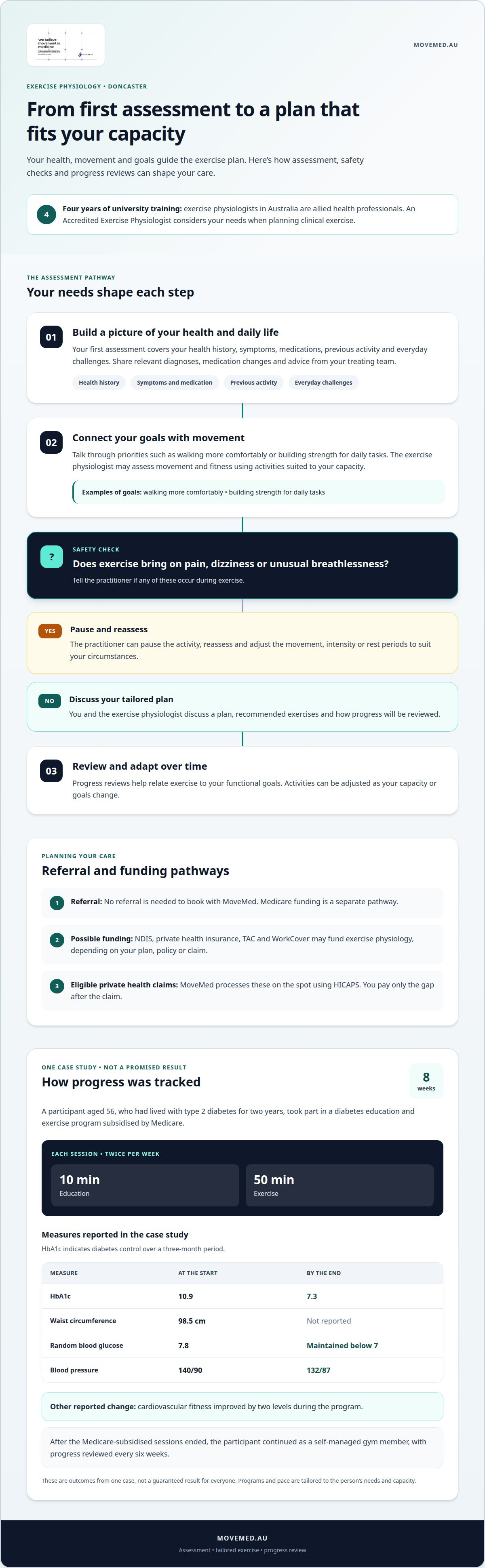
No referral is needed to book with MoveMed; Medicare funding is a separate pathway. NDIS, private health insurance, TAC and WorkCover may also fund exercise physiology, depending on your plan, policy or claim. MoveMed processes eligible health-fund claims on the spot using HICAPS, an electronic system for claiming private health insurance rebates. You pay only the gap after the claim.
Initial assessment process
Your first assessment covers your health history, symptoms, medications, previous activity and everyday challenges. The exercise physiologist discusses your priorities, such as walking more comfortably or building strength for daily tasks. They may assess movement and fitness using activities suited to your capacity. Together, you’ll discuss a tailored plan, recommended exercises and how progress will be reviewed.
When seeking allied health exercise physiology in Doncaster, share relevant diagnoses, medication changes and advice from your treating team. Tell the practitioner if exercise brings on pain, dizziness or unusual breathlessness. They can pause and reassess the activity, then adjust the movement, intensity or rest periods to suit your circumstances.
Conditions treated by exercise physiologists
Exercise physiology can support people living with chronic illness, injury or reduced mobility. A chronic medical condition is one that has been, or is likely to be, present for at least six months. The appropriate exercise approach depends on how your condition affects movement, energy, balance and everyday activities, not just its name.
For a musculoskeletal condition, which affects muscles, bones, joints, tendons or ligaments, pain can make ordinary tasks harder. A tailored program may focus on strength, mobility and joint stability, the muscles’ and ligaments’ role in maintaining joint alignment. For example, someone with knee osteoarthritis may work towards easier walking and standing through suitable strengthening and movement exercises.
Neurological conditions can affect coordination, balance and control of movement. Exercise Physiology for Neurological Conditions may support people with Parkinson’s disease, multiple sclerosis or post-stroke rehabilitation. An exercise physiologist can adapt activities to a person’s abilities and build practice around functional goals, such as steadier transfers, walking or managing daily tasks.
Exercise support can also form part of care for type 2 diabetes and fibromyalgia. A program for diabetes may incorporate physical activity alongside guidance that supports health management. For fibromyalgia, aquatic exercise may be considered to address widespread muscular pain, sleep and fatigue. The suitable activities and pace depend on symptoms, current capacity and how you respond during sessions.
Osteoarthritis, neurological conditions and chronic illness affect people differently. An assessment connects your diagnosis with specific challenges, such as climbing stairs, maintaining balance or returning to regular activity. The exercise physiologist can then select and adjust movements to your needs and track relevant functional changes. This helps relate clinical exercise to your condition and the goals you want to work towards.
Exercise and lifestyle programs
A tailored program connects exercise with health goals and daily routines. According to NSW Health, an exercise physiologist may assess a new client’s needs before developing a program. That assessment helps shape activity around your current capacity, symptoms and priorities. For someone managing type 2 diabetes, goals might include improving fitness and supporting day-to-day health management through planned exercise and education.
A case study illustrates how a program can combine these elements. The participant was 56 and had lived with type 2 diabetes for two years. At the start, their HbA1c was 10.9, waist circumference was 98.5 cm, random blood glucose was 7.8, and blood pressure was 140/90. HbA1c indicates diabetes control over a three-month period.
The participant began an eight-week diabetes education and exercise program subsidised by Medicare. Each session included 10 minutes of education and 50 minutes of exercise, twice per week. This structure paired practical health information with supervised activity, rather than treating exercise as separate from condition management. A program’s activities and pace are tailored to the person’s needs and capacity.
By the end of the program, the case-study participant’s HbA1c had improved to 7.3, blood glucose levels were maintained below 7, and blood pressure was 132/87. Cardiovascular fitness improved by two levels during the program. These are outcomes from one case, not a guaranteed result for everyone. They show how progress can be tracked using relevant health measures alongside fitness.
Lifestyle planning can help make structured activity part of a routine that fits everyday life. An exercise physiologist may review progress and adapt exercises as your capacity or goals change. For example, someone building walking tolerance might work towards a practical daily activity and review how it feels over time. The case-study participant continued as a self-managed gym member, with progress reviewed every six weeks after the Medicare-subsidised sessions ended.
What allied health exercise physiology services are available in Doncaster, Victoria?
In Doncaster, exercise physiology can involve clinical assessment, prescribed exercise and progress reviews. It may suit people whose health or injury affects how they move, exercise or manage daily activities. Start by identifying a main goal, such as improving walking tolerance, building strength or moving with greater confidence.
An Accredited Exercise Physiologist considers your health history and functional needs before recommending activities. Depending on your goals, a program may include strength exercises, balance practice, aerobic activity or mobility work. Someone who finds stairs difficult, for example, might focus on leg strength and controlled step movements. Exercise should relate to a task that matters in your routine.
Clinical exercise differs from general fitness instruction. A personal trainer works with generally healthy individuals and is not qualified to prescribe clinical exercise for chronic conditions, while an exercise physiologist considers health-related needs when planning and adapting exercise. This distinction can help you choose the professional whose approach better matches your reason for seeking support.
When considering a service, look at how the assessment informs the plan, how progress is reviewed and whether activities reflect your priorities. If fatigue affects shopping, for instance, a goal might be building capacity for that outing. Clear communication about symptoms and changes in function helps the exercise physiologist adjust your program as your needs evolve.
Access is also a practical consideration for people around Doncaster, Doncaster East, Bulleen, Templestowe and Box Hill. Think about whether the appointment arrangements and planned activities can fit your routine and physical needs. To discuss how clinical exercise may relate to your goals, explore exercise physiology consultations as a next step.
MoveMed: Exercise Physiology Consultations
MoveMed provides Exercise Physiology Consultations to help you work towards better health, function and independence through personalised exercise planning. An Accredited Exercise Physiologist considers your condition, current abilities and goals when developing an evidence-based management plan.
These consultations may suit you if illness, injury or reduced mobility makes exercising safely or consistently difficult. MoveMed also offers Hydrotherapy, Aged Care Funded Therapy and NDIS Funded Therapy, which may suit your support needs and funding arrangements. The right starting point depends on what you want to improve, such as strength, mobility or confidence with everyday activities.
Ready to discuss how exercise physiology could support your goals? Contact MoveMed to book. No referral needed.
Take a confident step towards movement that fits
Start with one clear priority: an everyday activity you want to manage more comfortably. It might be walking to the shops, getting up from a chair or keeping up with a regular routine. Sharing what matters to you gives an exercise physiologist a practical starting point for discussing support that fits your circumstances.
If you’re considering allied health exercise physiology in Doncaster, think about the change you’d most like to work towards and what currently makes it difficult. You don’t need a complete plan before starting a conversation. A discussion can help clarify whether structured exercise support aligns with your health needs and what a suitable first step could be.
MoveMed can talk through your priorities and help you consider the next step in your care. Contact MoveMed to discuss your needs, and take the next step at a pace that feels right for you.
Frequently Asked Questions
What is an Exercise Physiologist?
An Exercise Physiologist is an allied health professional who uses prescribed exercise to support your health and physical function. They consider how your health affects movement, then adapt activities to your abilities and priorities. For example, if balance affects your confidence on uneven paths, sessions can focus on controlled movement and stability. The aim is to make exercise relevant to your health needs and everyday goals.
What areas do you service?
MoveMed serves people in Templestowe Lower, Templestowe, Doncaster, Doncaster East, Bulleen, Warrandyte, Lower Plenty, Balwyn North and Box Hill. These neighbouring areas make it easier to consider local exercise physiology support as part of your regular routine. For example, you might travel from Doncaster East or Bulleen to attend an in-person appointment in Templestowe Lower.
Which exercise physiologists in Doncaster are AEP accredited with Exercise & Sports Science Australia?
MoveMed’s exercise physiology care is provided by Accredited Exercise Physiologists with accreditation from Exercise & Sports Science Australia (ESSA). This professional accreditation reflects the training and standards behind clinical exercise assessment and prescription. If you’re choosing support for a health condition, you can ask how the practitioner’s experience relates to your needs, such as balance difficulties, persistent pain or managing exercise alongside another diagnosis.
Where are exercise physiology clinics located in and near Doncaster, and what are their opening hours?
MoveMed is inside Aquarena, Level 1, 139/153 Williamsons Rd, Templestowe Lower VIC 3107, near Doncaster and surrounding suburbs. The clinic is open Monday to Friday, 9 am to 6 pm, and closed on Saturday and Sunday. The site has wheelchair access, disability parking, accessible toilets and seating, which can help you plan an in-person visit.
What conditions and health goals can an accredited exercise physiologist treat?
An Accredited Exercise Physiologist can support people with conditions including osteoarthritis, chronic pain, fibromyalgia, diabetes, neurological conditions and cardiac or respiratory concerns. Sessions can also address goals such as improving balance, building strength or returning to everyday activities. If you’re concerned about falls, for instance, you may work on movement control and confidence. Your program is shaped around the effects of your condition and your priorities.
How can an exercise physiologist help you arrange a referral or book an exercise physiology appointment in Doncaster?
You don’t need a referral to book an initial appointment with MoveMed. Book online or by phone, then discuss your health needs and goals with the team. If you plan to use Medicare, NDIS, DVA, TAC, WorkSafe or aged-care funding, have relevant plan or claim details ready. Contact MoveMed to book and discuss the appointment pathway for your funding arrangement.


