

What if the most useful exercise plan for Parkinson’s isn’t built around one activity? If you’re weighing what to do, aerobic options such as walking, cycling, swimming and dancing can be combined with strength, balance and flexibility work. An exercise plan for managing Parkinson’s disease in Doncaster East should reflect your movement, confidence and goals, rather than follow a one-size-fits-all routine.
You may know exercise matters, but changes in gait, balance, tremor or coordination can make it harder to choose a safe, realistic starting point. A tailored program can build aerobic fitness and practise movements that support everyday activities. Exercise works alongside your broader Parkinson’s management, not instead of it.
This article explains how aerobic activities may suit different needs, how exercise can support mobility and coordination, and how aerobic work fits with strength, balance and flexibility training. You’ll also learn when professional exercise planning can help you stay active with a plan shaped around you.
Key Takeaways
- Walking, cycling, swimming and dancing are aerobic options to consider; a suitable choice depends on your movement, confidence and goals.
- Exercise can target gait, balance and coordination, but balance activities need a safe setup and appropriate support.
- A Parkinson’s exercise program can combine aerobic activity with strength, balance and flexibility work, alongside your broader management plan.
- An exercise physiologist can tailor the program to your symptoms, fitness and daily activities, then adapt it as your needs change.
Aerobic exercise options
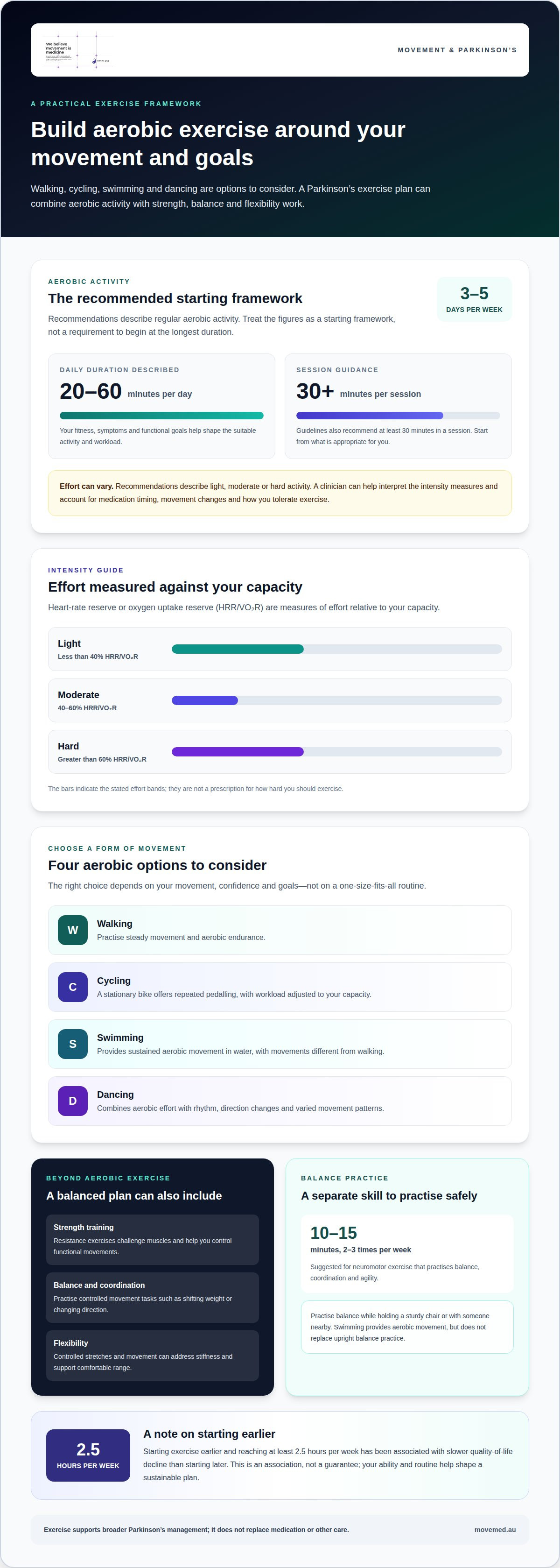
Walking, cycling, swimming and dancing are aerobic options that raise your heart rate through sustained movement. For Parkinson’s, recommendations describe aerobic activity for 20 to 60 minutes per day, 3 to 5 days per week. Guidelines also recommend at least 30 minutes per session. These figures offer a starting framework, not a requirement to begin at the longest duration. Your fitness, symptoms and functional goals shape the appropriate activity and workload.
Intensity can be light, moderate or hard, measured against heart-rate reserve or oxygen uptake reserve (HRR/VO2R). Light activity is less than 40% HRR/VO2R; moderate is 40-60%; hard is greater than 60%. These technical measures describe effort relative to your capacity. A clinician can help interpret them and account for medication timing, movement changes and how you tolerate exercise.
- Walking: Practise steady walking to work on continuous movement and aerobic endurance.
- Cycling: A stationary bike offers repeated pedalling, with the workload adjusted to your capacity.
- Swimming: Swimming provides sustained aerobic activity in water, with movements different from walking.
- Dancing: Dance combines aerobic effort with rhythm, direction changes and varied movement patterns.
A balanced Parkinson’s program can include strength training, balance practice and flexibility work. Aerobic exercise develops endurance, while resistance exercises challenge muscles and balance activities practise control during movement. Flexibility work can address stiffness that makes turning, reaching or taking longer steps harder. For example, walking might sit alongside chair-based strengthening, supported balance practice and gentle stretching. The right mix depends on your symptoms and daily tasks, not weight or fitness goals alone. Exercise therapy can connect these elements to activities you want to manage more confidently.
Effects on gait, balance, tremor and coordination
Parkinson’s can affect walking patterns, balance and movement control, making everyday tasks harder. Exercise can practise these skills directly. Treadmill research has reported improvements in gait and balance.
Balance and coordination practice
Neuromotor exercise practises balance, coordination and agility through controlled movement tasks. Parkinson’s exercise recommendations suggest 10 to 15 minutes, 2 to 3 times per week. Activities might involve shifting your weight, changing direction or coordinating a movement with a cue. These tasks can connect exercise to living activities, such as turning while walking or reaching without losing stability. Structured classes can also provide repetition and a shared routine.
Flexibility and balance activities
Flexibility activities use controlled stretches and movement to maintain comfortable range through joints and muscles. Balance activities challenge your ability to stay steady while standing, stepping or changing direction. Together, they address different aspects of movement: flexibility supports freer positioning, while balance practice develops control. For example, a program might pair gentle trunk movement with supported stepping. A plan can also include strength and resistance work, since stronger muscles help you control functional movements.
Agility and multitasking
Agility practice involves controlled changes in direction, speed or movement pattern. Multitasking exercises add another task, such as walking while responding to a simple prompt. This can help practise coordination demands that arise during daily activities. Treadmill training has also been studied for gait: of 14 studies, three reported immediate improvements in walking speed, stride length and balance after one session. Eleven longer-term trials found safe training and positive gait effects several weeks later.
Balance practice and fall prevention
Balance practice works on steadiness, while fall prevention shapes how and where that practice happens. Tai Chi can improve balance and reduce falls for people with Parkinson’s. Practise balance activities while holding a sturdy chair or with someone nearby, reducing the risk of tripping or injury. Swimming provides aerobic movement, but it does not replace upright balance practice. An exercise physiology consultation can help tailor balance tasks to your movement and daily needs.
Can exercise help with Parkinson’s disease management?
Yes. Exercise can support mobility, strength and balance alongside other Parkinson’s care. An exercise plan for managing Parkinson’s disease in Doncaster East should reflect your symptoms, fitness and everyday goals.
Programmes tailored to symptoms
A tailored exercise programme matches activities and intensity to your symptoms, fitness and movement goals. This matters because stiffness, fatigue or balance changes can affect which activities feel manageable. Recommendations include aerobic exercise alongside strength, balance and flexibility work, adjusted to individual circumstances. Starting exercise earlier and reaching at least 2.5 hours per week has been associated with slower quality-of-life decline than starting later. Your ability and routine help shape a sustainable plan.
Exercise benefits for symptoms and wellbeing
Exercise can support physical function and wellbeing, but it doesn’t replace medication or other care. Alongside medication, it may improve mobility, muscle strength and balance, and help reduce falls and motor symptoms. Physical activity may also benefit cognition, mood, fatigue, pain, constipation and sleep. For example, a plan could combine aerobic movement, resistance exercises and stretching, addressing needs from endurance to stiffness.
Local classes and physiotherapists
In Doncaster East, Exercise Physiology Consultations can provide individualised exercise planning for Parkinson’s. Group classes are another possible format, and exercising with others may help maintain motivation. NDIS funding depends on plan arrangements, while private health cover depends on your policy. An individual exercise physiology consultation can shape activities around your needs.
Before starting an exercise program, discuss medication management with your GP and neurologist. Your exercise professional should understand your medication timing, current symptoms, movement changes, falls and goals. This context helps shape the activities, intensity and timing. An exercise plan for managing Parkinson’s disease in Doncaster East should also account for medication “on” periods, when medication is effective.
Exercise-based Parkinson’s treatment
An exercise program works best as a regular part of Parkinson’s care, not as a replacement for medication. It can combine aerobic activity, resistance work, balance practice and flexibility training. Repeated movement may encourage neuroplasticity, the brain’s ability to adapt and form connections. The practical takeaway is variety: each exercise type challenges a different aspect of mobility and daily function.
Resistance training can use body weight, bands, light hand weights or gym machines. Recommendations include progressive training for large muscle groups, using 2 to 4 sets of 8 to 15 repetitions. The level of resistance should match your capacity and movement control. Stretching can address stiffness: guidance suggests 3 to 4 sessions weekly, ideally daily, holding each stretch for 20 to 60 seconds without bouncing.
Consistency matters more than forcing a demanding session. Neuromotor exercise, which practises balance and coordination, is suggested for 10 to 15 minutes, 2 to 3 times per week. If fatigue makes continuous activity difficult, exercise can be split into shorter bursts throughout the day. Seated activities can also adapt movement on days when standing or walking feels particularly challenging.
Medication timing can affect how movement feels. People with Parkinson’s are advised to exercise during medication “on” periods, when medication is effective. If you have deep brain stimulation, seek professional advice about suitable exercise. These details help shape a program alongside your symptoms, fitness and functional goals.
Some studies point to the value of challenging, sustained practice. In a Cleveland Clinic study, stationary cycling at 30 percent above a person’s preferred rate improved aerobic fitness, motor function, coordination and manual dexterity. Programmes lasting longer than six months were associated with greater functional balance and mobility gains than programmes lasting two or ten weeks.
A tailored exercise physiology consultation can help translate these principles into a structured program that fits your needs.
MoveMed: Exercise Physiology Consultations
MoveMed provides Exercise Physiology Consultations to help you build a structured exercise approach for Parkinson’s. Accredited Exercise Physiologists can consider your movement, symptoms, fitness and functional goals when planning exercise. This connects activity with the tasks you want to manage in daily life.
Consider an individual consultation if you’re unsure how to adapt exercise as symptoms change, or want help fitting a program to your circumstances. MoveMed also provides Hydrotherapy, Aged Care Funded Therapy and NDIS Funded Therapy where these services suit your needs. Your exercise plan should work alongside your wider Parkinson’s management, including medication care with your medical team. Contact MoveMed to confirm the current Exercise Physiology consultation fee.
If you’d like support planning exercise around Parkinson’s, contact MoveMed.
Take the next step towards confident movement
Choosing an exercise direction is a useful start. Connect it with what matters in your day: walking around your home, getting out of a chair, turning safely or keeping up with an activity you value. These priorities can guide a discussion about which movements to practise and how to fit exercise alongside your wider Parkinson’s care.
A tailored exercise plan for managing Parkinson’s disease in Doncaster East can give you a clearer starting point, shaped around your symptoms, routine and goals. It can also be revisited as your movement or daily needs change. You don’t need every detail worked out before seeking guidance. Start with the activity you’d most like to manage with greater confidence, then build the conversation from there.
Contact MoveMed about exercise support to discuss a plan that reflects your needs. A considered next step can help you move forward with purpose.
Frequently Asked Questions
What type of exercise might an exercise physiologist recommend for Parkinson’s disease?
An exercise physiologist may recommend aerobic, strength, balance and flexibility activities matched to your symptoms and goals. For example, a program might pair stationary cycling with chair rises, then practise a movement used in daily tasks. The combination can change as your movement or confidence changes. Exercise supports Parkinson’s management; it doesn’t replace medication or care from your medical team.
What Parkinson’s symptoms can improve from exercise?
Exercise may support mobility, muscle strength, balance and motor symptoms, including walking ability. It may also help with mood, cognition, fatigue, pain, constipation and sleep. Effects depend on the activity and the person, so the program should reflect the symptoms affecting your daily life. For instance, someone concerned about turning may need movement practice that addresses direction changes.
What kinds of exercise programs are available?
Program formats can include aerobic and endurance training, progressive resistance exercise, flexibility work and neuromotor activities for balance and coordination. A functional program practises movements connected with daily routines, while dual-task activities combine movement with a thinking task. Exercise to music is another option. A professional can organise these elements around your goals, rather than treating each type as a separate solution.
What types of exercise might an exercise physiologist recommend for people with Parkinson’s disease?
Recommendations may include resistance exercises using body weight, resistance bands, light hand weights, gym machines or household items such as food cans. An exercise physiologist can select movements that suit your ability and target relevant muscle groups. For example, a supported sit-to-stand movement may build strength for rising from a chair. The exercise and challenge can be adjusted to your movement control.
How does an exercise physiologist tailor exercise frequency and intensity for people with Parkinson’s disease?
Frequency and intensity are matched to your fitness, symptoms and goals. Aerobic recommendations range from 20 to 60 minutes per day, 3 to 5 days per week; intensity may be light, moderate or hard, measured against your capacity. A physiologist can also account for fatigue and medication timing. Shorter bouts across the day may suit people who tire easily.
How can an exercise physiologist plan exercises for balance, walking, strength and flexibility in Parkinson’s disease?
An exercise physiologist can connect each exercise to a functional goal, such as stepping steadily, turning or standing from a chair. They can combine walking practice with strength work, stretching and balance activities, then adapt tasks to your movement and safety needs. Balance practice may use a sturdy chair or nearby support. Medication “on” periods and deep brain stimulation are also relevant planning considerations.


