
What could become easier if you had a safe, structured way to build strength, endurance and mobility around your goals? NDIS exercise physiology in Doncaster can help you work towards these outcomes through exercise planned for your abilities, health and daily activities.
If you’re unsure what an exercise physiologist does, or how NDIS support may apply, you’re not alone. Accredited Exercise Physiologists assess how you move and develop tailored exercise interventions, then adjust the program as your needs and progress change. The NDIS is designed to support people with permanent and significant disability, and the National Disability Insurance Agency says funding is based on each person’s specific needs.
This guide explains what exercise physiology involves, how it may support strength, endurance and mobility goals, and what to consider when arranging NDIS-funded care in Doncaster and nearby suburbs. It also shows how exercise goals can connect with activities that matter in everyday life.
Key Takeaways
- Learn how an exercise physiologist can tailor a program to your disability, health needs and everyday activities.
- See how structured exercise can work towards strength, endurance, balance and mobility goals.
- Understand how your NDIS plan and individual goals shape the support you can access.
- Explore what to consider when arranging local exercise physiology and how MoveMed’s consultations may support your next step.
What is Exercise Physiology?
Exercise physiology uses planned movement to support health, function and fitness. An Accredited Exercise Physiologist adapts exercise to your abilities, disability-related needs and practical goals.
Adaptive exercise programs
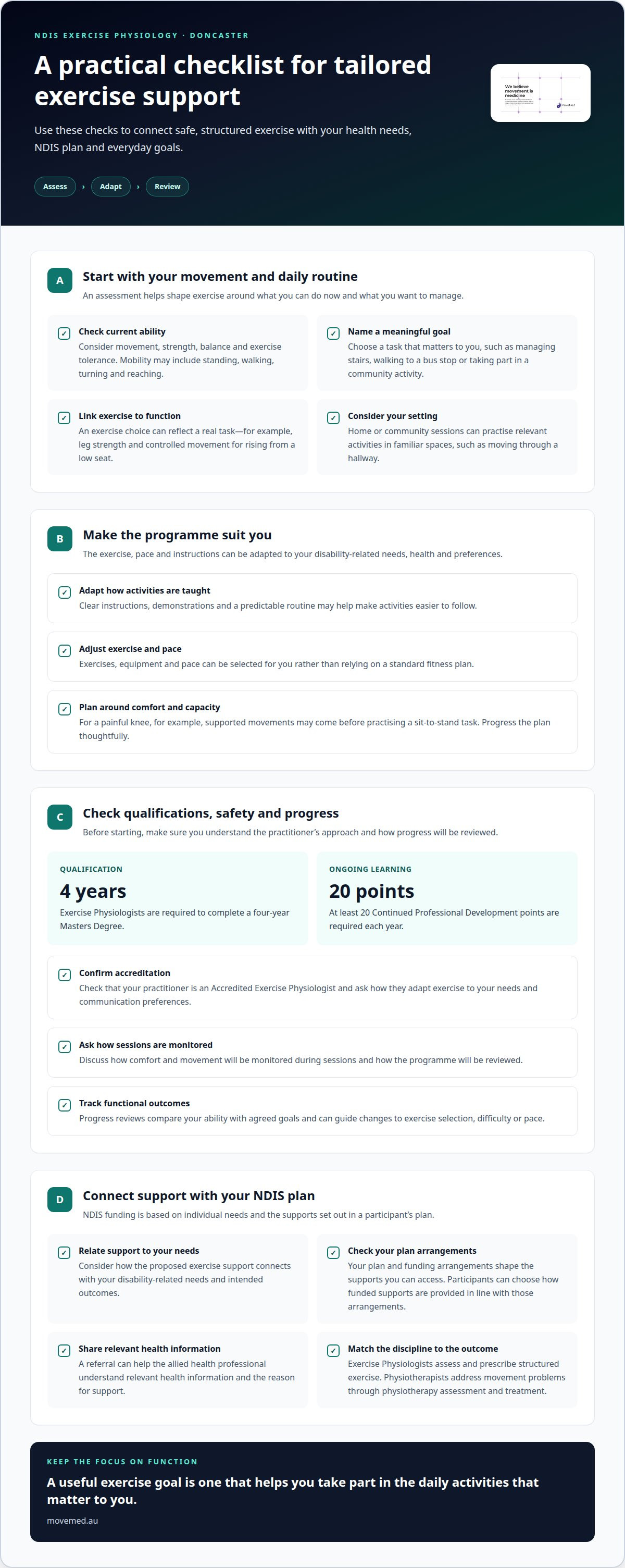
A suitable program considers how your disability or long-term condition affects movement, energy and daily tasks. Clear instructions, demonstrations and a predictable routine, for example, may help someone with an intellectual disability. Exercises, equipment and pace can be adapted to the person rather than requiring them to follow a standard fitness plan. Look for activities linked to real tasks, such as standing from a chair or walking safely.
Assessment and goal setting
Assessment helps identify your current movement, strength, balance and exercise tolerance. Your goals then shape the program: you might aim to manage stairs, take part in community activities or build endurance for daily routines. A referral can help the allied health professional understand relevant health information and the reason for support. Progress reviews compare your ability with those agreed goals and guide changes to exercise selection, difficulty or pace.
Qualifications, safety and outcomes
Before starting, check that the practitioner is an Accredited Exercise Physiologist and ask how they adapt exercise to your disability, health needs and communication preferences. Exercise Physiologists are required to complete a four-year Masters Degree and at least 20 Continued Professional Development points each year. Ask how the practitioner will monitor comfort and movement during sessions, review your program, and record progress towards functional outcomes. These details help you understand the approach before agreeing to begin.
NDIS funding is based on individual needs and the supports set out in a participant’s plan. Participants can choose how their funded supports are provided, in line with their plan and funding arrangements.
Support for strength, endurance and mobility goals
Personalised exercise connects physical capacity with tasks you want to manage. For people in Doncaster East, goals might focus on moving more confidently through familiar daily routines.
Mobility and functional capacity assessments
A mobility assessment may look at standing, walking, turning and reaching. Functional capacity describes how well you manage practical activities, from transferring between a chair and bed to carrying groceries. An exercise physiologist can use these observations to identify barriers and choose relevant exercises. For example, difficulty rising from a low seat may guide work on leg strength and controlled movement.
Strength, mobility and wellbeing goals
Goals are most useful when they describe an activity that matters to you. You might aim to walk to a nearby bus stop, maintain balance while dressing or build endurance for a community outing. Tailored exercise can target strength, coordination and stamina to support these tasks. A clear goal also helps track changes and adapt the program as your ability develops.
Pain management and mobility
Pain can affect confidence with movement, but avoiding activity altogether may make daily tasks harder. An exercise physiologist can adapt movement to your comfort and current capacity, then progress the plan thoughtfully. For example, someone with a painful knee might start with supported movements before practising a sit-to-stand task. Exercise can build capacity for function, rather than relying on pain scores alone.
Mobile exercise physiology means sessions take place in a person’s home or community setting. In Doncaster East, this approach can make it easier to practise a relevant task, such as navigating a hallway or walking to a nearby local destination. The setting also helps connect exercise with the spaces and routines where you want greater independence. Explore exercise physiology consultations as one way to discuss goals and suitable support.
Exercise physiology benefits and goal support
Exercise physiology may suit people whose health affects movement, confidence or participation. The right focus depends on how exercise can support your daily life and goals.
Conditions and participants supported
Programs may suit participants living with neurological conditions such as Parkinson’s disease, multiple sclerosis or stroke-related changes. They can also address exercise goals alongside chronic pain, diabetes or osteoarthritis. NDIS exercise physiology eligibility is described for people under 65 with permanent and significant disability; funding depends on the plan’s relevant support arrangements.
For NDIS participants, exercise physiologists assess and prescribe structured exercise. Physiotherapists address movement problems through physiotherapy assessment and treatment. The suitable discipline depends on your support needs and intended outcomes.
Disability fitness and support
Disability-focused exercise can be made more accessible with clear instructions, adapted activities and a suitable pace. For a participant with cerebral palsy, for example, exercise may account for coordination and movement control. Someone with low confidence in unfamiliar settings may prefer a consistent session routine and familiar exercises.
Exercise can also provide a structured way to practise regular activity when anxiety or low mood affects participation. A goal might be joining a community activity, with exercise helping build the physical capacity to take part.
Positive behaviour support has a different role from exercise physiology. Exercise sessions can use predictable transitions, straightforward communication and activities suited to a participant’s preferences to encourage engagement. A familiar warm-up followed by a preferred movement task, for example, may make a session easier to follow. These strategies support participation but do not replace a formal positive behaviour support plan or the work of the relevant practitioner.
MoveMed community-based exercise sessions support social participation goals and may motivate long-term exercise adherence. This can connect exercise with a participant’s aim to take part socially, rather than treating activity only as a standalone task. When social participation is a goal, community-based sessions may align exercise with that purpose. Their potential to motivate longer-term adherence can also keep ongoing exercise in view. The focus remains on the participant’s goals, with exercise serving as a way to support participation and encourage continued activity over time.
NDIS exercise physiology in Doncaster
NDIS exercise physiology in Doncaster connects funded support with practical goals for daily life. Your plan, goals and chosen provider shape how sessions are arranged.
NDIS funding and budget category
Exercise physiology may be funded when it relates to your disability support needs and NDIS plan. Depending on your plan and goals, relevant support categories may include Improved Daily Living or Improved Health and Wellbeing. Funding can be NDIA-managed, plan-managed or self-managed, which affects how payments are handled.
In Victoria, the applicable NDIS price limit is the national limit for the relevant exercise physiology item. The amount depends on the support item and delivery arrangement, so distinguish the price limit from the funding available in your plan. Budgeting also depends on session frequency, duration and any related costs charged under the applicable item.
Choosing an NDIS-registered provider
Look for an NDIS-registered provider with Accredited Exercise Physiologists and experience adapting exercise to disability or chronic conditions. Ask how the practitioner links assessment findings with functional goals, records progress and reviews the program. A clear plan should explain what each session works towards, such as building capacity for walking, transfers or community participation.
Before sessions begin, consider whether the provider’s communication style and exercise setting suit your needs. Share relevant plan goals, referral information and preferences, including any access or support requirements. This helps the practitioner shape training around the tasks that matter to you, rather than using a generic fitness routine.
For local participants, the key step is matching plan funding with an exercise program tied to everyday outcomes. If you’re ready to discuss your goals and NDIS support, contact MoveMed to arrange a conversation about exercise physiology.
Activate Allied Health states that NDIS participants in Australia can use their funding to access exercise physiology services, offering another point to consider when discussing available support.
MoveMed: Exercise Physiology Consultations
MoveMed provides NDIS-supported Exercise Physiology to help you work towards goals such as improving strength, mobility or everyday function. An Exercise Physiology Consultation gives you time to discuss your needs and develop an approach around your abilities, health and priorities.
MoveMed’s Accredited Exercise Physiologists design evidence-based exercise interventions and review progress towards functional outcomes. Bring your NDIS plan goals and relevant referral information to help guide the discussion. If movement in water better suits your needs, Hydrotherapy may also be considered as part of your support.
If you’re ready to discuss your exercise goals, contact MoveMed.
Make your next movement goal the starting point
Choose an everyday movement goal that feels meaningful to you. It might involve taking part in an activity you value or feeling more confident with a familiar routine. Naming that priority gives your next step a personal focus, rather than making progress about exercise alone.
With NDIS exercise physiology in Doncaster, you can bring that goal into a conversation about what you’d like to work towards. Consider what matters most to you, what support would help, and how you’d like to recognise progress. This can give your planning a clearer direction while keeping your priorities at the centre.
If you’re ready to take that step, arrange a conversation with MoveMed about your goals. A thoughtful starting point can help you move towards greater confidence in daily life.
Frequently Asked Questions
Which exercise physiology clinics in Doncaster, Victoria offer NDIS services?
MoveMed provides NDIS exercise physiology at MoveMed, inside Aquarena, Level 1, 139/153 Williamsons Rd, Templestowe Lower VIC 3107. The facility has a wheelchair-accessible entrance, assisted entry gate, disability parking, accessible toilets and seating. These features can help you plan an in-person visit around access needs, including support with entering and moving through the clinic.
What NDIS exercise physiology services are available in Doncaster?
MoveMed’s exercise physiology includes one-on-one sessions in a gym or pool, with an Accredited Exercise Physiologist guiding the program. Hydrotherapy takes place in Aquarena’s 34 °C pool, with a Hydrotherapist present in the water. If you’re considering group hydrotherapy, groups are limited to a maximum of four participants, and the progression begins with one-on-one sessions.
Do Doncaster exercise physiology providers offer clinic, home, or community visits?
MoveMed offers in-person appointments at its Templestowe Lower clinic and Telehealth sessions delivered by the same team. Telehealth is available anywhere in Australia, which can be useful if travelling to an appointment is difficult. In-person services operate Monday to Friday, 9 am to 6 pm. This gives you a choice between attending the clinic and meeting remotely.
What referral, assessment, and booking steps are required for NDIS exercise physiology?
No referral needed. You can book online or by phone for an initial one-on-one Exercise Physiology appointment, which lasts 45 minutes. The first appointment gives the exercise physiologist time to assess your needs and discuss suitable goals. For claims processed through HICAPS, the claim is made on the spot and you pay the gap after the claim.


