

Need a referral before you can claim a Medicare rebate for allied health care? A Medicare allied health services referral in Doncaster begins with an appointment with your GP, who can assess whether a chronic condition management plan and referral are appropriate. With an eligible plan, you may claim Medicare rebates for up to five individual allied health visits each calendar year, shared across eligible services, according to Services Australia.
It’s understandable to be unsure what to arrange and what it will cost. Medicare may contribute towards an eligible appointment, but it may not cover the full fee, leaving you with an out-of-pocket cost.
This guide explains when a GP appointment and referral are needed for a Medicare rebate, how funding works and what to consider when choosing allied health support in Doncaster and nearby suburbs. It also outlines how to take the next step towards care that suits your health needs and goals.
Key Takeaways
- Find out when a GP appointment is needed to assess your eligibility and arrange a chronic condition management plan and referral.
- Understand how the annual limit of five Medicare-rebated individual allied health visits is shared across eligible services, according to Services Australia.
- Learn why a Medicare rebate may not cover the full appointment fee, and what determines your out-of-pocket cost.
- See how referral details and practical needs, such as service type, billing and access, can guide your search for local allied health care.
GP Chronic Condition Management Plan and referral requirements
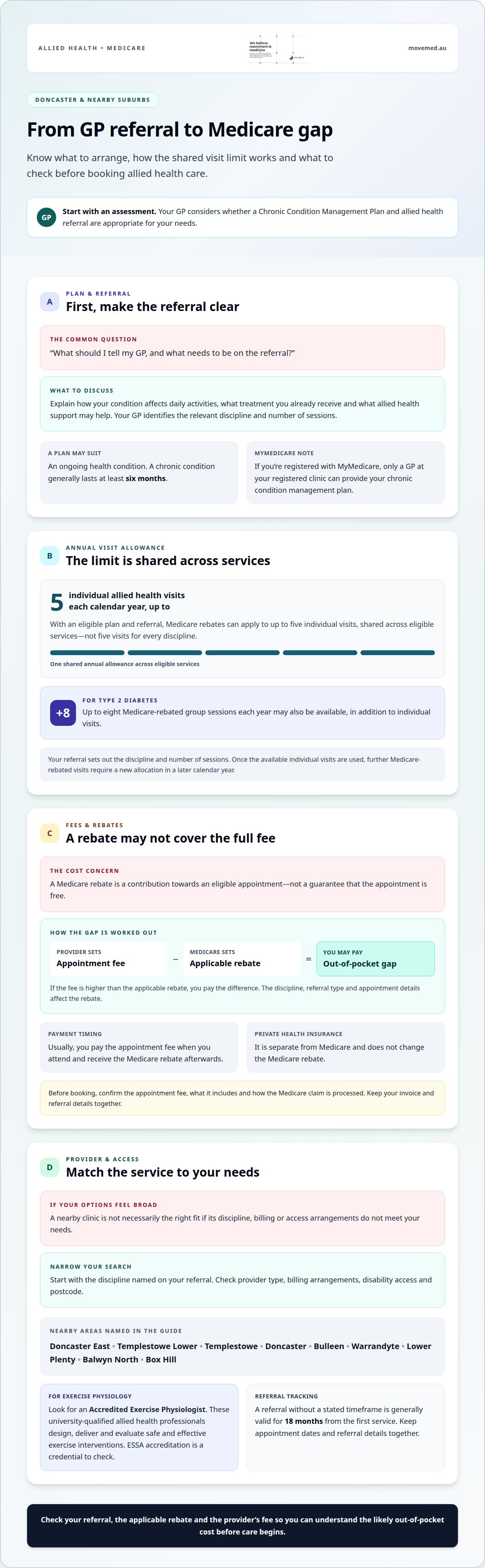
Yes. To be assessed for a Chronic Condition Management Plan and referral, book an appointment with your GP. Explain how your condition affects daily activities, what treatment you already receive and what allied health support may help. For a Medicare allied health services referral in Doncaster, your GP must identify the relevant discipline and sessions.
A GP Chronic Condition Management Plan coordinates care for an ongoing health condition. A chronic condition generally lasts at least six months. Your GP considers your health needs and other care when deciding whether a plan is suitable. The Medicare Chronic Disease Management Plans you may have heard about refer to the previous arrangements: from 1 July 2025, GP Management Plans and Team Care Arrangements were replaced by one GP Chronic Condition Management Plan.
With an eligible plan and referral, you can claim rebates for up to five individual allied health visits each calendar year, shared across eligible services, according to Services Australia. The referral sets out the discipline and number of sessions. A GP may allocate sessions across eligible care according to your needs, rather than providing five visits for every discipline. If you have type 2 diabetes, up to eight Medicare-rebated group sessions each year may also be available, in addition to individual visits, according to the Department of Health and Aged Care.
To get a GP referral for Medicare allied health services, book an appointment and discuss your condition, treatment goals and the discipline you need. If you’re registered with MyMedicare, only a GP at your registered clinic can provide your chronic condition management plan. Eligible GP Management Plans and Team Care Arrangements already in place before 1 July 2025 may support eligible services until 30 June 2027.
For renewing sessions, the key limit is the shared annual allowance: once you’ve used the available visits, further Medicare-rebated individual visits require a new allocation in a later calendar year. A referral without a stated timeframe is generally valid for 18 months from the first service. Keep your referral details and appointment dates together so you can track the sessions allocated and used for your Medicare allied health services referral in Doncaster.
Medicare rebate and out-of-pocket costs
A Medicare rebate contributes towards eligible allied health appointments in Australia. Medicare sets the rebate amount, while the provider sets the fee. If the fee is higher than the rebate, you pay the difference, known as the gap or out-of-pocket cost. The applicable rebate depends on the referral type and current Medicare rules, so a Chronic Condition Management Plan does not make every appointment free.
Your appointment fee and rebate are separate amounts. The fee is set by the provider; the rebate is set by the Australian Government. If the fee exceeds the rebate, the gap is the difference. For example, when an appointment fee is higher than its applicable rebate, you remain responsible for the unpaid balance. The discipline, referral type and appointment details affect the rebate that applies.
Usually, you pay the appointment fee when you attend and receive the Medicare rebate afterwards. Keep your invoice and referral details together to track each visit, payment and rebate. The claiming process depends on the arrangement for your appointment, so don’t assume the rebate will arrive before you need to pay the provider.
Private health insurance is separate from Medicare and does not change the Medicare rebate. Your out-of-pocket cost depends on the provider’s fee and the applicable rebate. Before booking, ask what the appointment fee includes and how the Medicare claim is processed, so you can budget for the full payment rather than the rebate alone.
To estimate your out-of-pocket cost, identify the allied health discipline on your referral, confirm the appointment fee, then compare it with the relevant Medicare rebate. Keep in mind that session length and referral arrangements can affect the applicable rebate. If you’re organising Medicare-funded care in Doncaster, understand your allied health care options before booking, so you can make an informed decision about costs.
Searching for a provider by type, billing, access or postcode
For a local search, start with the allied health discipline you need, then consider access and appointment arrangements. If Medicare covers fewer visits than your treatment plan requires, you can discuss private payment or another suitable funding arrangement for ongoing care.
Provider types and service locations
Start with the discipline named on your referral, such as exercise physiology, podiatry, physiotherapy or dietetics. A clinic in Doncaster East may suit you if its service and appointment arrangements meet your needs. You can also look in nearby suburbs, including Templestowe Lower, Templestowe, Doncaster, Bulleen, Warrandyte, Lower Plenty, Balwyn North and Box Hill. Filter by provider type, billing arrangements, disability access and postcode to narrow your options.
Consider practical needs alongside the discipline. If you need accessible facilities, check the provider’s access information; if you want care close to home, search by postcode. Choose therapy that addresses your health goals, whether you’re seeking exercise support, help with diabetes management or foot care.
Credentials and provider suitability
Check that the provider’s qualifications and professional credentials suit the service you need. Accredited Exercise Physiologists are university-qualified allied health professionals who design, deliver and evaluate safe and effective exercise interventions. ESSA accreditation is a credential to look for when seeking exercise physiology. For podiatry or another discipline, check for credentials relevant to that profession.
Suitability also depends on the provider’s experience with your condition, the therapy approach and how progress will be reviewed. Before booking, compare the referral discipline with the service offered, and clarify billing, clinic access and appointment format. This helps you choose care that fits your referral and circumstances.
If you need more sessions than Medicare covers, you can continue treatment through private payment or an applicable alternative funding arrangement. Medicare and NDIS may both contribute in some cases, but they cannot fund the same service at the same time. The appropriate pathway depends on your eligibility, plan and treatment needs.
Use your referral to identify the service you need, then consider postcode, billing and access. The provider’s credentials and approach can help you decide whether the therapy suits your goals. If you have diabetes, for example, consider whether the service addresses the support identified in your care plan.
Allied health referral requirements for funded treatment
A Medicare-funded referral connects an eligible patient’s chronic condition with a specific allied health discipline and treatment sessions. The key is to match the referral, condition and service.
Qualifying conditions
Medicare support through chronic condition management is intended for people whose ongoing health needs require coordinated care. Type 2 diabetes is one example: eligible patients may qualify for relevant allied health support under the applicable arrangements. Your GP assesses how the condition affects your health and whether allied health treatment fits your care needs. A diagnosis alone does not determine which services or sessions are appropriate.
Eligible allied health disciplines
Allied health disciplines that may help manage a chronic condition under a referral include exercise physiology, physiotherapy, podiatry, dietetics and chiropractic care. The referral must match the discipline providing treatment. For example, a podiatry referral does not authorise a physiotherapy appointment under the same referral. Your GP identifies the relevant discipline and session allocation based on your care needs.
For a Medicare claim, the patient needs a valid GP referral for the allied health service. It should specify the discipline, number of sessions and relevant item numbers. A referral without a stated timeframe is generally valid for 18 months from the first service provided under it. Medicare-supported individual allied health appointments must generally last at least 20 minutes, according to the Department of Health and Aged Care.
Care coordination also matters. Eligibility involves ongoing treatment with the GP and at least 2 other medical or allied health practitioners. The allied health professional sends a written report to the GP after the first and final visits, supporting communication across your treatment team. Bring your Medicare card and relevant reports when starting care, so the provider can refer to your clinical information.
Medicare, private health insurance and other government-funded arrangements have different eligibility and payment rules. Medicare and NDIS may both apply in some cases, but cannot fund the same service at the same time. If your care involves another funding arrangement, explore funded therapy options to understand a suitable pathway.
MoveMed
MoveMed can help you understand how your referral relates to allied health care and which next steps fit your needs. If your GP has referred you for exercise physiology, an Exercise Physiology Consultation can focus on your health goals and the support outlined in your care plan. Hydrotherapy may also be part of a broader approach to movement and wellbeing.
If Medicare is not the only funding pathway relevant to you, MoveMed also provides Aged Care Funded Therapy and NDIS Funded Therapy. Bring your referral and relevant plan details to help clarify how your funding arrangement relates to the care you’re seeking. Your treatment options depend on your referral, eligibility and individual needs.
For support understanding your allied health care options, contact MoveMed.
Take the next step towards care that fits
Good allied health care should support changes that matter in everyday life, whether you want to move with more confidence, build strength or stay active. Use your referral as a starting point to discuss your priorities, the treatment approach and how progress will be reviewed. This can make your care more purposeful than simply attending appointments.
If you’re arranging a Medicare allied health services referral in Doncaster, bring your questions and goals to the conversation. You don’t need to have every detail worked out before seeking guidance. A clear discussion can help you understand how your needs relate to available care and what to do next.
MoveMed can talk through your allied health pathway and help you consider a practical next step. Discuss your care options with MoveMed and take the next step with confidence.
Frequently Asked Questions
Do You Need a Referral?
To seek a Medicare rebate through a GP Chronic Condition Management Plan, you need the relevant GP referral. However, no referral is needed to book an initial appointment with MoveMed. Booking and claiming are separate steps: you can make an appointment without a referral, but you’ll need the appropriate referral for a rebate through this Medicare pathway. Let MoveMed know when booking if you have one.
Does Everyone With a Chronic Condition Qualify?
No. A diagnosis such as diabetes does not automatically qualify you for Medicare-funded allied health care. Your GP considers whether allied health input is suitable for managing your condition. If you already receive care from several professionals, discuss whether another service would contribute to your treatment goals. Eligibility depends on your assessed care needs, not the condition’s name alone.
Does Medicare cover all therapy sessions?
No. This applies to that arrangement, not every therapy or provider. When booking, clarify whether your appointment is an initial or subsequent session and whether it fits the Medicare arrangement, so you understand how the claim applies.
What Medicare-funded allied health services are available in Doncaster, Victoria?
Potentially eligible disciplines include exercise physiology, physiotherapy, podiatry, dietetics and chiropractic care. The service must match your referral. Some providers may offer eligible appointments by video or phone, which can help if travelling to a clinic is difficult. MoveMed offers Telehealth sessions for patients within our local service area. Check that the appointment format and discipline suit the care outlined by your GP.
Who is eligible for Medicare allied health services under a GP Chronic Condition Management Plan?
Your GP assesses eligibility based on your ongoing condition and the role allied health treatment could play in your care. If your condition affects daily activities and you’re working towards specific health goals, explain those impacts and your current supports during the appointment. This helps your GP decide whether coordinated allied health input suits your circumstances.
How many allied health sessions does Medicare cover per calendar year?
Medicare rebates can apply to up to five individual allied health visits each calendar year, shared across eligible services, according to Services Australia. Visits with different allied health disciplines draw on the same allowance rather than separate allowances. Keep track of appointments across your care team so you can discuss remaining visits and future treatment planning with your GP.


