

Could an exercise bike be funded through DVA, and what needs to happen first? For veterans in Templestowe considering an exercise bike through the DVA Rehabilitation Appliances Program, the key is to understand the clinical assessment and approval requirements before arranging equipment.
It’s understandable to want a clear answer about eligibility and costs before taking the next step. The program includes rehabilitation exercise and treatment machines, but an exercise bike isn’t automatically approved. A health provider assesses your needs, and prior approval is required in some circumstances, including when the RAP Schedule says so or a limit is exceeded.
This article explains how RAP access works, what the Schedule and approval rules mean for an exercise bike, and how to clarify the current requirements. It also explains how clinical exercise support can connect equipment decisions with your health and independence goals.
Key Takeaways
- RAP may include rehabilitation exercise equipment when a health provider identifies a clinical need and you meet the programme’s eligibility requirements.
- Prior approval can be required if the RAP Schedule says so, a financial or quantity limit is exceeded, or another specified circumstance applies.
- For questions about RAP, contact the DVA RAP team on 1800 838 372 or email [email protected].
- Exercise Physiology Consultations can help you connect safe, clinically guided exercise with your health and independence goals.
What is the Department of Veterans Affairs (DVA) Rehabilitation Appliances Program (RAP)?
RAP helps eligible Australian veterans access aids and equipment for health and independence. If you’re in Templestowe and considering an exercise bike through DVA’s Rehabilitation Appliances Program, your request is assessed against your clinical needs and the program’s requirements.
RAP Equipment and Appliances
RAP covers aids, appliances and therapeutic equipment, including rehabilitation exercise and treatment machines. If an exercise bike could support your function or health at home, a health provider assesses your clinical needs to determine which items may be appropriate. Contracted suppliers arrange delivery and installation for prescribed RAP items, while DVA covers freight charges for home delivery. For faults, repairs, replacement or collection, contact the contracted supplier handling the item and DVA about next steps.
Exercise Bike Eligibility
Eligibility depends on your DVA card and an assessed clinical need for the equipment. You may be eligible with a Veteran Gold Card, or a Veteran White Card when the equipment relates to an accepted condition. The assessment considers whether the bike is safe and suitable for your health needs and supports function or independence. Having a card alone does not mean a bike will be funded. The clinical assessment and applicable RAP requirements matter.
Accessing RAP Equipment
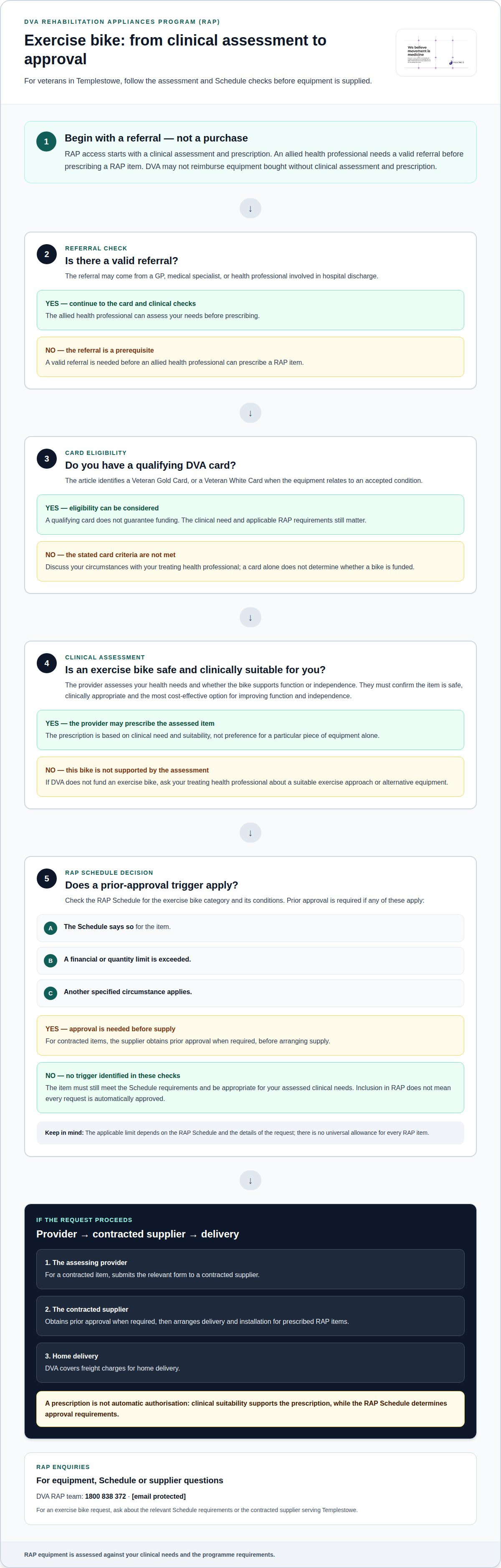
Access starts with a clinical assessment and prescription, not with buying a bike. An allied health professional needs a valid referral from a GP, medical specialist or health professional involved in hospital discharge before prescribing a RAP item. For contracted items, the assessing provider submits the relevant form to a contracted supplier. That supplier obtains prior approval when required and arranges delivery. You cannot request the same item through another government-funded program. DVA may not reimburse equipment purchased without clinical assessment and prescription.
Exercise Bike Options
If DVA does not fund an exercise bike, ask your treating health professional about a suitable exercise approach or alternative equipment. For an exercise bike through DVA RAP in Templestowe, contact the DVA RAP team to ask which contracted supplier applies to an approved item. This gives you a program-specific route without assuming a supplier based only on location.
Prior approval and RAP Schedule limits
The DVA RAP Schedule lists the aids, appliances and therapeutic items covered by the program, and indicates when an item needs prior approval. For an exercise bike, check the Schedule to understand whether approval is needed before supply. Inclusion in RAP does not mean every request is approved automatically: the item must also suit your assessed clinical needs.
Before prescribing, the assessing health provider must confirm that the item is safe and clinically appropriate. They must also consider whether it is the most cost-effective option for improving your independence and function. For an exercise bike, the assessment considers your health requirements and the intended functional benefit. This explains why a particular item is suitable, rather than relying only on a preference for specific equipment.
Prior approval is required when the RAP Schedule says it is, when a financial or quantity limit is exceeded, or when another specified circumstance applies. These are separate triggers: a request may need approval because of the item’s Schedule requirements, cost, quantity or another relevant condition. The applicable limit depends on the Schedule and the details of the request, not on a universal allowance for every RAP item.
For veterans in Templestowe, the practical step is to have the assessing provider review the exercise bike category and its Schedule conditions before prescribing. They can identify whether the requested item falls within a limit and whether prior approval is needed. If approval applies, a contracted supplier obtains it before arranging supply. This avoids treating a prescription as automatic authorisation and clarifies the path from assessed need to a funded item. Clinical suitability supports the prescription, while Schedule rules determine approval requirements.
DVA RAP enquiries
For veterans living in Templestowe, DVA has separate contact pathways for RAP questions and health provider enquiries. Choose the contact that matches your question, such as finding the contracted supplier for an assessed mobility need or asking about the Schedule.
Contact the DVA RAP team on 1800 838 372 or email [email protected]. These are the direct channels for questions about the Rehabilitation Appliances Program. For an exercise bike request, explain that you are asking about RAP equipment and want guidance on the relevant Schedule requirements or contracted supplier serving Templestowe.
The DVA Health Provider Line is 1800 550 457. It is intended for health providers seeking RAP information, including questions that arise during clinical assessment or prescription. If your clinician is preparing an equipment request, they can use this line to ask about the process that applies to the item and your circumstances.
To contact a local allied health professional, start with your GP and discuss a referral for an assessment. Before prescribing a RAP item, an allied health professional needs a valid referral from a GP, medical specialist or health professional involved in hospital discharge. The assessment considers whether equipment supports your healthcare needs, function and independence.
- RAP eligibility, equipment or supplier enquiry: call 1800 838 372 or email [email protected].
- Health provider RAP information: call 1800 550 457.
- Clinical assessment pathway: discuss a referral with your GP or relevant medical professional.
When contacting DVA, keep your question specific. Ask whether an exercise bike request needs prior approval, which Schedule conditions apply, or how a contracted supplier handles delivery. If you’re asking about repairs or collection, identify the prescribed item and its supplier. Clear details help DVA direct your enquiry to the right RAP process.
DVA Rehabilitation Appliance Program (RAP)
The Department of Veterans’ Affairs (DVA) RAP provides eligible veterans access to equipment that supports health and independence. A health professional assesses how an item relates to your clinical needs and accepted conditions. For an exercise bike, the assessment should explain its intended role in managing your health or function. This clinical reasoning distinguishes a therapeutic appliance request from a general preference for home fitness equipment.
Hospital discharge can also affect when RAP equipment is considered. After discharge from a public hospital, a DVA client may receive an item if they need it for more than 30 days. When leaving a private hospital, a client may be prescribed an item if they need it at that time. If you are planning for discharge, raise the equipment need with the hospital team and treating health professional before leaving.
RAP access depends on assessment and the item’s program requirements. DVA warns that it may not reimburse equipment bought without clinical assessment and prescription. Buying an exercise bike first can leave you responsible for the cost, even if you later seek funding. Have a health professional assess the need and identify the appropriate RAP pathway before purchase.
DVA updated its RAP information on 10 August 2026. This provides a useful reference point when comparing program information, particularly if you have older paperwork. For an item supplied through a contracted supplier, the assessment and prescription process connects the clinical need with the program’s supply arrangements. Keep the prescription and supplier details available if you need to discuss the item after delivery.
If an exercise bike is not the only part of your health plan, talk through your exercise goals and how structured activity may fit alongside equipment prescribed through RAP.
MoveMed: Exercise Physiology Consultations
MoveMed offers Exercise Physiology Consultations to help you build a personalised, evidence-based exercise plan around your health and functional goals. If you’re managing pain, reduced mobility or a chronic condition, Accredited Exercise Physiologists can guide safe, structured exercise to support your capacity and independence.
These consultations can complement equipment prescribed through DVA RAP, but they don’t replace DVA’s clinical assessment, prescription or approval process. Bring your exercise goals and relevant information about your current health needs to the discussion. Together, you can consider how structured exercise may fit alongside your broader care and daily routine.
If you’d like support to plan your next steps, contact MoveMed.
Take your next step towards supported movement
Choosing equipment is one part of building a routine that feels safe and workable in daily life. If an exercise bike isn’t suitable or funded, a clinician-guided plan can still help you work towards mobility, strength and independence. For a DVA rehab appliance program exercise bike assessment in Templestowe, focus on the health outcome you want to support, not just the equipment itself.
MoveMed can discuss Exercise Physiology Consultations and how structured exercise may fit your goals. Hydrotherapy and Aged Care Funded Therapy are also available for people whose needs and funding arrangements suit those services. The right next step depends on your circumstances and the support you’re seeking.
Contact MoveMed to discuss your options, and take the next step at a pace that works for you.
Frequently Asked Questions
How do I access RAP?
Start by discussing your equipment needs with your GP or treating health professional. They can help arrange the referral needed for an allied health professional to assess a RAP prescription. The assessment considers your clinical needs and the item’s suitability. Have the RAP pathway assessed before buying equipment, as DVA may not reimburse an item purchased without clinical assessment and prescription.
What is RAP?
RAP is the Department of Veterans’ Affairs program that helps eligible veterans access aids and equipment to support health and independence. Its equipment categories include rehabilitation exercise and treatment machines. For example, a person with mobility needs may have an appliance assessed for use at home. The clinical assessment and relevant RAP Schedule determine the appropriate item and process.
What is the DVA Rehabilitation Appliances Program (RAP) in Australia?
In Australia, RAP is a government program for eligible members of the veteran community with an assessed need for an appliance or aid. Eligibility can include Gold Card holders, White Card holders for accepted service-related conditions, and veterans from allied countries with accepted service-related conditions. Your health professional assesses your needs to identify which RAP items may be appropriate.
Does DVA RAP cover exercise bikes or stationary bicycles?
RAP includes rehabilitation exercise and treatment machines, but the Schedule determines whether a specific exercise bike can be supplied. The assessing health professional considers whether the bike is clinically appropriate and supports your function or independence. A stationary bicycle is not automatically funded just because it is exercise equipment: the relevant Schedule conditions and your assessed needs guide the decision.
Does a DVA client need a GP or specialist referral for an exercise bike?
Before an allied health professional prescribes a RAP item, they need a valid referral from a GP, medical specialist or health professional involved in hospital discharge. This referral supports the clinical assessment for the equipment. It is separate from booking an appointment with MoveMed, where no referral is needed to book an initial appointment.
What is the approval process for an exercise bike under DVA RAP?
A health professional assesses your needs and whether the exercise bike is safe, clinically suitable and cost-effective for improving function or independence. They then consider the RAP Schedule’s item requirements and limits. If prior approval is required, the contracted supplier obtains it before arranging supply. The assessment and approval are distinct steps, so a prescription alone does not mean the bike is authorised.


