
Could exercising in water make rehabilitation more manageable when an injury makes movement on land difficult? Hydrotherapy uses supervised, water-based exercise to support controlled movement and strengthening. For hydrotherapy for a construction worker injury in Templestowe, MoveMed can tailor a program to your injury, recovery goals and any post-surgical considerations.
It’s understandable to want a clear idea of what treatment involves before taking the next step. This article explains how buoyancy and water resistance can support rehabilitation, what may affect whether hydrotherapy suits your injury, and how WorkCover funding may apply. You’ll also learn what a supervised session can involve and what information helps shape an appropriate program, so you can make informed decisions about recovery and returning to everyday activities.
Key Takeaways
- See how buoyancy and water resistance can support controlled movement and strengthening during injury rehabilitation.
- Understand why your injury, recovery stage and post-surgical healing can affect whether aquatic exercise is suitable.
- Get a clearer picture of what research suggests about aquatic therapy and recovery, including where its benefits may be modest.
- Learn how WorkCover treatment funding differs from pool entry fees, so you can better understand potential costs.
Hydrotherapy for injury and post-surgical rehabilitation
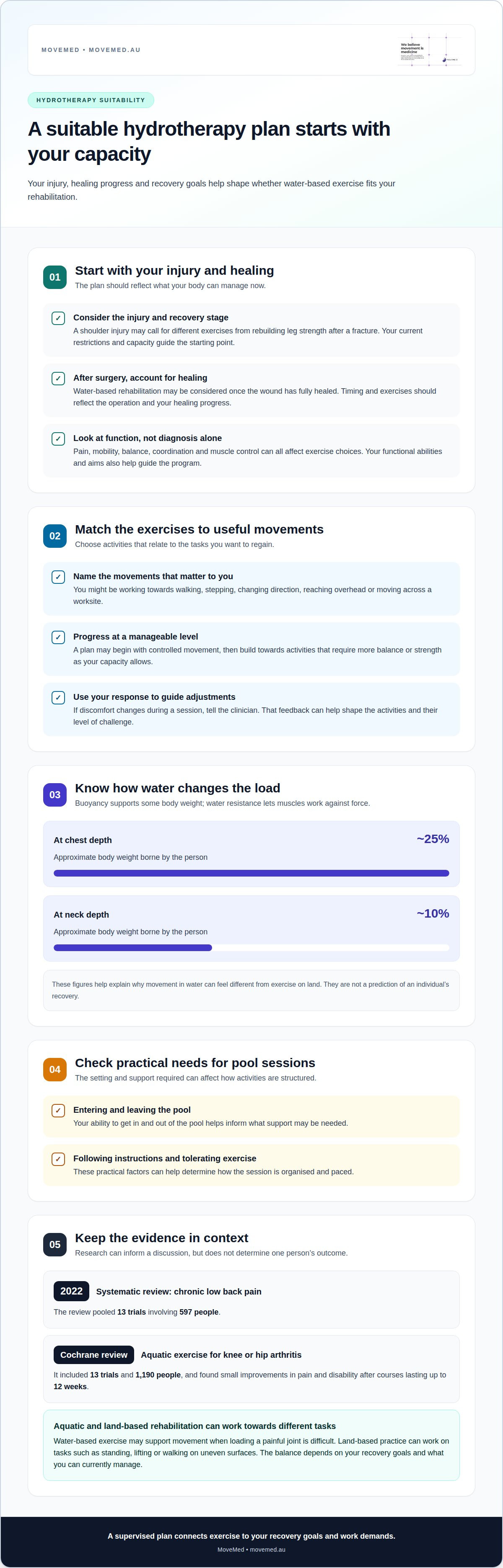
Water-based rehabilitation can help you practise movement when pain or reduced mobility makes land exercise difficult. Buoyancy supports some of your body weight, while water resistance provides a way to work muscles during controlled exercise. At chest depth, a person bears roughly 25% of their normal weight; at neck depth, around 10%. These figures help explain why moving in water may feel different from walking or exercising on land.
For a construction worker recovering from multiple trauma or fractures, sessions can focus on movements linked to daily tasks, such as walking, stepping and changing direction. Exercises need to suit the injury and recovery stage. Buoyancy can make water-based movement more manageable for someone with limited mobility by reducing the load they carry. The goal is to practise useful movements and build capacity, rather than exercise for its own sake.
Hydrotherapy is exercise-based rehabilitation. Warm water can help muscles relax, while water resistance lets you exercise against gentle force. A supervised session may include mobility, strengthening and balance activities, adjusted to your goals and response. This may be relevant after an injury or with conditions such as arthritis, where joint stress can affect movement and quality of life.
After orthopaedic surgery, water-based rehabilitation may form part of recovery once the wound has fully healed. The timing and exercises need to reflect the operation and healing progress. Sessions are tailored to the person and conducted one-on-one rather than as group exercises. That individual format allows the exercises to match your rehabilitation needs, whether you’re rebuilding mobility after a fracture or gradually returning to movements used at work.
Conditions that may affect hydrotherapy suitability
Suitability depends on your injury, current movement and rehabilitation goals. A plan for a construction worker with a shoulder injury may differ from one for someone rebuilding leg strength after a fracture. An assessment considers which movements are difficult, what you want to regain and how water-based exercise could fit your return to daily tasks or work. Your current capacity helps set a suitable starting point.
A musculoskeletal condition affects muscles, bones, joints, tendons or ligaments and may cause pain or limit function. Arthritis, back pain and fractures can each affect exercise choices. Neurological conditions, including Parkinson’s disease, multiple sclerosis and stroke-related changes, can affect balance, coordination or muscle control. Diagnosis is one part of planning; your functional abilities and rehabilitation aims also guide the program.
After surgery, an assessment can consider the procedure, your current restrictions and the movements you’re working to regain. If mobility is limited, the clinician can consider how you move, what support you may need and how exercises can match your capacity. For example, a plan may begin with controlled movement before progressing to tasks that demand more balance or strength.
Practical factors also shape the session. Your ability to enter and leave the pool, follow instructions and tolerate exercise can inform how activities are structured. Tell the clinician which movements matter most to your quality of life and return-to-work goals, such as reaching overhead or walking across a worksite. If discomfort changes during a session, that feedback can help guide adjustments. A clinical hydrotherapy suitability assessment can connect your goals with an appropriate treatment plan.
Evidence for aquatic therapy and injury recovery
For workplace injuries, aquatic exercise can make movement easier to practise, while land-based rehabilitation develops skills in everyday settings. Near Templestowe, look for supervised aquatic rehabilitation at a hydrotherapy pool, with the treatment approach matched to your injury and recovery goals.
Aquatic physiotherapy for workplace injuries
Hydrotherapy uses guided exercise in water to support workplace injury recovery. Buoyancy changes how much weight your body bears, while water resistance gives muscles a way to work against gentle force. For a worker with chronic lower back pain, for example, therapy may focus on controlled movement before progressing to more demanding work tasks.
Evidence varies by condition. A 2022 systematic review pooled 13 trials involving 597 people with chronic low back pain. A Cochrane review of aquatic exercise for knee or hip arthritis included 13 trials and 1,190 people. It found small improvements in pain and disability after courses lasting up to 12 weeks. These findings can inform discussion, but do not predict one person’s recovery.
Comparing aquatic and land-based rehabilitation
Water and land provide different exercise settings, not competing routes to recovery. Aquatic sessions can support movement when loading a painful joint is difficult. Land-based work can practise tasks such as standing, lifting or walking on uneven surfaces. The right balance depends on the movements your workplace role requires and what you can currently manage.
Rehabilitation may use hydrotherapy, land-based exercise or both. Progress can be judged by practical changes: whether you can walk further, lift with better control or tolerate a work-related movement. If pool exercise supports early movement, land practice can help translate that capacity into daily tasks. Each appointment should connect exercises to a recovery goal, rather than treating time in the water as the outcome.
For Templestowe-area care, a supervised aquatic program can be considered alongside land-based rehabilitation, with progress guided by your function and work demands. The evidence supports aquatic exercise as one option, not a guaranteed result; aquatic rehabilitation options can be discussed in relation to your recovery goals.
Is hydrotherapy free under workers comp?
Workers compensation doesn’t necessarily cover every pool-related expense. In Victoria, WorkSafe does not pay pool entry fees at a provider’s own pool. Treatment charges and pool entry are separate costs, so it helps to distinguish supervised rehabilitation from access to the facility when considering your claim.
Pool temperature is another practical feature. Hydrotherapy pools are typically heated to between 33°C and 36°C. In aquatic exercise trials for knee and hip osteoarthritis, pool water was typically 32 to 36°C. These figures describe reported pool conditions, not a fixed temperature for every session. A heated pool provides a setting for planned exercise, rather than general pool use.
For a workplace injury, treatment should relate to rehabilitation goals, such as rebuilding capacity for a work task. A supervised appointment can focus on exercises selected for your injury and current abilities. MoveMed’s hydrotherapy is individualised rehabilitation, not general fitness or leisure swimming. Treatment funding and any pool entry charge are separate considerations.
At your appointment, the clinician discusses your injury, movement and rehabilitation aims before guiding you through the planned exercises. Bring any claim details, work restrictions and information about the tasks you hope to return to. This helps connect the appointment with your practical goals.
Before planning ongoing sessions, clarify how the treatment charge and any pool entry fee are handled under your claim. The relevant details include the treatment being provided, pool entry arrangements and your claim circumstances. To discuss a supervised program for your injury, book a hydrotherapy appointment.
MoveMed: Hydrotherapy
MoveMed provides hydrotherapy and Exercise Physiology Consultations to support rehabilitation after injury. If pain or reduced mobility makes land-based exercise difficult, a personalised plan can connect water-based movement with practical goals, such as improving strength or returning to everyday tasks.
MoveMed’s Accredited Exercise Physiologists develop evidence-based management plans around your health, injury and priorities. They can help you understand how structured exercise may fit into rehabilitation and work towards improving your capacity and independence. Hydrotherapy is not a substitute for post-surgical clearance or treatment for an unhealed wound, so timing and suitability matter.
If you’re considering hydrotherapy in Templestowe for a construction injury, contact MoveMed to discuss your rehabilitation goals and book an assessment. No referral needed.
Take the next step towards work-focused recovery
Planning hydrotherapy for a construction worker injury in Templestowe starts with connecting rehabilitation to the movements and responsibilities you want to manage again. Think about which tasks feel hardest now, such as walking across uneven ground, lifting or reaching. Sharing these goals can make the discussion about your next steps more practical.
MoveMed offers hydrotherapy and Exercise Physiology Consultations to support personalised rehabilitation. Aged Care Funded Therapy is also available for eligible older clients. If you’re managing a workplace injury, discuss how your recovery goals and claim circumstances relate to a suitable exercise plan.
You don’t need to map out the whole recovery journey alone. Contact MoveMed about hydrotherapy to discuss your needs and take a considered step towards rebuilding confidence and function.
Frequently Asked Questions
What Is Hydrotherapy?
Hydrotherapy describes therapeutic use of water, while aquatic therapy is often used for similar supervised rehabilitation. The terms describe the treatment setting, not one fixed exercise routine. The clinician selects activities around your priorities, such as balance, strength or confidence with a particular movement. It differs from leisure swimming because the exercises are chosen to address rehabilitation goals.
Do You Need a Referral?
No referral needed to book an initial appointment with MoveMed. If you intend to use a workplace claim, have your claim details available to discuss how treatment relates to it. The clinic’s booking requirement and any insurer processes are separate considerations. You can arrange an assessment and explain your circumstances without first obtaining a referral.
How many sessions will I need?
There isn’t a set number of sessions that suits every workplace injury. A useful way to plan is to identify functional milestones, such as managing a work-related movement with greater control, then review progress against them. Your clinician can use these changes to guide the ongoing plan, rather than relying only on how many appointments have elapsed.
Still Sore After a Work Injury and Unsure What Your Claim Covers?
Ongoing soreness can raise both a health question and a claim question. Explain how symptoms affect your duties, including whether they change during a shift or after particular tasks. This gives your treating professional useful context for discussing rehabilitation needs. For questions about claim entitlements or decisions, contact the insurer handling your workplace claim.
What happens if my insurer says no?
If an insurer declines a treatment request, ask which part it has declined and why. This can clarify whether the decision concerns the proposed treatment, its relationship to your injury or supporting information. You can then discuss the explanation with the treating professional and insurer, and ask what further clinical details may help clarify the request.
When can I start treatment after a workplace injury?
You can arrange an assessment once you want professional guidance on rehabilitation after a workplace injury. Treatment planning considers the injury, your symptoms, current work duties and any restrictions already given to you. For a construction worker, describe tasks such as carrying materials, climbing or reaching, so the assessment can focus on movements relevant to your role and recovery goals.


