
What if fall-prevention exercise needs to change with your health, not just your age? An exercise program to avoid falls in the elderly in Templestowe Lower should build strength and balance while taking your mobility, confidence and health conditions into account. The Australian Government Department of Health and Aged Care advises older Australians to do strength and balance activities at least two days per week.
It’s understandable to feel cautious about exercise if you have a health condition or worry about losing your balance. The right approach isn’t about pushing through discomfort. It’s about choosing movements that challenge you safely and can be adjusted as your needs change.
Here, you’ll learn about four useful exercise approaches, who may benefit from a structured program and how professional guidance can adapt exercise for conditions such as arthritis, osteoporosis or Parkinson’s. You’ll also see how an Accredited Exercise Physiologist can assess your strength, balance and movement, then shape a program around your goals and capacity.
Key Takeaways
- Learn how strength, balance, flexibility and everyday movement can each support steadier mobility.
- Recognise when falls history, medication use or changes in confidence may make a tailored program helpful.
- See why supervision, gradual progression and a safe environment matter when starting or adjusting exercises.
- Understand how exercise can be adapted around conditions such as arthritis, osteoporosis, Parkinson’s disease and multiple sclerosis.
1. What Are Falls Prevention Exercises for Older People?
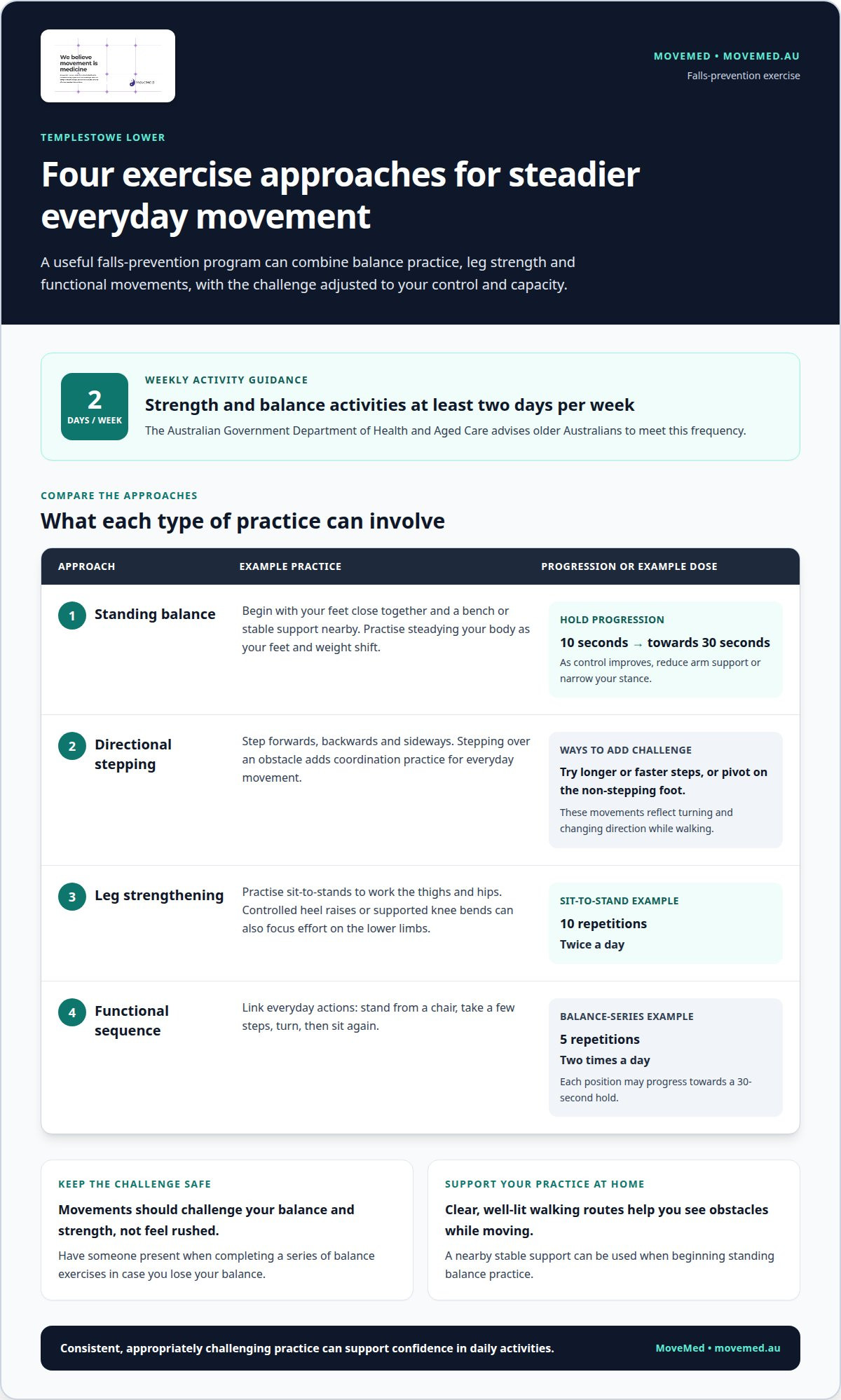
Falls prevention exercises build muscle strength, balance, coordination and control during everyday movements. For older adults, a useful program combines standing balance practice with leg strengthening and functional tasks, such as rising from a chair. Australian Government Department of Health and Aged Care advises older Australians to do strength and balance activities at least two days per week.
Balance exercises train you to steady your body as your feet and weight shift. A progressive standing sequence might begin with feet close together, using a bench or stable support nearby. As control improves, the challenge can increase by reducing arm support or narrowing the stance. Each position may start with a 10-second hold and progress towards 30 seconds.
Movement can then become more varied. Stepping forwards, backwards and sideways practises changing direction, while stepping over an obstacle adds coordination. Longer or faster steps and pivoting on the non-stepping foot can add further challenges. These movements reflect everyday tasks such as walking around furniture, turning in a hallway or negotiating an uneven path.
Strength work supports the legs needed for standing and walking. A sit-to-stand exercise practises rising from a chair, an everyday action that uses the thighs and hips. One recommended example is 10 repetitions, twice a day. Controlled heel raises or supported knee bends can also focus effort on the lower limbs while practising steady movement.
Functional training connects these skills: stand from a chair, take a few steps, turn, then sit again. A balance series may use five repetitions, two times a day, with each position progressing towards a 30-second hold. The movements should feel challenging enough to train balance and strength, not rushed. Consistent practice can support confidence while reducing avoidable difficulty with daily activities. Lighting also matters: clear, well-lit walking routes help you see obstacles while moving.
2. People who may benefit from fall prevention programs
A falls prevention program may help if you feel unsteady, have weaker muscles or have changed how you move. A previous fall, reduced balance or slower reactions can also affect your confidence during everyday activities. Four or more medicines a day is identified as a particularly high falls risk. If you’ve had two or more falls in the previous 12 months, or fell and were injured, see a doctor for an assessment.
Before recommending exercise, a falls-prevention professional can assess your strength, balance, coordination, gait and functional capacity. They can consider your health conditions, falls history, medicines, confidence and home hazards. This gives the program a clearer starting point and helps match activities to your current movement and support needs.
A professional can help you choose between group classes, home exercise programs and one-to-one sessions by considering your balance, confidence, health needs and required supervision. Group classes may suit you if you can participate safely alongside others. Home programs can relate practice to daily tasks, while individual sessions allow closer tailoring. An assessment helps identify the format that best fits your circumstances.
A practical “5 Ps” check can organise the discussion: previous falls, prescriptions, physical capacity, place and personal plan. For example, a recent fall may prompt closer assessment, while uneven flooring may call for attention to the home environment. Medication concerns belong in a conversation with your doctor or pharmacist; don’t change medicines on your own. A personalised approach also helps account for changing health and movement needs over time. For support with a personalised falls-risk assessment, consider discussing your goals and concerns with an exercise professional.
3. Exercise safety and supervision
Safe prevention exercise starts with your current mobility, health and confidence, not a standard routine. If you’re returning to activity after a sedentary period, an exercise professional can introduce movements gradually and observe how you respond. They can adjust support, pace and difficulty as your ability changes. If your balance is weak, speak with a doctor or exercise professional before starting new exercises.
Supervision matters most when standing movements challenge your balance. A professional can stay nearby, provide appropriate support and adapt activities if you feel unsteady. Have someone present when completing a series of balance exercises in case you lose your balance. This is especially relevant for movements involving turns, steps in different directions or reduced support.
Home hazards can undermine progress between sessions. Poor lighting, loose carpets and uneven surfaces can make walking and everyday activities less safe. A home safety assessment can identify hazards along your usual routes, such as the path between your bedroom and bathroom. Advice may include environmental changes alongside exercise to support independence and reduce the risk of falls.
Home safety education helps connect practice with the places you move through each day. A professional can discuss how lighting, floor surfaces and household layouts affect particular movements, then explain what changes may make them safer. Keep it practical: consider how you enter a room, turn near furniture or step across a doorway. Most falls happen at home, so these details deserve attention alongside exercise.
Progress should be reviewed, not left on autopilot. A professional can monitor your balance, strength and confidence, then adjust activities when your health or movement changes. This helps keep exercises appropriately challenging without exceeding your current capacity. If your health, pain or steadiness changes, share this before your next session so your plan can be adjusted.
4. Exercise adaptations for health conditions
Health conditions can change how you manage standing, walking and other movements. For older adults in Templestowe Lower, an exercise program to avoid falls should account for symptoms, mobility and everyday goals. Arthritis may make some movements uncomfortable, while osteoporosis or Parkinson’s disease can affect mobility and stability. Tell your exercise professional about changes in your health so the program can reflect your current needs.
With arthritis, an exercise professional can adapt the range and pace of movement around joint discomfort. Chair-based strengthening, for example, may feel more manageable than repeated deep bending. If you have osteoporosis, posture, balance and movement control can guide exercise choices. The aim is to practise useful movements at a suitable level, rather than push through pain or fear.
Parkinson’s disease can affect walking, turning and movement control. A tailored program may practise these tasks in a supported setting, with attention to safe changes of direction. For people with multiple sclerosis, balance and mobility exercise may help address fall risk. Home-based or leisure exercise may also ease fear of falling, while activities should reflect each person’s abilities.
Vision changes and medications can also affect how safely you move. Tell your exercise professional if you have trouble seeing obstacles, feel light-headed or notice changes after a medication adjustment. This information can guide the level of supervision and support during exercise. If your health changes significantly, review the program to ensure it reflects your current function.
A tailored exercise program to avoid falls for older adults in Templestowe Lower should also account for how multiple conditions affect daily tasks. Discuss activities that feel difficult, such as turning while walking or getting up from a chair. An exercise professional can use these goals to guide suitable adaptations and coordinate movement planning with your healthcare team. Arrange an exercise physiology consultation to discuss exercise options that fit your health and goals.
MoveMed: Exercise Physiology Consultations
MoveMed provides Exercise Physiology Consultations for older people seeking professional support with balance, strength and safer movement. An Accredited Exercise Physiologist assesses your movement, health conditions and daily goals, then develops a personalised, evidence-based exercise plan. This helps you understand which activities suit your capacity and how the program can be adjusted as your needs change.
Consider an assessment if you’ve fallen, feel unsteady or find everyday movements increasingly difficult. Share your falls history, health concerns and the tasks you want to manage with greater confidence. This information helps guide the discussion and shape an appropriate next step.
If you’d like support planning exercise for steadier movement, book an Exercise Physiology Consultation with MoveMed online or by phone.
Build confidence into your next step
Choosing an exercise program to avoid falls for older adults in Templestowe Lower is an opportunity to focus on more than exercise alone. Start with what you want to keep doing, such as walking to the shops, moving around your home or joining family activities. Sharing these priorities helps shape support around the parts of daily life that matter to you.
Health needs and confidence can change, so revisit your exercise plan when your circumstances do. MoveMed also offers Hydrotherapy and Aged Care Funded Therapy for people seeking supported care. The right option depends on your health, movement goals and support needs.
Take a practical step towards movement that feels more manageable. Explore your options with MoveMed, and keep working towards greater confidence in everyday activities.
Frequently Asked Questions
What Are the Exercises for Falls Prevention for the Elderly?
Falls-prevention exercise commonly combines balance practice, leg strengthening and movements that reflect daily activities. Tai Chi, for example, practises controlled weight shifts and coordinated steps. The right mix depends on your mobility and health. If standing feels unsafe, a professional can assess your needs and guide suitable adaptations before exercises progress.
What evidence-based exercise programs help older adults prevent falls?
Tai Chi is one of the most widely studied exercise approaches for fall prevention in older adults, and it can improve balance. Multicomponent programs combine different activities, such as balance and strength training. A professional can help match an approach to your ability, health conditions and goals, then adjust it as your needs change.
Which fall-prevention exercise classes are available in Templestowe Lower and nearby suburbs?
For people in Templestowe Lower and nearby suburbs, MoveMed offers Exercise Physiology Consultations at its Templestowe clinic. These consultations provide an opportunity to discuss professionally tailored exercise support for your movement and health needs. MoveMed’s service information describes consultations rather than a specific group-class timetable. A consultation can help clarify whether this form of support suits your goals.
Are there local physiotherapists or exercise physiologists offering falls-prevention programs near Templestowe Lower?
MoveMed offers Exercise Physiology Consultations at its Templestowe clinic, where accredited exercise physiologists prescribe programs after a one-to-one assessment. If you live in Templestowe Lower, Templestowe, Doncaster, Doncaster East, Bulleen, Warrandyte, Lower Plenty, Balwyn North or Box Hill, you can discuss your movement goals and whether an individually planned exercise approach suits you. The assessment helps shape activities and support around your needs.
What are the eligibility requirements and referral rules for local seniors' exercise programs?
Referral and eligibility rules depend on the particular program or funding arrangement. For MoveMed’s Exercise Physiology services, a GP referral isn’t required, and MoveMed accepts compensable schemes. If you’re considering support through a scheme, its eligibility requirements still matter. You can discuss your circumstances and the exercise support you’re seeking with MoveMed before deciding on a suitable next step.
What exercises should a professional include in a fall-prevention program, and how often should older adults practise?
A professional may select Tai Chi or other structured activities that practise controlled weight shifts and coordination, alongside suitable strength work. The schedule should be regular and matched to the older adult’s health, confidence and ability to recover between sessions. Comfort and progress during activities can guide when to adjust the plan, rather than applying one routine to everyone.


