
What if exercise didn’t have to put the same weight through painful joints? If you’re considering hydrotherapy for severe arthritis pain relief in Balwyn North, warm-water exercise may make movement more comfortable by reducing the load on your joints as you work on strength and mobility.
It’s understandable to wonder what happens in the pool, especially when pain or stiffness makes activity daunting. A session can include an assessment followed by walking, stretching, strengthening or balance exercises, adapted to your symptoms and goals.
This guide explains what a session may involve, how an exercise professional can support you, and why warmth and buoyancy may help. If you’re weighing up hydrotherapy for severe arthritis pain relief in Balwyn North, you’ll also learn about its potential role for osteoarthritis, rheumatoid arthritis and ankylosing spondylitis.
Key Takeaways
- Buoyancy can reduce weight-bearing load on your joints, making movement in water feel more manageable.
- A tailored session can begin with an assessment, then adapt exercises to your pain, mobility and goals.
- Warm water may ease stiffness and support comfortable exercise, while gradual movement helps build strength and mobility.
- Hydrotherapy may support people with different forms of arthritis, including osteoarthritis, rheumatoid arthritis and ankylosing spondylitis.
What does a hydrotherapy session look like?
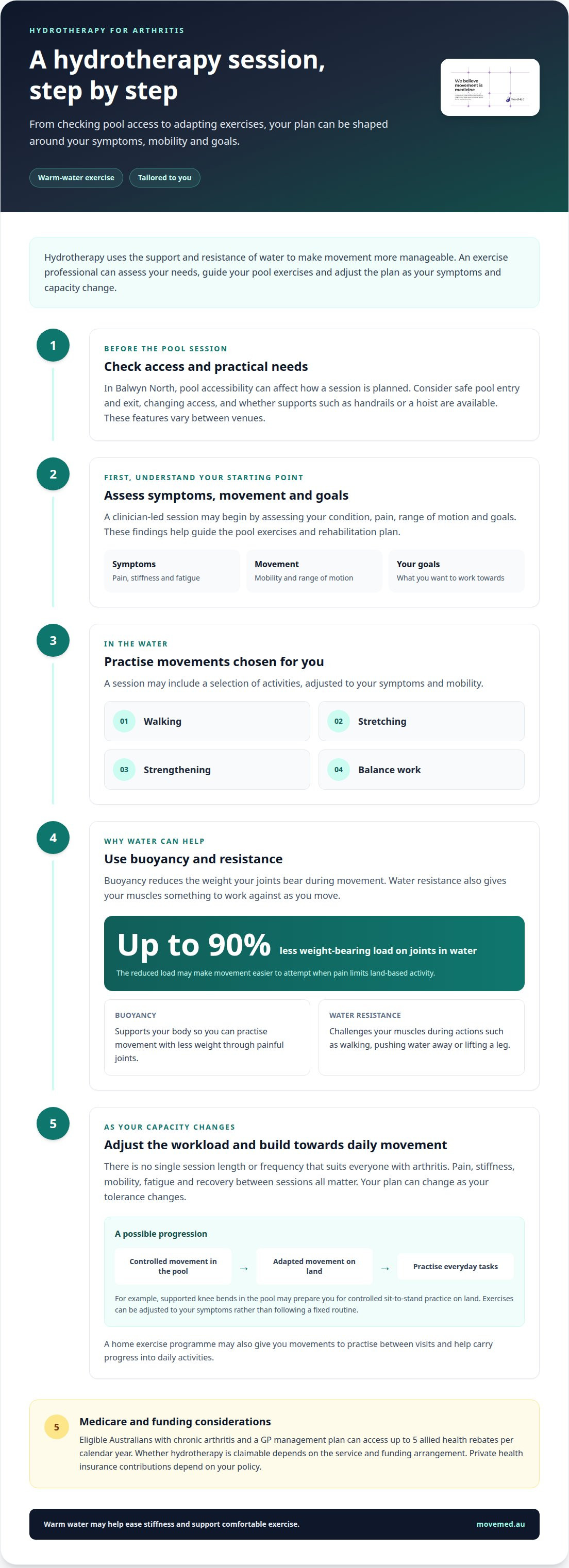
Hydrotherapy uses water to make exercise more manageable when you have arthritis. Buoyancy reduces weight-bearing on your joints, and movements can be adapted to your symptoms and mobility.
For eligible Australians with chronic arthritis and a GP management plan, Medicare can provide up to 5 allied health rebates per calendar year. Whether hydrotherapy is claimable depends on the service and funding arrangement; private health insurance contributions depend on your policy. In Balwyn North, accessibility involves safe pool entry and exit, changing access, and supports such as handrails or a hoist. These features vary between venues and affect how a session is planned.
Buoyancy and joint loading
Buoyancy is the upward force water provides, reducing the weight your joints bear during movement. Water can reduce weight-bearing load on joints by as much as 90%, making exercises easier to attempt when pain limits land-based activity.
The reduced load can help you practise movement without placing your full body weight through painful joints. For example, walking in water may feel more manageable than walking on land, letting you focus on control and function.
Buoyancy-assisted movement
Buoyancy uses the water’s support to help you move with less weight bearing down on your joints. You can practise walking, stretching, strengthening exercises or balance work in the water.
This can be useful when stiffness restricts your range of motion or a movement feels difficult on land. Water resistance also gives your muscles something to work against, helping you build strength while buoyancy reduces the load on your joints.
Session frequency and duration
Session frequency and duration refer to how often and for how long you exercise in the pool. There’s no single schedule or session length that suits everyone with arthritis. Pain, stiffness, mobility, fatigue and recovery between sessions all matter.
A suitable plan matches the exercise to your current capacity and goals. For example, when symptoms limit movement, a session may focus on controlled walking and gentle range-of-motion work. As your tolerance changes, the exercise mix and workload can be adjusted instead of sticking to a fixed routine.
Physiotherapist- or exercise physiologist-led sessions
A clinician-led session connects your arthritis symptoms with a practical exercise plan. It may begin with an assessment of your condition, pain, range of motion and goals. Those findings can then guide pool exercises and rehabilitation.
For osteoarthritis, exercise therapy is recommended as a first-line intervention. An exercise physiologist or physiotherapist can tailor movements to your ability, then modify or progress them as strength and mobility change. For example, someone experiencing painful knee movement may begin with controlled exercises in the hydrotherapy pool before attempting a more demanding version.
For people with knee osteoarthritis, aquatic exercise has been found equally as effective as land-based exercise for improving pain, function and quality of life. Water isn’t automatically better for everyone. The pool may allow movement with less joint loading, while land exercises practise tasks closer to everyday activities, such as standing from a chair or walking across a room.
Progression can connect pool and land-based exercise. A clinician may help you practise a movement in water first, then adapt it for land as your capacity develops. For instance, supported knee bends in the pool may prepare you for controlled sit-to-stand practice on land. Exercises can be adjusted to your symptoms rather than following a fixed routine.
Some people benefit from a home exercise program alongside their sessions. It gives you movements to practise between visits and can help carry progress into daily activities. A clinician can select exercises around your goals, such as walking more comfortably or making transfers easier, and adjust them based on your response.
If you’re considering structured pool-based rehabilitation, hydrotherapy and exercise physiology support can help connect your assessment with an individual exercise plan.
Warm-water hydrotherapy for arthritis pain and stiffness
Warm water may make movement more comfortable when arthritis causes pain or stiffness. Hydrotherapy at MoveMed takes place in a warm-water pool, where water supports low-impact exercise at a controlled pace.
Warm water and symptom relief
Therapeutic hydrotherapy pools are typically maintained at 33°C to 35°C. Warm water can help reduce pain, ease muscle spasms and improve comfort during exercise, which may make it easier to practise movements that feel uncomfortable on land.
For osteoarthritis, water exercise may help reduce pain, improve joint lubrication and strengthen the muscles around affected joints. In rheumatoid arthritis, warmth and gentle water pressure may help ease inflammation, pain and stiffness. Effects vary with symptoms, so exercises can be adjusted to how you feel.
Confidence and freedom of movement
Water supports your body as you move, helping you practise actions that feel difficult on land. For example, slow squats in water can build confidence while working on knee range of motion and coordination.
That support can help you focus on controlled movement rather than bracing against discomfort. Walking through the water or practising a gentle bend gives you space to explore your movement and notice how your joints respond. You don’t have to be able to swim for most water exercise classes, but you should feel confident moving around independently and letting go of the pool edge.
Water resistance for strength and endurance
Water resistance is the force you work against as you move through the pool. It challenges your muscles during activities such as walking, pushing water away or lifting a leg, supporting strengthening exercise without weights.
Changing the speed or range of a movement changes how much resistance you encounter. A controlled leg lift, for instance, can challenge the muscles around your hip and knee, while steady water walking can build endurance. Water exercise can also provide aerobic activity to support cardiovascular fitness. Hydrotherapy lets exercise progress gradually, with movements adapted to your comfort and capacity.
Arthritis types treated with hydrotherapy
Arthritis includes more than 100 types and related conditions, so the best water-based exercise depends on your symptoms and movement goals. Hydrotherapy may support people with several forms, but it complements a broader care plan rather than curing arthritis.
Osteoarthritis involves cartilage breakdown and changes to the underlying bones. These changes can restrict joint movement and make everyday actions, such as walking or bending a knee, painful. In a hydrotherapy session, supported movement offers a way to practise mobility and build strength around affected joints. Your exercise plan can focus on the joints and tasks that matter most to you.
Water exercise may also be useful for rheumatoid arthritis. Warm water and gentle pressure may help ease symptoms such as pain and stiffness, while exercises can be adapted to how your joints feel. For example, if hand or knee symptoms make a movement difficult, its range or effort can be adjusted to keep activity comfortable and controlled.
Ankylosing spondylitis affects the spine, and hydrotherapy may help improve spinal mobility, reduce pain and support better posture. Gentle movements in water can give you a way to practise turning or extending your back with support. A physiotherapy or exercise-based plan can connect these movements with functional goals, such as standing more comfortably or moving through daily tasks.
Hydrotherapy may also benefit people with other forms of arthritis, but the relevant symptoms and goals differ. In Australia, juvenile idiopathic arthritis affects about 6,000 children; exercise needs to suit the child’s age, condition and abilities. The clear takeaway is that diagnosis alone doesn’t determine suitability: the affected joints, pain, mobility and daily function help shape the exercise approach. Explore tailored hydrotherapy support as part of an arthritis management plan.
MoveMed: Hydrotherapy
MoveMed provides Hydrotherapy for people with arthritis who want to explore supported, water-based exercise as part of managing pain and mobility. If joint symptoms make land-based movement difficult, an Exercise Physiology Consultation can connect your goals and current capacity with an evidence-based exercise approach.
MoveMed’s Accredited Exercise Physiologists create personalised management plans to support recovery and improve health. Hydrotherapy may suit you if you’re looking for guided exercise in water. Aged Care Funded Therapy and NDIS Funded Therapy may be relevant if you’re eligible to use those funding pathways. Contact MoveMed to ask about hydrotherapy session pricing.
The next step is to discuss your arthritis, the activities you want to manage and whether hydrotherapy fits your needs. Contact MoveMed to arrange an Exercise Physiology Consultation or talk about Hydrotherapy.
Take the next step towards movement that matters
Living with arthritis can make it harder to keep doing the activities that matter to you. Think of one movement you’d like to approach with more confidence, such as walking to the shops or standing from a chair. That goal can help shape a conversation about support suited to your needs.
If you’re considering hydrotherapy for severe arthritis pain relief in Balwyn North, MoveMed offers Hydrotherapy and Exercise Physiology Consultations. Aged Care Funded Therapy is also available. Ask MoveMed about the cost of private hydrotherapy and discuss how it may fit your broader care and movement goals.
You don’t need every detail worked out before taking a step. Contact MoveMed to discuss hydrotherapy and explore a considered way forward.
Frequently Asked Questions
Are there different pools that I can exercise in?
Yes, pool settings differ in water temperature and access features. Therapeutic pools used for arthritis are typically maintained at 33°C to 35°C, while recreational pools for public aqua aerobics are typically 27°C-29°C. These temperatures describe different environments; the pool setting can affect how comfortable you feel exercising and which movements are practical for your needs.
Do I need to know how to swim to attend hydrotherapy?
No. Hydrotherapy is exercise, not swim training, so swimming laps isn’t the goal. What matters is whether you can access and move through the water in a way that suits the session. If balance, transfers or fatigue affect pool access, mention this when planning exercises so your mobility needs can be considered.
How do I get started?
Book an Exercise Physiology Consultation or discuss Hydrotherapy with MoveMed. You don’t need a GP referral to book. Be ready to describe your arthritis diagnosis, movements you find difficult and an activity you’d like to manage more comfortably, such as shopping or standing from a chair. This context can guide a discussion about an exercise plan.
How does it help, and what types of arthritis is it used for?
Hydrotherapy can support exercise for osteoarthritis, rheumatoid arthritis and ankylosing spondylitis, and may suit other arthritis presentations. The focus depends on your needs. For example, someone with hip symptoms may prioritise walking, while a person with spinal symptoms may work towards posture and mobility goals. The exercise plan should reflect your diagnosis, affected areas and daily activities.
How effective is hydrotherapy?
Evidence for hydrotherapy should be understood in context. For knee osteoarthritis, aquatic exercise has been found equally as effective as land-based exercise for pain, function and quality of life. This doesn’t show that water exercise is superior or that results are the same for every type of arthritis. Progress can be considered in relation to activities that matter to you.
Is hydrotherapy safe if I have high blood pressure or heart conditions?
Before starting hydrotherapy, speak with your GP or treating clinician, particularly if you have high blood pressure or a heart condition. Discuss your diagnosis, current symptoms and the activities you hope to manage. This gives them context to advise whether pool exercise is appropriate and what level of exertion to plan for.


