

What if moving with less discomfort meant changing the environment, rather than pushing harder? Hydrotherapy uses therapeutic movement in water, where buoyancy reduces the load on your joints and water provides gentle resistance. For people considering hydrotherapy as an alternative to pain medication in Box Hill, it may offer another way to work on pain and mobility, but it isn’t a replacement for medication prescribed by your healthcare provider.
If pain, stiff joints or concerns about balance are making everyday movement harder, it’s understandable to look for a manageable approach. Hydrotherapy as an alternative to pain medication in Box Hill may offer a way to practise movement in warm water, where buoyancy and resistance can support comfort, strength and confidence. This article explains what aquatic exercise may help with, what to consider before starting and how a tailored program can support movement beyond the pool.
Key Takeaways
- Buoyancy can make movement feel more manageable by reducing joint loading, while water’s resistance offers a way to practise strength and mobility.
- Aquatic therapy may support people with a range of conditions, but the exercises should suit your symptoms, goals and movement confidence.
- Gentle, progressive pool exercises can help you practise balance and movement with less discomfort, then build towards everyday activities on land.
- MoveMed’s hydrotherapy and Exercise Physiology Consultations can help you work towards safer, more confident movement with a tailored approach.
Water’s buoyancy, warmth, resistance and hydrostatic pressure
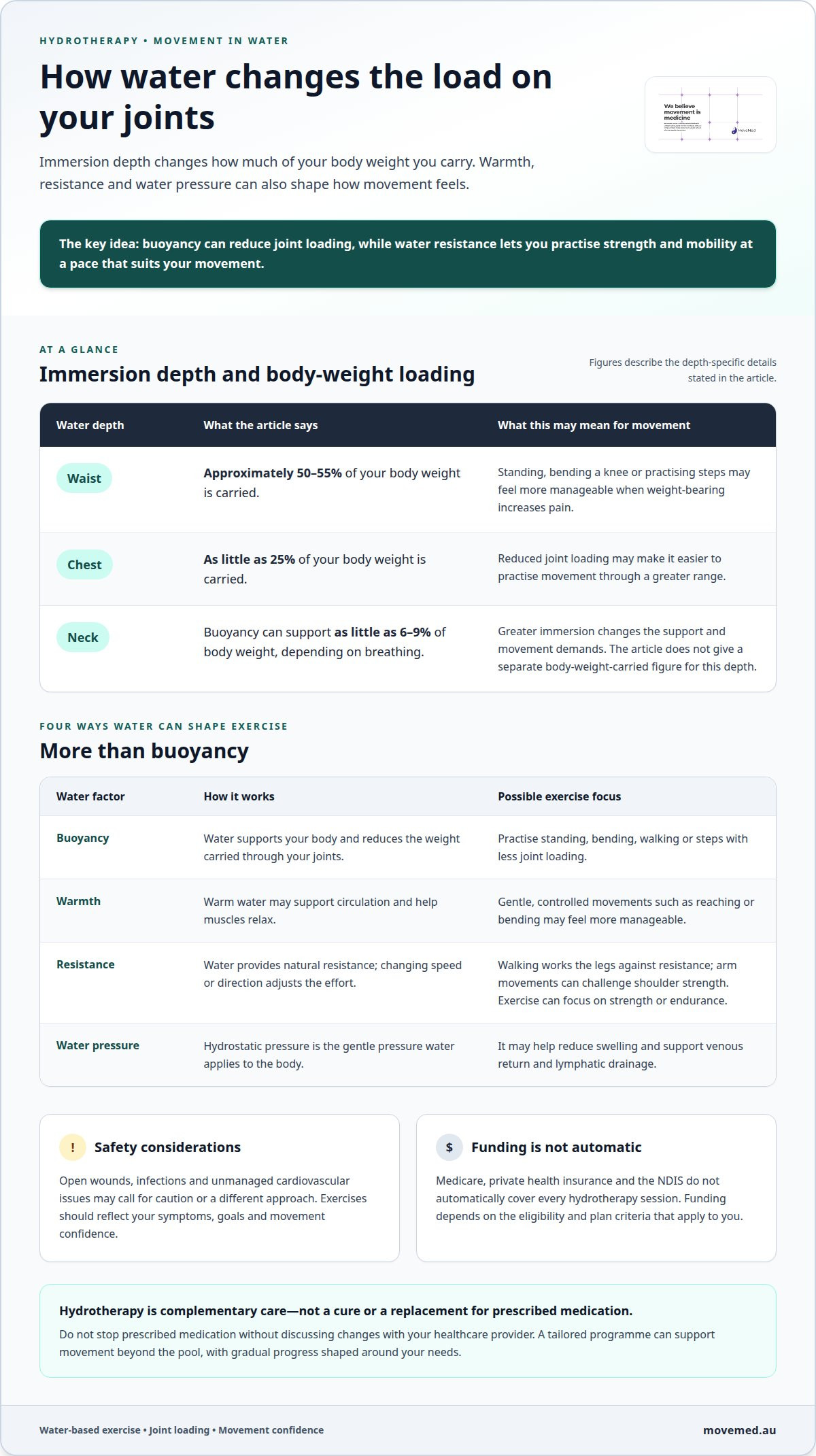
Water combines buoyancy, warmth, resistance and pressure, each of which can support a different aspect of exercise. Buoyancy can reduce joint loading, while resistance offers a way to practise strength and mobility.
Buoyancy and reduced joint stress
Buoyancy is the upward force of water that supports your body and reduces the weight carried through your joints. At waist depth, you carry approximately 50-55% of your body weight; at chest depth, as little as 25%. This can make standing, bending a knee or practising steps more comfortable when weight-bearing increases pain. Less joint loading may help you move through a greater range, while still practising useful everyday actions.
Warmth, circulation and relaxation
Warm water may support circulation and help muscles relax. For people with stiffness, this can make gentle movement feel more manageable than starting with demanding land-based exercise. Relaxed muscles may also make controlled movements, such as reaching or bending, easier to practise. The aim is greater comfort during activity, not a cure for the condition causing pain.
Movement supported by warm water
Water combines buoyancy with natural resistance, so you can practise movement with less impact than on land. Walking through water works the legs against resistance, while moving your arms can challenge shoulder strength. Changing your speed or direction adjusts the effort, allowing exercise to focus on strength or endurance. This can make water useful for graded practice when stiffness or discomfort limits movement on land.
Water pressure also matters. Hydrostatic pressure, the gentle pressure water applies to the body, may help reduce swelling and support venous return and lymphatic drainage. At neck depth, buoyancy can support as little as 6-9% of body weight, depending on breathing. The depth of immersion changes the support and movement demands.
Medicare, private health insurance and the NDIS don’t automatically cover every hydrotherapy session. Funding depends on the eligibility and plan criteria that apply to you, so check your coverage before assuming aquatic therapy is funded.
Open wounds, infections and unmanaged cardiovascular issues may call for caution or a different approach. Hydrotherapy is complementary care, not a cure or a replacement for medication prescribed by your healthcare provider.
What does aquatic therapy treat?
Aquatic therapy uses exercise in water to support movement when pain, weakness or difficulty bearing weight limits activity. Whether it’s suitable depends on your condition and the movements you want to practise.
Conditions aquatic therapy may help manage
Aquatic exercise may help manage symptoms associated with arthritis, fibromyalgia, Parkinson’s disease, neuropathy, multiple sclerosis and cerebral palsy. For arthritis, buoyancy reduces the weight carried through painful joints, which may make walking or bending easier to practise. For people with neurological conditions, supported movement can provide an environment to work on balance, strength and coordination. The program should reflect your symptoms and rehabilitation goals.
Back pain and musculoskeletal conditions
Musculoskeletal conditions affect muscles, bones, joints, tendons or ligaments and can limit everyday movement. For back pain, water can support walking, gentle strengthening and mobility exercises with less discomfort. Arthritis and joint degeneration may also make weight-bearing exercise challenging. After surgery, aquatic exercise may form part of recovery when appropriate, with its focus and pace shaped around your rehabilitation needs.
Neurological conditions can affect balance, coordination and muscle control. For example, aquatic exercises may help people with Parkinson’s disease or multiple sclerosis practise controlled movement and build physical capacity. Hydrotherapy may also support cardiovascular endurance, depending on the person and program. It doesn’t address every symptom or replace condition-specific care, so exercises should reflect your health, confidence and goals.
Hydrotherapy and pain medication have different benefits and risks. Aquatic exercise can support movement, while medication may help manage symptoms. Water-based therapy calls for caution with open wounds and unmanaged cardiovascular issues; prescribed medication also has individual risks. Costs depend on the medication, therapy plan and applicable funding, so there’s no single price comparison. Don’t stop prescribed medication without discussing changes with your healthcare provider.
If pain or a musculoskeletal condition is limiting your movement, guided aquatic exercise may be one option to discuss as part of your care.
Is hydrotherapy suitable for balance work and stiff joints?
Water-based exercise can help you practise balance, mobility and strength when pain or stiffness makes land-based movement difficult. Exercises can be adapted to your rehabilitation goals.
Arthritis and joint degeneration
Arthritis and joint degeneration can make standing, walking or bending painful. In water, reduced weight-bearing may make these movements easier to practise, while resistance gives your muscles a chance to work. For example, you might practise bending and straightening a stiff knee before trying the same movement on land. This can support mobility without suggesting that hydrotherapy cures arthritis.
Chronic pain and joint stiffness
Aquatic exercise can help people with chronic pain practise movement within comfortable limits. For a stiff shoulder, controlled arm movements can work on range of motion; for lower back pain, gentle walking may support mobility. Exercises should be tailored to your condition, pain levels and confidence. Progress can be gradual, building capacity without pushing through pain.
Muscle strength and joint mobility
Water resistance creates a load for your muscles to work against during movement. Repeating a controlled leg lift, for example, can challenge strength while buoyancy supports your body. This combination can help you practise joint movement and muscle control when weight-bearing exercise feels difficult. A physiotherapy program can adjust the movements to your rehabilitation goals, including balance, walking or everyday tasks.
After a joint replacement or another operation, hydrotherapy may support recovery when it suits your rehabilitation needs. Balance exercises can progress from supported standing to controlled walking in water, giving you a chance to practise steadier movement. For people managing injuries or joint stiffness, the aim is to build functional movement that carries over to daily activities.
A physiotherapy assessment is recommended before starting, to establish whether hydrotherapy suits you and when it fits your rehabilitation. Whether you need a GP referral depends on how you access and fund care.
To find a qualified hydrotherapy physiotherapist near Box Hill, look for a physiotherapist who guides aquatic sessions and tailors exercises to your condition, movement confidence and rehabilitation goals.
Pain relief and movement confidence
Persistent pain can make movement feel uncertain, even during familiar daily tasks. Hydrotherapy may offer a way to practise gentle activity and build confidence gradually.
Pain relief and inflammation
Pain and inflammation can occur together, but they aren’t the same: inflammation is the body’s response to irritation or injury. Hydrotherapy may help manage pain and stiffness, but it shouldn’t be described as a treatment that reduces inflammation. For example, someone with osteoarthritis may practise comfortable walking in water while following their broader care plan. The aim is purposeful movement, not a claim that pool exercise resolves the underlying cause.
Evidence for an alternative to medication
Hydrotherapy involves therapeutic exercise or movement in a warm-water pool. It may help manage chronic pain associated with osteoarthritis, fibromyalgia, low back pain and complex regional pain syndrome. This makes it a movement-based option, but doesn’t prove it works better than medication. It isn’t a substitute for medication prescribed by your healthcare provider, and you should discuss medication changes with them.
If you’re considering hydrotherapy as an alternative to pain medication in Box Hill, view it as a complementary approach, not a reason to stop prescribed treatment. The information here describes potential symptom benefits, not a direct comparison showing aquatic therapy is more effective or safer than pain medicines. Benefits, risks and costs differ between treatments and depend on the person, medicine and therapy plan.
Persistent pain can affect more than exercise. People experiencing it are five times more likely to be limited a lot in their daily activities. A practical goal, such as standing long enough to prepare a meal, can help define what progress means for you. For people considering hydrotherapy as an alternative to pain medication in Box Hill, confidence with meaningful daily tasks can be one measure of progress.
If pain is limiting your movement, explore support for your movement goals and how aquatic exercise may fit your care.
MoveMed: Hydrotherapy
MoveMed provides hydrotherapy in a warm-water pool for people working on movement, strength or balance. In Exercise Physiology Consultations, Accredited Exercise Physiologists prescribe personalised, evidence-based programs after a one-on-one assessment, taking your health, symptoms and goals into account.
This approach may suit you if pain or stiffness makes land-based exercise difficult, or if you want supported practice as part of managing a chronic condition. Hydrotherapy doesn’t replace prescribed medication, and your broader care plan remains important. MoveMed also provides Aged Care Funded Therapy and NDIS Funded Therapy for eligible clients.
If you’re ready to explore whether guided water-based exercise fits your movement goals, contact MoveMed to discuss the next step.
Take a considered next step towards easier movement
Choosing hydrotherapy as an alternative to pain medication in Box Hill doesn’t mean making an either-or decision about your care. A useful next step is to identify a daily movement you want to make easier, such as getting up from a chair or walking with greater confidence. That goal can help guide a discussion about whether water-based exercise fits your needs.
MoveMed offers Hydrotherapy and Exercise Physiology Consultations to help you work towards movement goals with a tailored approach. Aged Care Funded Therapy is also available for eligible clients. Your health, symptoms and goals guide whether hydrotherapy is suitable, and it shouldn’t replace medication prescribed by your healthcare provider.
Take the next step at your pace. Contact MoveMed about hydrotherapy to discuss your movement goals.
Frequently Asked Questions
What Is Hydrotherapy?
Hydrotherapy is a structured form of rehabilitation that uses exercise in a warm-water pool. It differs from a general swim because the activities are selected for therapeutic goals and guided by a clinician. At MoveMed, the service includes an initial in-clinic assessment, a personalised treatment plan and an exercise program, giving you a starting point that reflects your needs.
Do I need to know how to swim?
Hydrotherapy focuses on therapeutic exercise, not swimming laps. If you’re unsure about your comfort in water, mention it during your initial assessment so it can inform your exercise plan. You can also explain which movements or water activities feel difficult. This helps your clinician understand your concerns before you begin.
What does a session feel like?
The experience varies according to the movements in your program and your comfort in water. Exercises are supervised and selected to suit your rehabilitation goals, rather than following a standard workout. Your initial assessment and personalised plan give you the opportunity to discuss what you hope to achieve and any concerns that could affect your participation.
Which pains and problems can hydrotherapy help with?
Hydrotherapy may be considered when pain, stiffness or injury makes some forms of exercise difficult. Think about which activities you’d like to manage more comfortably, such as moving around at home or returning to your usual routine. Sharing these goals during an assessment helps shape an exercise plan around function, not just a diagnosis.
Which pain conditions may benefit from hydrotherapy?
Hydrotherapy may form part of chronic pain care when suitable movement is included in your management plan. Rather than relying on a condition name alone, a clinician considers how symptoms affect your activity, your movement goals and your comfort with exercise. Keep taking prescribed medication as directed, and discuss proposed changes with the healthcare professional who prescribed it.
Which hydrotherapy pools and providers are available near Box Hill?
MoveMed offers hydrotherapy and Exercise Physiology Consultations. Look for a qualified physiotherapist who guides aquatic sessions and tailors exercises to your condition, movement confidence and rehabilitation goals.


