

Have you ever felt like your own body is working against you every time your feet hit a hard floor? For many people living in Templestowe, Doncaster, or Box Hill, the simple act of walking to the letterbox or standing to cook a meal is often overshadowed by sharp joint pain or a genuine fear of falling. If you are currently searching for ndis hydrotherapy melbourne, you likely already know that a standard public gym can feel intimidating and physically unforgiving when you are managing a chronic condition. It is exhausting to feel that your independence is slipping away while you struggle to navigate the complexities of TAC or NDIS funding requirements.
We understand that you want more than just a place to swim; you need a clear, supervised path to feeling better. This guide will show you how clinical hydrotherapy in Melbourne’s eastern suburbs can accelerate your recovery and restore your mobility without the impact of gravity. We will explain how our Accredited Exercise Physiologists create tailored programmes (specialised exercise plans) that reduce pain and build strength. You will also learn exactly how to use your funding to access the expert care you deserve, ensuring you can move forward with total confidence and reclaim your daily life.
Key Takeaways
- Learn how the buoyancy of a heated clinical pool reduces weight-bearing stress, allowing you to exercise with significantly less joint pain.
- Understand the vital role an Accredited Exercise Physiologist plays in designing a safe aquatic programme that targets the root cause of your discomfort.
- Find out how to streamline your paperwork and access ndis hydrotherapy melbourne using your existing NDIS, TAC, or WorkCover funding.
- Identify the essential accessibility features a local facility should provide, such as hydraulic hoists and ramps, for safe pool entry and exit.
- Discover how a structured transition from water-based therapy to land-based strength training helps you reclaim long-term independence.
Understanding the Role of a Melbourne Hydrotherapy Centre
Finding the right ndis hydrotherapy melbourne provider is about more than just finding a pool. It is about accessing a clinical environment where movement is treated like medicine. A dedicated hydrotherapy centre is vastly different from your local public swimming lanes. While those pools are designed for recreation and sport, a clinical aquatic facility is a controlled space where the water temperature, accessibility, and supervision are all calibrated for recovery.
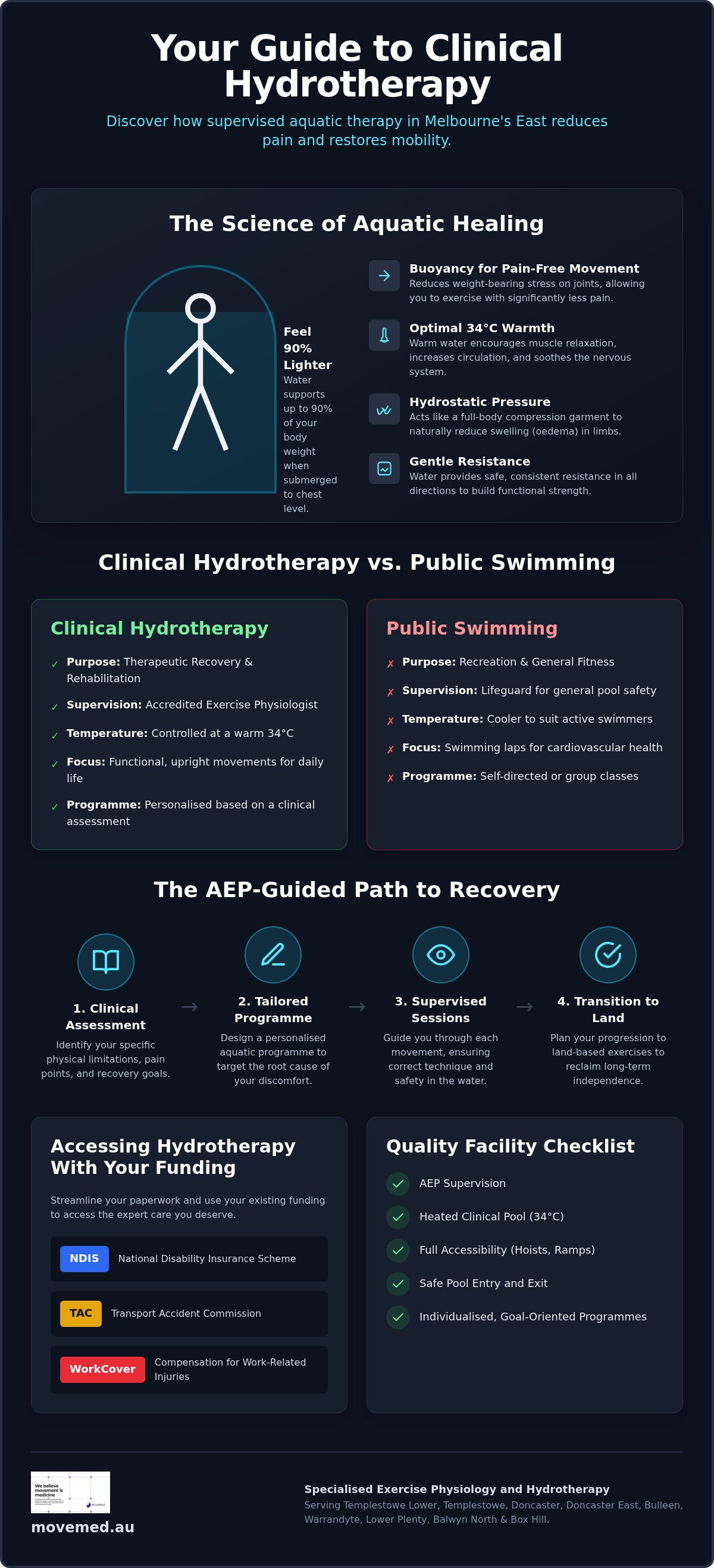
At the heart of this treatment is Hydrotherapy, which uses the physical properties of water to facilitate healing. The most immediate benefit you'll notice is buoyancy. When you are submerged to your chest, the water supports about 90% of your body weight. This dramatic reduction in weight-bearing stress means that joints which usually throb when walking on hard surfaces can move freely and without pain. We often see clients who can't stand for five minutes on land comfortably performing a full 30-minute exercise circuit in the water.
The "magic number" for this environment is 34°C. Standard pools are typically kept much cooler to accommodate active swimmers, but that temperature can cause muscles to tense up. In a clinical centre, the warmth encourages immediate muscle relaxation and increases circulation. This improved blood flow brings essential nutrients to injured areas, helping to speed up the natural repair process while soothing a sensitised nervous system.
The Science of Aquatic Therapy
Water offers unique physiological benefits that land-based exercise simply cannot match. One key factor is hydrostatic pressure. This is the pressure exerted by the water against your body, which helps to reduce oedema (swelling) in the lower limbs. It effectively acts as a whole-body compression garment, pushing fluid away from swollen joints and back into circulation.
We also use water density to create resistance. Unlike lifting heavy weights in a gym, which can be intimidating or risky, water provides a gentle, constant resistance in every direction. This allows you to build strength at your own pace. For conditions like fibromyalgia or chronic fatigue, the thermoregulation provided by the warm water is essential. It helps regulate your body temperature and reduces the "flare-up" response often triggered by traditional exercise.
Hydrotherapy vs. Swimming
It is a common misconception that swimming laps is the same as hydrotherapy. While swimming is excellent for cardiovascular health, a clinical programme focuses on functional, upright movements. These are the motions you need for your daily life, such as stepping over a gutter, reaching into a cupboard, or maintaining your balance on an uneven path.
Our Accredited Exercise Physiologists don't just give you a list of laps to complete. They provide a tailored plan based on a clinical assessment. Every movement is purposeful and supervised to ensure you are building the right muscles without overstraining others. This expert guidance is what turns a simple dip in the pool into a powerful tool for reclaiming your independence.
Why Allied Health Supervision is Critical for Your Recovery
Why is it so important to have a professional present during your pool session? When you are looking for ndis hydrotherapy melbourne, the quality of supervision is the most significant factor in your success. Clinical aquatic recovery is not about swimming laps; it is about precise, therapeutic movement guided by an Accredited Exercise Physiologist (AEP). Our role is to ensure every exercise is performed with the correct technique to maximise your results and, most importantly, to keep you safe. A clinical assessment is always our starting point, as it allows us to identify your specific physical limitations and prevent re-injury during your supervised water sessions.
Safety protocols are vital for clients with balance issues or a high risk of falling. The water provides a buoyant environment that reduces the fear of injury, but professional guidance ensures you don't overexert yourself. Aquatic physiotherapy and exercise physiology principles are used to create a sanctuary where you can move without the constant threat of a trip or stumble. As your confidence grows and your pain decreases, we begin to plan your transition from the pool to land-based movements. This often involves integrating clinical reformer pilates in Templestowe, ensuring the strength you gained in the water supports your independence in the "real world."
Exercise Physiology: The Long-Term Advantage
Exercise Physiology is a university-qualified allied health profession specialising in clinical exercise intervention. This high level of training makes AEPs the ideal experts for managing complex chronic diseases like Diabetes and Osteoarthritis. We don't believe in a one-size-fits-all approach. Instead, we create "dosed" exercise plans that evolve as your physical strength and stamina improve. This methodical progression ensures your body continues to adapt and heal over time. Many residents in Doncaster and Bulleen find that they achieve more sustainable results when they partner with our local clinical team rather than trying to manage their rehab alone.
Conditions That Thrive in the Water
The unique properties of a heated pool make it the perfect setting for several specific health challenges. It is an exceptional tool for post-operative rehab, particularly following hip and knee replacements when weight-bearing on land is still too painful. We also see remarkable progress in clients with neurological conditions, such as Multiple Sclerosis or Parkinson’s disease, where the water's resistance helps improve gait and coordination. By effectively managing the symptoms of various NDIS-related disabilities, we help you reclaim the ability to perform daily tasks with ease and less discomfort.
Navigating NDIS, TAC, and WorkCover Funding in Victoria
The bureaucracy of healthcare funding can often feel more exhausting than the physical pain itself. Whether you are managing a long term disability or recovering from a sudden accident, understanding how to fund your sessions is a common hurdle. If you are searching for ndis hydrotherapy melbourne, it is helpful to know that clinical aquatic therapy is recognised as an evidence based intervention across several major Victorian schemes. Our team acts as your partner in this process, handling the technical reporting so you can focus entirely on your physical progress.
But what is hydrotherapy in the eyes of a funding body? It is viewed as a clinical tool to improve functional capacity; this is why it is often covered by the NDIS, TAC, and WorkCover VIC. We also support local veterans through the DVA and provide rebates for those on Medicare Chronic Disease Management Plans. These Medicare plans, often referred to as EPC or CDM plans, allow for five rebated allied health sessions per calendar year for those with chronic conditions, making supervised hydrotherapy more accessible for the local community.
NDIS Hydrotherapy in Melbourne’s East
To access support under the NDIS, the therapy must be deemed "reasonable and necessary". This means it must directly relate to the goals in your plan, such as improving your ability to walk to the shops or manage daily tasks independently. We specialise in linking your pool sessions to these functional outcomes under the "Capacity Building - Improved Daily Living" or "Improved Health and Wellbeing" categories. Our Accredited Exercise Physiologists provide the detailed progress reports required for your plan reviews, ensuring your funding remains secure by proving the tangible benefits you are achieving in the water.
TAC and WorkCover Claims
For those recovering from a road accident or a workplace injury, early intervention is the key to a successful recovery. The referral process usually begins with your GP, who can recommend a programme led by an Exercise Physiologist. Starting in the water allows for low impact conditioning long before land based exercise is viable; this often results in a faster return to work and daily life. We also provide dedicated support for local veterans. Please see our DVA Exercise Physiology Guide for more on how we assist the veteran community in Templestowe and surrounding suburbs.
What to Look for in a Quality Melbourne Hydrotherapy Facility
Selecting the right facility for your ndis hydrotherapy melbourne sessions is a decision that directly impacts your safety and the speed of your recovery. It is about more than just finding a warm pool. A clinical facility must provide specific hardware, such as hydraulic hoists and ramps, to ensure every participant can enter the water safely and with dignity. For those with significant mobility challenges, waterproof wheelchairs should be available to facilitate a smooth transition from the change room to the pool deck. These features remove the physical and emotional barriers that often prevent people from seeking aquatic therapy in the first place.
The environment inside the pool area is equally vital. A true clinical centre maintains a water temperature strictly between 32°C and 34°C. This specific range is necessary to induce muscle relaxation and suppress pain signals. Beyond the temperature, look for a facility that provides professional clinical equipment. This includes underwater weights for strength training, resistance fins to increase the "drag" during movement, and specialised noodles for buoyancy support. Privacy is another non-negotiable factor. Change rooms must be spacious enough to accommodate mobility aids and carers, ensuring your experience is comfortable from the moment you arrive until the moment you leave.
Location Matters: Finding Hydrotherapy Near Templestowe
Consistency is the secret to long-term physical change. Choosing a centre close to home makes it much easier to stick to your programme when you are feeling tired or in pain. We focus on serving our local community in Templestowe Lower, Doncaster, and Bulleen, as well as residents in Warrandyte and Lower Plenty. When evaluating a location, always check the parking and transport options. Having accessible, close-proximity parking is essential for those who find walking long distances on hard bitumen painful or exhausting. If you are ready to see how a clinical environment can change your recovery, book your initial assessment with MoveMed today.
Staff Qualifications
The most beautiful pool in the world is of little value without expert guidance. You must ensure your provider is ESSA accredited (Exercise & Sports Science Australia). There is a vast difference between a lifeguard, who is there for general safety, and a clinical supervisor, who understands the pathology of your condition. An Accredited Exercise Physiologist knows how to adjust your exercises if you have a flare-up or if your blood pressure changes. Don't be afraid to ask about their specific experience with your disability or injury; a qualified professional will be happy to explain their clinical approach to your care.
The MoveMed Approach: Personalised Hydrotherapy in Templestowe Lower
MoveMed is more than just a clinical provider; we are a dedicated partner in your recovery journey. When you choose us for ndis hydrotherapy melbourne, you aren't just getting a pool session. You are entering a structured, evidence-based system designed to move you from pain to power. Our approach is built on a methodical 4-step process. It begins with a thorough Clinical Assessment on land, followed by collaborative Goal Setting. We then move to a gentle Pool Induction to ensure your safety, before finally focusing on Progression. We believe the water is a fantastic starting point, but the ultimate goal is often to transition you back to land-based activities.
This progression is particularly effective when we integrate hydrotherapy with strength training for Templestowe seniors. By building a foundation of movement in the heated pool, we prepare your body for the resistance needed to maintain bone density and muscle mass as you age. It is about creating a bridge between the buoyancy of the water and the functional strength you need for your daily life in Templestowe Lower or Doncaster.
We don't just guess your progress. We track specific data points during every session to prove functional improvements. This information is compiled into detailed reports for your GP or NDIS coordinator, providing clear evidence of how the therapy is helping you reclaim your independence. Beyond the clinical data, you will find that MoveMed is a genuine community. We've created a supportive, non-intimidating environment where residents from Doncaster East and Warrandyte feel at home, rather than just another patient in a busy hospital system.
Your First Session: What to Bring
Preparation is key to feeling calm and confident. For your first session, please bring your swimwear, a towel, and a water bottle. If you use any mobility aids, such as a walker or cane, bring those along too. We start with a land-based assessment in our clinic to understand your movement patterns before we ever get near the water. Our Exercise Physiologists will guide you through every step of the pool entry process, ensuring you feel completely secure and supported as you experience the relief of the heated water for the first time.
Booking Your Assessment
Starting your recovery should be the easiest part of your week. If you are a private health client, you can get started immediately without a GP referral. For those using NDIS or TAC funding, the process is just as simple. We handle the bulk of the paperwork and can coordinate directly with your plan manager or insurance case officer to ensure your sessions are covered. It's time to stop simply managing pain and start reclaiming your life. Book your initial clinical assessment at MoveMed today and take the first step toward a more mobile, independent future.
Reclaim Your Independence Through Expert Aquatic Care
Living with chronic pain doesn't mean you have to accept a limited lifestyle. Clinical aquatic recovery offers a unique path to build strength and confidence without the punishing impact of gravity. By choosing a specialised Eastern Suburbs clinic, you ensure your progress is guided by Accredited Exercise Physiologists who understand the nuances of your condition. We manage the underlying causes of your pain, not just the symptoms, while helping you navigate the complexities of being an NDIS and TAC Registered Provider.
Securing high-quality ndis hydrotherapy melbourne is a significant step toward restoring your daily mobility. Our team is ready to partner with you to create a personalised programme that bridges the gap between the pool and your long-term land-based recovery. You don't have to navigate this journey alone; expert clinical support is available right here in your local community. We are committed to helping you move with ease and optimism once again.
Book Your Hydrotherapy Assessment at MoveMed Templestowe Lower
Frequently Asked Questions
Do I need to be a strong swimmer to do hydrotherapy?
No, you don't need any swimming skills to participate in clinical aquatic therapy. Most sessions are conducted in chest-deep water where your feet remain firmly on the pool floor at all times. Our Accredited Exercise Physiologists provide constant supervision to ensure you feel safe and supported. We focus on functional movements like walking, reaching, and balancing rather than swimming laps, making it an ideal environment for those in Doncaster or Templestowe who may feel anxious about deep water.
Is hydrotherapy covered by my private health insurance in Melbourne?
Most private health insurers in Australia provide rebates for hydrotherapy when an Accredited Exercise Physiologist leads the session. You should check your "extras" cover for Exercise Physiology to confirm your eligibility. Because MoveMed provides clinical intervention rather than open pool access, your insurer recognises the therapeutic nature of the service. We recommend residents in Bulleen or Box Hill contact their specific provider to confirm their exact rebate amount per session before starting.
What should I wear to a hydrotherapy session if I have mobility issues?
You should wear comfortable swimwear that allows you to move freely. Many of our clients prefer wearing a rash shirt or swim shorts over their bathers for extra coverage and warmth. If you have mobility issues, we strongly recommend bringing slip-resistant pool shoes to help you navigate the wet surfaces of the change rooms and pool deck safely. It’s also a good idea to bring a warm change of clothes for after you leave the 34°C water.
Can I use my NDIS funding for hydrotherapy sessions at MoveMed?
Yes, you can certainly use your funding for sessions at our clinic. We are a registered provider and frequently support participants with ndis hydrotherapy melbourne through their "Improved Daily Living" or "Improved Health and Wellbeing" budget categories. We handle all the necessary goal tracking and clinical reporting to ensure your therapy aligns with your NDIS plan, helping you maintain your independence and physical health within the Templestowe Lower community.
How many hydrotherapy sessions will I need before I see results?
You will often feel immediate relief from joint pressure and muscle tension during your very first session due to the water's buoyancy. However, for long-term functional improvements such as increased muscle strength or a better walking gait, a structured programme usually spans 8 to 12 weeks. We monitor your progress data throughout this period to ensure you are meeting the specific milestones we set during your initial clinical assessment in our Templestowe clinic.
Is hydrotherapy better than physiotherapy for chronic back pain?
Hydrotherapy led by Accredited Exercise Physiologists is exceptionally effective for chronic back pain because it "unloads" the spine. In the water, gravity's pressure on your vertebrae is significantly reduced, allowing you to perform strengthening exercises that would be too painful on land. While we don't offer general physiotherapy, our clinical aquatic programmes focus on the underlying biomechanical causes of your pain to provide lasting relief and help you return to your favourite land-based activities.
What is the difference between a hydrotherapy pool and a regular heated pool?
The primary differences are the water temperature and the clinical accessibility features. A standard heated pool is usually kept around 28°C to 30°C, whereas a clinical hydrotherapy pool is maintained at a therapeutic 34°C to promote immediate muscle relaxation. Additionally, facilities near Doncaster East are equipped with hydraulic hoists, ramps, and rails. These features ensure that individuals with limited mobility can enter and exit the water safely, which is rarely a priority in public recreational pools.
Do I need a GP referral to visit a Melbourne hydrotherapy centre?
You don't need a GP referral to visit us as a private client; you can simply book an assessment and start your journey immediately. However, a referral is necessary if you intend to claim through a Medicare Chronic Disease Management plan, DVA, WorkCover, or the TAC. Our team is happy to guide residents from Lower Plenty or Warrandyte through the specific paperwork and referral requirements for these funding schemes during their very first phone call.


