
Have you ever felt like your own body is working against you, where even a short walk across the kitchen feels like navigating a minefield of sharp joint pain? For many residents in Melbourne's eastern suburbs, the fear of a stumble or the sheer exhaustion of standing on hard surfaces makes a standard public gym feel like a danger zone rather than a place of healing. We understand that when you are already managing chronic pain or a disability, the added stress of navigating ndis hydrotherapy melbourne paperwork can feel completely overwhelming.
You deserve a recovery path that feels safe, supported, and clear. In this guide, you will discover how clinical hydrotherapy uses the natural buoyancy of 34°C water to reduce joint pressure, allowing you to build strength without the usual flare-ups. We will walk you through how our Accredited Exercise Physiologists (AEPs) create tailored aquatic programs that bridge the gap between injury and independence. From mastering NDIS and TAC funding to transitioning safely back to land-based activities, this is your roadmap to moving with confidence again.
Key Takeaways
- Learn how clinical hydrotherapy uses the natural buoyancy of water to reduce weight-bearing stress, allowing for pain-free movement and faster recovery.
- Discover the clear path to accessing ndis hydrotherapy melbourne under your Improved Health and Wellbeing budget, including how we assist with TAC and WorkCover documentation.
- Understand the vital role of an Accredited Exercise Physiologist in supervising your sessions to ensure every movement is purposeful and safe.
- Identify the clinical standards required for a quality aquatic facility, from accessibility ramps to maintaining a therapeutic water temperature of 34°C.
- Explore how our structured MoveMed approach helps you transition from water-based therapy to long-term independence and land-based strength.
Understanding the Role of a Melbourne Hydrotherapy Centre
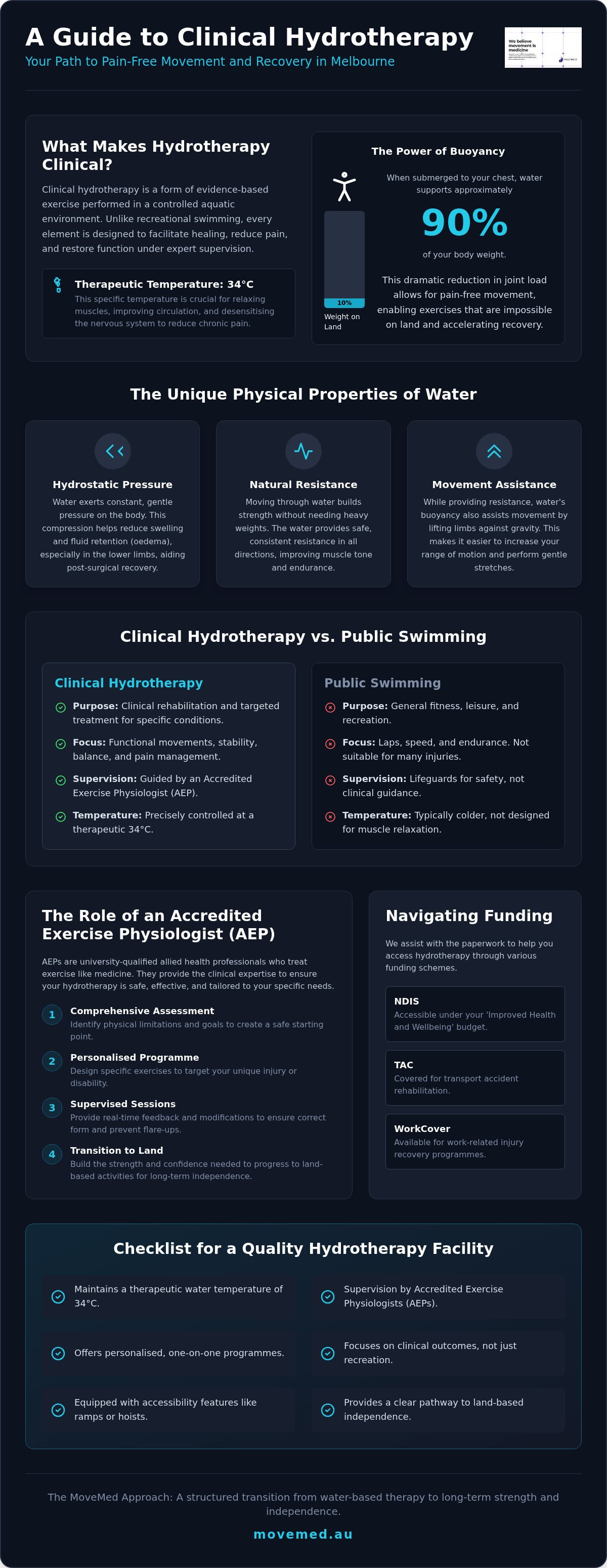
Many people think of a pool as a place for leisure, but a dedicated Melbourne hydrotherapy centre serves a much more clinical purpose. Hydrotherapy is an evidence-based form of exercise physiology performed in a controlled, heated environment. Unlike a standard public pool which is often too cold or crowded, a clinical facility maintains a consistent water temperature of 34°C. This specific heat is vital for muscle relaxation and improving circulation, creating a safe space for those who find land-based movement too painful.
When searching for ndis hydrotherapy melbourne, it's essential to look for a centre that prioritises clinical outcomes over general recreation. The magic of water lies in buoyancy. When you're submerged to your chest, water supports approximately 90% of your body weight. This dramatic reduction in weight-bearing stress allows you to perform movements that would be impossible on a hard gym floor, such as walking with a normal gait or performing squats without knee pain.
The Science of Aquatic Therapy
Water provides unique physical properties that land-based therapy simply cannot match. One key factor is hydrostatic pressure, which is the pressure exerted by water against the body. This constant, gentle compression helps reduce swelling and oedema (fluid retention) in the lower limbs. It's particularly beneficial for post-surgical recovery or circulatory conditions where gravity usually makes swelling worse.
- Resistance vs. Assistance: Moving through water creates natural resistance to build strength without the need for heavy weights. Conversely, the water also assists movement by lifting the limbs, making it easier to increase your range of motion.
- Thermoregulation: The 34°C temperature helps desensitise the nervous system; this is a game-changer for managing chronic pain conditions like fibromyalgia. It allows the muscles to relax deeply, which facilitates more effective stretching and strengthening.
Hydrotherapy vs. Swimming
While swimming laps is excellent for general fitness, it often isn't appropriate for clinical rehabilitation. Hydrotherapy focuses on upright, functional movements that translate directly to your daily life. When you access ndis hydrotherapy melbourne services, you aren't just paying for pool time; you're investing in a supervised clinical programme. An Accredited Exercise Physiologist (AEP) doesn't just watch you swim. They tailor specific exercises to your unique injury or disability.
We focus on stability and balance rather than speed. For NDIS participants, this might mean practicing safe stepping or reaching movements that improve your independence at home. It's about purposeful movement, not just staying afloat. This targeted approach ensures that every session in the water builds the resilience you need for life back on land.
Why Allied Health Supervision is Critical for Your Recovery
Stepping into a pool is easy; moving with clinical purpose requires expert guidance. When you access ndis hydrotherapy melbourne services, the most valuable part of your session isn't just the heated water, but the Accredited Exercise Physiologist (AEP) guiding your movements. We begin every journey with a comprehensive clinical assessment. This initial step is vital because it identifies your specific physical limitations and ensures we don't inadvertently cause a flare-up. For someone with a high fall risk or significant balance issues, professional supervision provides a safety net that a standard public gym simply cannot offer.
Supervised water sessions allow for immediate adjustments to your form. If a particular movement causes discomfort, your AEP can modify the angle or depth instantly to keep you safe. This level of care is about more than just avoiding injury. It's about building the confidence to move again. Once you have established a baseline of strength in the water, we often help you transition to clinical reformer pilates in Templestowe to further challenge your core stability and functional strength on land.
Exercise Physiology: The Long-Term Advantage
Exercise Physiology is a university-qualified allied health profession specialising in clinical exercise intervention. Unlike general fitness instructors, AEPs are trained to manage complex chronic conditions such as Type 2 Diabetes and Osteoarthritis. We treat exercise like medicine, creating carefully dosed plans that evolve as your physical resilience improves. As you progress through your ndis hydrotherapy melbourne programme, we monitor your physiological response to ensure the "dosage" of movement is exactly what your body needs to heal. This clinical oversight is supported by the National Disability Insurance Scheme (NDIS), which prioritises evidence-based supports that help participants build long-term independence.
Conditions That Thrive in the Water
The weightless environment of a clinical pool is particularly effective for post-operative rehabilitation. If you've recently undergone a hip or knee replacement, the water allows you to practice normal walking patterns without the jarring impact of gravity. We also see life-changing results for clients with neurological conditions, such as Multiple Sclerosis or Parkinson’s disease, where the water’s buoyancy helps manage tremors and improves coordination. Managing the symptoms of NDIS-related disabilities requires a partnership between you and your therapist. If you're ready to reclaim your mobility, you can partner with an expert at MoveMed to begin your tailored recovery plan.
Navigating NDIS, TAC, and WorkCover Funding in Victoria
Understanding the financial side of recovery shouldn't be as painful as the injury itself. Navigating the Australian healthcare system often feels like a full-time job, especially when you're already managing chronic pain or a disability. At MoveMed, we believe your energy should be spent on healing, not on administrative hurdles. Whether you're accessing ndis hydrotherapy melbourne services or recovering from a workplace injury, our team acts as your clinical ally. We handle the complex communication with funding bodies to ensure your sessions are approved and your progress is documented correctly.
NDIS Hydrotherapy in Melbourne’s East
Most NDIS participants access aquatic therapy through the "Improved Health and Wellbeing" or "Capacity Building" categories of their plan. To be considered "reasonable and necessary," the therapy must directly relate to the goals outlined in your plan, such as increasing community participation or improving daily living skills. We don't just provide the pool session; we provide the evidence. Our AEPs specialise in NDIS reporting and goal tracking, ensuring that every increase in your mobility is measured and reported back to your coordinator. This data-driven approach is essential for plan reviews and helps secure the long-term support you need for functional independence.
TAC and WorkCover Claims
If you've been involved in a road accident or a workplace incident, the path to recovery often starts with a referral from your GP. For TAC (Transport Accident Commission) and WorkCover VIC claims, early intervention in a clinical pool is the gold standard. Low-impact conditioning allows you to maintain muscle mass and cardiovascular health while your injuries are still too sensitive for the gym. This proactive approach often leads to a much faster return to work and land-based activities.
For local veterans in Templestowe and Doncaster, we also provide streamlined support through the Department of Veterans' Affairs; see our DVA Exercise Physiology Guide for more on veteran support. If you aren't covered by these specific schemes, you may still be eligible for Medicare rebates. Through a Chronic Disease Management Plan, your GP can authorise up to five subsidised allied health sessions per calendar year, making expert-led hydrotherapy more accessible for those managing long-term health challenges.
What to Look for in a Quality Melbourne Hydrotherapy Facility
Not all pools are created equal. For those seeking ndis hydrotherapy melbourne, the physical environment is just as important as the clinical programme itself. A high-quality facility must be designed with significant mobility challenges in mind. This means moving beyond a simple ladder; it requires ramps with sturdy handrails, waterproof wheelchairs, and hydraulic hoists for those who cannot safely enter the water unaided. We believe that a safe entry is the first step toward a confident recovery.
The water itself must be treated as a therapeutic tool. We ensure our partner facilities maintain a temperature between 32°C and 34°C. Standard public pools often hover around 27°C, which is far too cold for clinical work; it can cause muscles to tense up and actually increase your pain levels. In a clinical setting, the warmth is constant, facilitating the deep muscle relaxation needed for effective rehab. Privacy is another vital factor. Change rooms should be spacious enough for mobility aids and designed for dignity, ensuring you feel comfortable from the moment you arrive until the moment you leave.
To get the most out of your session, your AEP will utilise specialised clinical equipment, such as:
- Underwater weights: These help build bone density and strength without the joint impact of land-based weights.
- Resistance fins: These increase the effort of movement to improve cardiovascular health.
- Buoyancy belts: These allow for deep-water traction, which is excellent for decompressing the spine.
Location Matters: Finding Hydrotherapy Near Templestowe
Consistency is the secret to long-term recovery. If your facility is an hour's drive away, you are much less likely to attend when you're feeling tired or in pain. We focus on serving our local community in Melbourne's eastern suburbs, including Templestowe, Doncaster, Bulleen, Warrandyte, and Lower Plenty. Easy parking and proximity to public transport are non-negotiable requirements for our clients. By reducing the travel burden on your energy, you can save your focus for the session itself. This principle of accessible, high-quality care is universal; for instance, pet owners in regional areas often rely on a veterinary clinic West Gippsland to ensure their animals receive rapid diagnostics and professional support close to home.
Before you dive in, you should always ask about the person standing on the pool deck. A lifeguard is trained for safety, but an Accredited Exercise Physiologist is trained for your recovery. All MoveMed clinicians are ESSA accredited (Exercise & Sports Science Australia). This means they have completed a minimum of four years of university study and specialise in clinical exercise intervention. They understand the nuances of how a neurological disorder or a post-surgical joint responds to water pressure. If you're looking for a facility that prioritises your safety and clinical progress, book your initial assessment with our exercise physiology team today.
The MoveMed Approach: Personalised Hydrotherapy in Templestowe Lower
MoveMed is more than just a service provider; we're your local partner in reclaiming independence. In Templestowe Lower, our approach to ndis hydrotherapy melbourne is built on a methodical four-step process. We begin with a thorough clinical assessment, followed by collaborative goal setting to define what success looks like for you. From there, we move to a pool induction to ensure you're comfortable in the water, before finally focusing on clinical progression. This final stage is where we bridge the gap between aquatic therapy and land-based resilience, often integrating your programme with strength training for Templestowe seniors to ensure your results are permanent.
We don't rely on guesswork. Every session is an opportunity to track your data, from your range of motion to your perceived exertion levels. This objective evidence is vital for your GP and NDIS coordinators, as it proves that your functional independence is actually improving. Our environment is designed to be supportive and non-intimidating. We know that gyms can feel overwhelming, so we've created a community where every client feels seen and supported by our expert Exercise Physiologists.
Your First Session: What to Bring
Preparing for your first aquatic session doesn't need to be stressful. We recommend bringing the following essentials to ensure you're comfortable:
- Your preferred swimwear and a clean towel
- A water bottle to stay hydrated in the heated environment
- Any mobility aids (canes, walkers) you use for daily movement
- A change of comfortable clothes for after the session
Before we even touch the water, we'll conduct a land-based clinical assessment at our clinic. This allows us to test your balance and strength in a dry environment first. Once we're ready for the pool, your AEP will be right there with you, ensuring you feel safe and confident as you enter the 34°C water. We take the time to explain every movement, so you never feel rushed or unsure.
Booking Your Assessment
Getting started is a straightforward process. If you're a private health client, you can book in directly without needing a GP referral. For those using ndis hydrotherapy melbourne funding or TAC support, simply provide us with your plan details or claim number. We'll handle the rest of the paperwork and coordinate with your support team to get your programme approved. We're here to make the system work for you, not the other way around. If you're ready to take the first step toward a pain-free life, book your initial clinical assessment at MoveMed today.
Take the Next Step Toward Pain-Free Movement
Reclaiming your mobility starts with choosing the right environment and the right partners. We have explored how the clinical warmth of a 34°C pool and the physical property of buoyancy work together to deweight your joints, making movement feel effortless and safe. You now understand that the true value of ndis hydrotherapy melbourne lies in the expert supervision of an Accredited Exercise Physiologist. Our clinicians don't just watch you move; they guide your recovery with a data-driven plan that tracks your progress toward real-world independence.
As a registered NDIS and TAC provider, MoveMed is proud to serve the Templestowe and Doncaster communities with specialised clinical care. We handle the complex reporting and paperwork so you can save your energy for what matters most: your health. Whether you're recovering from surgery or managing a long-term disability, our team is committed to helping you transition from the water back to a confident life on land. We invite you to Book Your Hydrotherapy Assessment at MoveMed Templestowe Lower and begin your journey toward lasting resilience. You have the strength to move forward, and we're here to help you find it.
Frequently Asked Questions
Do I need to be a strong swimmer to do hydrotherapy?
No, you don't need to be a strong swimmer to participate in clinical hydrotherapy. Most aquatic exercises are performed in chest-deep water where you can comfortably stand at all times. Our Accredited Exercise Physiologists stay close by to provide physical support or use buoyancy aids to keep you stable. We focus on functional movements like walking, reaching, and balancing, rather than swimming laps. This makes it a safe environment for those who feel anxious around water.
Is hydrotherapy covered by my private health insurance in Melbourne?
Yes, most private health insurers in Melbourne provide rebates for hydrotherapy when it is delivered by an Accredited Exercise Physiologist. You'll usually find this under the Exercise Physiology section of your extras cover. We recommend contacting your provider to check your specific level of cover and any annual limits. We can provide you with the necessary clinical item codes after your initial assessment to make the claiming process as smooth as possible for you.
What should I wear to a hydrotherapy session if I have mobility issues?
You should wear standard swimwear that you feel comfortable and confident in while moving. Many of our clients with mobility issues prefer wearing a rash vest or aquatic leggings for extra warmth and modesty. If you have concerns about slipping on wet tiles, we highly recommend wearing clean, waterproof pool shoes with good grip. Please bring your own towel and a change of warm clothes to help regulate your body temperature after leaving the 34°C water.
Can I use my NDIS funding for hydrotherapy sessions at MoveMed?
Absolutely, you can use your funding for ndis hydrotherapy melbourne sessions at our clinic. MoveMed is a registered provider, and we regularly work with participants to achieve goals under the Improved Health and Wellbeing or Capacity Building categories. We assist with all the necessary reporting and goal tracking required by the NDIS. Our team ensures your aquatic programme aligns perfectly with the functional independence goals outlined in your current plan to ensure continued funding.
How many hydrotherapy sessions will I need before I see results?
While every individual's journey is unique, many clients report a reduction in joint pain and muscle tension after their very first session. For long-term functional improvements, such as increased walking distance or better balance, we typically suggest a consistent programme over four to six weeks. We track your data at every session to ensure you are progressing safely. Our goal is always to build enough strength in the water to eventually transition back to land-based activities.
Is hydrotherapy better than physiotherapy for chronic back pain?
Both approaches have their merits, but hydrotherapy offers the unique benefit of buoyancy which unloads the spine. For chronic back pain, this decompressing effect allows you to strengthen your core muscles without the painful impact of gravity. While we don't offer general physiotherapy, our Exercise Physiologists specialise in using water-based movement to treat the underlying causes of back pain. This clinical approach helps you regain mobility in a way that land-based exercise often cannot.
What is the difference between a hydrotherapy pool and a regular heated pool?
The primary difference is the temperature and the clinical design. A standard heated pool is usually around 28°C, which is designed for active swimming. A clinical hydrotherapy pool is maintained at 34°C to facilitate muscle relaxation and better circulation. Additionally, clinical pools feature specialised accessibility tools like ramps, hoists, and underwater exercise equipment. These facilities are designed specifically for rehabilitation and disability support rather than general public recreation or lap swimming for the general community.
Do I need a GP referral to visit a Melbourne hydrotherapy centre?
You don't need a GP referral if you are attending as a private client or using private health insurance. However, a referral is essential if you wish to claim rebates through Medicare's Chronic Disease Management plan or if your treatment is funded by the DVA, TAC, or WorkCover. If you're unsure which pathway applies to you, our Templestowe Lower team can help you navigate the requirements for your specific Melbourne hydrotherapy centre visit so you don't have to worry.


