
What if the most effective way to manage your hip or knee pain wasn't found in a surgical theatre, but through a specific way of moving? For many Templestowe residents, the GLA:D program for seniors is proving that bone-on-bone stiffness doesn't have to mean a permanent loss of independence. It's completely natural to feel anxious when every morning walk starts with a wince, or to worry that exercise might only make the inflammation worse. You might feel like surgery is the only real solution left, but there's a different path available.
This article will show you how this evidence-based programme helps you reclaim your mobility, reduce pain, and potentially delay or even avoid joint replacement surgery altogether. We'll explore the clinical science behind these specialised movements, how our Exercise Physiologists (experts in using exercise as medicine) guide your journey, and what you can expect as you build the stability needed to walk to the local Doncaster shops with confidence once again.
Key Takeaways
- Learn how the GLA:D program for seniors uses clinical exercise to rebuild joint stability and reduce the need for invasive surgical procedures.
- Discover the structured 6-week journey that pairs expert physical assessment with education to help you master your osteoarthritis management.
- Explore the clinical evidence that proves targeted movement can reduce pain and improve your confidence during daily activities and local walks.
- Find out how to access the programme through various funding streams, such as Medicare Chronic Disease Management plans and DVA support.
What is the GLA:D Program for Seniors?
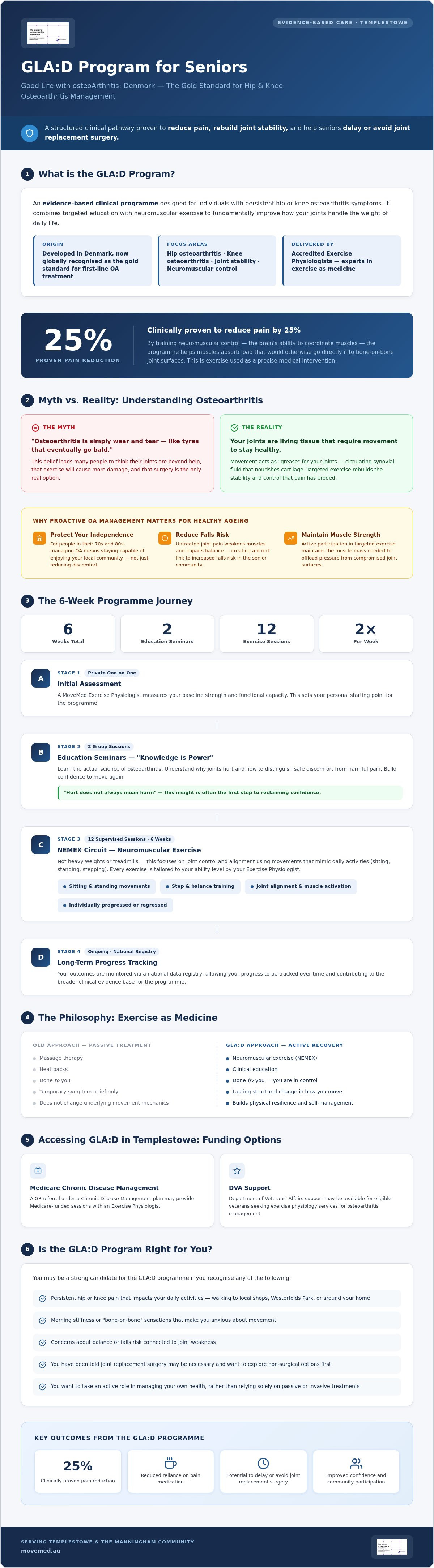
The GLA:D program for seniors is an acronym that stands for "Good Life with osteoArthritis: Denmark." While the name sounds clinical, the reality is deeply personal. It is a world-class, evidence-based initiative specifically designed for individuals experiencing the persistent symptoms of knee or hip osteoarthritis (OA). Rather than just managing symptoms, this programme focuses on a combination of targeted education and neuromuscular exercise to fundamentally improve how your joints handle the weight of daily life.
Around the world, clinicians recognise GLA:D as the "gold standard" for first-line osteoarthritis treatment. It isn't a generic gym circuit; it's a structured clinical pathway. By teaching you how to move with better alignment and control, the programme helps you regain the stability that often feels lost when joint pain takes hold. It's about empowering you with the tools to manage your own health journey rather than relying on temporary fixes.
Why Osteoarthritis Management Matters for Healthy Ageing
Many of us grew up hearing that osteoarthritis is simply "wear and tear," as if our joints were like the tyres on a car that eventually go bald. This is a common myth. In reality, your joints are living tissue that require movement to stay healthy. Think of movement as "grease" for the joint; it helps circulate synovial fluid, which nourishes the cartilage and keeps things gliding smoothly.
For people in their 70s and 80s, managing OA is about more than just comfort. It's about protecting your independence. When hip or knee pain makes you hesitant to walk, your balance can suffer, and your muscles may weaken. This creates a direct link between untreated joint pain and an increased risk of falls within the senior community. Proactive management ensures you stay steady on your feet and capable of enjoying your local Manningham community without the constant fear of a stumble.
The Core Philosophy: Exercise as Medicine
Historically, many people sought passive treatments like massage or heat packs for joint relief. While these feel good in the moment, they don't change the underlying mechanics of how you move. The GLA:D program for seniors shifts the focus toward active recovery. We move away from things being done "to" you and toward things done "by" you.
The secret lies in "neuromuscular control." This is the brain's ability to coordinate muscles to support the joint correctly. When your muscles fire in the right sequence, they absorb the load that would otherwise go straight into your "bone-on-bone" joint surfaces. GLA:D is a clinical education and exercise programme proven to reduce pain by 25%. By treating exercise as a precise medical intervention, we help you transition from being a patient to being the person in control of your own physical resilience.
How the GLA:D Programme Works: The 6-Week Journey
Embarking on the GLA:D program for seniors is a structured commitment to your future mobility. It isn't a "quick fix" or a generic fitness class; it's a methodical 6-week journey designed to produce lasting change in how your body supports your joints. The process is broken down into four distinct stages, ensuring you feel supported at every turn. You'll start with a private initial assessment where a MoveMed Exercise Physiologist (EP) sets your baseline, measuring your current strength and functional capacity. From there, the path involves two education seminars, 12 supervised group exercise sessions (held twice weekly), and long-term data tracking via a national registry to monitor your personal progress.
Phase 1: Knowledge is Power (The Education Sessions)
It's completely normal to feel hesitant about exercising when your knees or hips already feel tender. Many of our clients worry that moving will cause more damage or lead to a painful flare-up. During our education sessions, we dismantle these fears by explaining the actual science of osteoarthritis. You'll learn exactly why your joint hurts and, more importantly, how to distinguish between "safe" discomfort and "harmful" pain. We provide practical tips for managing daily life in Templestowe, such as how to handle a flare-up after a busy morning at the shops or a long walk through Westerfolds Park. Understanding that "hurt does not always mean harm" is often the first step toward reclaiming your confidence.
Phase 2: The NEMEX Exercise Circuit
The heart of the programme is the NEMEX (Neuromuscular Exercise) circuit. This isn't about lifting heavy weights or running on treadmills. Instead, it focuses on joint control and alignment. We work on exercises that mimic daily movements—like sitting down, standing up, and stepping—to train your muscles to support your joints more effectively. Every movement is tailored to your specific ability; if an exercise feels too difficult or causes too much discomfort, your EP will regress the movement to a level that suits you. If you're ready to see where your current mobility stands, you can book an Exercise Physiology consultation to begin your assessment.
The group environment is one of the most rewarding aspects of the programme. You'll be exercising alongside other local seniors who understand exactly what you're going through. This social connection turns a clinical requirement into a supportive community experience. Sharing the journey with others who are also working to avoid surgery or reduce pain makes the 6-week commitment feel less like a chore and more like a shared path toward a better quality of life.
GLA:D vs. Surgery: Can You Avoid a Joint Replacement?
For many Templestowe residents, the word "surgery" feels like a heavy, final sentence. It's daunting to face the prospect of a total knee or hip replacement, especially when considering the risks, hospital stays, and the long road of post-operative recovery. Clinical evidence suggests the GLA:D program for seniors can often change that trajectory. Many participants who were previously on surgical waitlists find their pain levels drop so effectively that they no longer feel the need for an operation. By restoring the brain-muscle-joint connection, we often find the "bone-on-bone" sensation becomes far more manageable.
Why do orthopaedic surgeons now frequently recommend trying the GLA:D programme before booking a theatre date? It's because a stronger, more stable joint is a better candidate for any outcome. Even if you eventually decide that surgery is the right path for your specific situation, the GLA:D program for seniors serves as the ultimate "pre-hab." Entering a surgical procedure with better muscle tone and joint control significantly speeds up your recovery time and improves the long-term success of the prosthetic joint.
The 'First-Line' Treatment Approach
Australian clinical guidelines, including those from the Royal Australian College of General Practitioners (RACGP), are very clear. Exercise, education, and weight management should be the first-line treatments for osteoarthritis, long before scans or surgical interventions are considered. This approach focuses on "offloading" the painful joint. When the surrounding muscles are strong and firing correctly, they act as a biological shock absorber. If you're interested in how this fits into a broader health plan, you might find our Strength Training for Templestowe Seniors: Clinical Guide a useful resource for understanding the role of resistance in healthy ageing.
Long-Term Benefits Beyond Pain Relief
The goal of the GLA:D programme isn't just to lower a number on a pain scale. It's about the return of your confidence. We see clients move from being hesitant about taking the stairs at the Pines Shopping Centre to navigating them without a second thought. This improved stability also makes getting in and out of the car or playing with grandchildren much easier. One in three GLA:D participants report significant functional improvements that change their daily life.
Another vital benefit is the reduced reliance on anti-inflammatory medications. Long-term use of these drugs can lead to unwanted side effects, particularly for seniors. By managing the underlying mechanics of the joint through movement, many of our clients find they can gradually reduce their medication under their doctor's guidance. This shift toward active management empowers you to rely on your own body's strength rather than a prescription pad.
Is the GLA:D Program Right for You?
Do you find yourself hesitating at the top of a flight of stairs, or perhaps you've noticed your knee "giving way" during a morning stroll? These experiences are common indicators that your joints are struggling to manage daily loads. The GLA:D program for seniors is specifically designed for people experiencing symptoms of hip or knee osteoarthritis, such as persistent joint pain or that familiar stiffness when you first get out of bed. You don't need a "severe" scan or a referral for surgery to begin. In fact, early intervention often yields the best results, as it allows us to build strength before significant muscle loss occurs.
While the programme is highly effective for most, it isn't a universal fit for every joint condition. If your pain is caused by inflammatory arthritis (like rheumatoid arthritis), a recent fracture, or other non-OA related issues, different clinical pathways might be more appropriate. This is why we insist on a thorough clinical screening at our Templestowe Lower clinic. Our Exercise Physiologists need to ensure your cardiovascular health and physical capacity are ready for the programme's specific movements, keeping your safety as our absolute priority.
Common Concerns for Seniors
A frequent question we hear in the Manningham community is: "Am I too old for this?" The short answer is no. We've seen incredible progress in participants well into their 90s. Age is not a barrier to building better joint control. If you're living with other chronic conditions like heart disease or diabetes, you can still participate safely. Our accredited Exercise Physiologists are experts in clinical exercise; they monitor your heart rate, fatigue levels, and perceived exertion throughout every session. We adjust the intensity to match your body's needs on any given day, ensuring you feel challenged but never overwhelmed.
Complementary Therapies at MoveMed
Sometimes, joint pain is so high that even basic movements feel like a mountain to climb. In these cases, we often suggest hydrotherapy as a supportive starting point. The buoyancy of the water reduces the weight on your joints, allowing you to build the initial strength required to transition into the full GLA:D circuit. It's an excellent way to "bridge the gap" if you're currently in a high-pain phase.
Once you've completed the initial 6-week GLA:D journey, many of our clients choose to transition into Clinical Reformer Pilates for long-term maintenance. This helps preserve the stability gains you've made while adding further variety to your routine. Our goal is to create a holistic, long-term plan that keeps you active and independent in your own home. If you're unsure if your symptoms fit the criteria, our team can help. Book your assessment at MoveMed in Templestowe Lower to find the right starting point for your recovery.
Accessing GLA:D in Templestowe: Funding and Referrals
Navigating the financial side of healthcare can often feel as stiff as a morning knee joint. At MoveMed, we aim to make the administrative part of your journey as smooth as the physical one. There are several ways to access the GLA:D program for seniors through various funding streams, ensuring this gold-standard care remains accessible to the Manningham community. Whether you're using government support or private cover, we're here to help you understand the best pathway for your circumstances.
The most common pathway is through a Medicare Chronic Disease Management (CDM) plan, formerly known as an EPC. Your GP can set this up if you've been living with osteoarthritis for more than six months. This plan provides a rebate for your initial assessment and several group sessions, which significantly reduces your out-of-pocket costs. For our veteran community, the Department of Veterans' Affairs (DVA) offers fully funded options for Gold Card holders. This means there's often no cost to you at all for the entire 6-week programme.
If you're currently receiving a Home Care Package (Aged Care funding), you can usually use these funds to pay for your sessions. Using your package for clinical exercise is a proactive investment in your longevity; it helps you stay mobile and independent in your own home for longer. Additionally, if you have private health insurance with "Exercise Physiology" on your extras cover, you can typically claim a portion of the fee back immediately after your session.
Getting Started at MoveMed Templestowe Lower
A common question we hear is whether you need a doctor's referral to walk through our doors. If you're attending as a private client, you don't need any referral to start. However, if you intend to use Medicare or DVA funding, a specific GP referral is essential. When you speak to your doctor, mention that you're interested in the GLA:D program for seniors at MoveMed. We handle the clinical reporting back to your GP, so they're kept in the loop regarding your progress. For your initial assessment, just bring any recent scan results and wear comfortable clothes you can move in.
The MoveMed Difference
We aren't a corporate health chain; we're a local clinic deeply committed to the Templestowe, Doncaster, and Bulleen communities. We understand that starting a new clinical programme can feel intimidating. That's why we keep our group sizes small. This ensures you get the individual clinical attention you deserve from our accredited Exercise Physiologists, who lead every single session. We're here to guide you, step by step, back to the activities you love. Ready to take that first step? You can Book your GLA:D assessment at MoveMed today and begin your path to better joint health.
Reclaiming Your Active Lifestyle in Templestowe
Reclaiming your independence doesn't have to be a solo struggle against persistent joint pain. We've explored how the GLA:D program for seniors provides a structured, evidence-based alternative to surgery by focusing on neuromuscular control and clinical education. By shifting from passive treatments to active, guided movement, you aren't just managing symptoms; you're rebuilding the stability needed for a confident life in our local community.
Our accredited Exercise Physiologists at MoveMed are here to guide you through every step of this 6-week journey. We specialise in providing Aged Care and DVA support, ensuring that navigating funding systems never stands in the way of high-quality care. Whether your goal is a pain-free walk through Westerfolds Park or simply feeling more stable on your feet at home, the evidence-based results for Manningham seniors demonstrate that significant improvement is possible at any age.
You have the power to change how your joints feel and function. Start your GLA:D journey at MoveMed Templestowe Lower today and take the first step toward a more mobile, optimistic future. Your joints were made to move, and we're here to help you do it safely.
Frequently Asked Questions
Do I need a GP referral to start the GLA:D program at MoveMed?
You don't need a GP referral to join the GLA:D program for seniors as a private client or if you're using your private health insurance extras. However, if you wish to access government funding through Medicare or the DVA, a specific referral from your doctor is required. During your first session in Templestowe Lower, we'll help you identify the right paperwork to ensure your clinical journey starts smoothly.
Is the GLA:D program covered by Medicare?
Rebates are available for the GLA:D program for seniors if you have a Chronic Disease Management (CDM) plan from your GP. This Medicare initiative allows you to claim a rebate for your initial physical assessment and several of the supervised exercise sessions. While it doesn't cover the full cost of the programme, it significantly reduces out-of-pocket expenses for seniors living in Doncaster, Bulleen, and the wider Manningham area.
Can I do the GLA:D program if I've already had a joint replacement on one side?
Yes, you can certainly participate. Many of our clients join the programme to strengthen the muscles around their prosthetic joint or to protect the natural hip or knee on their other side. Our Exercise Physiologists tailor the movements to your specific surgical history. We focus on balancing your biomechanics (how your body moves) to reduce uneven loading and keep you walking comfortably for years to come.
How much does the GLA:D program cost for seniors in Templestowe?
The total cost varies depending on your eligibility for government rebates and your level of private health cover. We accept funding from DVA Gold Cards, Home Care Packages, and Medicare CDM plans, which can all reduce your personal contribution. Because every senior's funding situation is unique, we recommend contacting our Templestowe Lower clinic for a personalised breakdown of the fees and the rebates available to you.
Will the exercises make my knee or hip pain worse?
It's normal to feel some temporary muscle soreness when starting, but the programme is specifically designed to lower your overall joint pain. Our Exercise Physiologists use a clinical pain monitoring model to ensure you stay within safe limits during every session. If an exercise causes a sharp increase in discomfort, we immediately modify the movement. You're always in control of the intensity, ensuring you build strength without causing a flare-up.
What happens if I miss a session during the 6-week program?
Consistency is vital for clinical results, but we understand that local appointments in Doncaster or family commitments can occasionally interfere. If you miss a session, we'll work with you to find a suitable catch-up time or provide specific guidance for home-based movements. Maintaining the twice-weekly rhythm is important for building the neuromuscular control needed to support your joints effectively and reclaim your confidence on your feet.
Is GLA:D better than regular physiotherapy for osteoarthritis?
The GLA:D programme is a specialised protocol led by Exercise Physiologists who use "exercise as medicine" to treat the underlying cause of joint instability. Unlike passive treatments that focus on temporary relief, GLA:D is an active recovery pathway. It is considered the gold standard for osteoarthritis because it empowers you with long-term self-management skills. This active approach leads to more durable improvements in mobility and a reduced reliance on medications.
I use a walking frame; can I still participate in GLA:D?
Absolutely. The programme is highly adaptable and we regularly welcome participants who use walking frames or other mobility aids. Our Exercise Physiologists are experts in modifying the NEMEX circuit to match your current functional ability. Whether we're performing seated strength work or using your frame for balance during standing exercises, the focus remains on improving your stability so you can move more independently around your home and community.


