

Last Tuesday, Margaret stood at her front gate in Templestowe, wanting to walk to the local shops but feeling held back by a sharp, familiar ache in her hips. For many Melbourne seniors, the fear of a fall or the grind of chronic joint pain makes land-based exercise feel dangerous, which is why many are now looking into aged care funded hydrotherapy. It's a frustrating cycle where the less you move, the stiffer you become, but there is a clinical way to break that pattern and move freely again.
This guide explains how to use your Support at Home funding to access water-based rehabilitation and reclaim your independence. Since the Support at Home program replaced Home Care Packages in November 2025, clinical allied health services are 100% government-funded with no co-contribution required from you. We'll walk you through the My Aged Care assessment process, explain how to use your quarterly budget for clinical sessions, and help you find a local clinic where Accredited Exercise Physiologists handle the supervision. You'll discover the exact steps to reduce pain and improve your balance without the stress of navigating complicated systems alone.
Key Takeaways
- Learn how clinical hydrotherapy uses buoyancy to take the weight off your joints, allowing for movement that might feel impossible on land.
- Discover how to access aged care funded hydrotherapy through the Support at Home program with no clinical co-contribution required.
- Understand how to work with My Aged Care assessors to ensure water-based rehabilitation is included as a formal goal in your care plan.
- Explore why Exercise Physiologist-led sessions are the gold standard for managing osteoarthritis pain and improving your balance safely.
- Get a practical checklist for your first appointment to help you organise your transition into clinical water-based care.
What is Aged Care Funded Hydrotherapy and How Does It Work?
Aged care funded hydrotherapy is a specialised form of physical rehabilitation conducted in a heated pool, specifically designed to help seniors manage chronic conditions and regain mobility. Unlike a casual dip at the local leisure centre, this is a clinical intervention led by Accredited Exercise Physiologists (AEPs). When looking at what is aquatic therapy, it's clear that the controlled environment of the water provides unique physical benefits that land-based exercise simply cannot match. For many Melbourne seniors, it's the only way to perform movement without the sharp pain of weight-bearing on sensitive joints.
The Science of Water-Based Rehabilitation
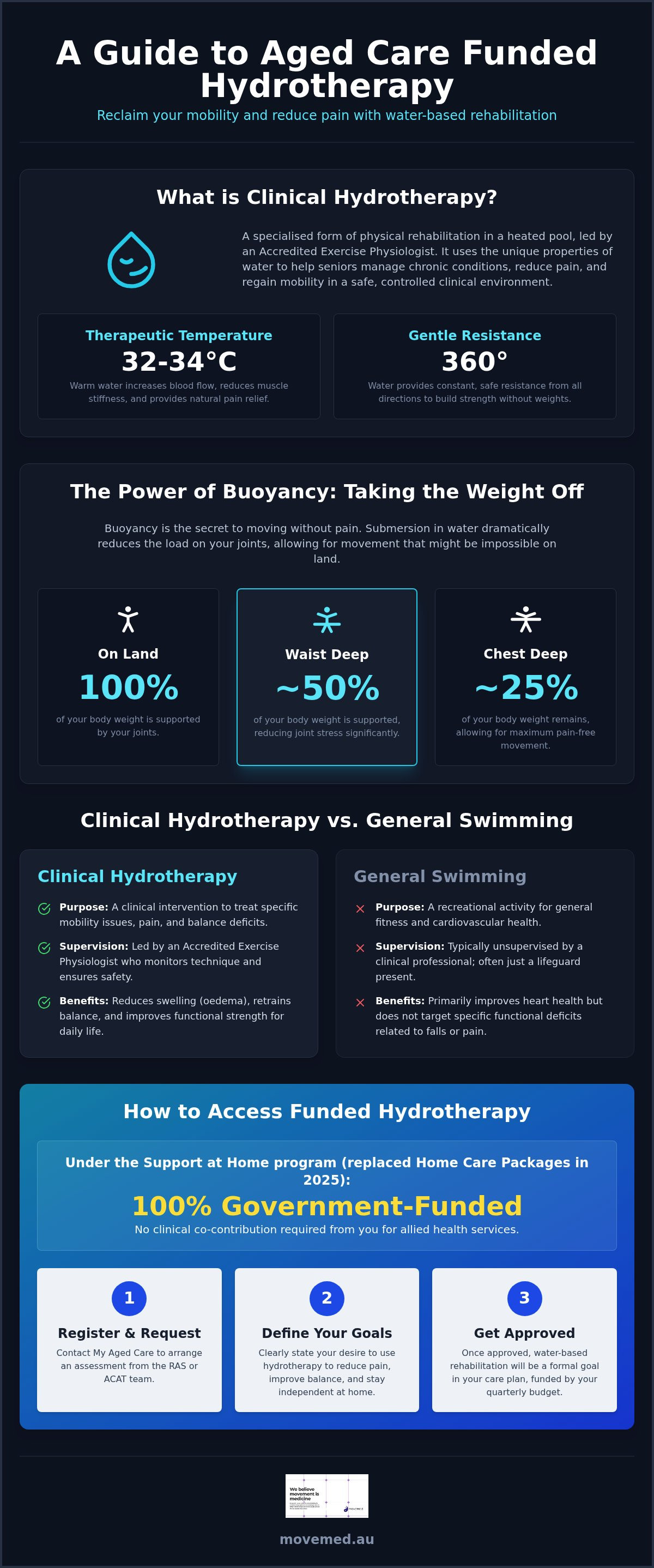
Hydrotherapy is a clinical tool used for functional recovery rather than a recreational activity. The most immediate benefit is buoyancy. When you're submerged to the waist, you're only supporting about 50% of your body weight; at chest height, that drops to roughly 25%. This weightlessness allows you to walk, stretch, and strengthen muscles without the "grinding" sensation often felt in osteoarthritic knees or hips.
Temperature plays a vital role too. Clinical pools are typically maintained between 32°C and 34°C. This warmth increases blood flow to the muscles, reducing stiffness and acting as a natural form of pain relief. Additionally, the water provides constant, gentle resistance. Unlike lifting a heavy dumbbell, water resistance is proportional to your effort; the faster you move, the harder the water pushes back, making it an incredibly safe way to build strength without the risk of dropping weights.
Clinical Hydrotherapy vs. General Swimming
It's a common misconception that "just going for a swim" is the same as aged care funded hydrotherapy. While swimming is excellent for cardiovascular health, it doesn't always address the specific functional deficits that lead to falls or a loss of independence. A structured clinical programme is different because every movement is chosen to treat an underlying cause of mobility decline.
At MoveMed, our sessions aren't about swimming laps. We focus on specific clinical outcomes:
- Hydrostatic pressure: The weight of the water against your skin helps push fluid back toward the heart, which is essential for reducing swelling (oedema) in the lower limbs.
- Vestibular challenge: The movement of the water creates a safe environment to challenge your balance, effectively retraining your brain and body to prevent falls on land.
- Supervised safety: Having an AEP present means your technique is constantly monitored, ensuring you don't over-exert yourself or risk injury.
By focusing on these clinical markers, we help you transition from the pool back to your daily life in Templestowe with more confidence and less pain. It's about moving with purpose so you can return to the activities you love.
Navigating My Aged Care: How to Access Funded Hydrotherapy
The Australian aged care system can feel like a maze of acronyms and red tape, especially when you're already dealing with the daily burden of chronic pain. However, these systems are the essential gateway to reclaiming your mobility. To access aged care funded hydrotherapy, you first need to be registered with My Aged Care. Whether you're entering the system for the first time or looking to update an existing plan, the goal is to ensure that clinical exercise is recognised as a priority for your health and safety at home.
Most seniors access help through two main avenues. The Commonwealth Home Support Programme (CHSP) is typically for those who only need one or two basic services. For those with more complex needs, the Support at Home programme, which replaced the old Home Care Package system in late 2025, provides a coordinated budget. Under this current model, clinical services like hydrotherapy are 100% government-funded. This means there's no out-of-pocket co-contribution for the therapy itself, making high-quality clinical care more accessible than ever before.
Step-by-Step Guide to Getting Approved
Getting your funding approved requires a clear focus on your physical goals during the assessment process. You can follow these three steps to get started:
- Register and Request Assessment: Contact My Aged Care to arrange a visit from the Regional Assessment Service (RAS) or Aged Care Assessment Team (ACAT).
- Define Your Goals: During the interview, don't just list your conditions; describe how they limit your life. Mention if joint pain prevents you from walking or if you have a fear of falling. Specifically state that you want "Exercise Physiology-led hydrotherapy" to manage these risks.
- Ensure it's in the Plan: Check that "Allied Health" or "Clinical Care" is included in your support plan. Without these specific codes, your provider cannot allocate funds for pool-based rehabilitation.
Managing Your Funding: Support at Home vs. CHSP
The way your therapy is billed depends on your specific funding stream. If you're on a Support at Home plan, your funding is delivered in quarterly instalments. You have the right to "self-manage" or at least have a significant say in who provides your clinical care. You aren't restricted to the providers your main package manager suggests; you can choose a local expert who specialises in senior rehabilitation.
At MoveMed, we understand that the administrative side of care can be overwhelming for families. We act as a knowledgeable guide, helping you partner with your provider to ensure the paperwork is handled correctly. We can speak directly with your package manager to explain the clinical necessity of your programme, ensuring your funds are utilised effectively to keep you moving safely in the community.
The Clinical Benefits of Hydrotherapy for Melbourne Seniors
For many Melbourne seniors, the transition from chronic pain to fluid movement starts in the water. Aged care funded hydrotherapy is not merely a way to relax; it is a powerful clinical intervention that addresses the physical challenges of ageing. We understand that chronic pain can make your world feel like it's shrinking, but the unique properties of water allow you to perform exercises that would be too painful or dangerous on land. By removing the fear of falling and the stress of weight-bearing, you can focus entirely on your recovery and functional goals.
Osteoarthritis is one of the most common reasons seniors seek our help. The condition often feels like a constant "grinding" in the knees or hips, making every step a chore. In the pool, the water's buoyancy supports your weight, which effectively creates a gap between joint surfaces. This decompression allows you to strengthen the muscles surrounding the joint without the painful friction. Whether you are accessing care through the Commonwealth Home Support Programme or a Support at Home plan, this pain-free movement is essential for maintaining your independence.
Balance and falls prevention are equally critical. The vestibular system, which is the sensory system responsible for balance, is safely challenged by the gentle turbulence of the water. If you lose your balance in the pool, the water catches you, providing a "fail-safe" environment to push your limits. This builds the confidence needed to navigate uneven footpaths in Templestowe or stairs at home without the constant anxiety of a trip or stumble.
Specific Conditions Treated in the Pool
Clinical hydrotherapy is particularly effective for managing complex neurological and musculoskeletal issues. For those recovering from a stroke or living with Parkinson’s disease, the water provides a supportive medium to practice gait (walking) patterns and coordination. It is also a primary tool for chronic back pain, as the water allows for gentle spinal decompression that is difficult to achieve in a traditional gym. For a deeper look at these clinical applications, you can read our Hydrotherapy: The Complete Guide to Water-Based Recovery in Melbourne.
Improving Cardiovascular Health Without Impact
Maintaining heart health is vital as we age, but many seniors find that land-based walking or cycling puts too much strain on their joints. Water resistance provides a safe environment for cardiac conditioning by allowing the heart to work efficiently without the jarring impact of land-based exercise. The pressure of the water also assists with peripheral circulation. This hydrostatic pressure helps to reduce oedema (swelling) in the lower limbs, which is a common issue for those with circulatory challenges. By reducing this swelling, we often see an immediate improvement in ankle mobility and overall comfort during daily walks.
Exercise Physiology-Led Hydrotherapy in Templestowe Lower
At MoveMed, we believe that the best clinical outcomes happen when high-level expertise meets genuine community connection. Our clinic in Templestowe Lower is specifically designed to serve the Manningham area, including our neighbours in Doncaster and Bulleen. While many large corporate providers offer generic services, we focus on a boutique, AEP-led model. This ensures that every session of aged care funded hydrotherapy you attend is supervised by an Accredited Exercise Physiologist who understands your specific medical history. Unlike open pool access at a public centre, where you might be left to your own devices, our sessions are structured clinical rehabilitation. We don't just provide a pool; we provide a clinical pathway to better health.
What to Expect at Your First Session
Your journey doesn't actually begin in the water. We start with a comprehensive land-based assessment at our Templestowe Lower clinic. This allows us to understand your joint range of motion, current pain levels, and any cardiovascular considerations that might affect your safety. Once we've established a safe baseline, we transition to the pool. Your first session focuses on safety protocols and acclimatisation, ensuring you feel confident in the aquatic environment. We track your progress meticulously. We also provide detailed reports to your GP or Home Care Package case manager, ensuring your clinical goals remain the focus of your funding.
Our Local Commitment to Seniors
Being a local, independent clinic allows us to offer a level of continuity that larger chains often miss. We collaborate closely with local Melbourne Home Care Package providers to streamline your aged care funded hydrotherapy and handle the administrative burden. Our approach is holistic. We often integrate pool-based work with other clinical services to maximise your results. For instance, many clients find that combining water-based rehab with Clinical Reformer Pilates in Templestowe provides the perfect balance of joint mobility and core stability. If you're looking for broader advice on maintaining your health as you age, our guide on Strength Training for Templestowe Seniors is an excellent resource for staying active. If you're ready to see how a personalised programme can help you, you can book your initial assessment with MoveMed today.
Getting Started: Your Journey to Better Mobility in 2026
Starting a new clinical programme is a significant step toward reclaiming your life. It's common to feel a mix of hope and hesitation, particularly if land-based exercise has felt impossible or painful in the past. Remember, the goal of aged care funded hydrotherapy isn't just to manage symptoms; it's to build the physical resilience you need to stay active and safe in your own home. It's never too late to start. Even small, incremental improvements in muscle strength can lead to a massive boost in your daily confidence.
Physiological change takes time. While the warmth of the pool provides immediate relief for stiff joints, the real work of improving your balance and bone density happens over weeks and months. We encourage you to view these sessions as a vital investment in your long-term independence. Consistency is what transforms a temporary reduction in pain into a permanent improvement in your quality of life. To ensure your first visit is as smooth as possible, we recommend preparing a small kit:
- Comfortable swimwear or clean shorts and a t-shirt.
- A large towel and non-slip footwear for the poolside.
- Your My Aged Care referral codes or Support at Home plan details.
- A current list of medications and any recent hospital discharge summaries if you've had recent surgery.
The Referral Process Simplified
You don't always need a GP referral to begin your journey, though it can be helpful for your medical records. If you're using a Support at Home plan, you can refer yourself or have your case manager contact us directly to arrange an assessment. We also have extensive experience working with veterans and those recovering from transport accidents. If you're a veteran, our DVA Exercise Physiology Guide provides specific details on how to use your Gold or White card for clinical care. Regardless of your funding route, we handle the clinical reporting and coordination so you can focus entirely on your movement.
Book Your Assessment in Templestowe Lower
Our clinic is located in the heart of Templestowe Lower, with easy access and parking designed for those with limited mobility. We pride ourselves on being a friendly, approachable centre where you'll never feel like just another number on a list. We're here to sit with you, listen to your story, and create a plan that actually works for your lifestyle. If you're ready to take that first step, contact MoveMed to start your aged care hydrotherapy journey today. Our team is ready to help you move better and live more.
Take the First Step Toward Pain-Free Movement
Living with chronic joint pain or a fear of falling can make your world feel small, but clinical hydrotherapy offers a way to expand it again. By using the unique properties of water, you can build the strength and balance required to stay independent in your own home. Whether you're managing osteoarthritis or recovering from surgery, the transition from land-based struggle to aquatic freedom is a proven path to better health and long-term resilience.
Navigating the complexities of aged care funded hydrotherapy shouldn't be another source of stress. At MoveMed, our Accredited Exercise Physiologists specialise in geriatric care and provide the expert guidance needed to move through the My Aged Care funding maze. We're proud to serve our local Templestowe, Doncaster, and Bulleen residents with a level of care that prioritises your quality of life. You don't have to manage your condition alone; we're here to partner with you every step of the way.
Ready to see how water-based rehabilitation can change your daily life? Book your clinical hydrotherapy assessment at MoveMed today and start your journey toward more confident, comfortable movement. It's never too late to invest in your mobility and reclaim the activities you love.
Frequently Asked Questions
Is hydrotherapy covered by a Level 1 or 2 Home Care Package?
Hydrotherapy is covered under the Support at Home program, which replaced the previous Home Care Package system in late 2025. Because hydrotherapy is classified as clinical allied health care when led by an Accredited Exercise Physiologist, it is 100% government-funded with no co-contribution required from you. This makes it an accessible option for seniors at various funding levels who need help with chronic pain management in the Templestowe and Doncaster areas.
Do I need to be able to swim to participate in hydrotherapy?
You don't need any swimming ability to participate in our clinical sessions. Hydrotherapy is conducted in chest-deep water where you can always keep your feet firmly on the floor. Our Exercise Physiologists provide constant supervision and support, ensuring you feel safe and stable while performing your movements. Most exercises involve walking, stretching, or controlled strength work designed to improve your land-based mobility rather than traditional swimming strokes or laps in deep water.
How is hydrotherapy different from a regular aqua aerobics class?
Hydrotherapy is a clinical rehabilitation service led by an Accredited Exercise Physiologist, while aqua aerobics is a general fitness class. Our aged care funded hydrotherapy focuses on treating the underlying causes of your pain or mobility issues using evidence-based management plans. Every movement is specifically chosen to help you reach a functional goal, such as reducing joint stiffness or preventing falls. Unlike recreational classes, we track your clinical progress and report back to your GP.
Can I use my Commonwealth Home Support Programme (CHSP) funding for sessions?
Yes, you can use your Commonwealth Home Support Programme funding to access our supervised sessions. CHSP is designed for seniors who need entry-level support to stay independent at home. To get started, you'll need to ensure that Exercise Physiology or allied health is listed as a service in your My Aged Care support plan. We work closely with local providers in Bulleen and Warrandyte to help you coordinate these sessions and handle the administrative paperwork.
What should I bring to my first hydrotherapy session at MoveMed?
For your first session in the pool, please bring comfortable swimwear or clean lightweight clothing like a t-shirt and shorts. You'll also need a large towel, a bottle of water, and non-slip footwear for the poolside area. If you're using aged care funded hydrotherapy, remember to bring your My Aged Care referral details or Support at Home plan documentation. We'll handle the land-based assessment first at our Templestowe Lower clinic to ensure your programme is safe.
How often should a senior attend hydrotherapy for the best results?
Consistency is the key to seeing long-term improvements in your strength and balance. Most seniors find that attending clinical sessions one to two times per week provides the best results. This frequency allows your body to adapt to the resistance of the water and build muscle resilience without over-exertion. During your initial assessment, your Exercise Physiologist will recommend a specific schedule based on your current health goals and your available quarterly funding budget.
Is the pool at MoveMed heated to a specific temperature for arthritis?
Yes, our clinical sessions are conducted in water heated to between 32°C and 34°C. This specific temperature range is essential for therapeutic results as it helps to relax tight muscles and soothe arthritic joints. The warmth increases blood flow to your extremities, acting as a natural form of pain relief that makes movement much easier. This controlled environment is far more effective for rehabilitation than a standard public swimming pool, which is usually much cooler.
Can hydrotherapy help with recovery after a hip replacement?
Hydrotherapy is an excellent tool for post-surgical recovery after a hip or knee replacement. The buoyancy of the water allows you to start walking practice much earlier than you could on land because it reduces the impact on your new joint. Our AEPs focus on reducing post-operative swelling and gently building the muscle strength needed for a safe return to your daily activities. It provides a confident, low-risk environment to regain your mobility quickly.


