
Imagine the simple pleasure of walking down to the local Templestowe shops for a morning coffee, only to find yourself hesitating at the front door because the footpath feels like a series of obstacles. It's a quiet anxiety that many of our Manningham neighbours feel, where the fear of a trip or stumble begins to shrink your world and limit your freedom. This is where exercise physiology for falls prevention changes the narrative. By focusing on the clinical science of movement, we help you address the physical and sensory factors that cause instability before they lead to a life-changing event.
We understand that losing your confidence isn't just about physical strength; it's about the deep-seated worry of losing your independence and the frustration of navigating complex funding systems. You'll discover how targeted, evidence-based movement can retrain your balance and rebuild the leg power needed to stay steady on your feet. We will explain the specific role of an Accredited Exercise Physiologist (AEP; a university-qualified health professional), look at how Clinical Pilates and hydrotherapy support your goals, and clear up exactly how you can access these services through your Home Care Package or NDIS plan.
Key Takeaways
- Understand why the 'fear of falling' can unintentionally increase your risk and how to break this cycle through proactive clinical movement.
- Discover how exercise physiology for falls prevention uses functional training to improve the way your body handles real-life challenges like uneven footpaths or stairs.
- Compare the unique benefits of Clinical Pilates and hydrotherapy to choose the right starting point for your strength and stability journey.
- Gain a clear understanding of how to use NDIS or Aged Care funding to access accredited therapy in the Templestowe and Doncaster area.
The Hidden Risk: Understanding the Science of Falls in Older Adults
Falls aren't an inevitable part of getting older, though they are often treated that way. Many people view falls prevention as a reactive measure, something to consider only after a trip or a hospital stay. In reality, effective prevention is a proactive clinical strategy. It involves identifying the subtle shifts in your balance and strength before a mishap occurs. Our approach at MoveMed focuses on exercise physiology for falls prevention to help you stay active and confident in the Templestowe community.
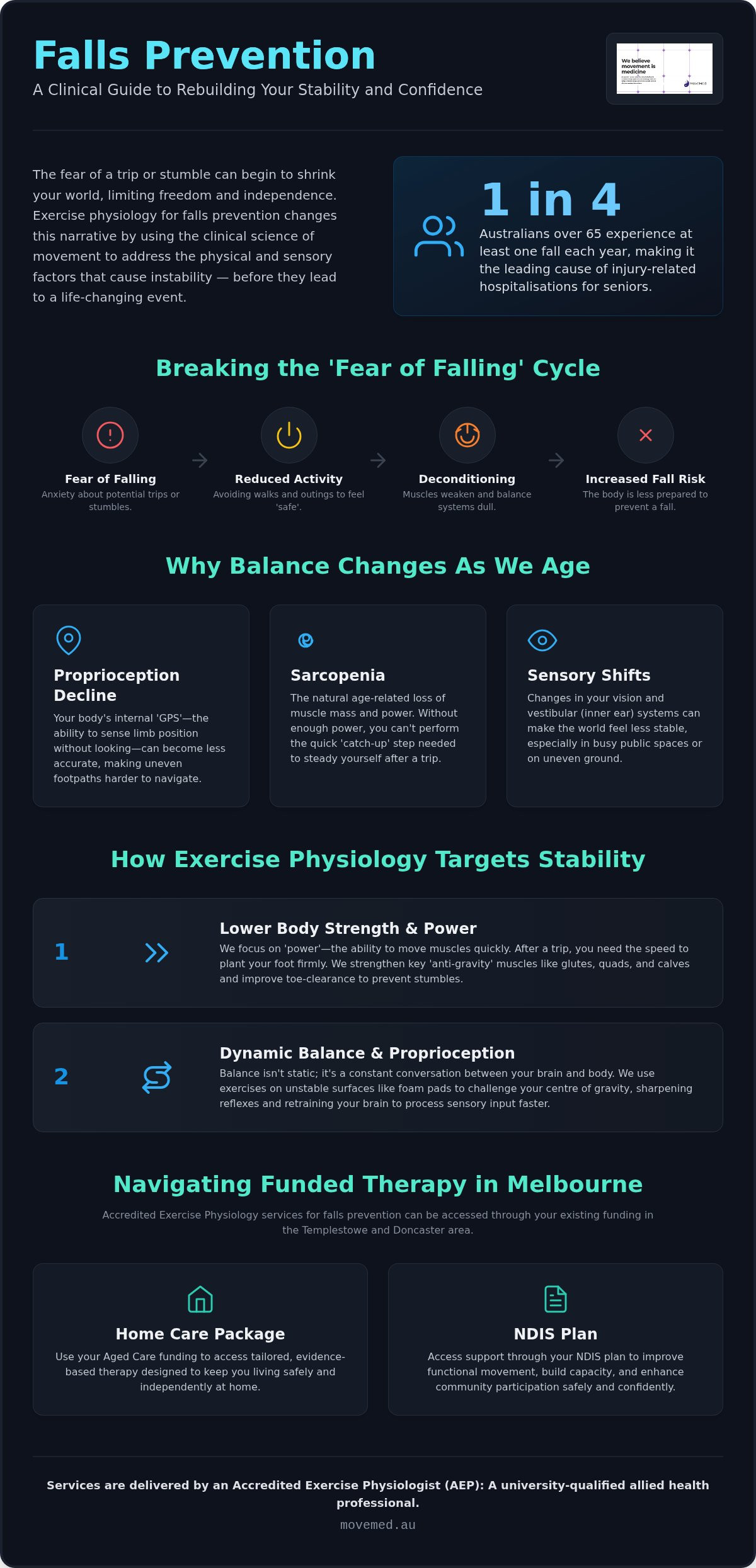
There's a hidden risk that often goes unspoken: the 'Fear of Falling'. When you experience a near-miss or hear about a friend's accident, it's natural to become more cautious. However, this anxiety can create a restrictive cycle. You might start avoiding the local shops or skipping your morning walk to stay 'safe'. This reduction in movement actually makes you less steady, as your muscles and balance systems need regular challenge to stay sharp. The data tells a clear story. In Australia, approximately one in four people aged over 65 experience at least one fall every year. These aren't just minor incidents; falls are the leading cause of injury-related hospitalisations for seniors. An Accredited Exercise Physiologist (AEP) acts as a specialist in movement medicine, helping you break the cycle of fear with a tailored, evidence-based plan.
Why Balance Changes as We Age
Maintaining your upright position is a complex task for the brain. The science of falls in older adults highlights several physical factors that shift over time, making it harder to stay steady on your feet.
- Proprioception: Your body's internal 'GPS' (the ability to sense where your limbs are without looking) can become less accurate, making uneven footpaths harder to navigate.
- Sarcopenia: This is the natural loss of muscle mass and power. Without enough power, you can't perform the quick 'catch-up' step needed to steady yourself after a trip.
- Sensory changes: Shifts in your vision and vestibular (inner ear) systems can make the world feel less stable, especially in busy public spaces.
The Cost of Inactivity
It's tempting to think that sitting more is the safest option, but the opposite is true. The deconditioning cycle is a primary driver of falls, where less activity leads to weaker muscles and poorer balance, which in turn makes a fall more likely. Beyond muscle strength, staying active is vital for maintaining bone density. If a fall does occur, having resilient bones can be the difference between a bruise and a serious fracture. Using exercise physiology for falls prevention ensures you're building the right kind of resilience to stay independent at home for longer.
How Exercise Physiology Targets the Three Pillars of Stability
Clinical exercise physiology for falls prevention is distinct from a general senior fitness class or a standard gym membership. While those programs are great for general health, they often lack the clinical precision required to address specific neurological or musculoskeletal deficits. At MoveMed, we begin with a comprehensive assessment to understand your unique movement patterns. This allows us to design a program focused on 'functional' movements. These are exercises that mimic the real-world challenges you face in Templestowe, like stepping over a rug in the hallway or navigating a kerb while carrying groceries.
Pillar 1: Lower Body Strength and Power
We focus heavily on your 'anti-gravity' muscles, specifically the glutes, quads, and calves. While general strength, the ability to lift a weight, is important, we prioritise 'power'. Power is the ability to move your muscles quickly. If you trip, you don't just need strong legs; you need the speed to plant your foot firmly before you hit the ground. Improving your 'toe-clearance' while walking is another critical clinical metric we track. It ensures you aren't catching your feet on small obstacles, which is a common cause of stumbles.
Pillar 2: Dynamic Balance and Proprioception
Balance isn't a static skill; it's a constant conversation between your brain and your body. We use specific exercises to help prevent falls that challenge your centre of gravity in a safe, controlled environment. Our Accredited Exercise Physiologists use foam pads or balance beams (unstable surfaces) to sharpen your balance reflexes and retrain your brain to process sensory input more efficiently. This builds the resilience needed for uneven footpaths or crowded shops.
Pillar 3: Cognitive-Motor Dual-Tasking
Most falls don't happen when we are perfectly focused on our feet. They happen when we are distracted, such as talking to a friend or looking for a house number. We train your brain to maintain stability while performing secondary tasks. This 'dual-tasking' reduces the risk of 'stiffening' strategies, where fear makes your body rigid and actually more prone to falling. If you're ready to see how these pillars apply to your own health, an initial consultation with our team is the best place to start. By building confidence in your movement, we help you transition from 'playing it safe' to moving with purpose and agency.
Clinical Pilates vs. Hydrotherapy: Which is Best for Falls Prevention?
Choosing the right environment for your recovery is a vital part of staying consistent. While the goals of exercise physiology for falls prevention remain the same, the way we achieve them can vary depending on your physical needs and comfort levels. At MoveMed, we offer two primary clinical modalities: Clinical Pilates and hydrotherapy. It's important to understand that these aren't general fitness classes. Every session is designed and led by an Accredited Exercise Physiologist who understands your medical history and specific risk factors. This clinical oversight ensures that every movement is safe, purposeful, and effective.
Clinical Reformer Pilates for Core and Alignment
If your primary goal is to improve posture and core stability, Clinical Reformer Pilates in Templestowe is an excellent choice. The Reformer machine uses a system of springs and pulleys to provide adjustable resistance. This allows us to strengthen your muscles without placing excessive strain on your joints. We focus heavily on deep core stability, which acts as the 'anchor' for your limbs during movement. By improving your spinal alignment, we help you maintain a more upright posture, reducing the tendency to stoop forward, which is a common risk factor for trips. We often utilise 'closed-chain' exercises, where your feet remain in contact with a solid surface like the footbar. This provides your brain with constant sensory feedback, helping to sharpen your proprioception and body awareness.
Hydrotherapy for Safe, Low-Impact Training
For many of our clients, the sheer fear of falling during exercise can be a major hurdle. This is where our Hydrotherapy Guide becomes relevant. The buoyancy of water supports your body weight, effectively removing the risk of a hard impact. In the pool, you can practice challenging balance tasks that might feel too risky on land. You can move with more freedom and confidence, knowing the water will catch you. Hydrotherapy is particularly beneficial if you are managing co-existing conditions like osteoarthritis. The warmth of the water helps soothe aching joints, while the natural resistance of the water allows you to build strength without the need for heavy weights. It's a gentle yet powerful way to address the physical causes of instability while keeping pain levels low.
Ultimately, the best choice depends on your starting point. If you struggle with joint pain or significant anxiety about movement, the pool offers a safe sanctuary. If you're looking to bridge the gap between rehab and daily activities like walking to the shops, the Reformer provides the precision needed for long-term resilience. We work with you to determine which path, or perhaps a combination of both, will best help you reclaim your independence.
Navigating Funded Therapy in Melbourne: Aged Care and NDIS
The administrative side of healthcare can often feel more daunting than the physical therapy itself. We know that navigating the NDIS or My Aged Care portals feels like a full-time job. However, accessing clinical support in Templestowe and Doncaster is a vital step in maintaining your safety at home. Whether you are self-managed, plan-managed, or using a Home Care Package, exercise physiology for falls prevention is a funded service designed to keep you independent. At MoveMed, we don't just provide the therapy; we partner with you to handle the clinical reporting and progress updates required by these schemes, ensuring your funding continues to work for you.
Home Care Packages (HCP) and Commonwealth Home Support Programme (CHSP)
Most seniors prefer to stay in their own homes for as long as possible. This 'ageing in place' is a core focus of the Australian aged care system. You can use your Aged Care Funded Therapy to pay for individualised sessions with an exercise physiologist. This is often a more effective use of funds than a general gym membership, as it targets the specific causes of instability. Local residents can also look into Manningham Council support services, which often provide pathways to the Commonwealth Home Support Programme (CHSP) for entry-level assistance.
NDIS and DVA Pathways
For participants with mobility-related disabilities, exercise physiology is funded under the 'Capacity Building' category of an NDIS plan. It focuses on improving your functional ability and reducing the risk of secondary health complications. You can find more detail in our NDIS Exercise Physiology Guide. Similarly, veterans holding a Gold or White Card can access DVA Funded Exercise Physiology. This pathway provides clinically necessary treatment to manage chronic conditions and improve balance. For a full breakdown of how this works for local veterans, see our DVA Exercise Physiology Guide.
Medicare Chronic Disease Management (CDM) Plans
If you don't have an NDIS plan or a Home Care Package, you may still be eligible for subsidised support. Speak to your local Templestowe GP about a Chronic Disease Management plan, formerly known as a Team Care Arrangement. This plan allows for a specific number of rebated sessions per calendar year for people with chronic conditions. A formal referral from your doctor is the first step. This ensures that your GP and our exercise physiologists are working together as a team. If you need help understanding which funding path is right for you, contact our Templestowe clinic for a clear explanation of your options.
Starting Your Journey: What to Expect at MoveMed Templestowe Lower
Starting your journey with us isn't about jumping straight into a high-intensity gym routine. It's about a conversation. We know that walking into a clinical setting can feel intimidating, especially if you're already feeling vulnerable about your balance or have had a recent near-miss. At our Templestowe Lower clinic, we've cultivated a warm, community-focused atmosphere where you're treated as a partner, not just a patient. We don't believe in quick fixes; we're here to help you build the long-term resilience needed to stay active in the Manningham area for years to come.
The Initial Clinical Assessment
Your first visit is dedicated to understanding your unique movement story. We use validated balance tests, such as the Berg Balance Scale, to find your precise baseline. This isn't about pass or fail; it's about identifying where your stability needs the most support. We'll review your medical history and discuss specific 'trigger' scenarios, like that tricky step in your laundry or the uneven grass in your backyard. Together, we set collaborative goals that actually matter to your daily life, whether that's walking safely to Finns Reserve or getting back into the garden without the constant worry of a trip.
Your Personalised Management Plan
Once we have your baseline, we design a path forward that suits your preferences. Depending on your assessment, we might suggest gym-based exercise physiology for falls prevention, Clinical Pilates, or hydrotherapy. Every plan is evidence-based and tailored to your specific environment at home. We don't just give you a list of exercises and leave you to it. We schedule regular reviews to celebrate your progress and adjust the intensity of your sessions. This ensures you're always being challenged safely while moving toward greater independence.
A Community of Support
You aren't navigating this path alone. We work closely with your GP and other allied health professionals to ensure your care is seamless and well-coordinated. Having an expert guide you through every movement provides the reassurance you need to push past the 'fear of falling' cycle we discussed earlier. This partnership is about more than just physical strength; it's about reclaiming the confidence to live your life on your terms, whether that involves walking to the local park or planning a trip to see family. For those who require medical assistance for commercial flights, RN MEDflights provides expert support for non-emergency patients. We invite you to take that first step toward a steadier, more certain future with our team today.
Reclaiming your independence starts with understanding that falls are not an inevitable part of ageing. By addressing the physical pillars of stability through clinical movement, you can break the cycle of anxiety that often limits your daily life. We have explored how specialised modalities like Clinical Pilates and hydrotherapy provide safe, supervised environments to rebuild your power and balance. Choosing exercise physiology for falls prevention is a proactive investment in your future, ensuring you have the resilience to navigate the footpaths of Templestowe and Doncaster with ease.
As an NDIS and Aged Care registered provider, our team of Accredited Exercise Physiologists is here to handle the clinical reporting and paperwork so you can focus on your progress. Whether you're using a Home Care Package or a Medicare referral, we partner with you to create a plan that fits your specific goals. You deserve to walk to the local shops or spend time in your garden with a genuine sense of certainty. Book your clinical balance assessment at MoveMed Templestowe Lower today and let us help you move with purpose again. We are ready to guide you on this journey toward a stronger, more confident version of yourself.
Frequently Asked Questions
Is exercise physiology the same as physiotherapy for falls?
Exercise physiology is distinct from general physiotherapy. While both professions improve mobility, an Accredited Exercise Physiologist (AEP) specialises in using evidence-based movement as a clinical intervention. We focus on long-term lifestyle changes and functional strength training rather than manual therapy. In the context of exercise physiology for falls prevention, our role is to design and supervise specific protocols that retrain your balance and build the power needed for your daily independence.
Can I use my Home Care Package to pay for exercise physiology at MoveMed?
Yes, you can certainly use your Home Care Package (HCP) to access our services. We are experienced in providing Aged Care Funded Therapy for residents across Templestowe and Doncaster. Because exercise physiology is a clinical service designed to support 'ageing in place', it's an eligible expense for most packages. We can work directly with your package provider to arrange the necessary paperwork, making the process as simple and stress-free as possible for you.
I'm worried I'll fall during a session; is it safe?
Your safety is our absolute priority. Every session is conducted in a controlled, clinical environment under the direct supervision of an Accredited Exercise Physiologist. We use specialised equipment and safety protocols to ensure you are challenged without being put at risk. If you feel particularly anxious, we might begin with hydrotherapy, where the water's buoyancy supports your weight. This allows you to practice balance tasks with zero risk of a hard impact, helping you build confidence gradually.
How many sessions will I need before I feel steadier on my feet?
The timeline for feeling steadier is unique to every individual, but most clients notice a difference in their confidence within six to eight weeks of consistent training. Physical changes like muscle power and balance reflexes take time to develop, but the psychological benefit of moving in a safe environment often happens much sooner. We conduct regular reviews to track your progress against your baseline, ensuring your plan evolves as your strength and stability improve.
Do I need a GP referral to see an exercise physiologist for balance?
You don't need a referral to see us as a private client. You can simply call our Templestowe clinic and book an initial assessment. However, if you wish to claim rebates through Medicare or access DVA Funded Exercise Physiology, a GP referral is essential. Your doctor will need to provide a Chronic Disease Management plan or a specific DVA request. We recommend speaking with your local Manningham GP to discuss which funding pathway best suits your needs.
What should I wear to my first falls prevention appointment?
We recommend wearing comfortable, loose-fitting clothing that allows you to move freely, such as tracksuits or activewear. The most important part of your outfit is your footwear. Please wear sturdy, closed-toe shoes with good grip, like well-fitting sneakers. Avoid wearing loose slippers or walking in socks, as these can increase the risk of a slip. If you are attending a hydrotherapy session, you will need appropriate swimwear and a towel for the pool area.
Can hydrotherapy help if I also have bad arthritis in my knees?
Hydrotherapy is an excellent option if you are managing osteoarthritis alongside balance concerns. The warmth of the water helps to reduce joint pain and stiffness, while buoyancy takes the pressure off your knees. This allows you to perform strength and balance exercises that might be too painful to do on land. It's a gentle way to build the leg strength required for falls prevention without aggravating your existing joint issues or causing further discomfort.
Does MoveMed provide exercise physiology for NDIS participants in Templestowe?
Yes, MoveMed is a provider of NDIS Funded Therapy for participants in Templestowe, Doncaster, and the surrounding Manningham area. We work with self-managed, plan-managed, and NDIA-managed participants to improve functional mobility and independence. Our exercise physiology for falls prevention programs are tailored to meet the specific goals outlined in your NDIS plan. We also provide the clinical reports and progress updates required for your plan reviews to ensure your support continues seamlessly.


