
After a fall, even a familiar walk can feel daunting when you’re worried about what might happen without someone nearby. You don’t have to wait until you feel completely ready before thinking about how to return to walking. For people in Templestowe, regaining confidence walking alone after a fall starts with a manageable plan that takes your abilities, concerns and everyday goals into account.
You may be unsure whether to practise alone or with someone beside you. The right level of support depends on your health, balance, surroundings and how safe you feel. You don’t need to push through fear or give up on independence. Gradual, supported practice can help you work towards walking with greater confidence.
This article explains why confidence can change after a fall, how to plan safer walking practice and when extra support may help. You’ll also learn how an Accredited Exercise Physiologist can assess your needs and guide individualised exercise to work on strength, balance and mobility. MoveMed supports people across Templestowe and nearby suburbs with evidence-based exercise physiology focused on your goals and everyday independence.
Key Takeaways
- Feeling hesitant about walking to the letterbox or local shops after a fall is understandable. Your next steps can reflect your circumstances.
- An Accredited Exercise Physiologist can consider your goals, movement capacity and health needs when planning manageable practice.
- Supervision, a walking aid and clinician-guided exercise can each play a different role. The right option depends on your needs.
- For regaining confidence walking alone after a fall Templestowe, plan around a familiar route, its surface, distance and places to pause.
- MoveMed provides personalised exercise physiology, hydrotherapy and Clinical Reformer Pilates to support movement goals.
Why walking alone can feel daunting after a fall in Templestowe
You might feel steady moving around home but hesitate when it’s time to walk to the letterbox or visit the local shops alone. That change can be unsettling, especially if walking used to feel routine. After a fall, familiar movements and places may feel less safe, even as your physical ability improves.
There’s no single way to respond. You may be comfortable going out with someone beside you but not yet feel ready to walk alone. Or you may want to resume your usual routine while still feeling cautious. Neither response is a measure of bravery or a reliable test of recovery. Regaining confidence walking alone after a fall in Templestowe can start with identifying what feels difficult and planning around those concerns.
Why confidence can take longer to return than movement
Movement and confidence don’t always recover at the same pace. You might manage a short walk but still worry about uneven ground, losing your balance or not having help nearby. These concerns can affect your routine and willingness to leave home. The Fear of falling (Basophobia) describes this concern, but feeling hesitant after a fall doesn’t automatically mean you have a disorder. Your experience and the reasons behind it are individual.
What a safe return to walking should prioritise
A considered return starts with your goals, current abilities and what was happening around the time of the fall. A route that suits one person may feel too demanding for another because of its distance, surface, surroundings or lack of places to pause. Safety and confidence can be worked on together. The level of support should reflect your needs, not pressure to walk alone quickly.
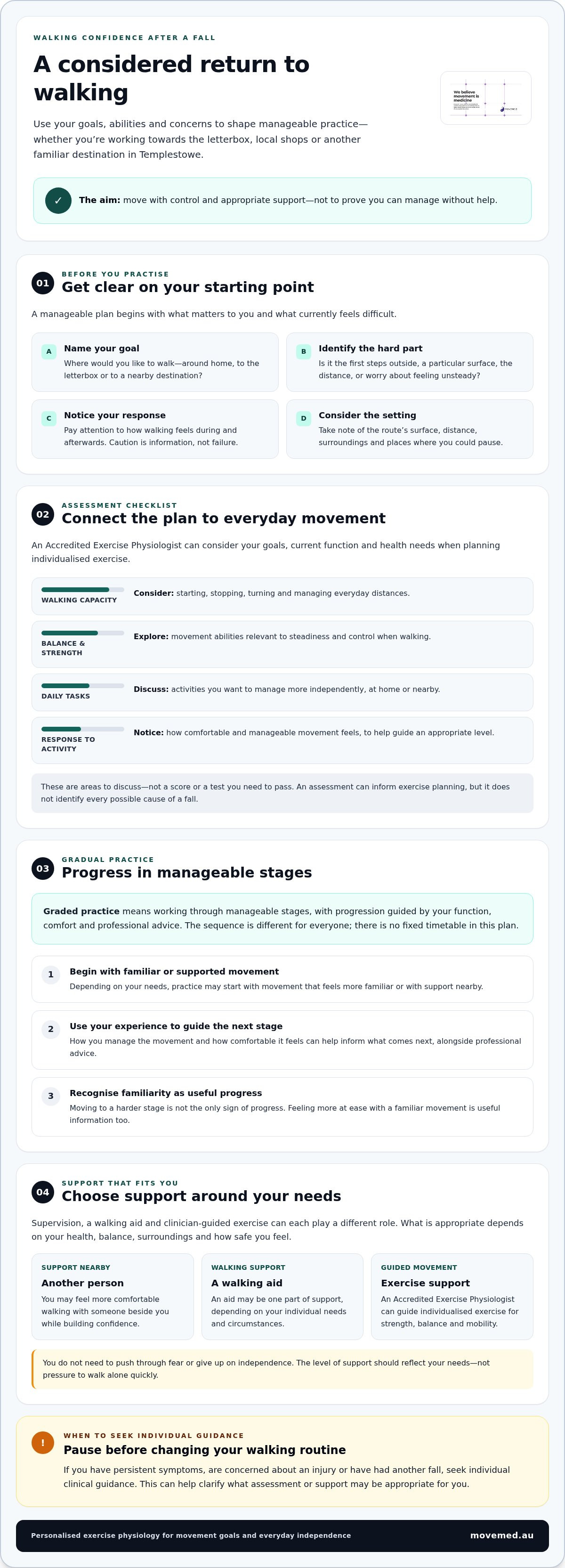
Confidence means feeling able to move with control and appropriate support, not having to prove you can manage without help.
If you have persistent symptoms, are concerned about an injury or have had another fall, seek individual clinical guidance before changing your walking routine. This can help clarify what assessment or support is appropriate for you. It may also help to identify what makes a walk difficult: the first few steps outside, a particular surface, the distance or worry about what you would do if you felt unsteady.
- Name your concern: Identify the part of walking alone that feels least comfortable.
- Consider the setting: Note route features such as the surface, distance and places to pause.
- Notice your response: Pay attention to how you feel during and after walking without treating caution as failure.
These observations can help you explain your priorities when seeking support. The aim isn’t to ignore risk or wait until every worry disappears. It’s to understand your starting point and make decisions that respect both your safety and your wish for greater independence.
How assessment and gradual practice can rebuild walking confidence
Knowing what to practise and how to progress can make returning to walking feel more manageable. An Accredited Exercise Physiologist can connect a goal, such as walking independently to a nearby destination, with a plan based on your movement capacity and health needs. The aim isn’t to push you through discomfort or set a fixed timetable. It’s to make practice purposeful and adjust it in response to how you manage.
This section offers general information, not a personal assessment or exercise prescription. Your needs may differ, so seek individual clinical guidance before starting or changing an exercise routine, particularly if you have ongoing symptoms or concerns about an injury.
What an exercise physiology assessment may explore
An assessment may begin with your priorities: where you want to walk, what feels difficult and which everyday activities matter to you. The practitioner can consider relevant movement and balance needs alongside your current function and health context before planning exercise. This connects support to a real-life goal rather than a general aim to “get fitter”. An assessment can inform exercise planning, but it shouldn’t be taken as identifying every possible cause of a fall.
Depending on your situation, discussion may include:
- Walking capacity: How you manage starting, stopping, turning and walking everyday distances.
- Balance and strength: Movement abilities that may be relevant to steadiness and control when walking.
- Daily tasks: Activities you want to manage more independently, such as moving around home or reaching a nearby destination.
- Your response to activity: How comfortable and manageable movement feels, so the plan can be set at an appropriate level.
These details help guide a personalised exercise approach. They also give you the opportunity to share what you want to achieve and what support would help you take part.
How graded walking practice can build familiarity
Graded practice means working through manageable stages, with progression guided by your function, comfort and professional advice. Depending on your needs, it might begin with supported or familiar movement before progressing to more independent walking when appropriate. The sequence is different for everyone, and moving to a harder stage isn’t the only sign of progress. Feeling more at ease with a familiar movement can also be useful information.
Graded practice builds familiarity through achievable steps, repeated at a pace that reflects your response. Your practitioner can help you review what felt manageable, what challenged you and whether to keep the next step the same or adjust it. If symptoms worsen or something feels unsafe, pause and seek individual guidance rather than pushing through.
For regaining confidence walking alone after a fall in Templestowe, an individual plan can turn a broad goal into practical stages without assuming how quickly you should progress. MoveMed’s personalised exercise physiology support can help you work towards a walking goal with guidance shaped around your needs.
Walking alone after a fall: comparing supervision, aids and exercise support
Support for walking alone after a fall can take different forms. Practising with someone, using a walking aid or working with an Accredited Exercise Physiologist may each address a different need. These options aren’t necessarily alternatives, and not everyone needs an aid. Consider what would make movement safer and more manageable for you while supporting your longer-term goals.
| Option | Potential role | Limits and considerations | May suit when |
|---|---|---|---|
| Supervised practice | A trusted person can offer reassurance and stay nearby during early walks, if that feels appropriate. | Their presence doesn’t replace individual clinical guidance or necessarily address movement needs. | You feel more settled with company while practising a familiar route. |
| Walking aid | An aid may provide physical support during mobility. | It won’t, by itself, build walking capacity or confidence. Suitability and safe use matter. | You may benefit from extra physical support while moving. |
| Clinician-guided exercise | An Accredited Exercise Physiologist can tailor exercise to movement goals and relevant needs. | Progress depends on your circumstances, and an exercise plan isn’t a substitute for assessment of other health concerns. | You want structured support for movement, balance, strength or walking function. |
When practising with another person may help
A trusted companion may help you feel more at ease, especially if being alone is your main concern. You could agree on what support feels useful, such as having them walk nearby without taking over. As your comfort and ability change, the amount of company may change too. A family member can encourage practice, but their support isn’t a substitute for individual clinical guidance about your needs.
How a walking aid and exercise support differ
A walking aid can offer physical support while you move. Exercise support has a different focus: an Accredited Exercise Physiologist can plan and adapt movement practice to address relevant aspects of your capacity and everyday function. An aid doesn’t suit everyone, and safe use should be considered for the individual. For those exploring supportive mobility and rehabilitation options, platforms such as FIVESTEP 五步健 showcase daily living aids designed for seniors and individuals in recovery. If you already use an aid, it can be part of a broader plan rather than the whole plan.
A walking aid can support mobility; a personalised exercise plan works on movement capacity and function. The two may complement each other, depending on your circumstances. When working towards walking alone after a fall in Templestowe, consider which support addresses your immediate concern and which can help you build towards more independent walking. The decision should reflect your abilities and goals, not an assumption that everyone needs the same equipment or level of supervision.
Support can change over time. You might begin with company or an aid, then review what feels manageable with appropriate guidance. Less support doesn’t have to be the only measure of progress. The aim is to find an approach that helps you move with suitable support and build towards the activities that matter to you.
A practical, gradual plan for walking alone again around Templestowe
The steps below are general guidance, not a prescribed walking program or a substitute for individual clinical advice. Use them to consider what may make practice manageable. If you have ongoing symptoms, injury concerns or doubts about whether walking is safe for you, seek appropriate clinical guidance before starting or changing your routine.
Choose a manageable first route and practice conditions
Start with a familiar place that has a clear purpose for you. It might be a short, known stretch near home in Templestowe, Doncaster or a nearby suburb. Consider the surface, distance, lighting, weather and places where you could pause. Choose a time and pace that feel manageable, and arrange company if that suits your needs.
Review progress and adjust the next step
After the walk, note what felt easier, what was difficult and what support helped. You might record your comfort and confidence as well as the distance, but treat these as information, not a pass-or-fail score. Repeating a stage or changing the conditions can be a useful adjustment. Progress doesn’t always mean going further.
Use this sequence as a planning prompt, adapting it to your abilities and any professional guidance you’ve received:
- Choose your reason for walking. Pick a personally meaningful goal, such as reaching a nearby destination or returning to part of a familiar routine. A clear purpose helps you decide what to practise.
- Map the route in your mind. Consider its distance, surface, lighting and opportunities to pause. If a section feels uncertain, think about whether a shorter or more familiar route would be a manageable starting point.
- Decide what support is appropriate. Depending on your needs, you may prefer another person nearby or a walking aid already recommended for you. Don’t assume you need equipment, and don’t change how you use an aid without suitable guidance.
- Set a comfortable practice condition. Choose a time and pace that suit you. If appropriate, begin with a manageable part of the route instead of treating the whole journey as one test.
- Review before deciding what comes next. Reflect on how the walk felt during and afterwards. You might repeat the same stage, adjust the route or consider more support. If symptoms arise or you feel unsafe, stop and seek appropriate clinical guidance.
There’s no need to rush towards walking alone simply because that’s your eventual goal. Thoughtful practice can help you notice what supports your comfort and what may need a different approach. An Accredited Exercise Physiologist can relate movement practice to your individual goals and needs.
If you’d like guidance shaped around your walking goals, learn about MoveMed’s exercise physiology support.
How MoveMed can support your walking goals in Templestowe
Working towards more independent walking can be a practical goal for exercise physiology. MoveMed’s Accredited Exercise Physiologists develop personalised, evidence-based exercise plans around your movement goals and needs. You can discuss what you want to manage in everyday life, whether that’s moving more confidently around home or preparing for a familiar walk in your community. The focus is on a considered approach that supports your goals, not a promise of a particular outcome.
What personalised exercise physiology support can involve
Planning starts with understanding what matters to you. An Accredited Exercise Physiologist can consider your current abilities, health needs and movement goals when shaping an exercise plan. This connects the work you do in a session with activities you want to manage in daily life.
Your practitioner can review how the plan is working and adjust it over time in response to your needs and progress. The right exercises and pace are individual. Share what feels manageable, what remains challenging and where you’d like your practice to lead, so your goals continue to guide the work.
MoveMed also provides hydrotherapy and Clinical Reformer Pilates. These distinct services can support movement and physical wellbeing, depending on your needs and goals. Your exercise support can be tailored to the walking priorities that matter to you.
Taking the next step with local support
MoveMed supports people in Templestowe and nearby communities, including Templestowe Lower, Doncaster, Doncaster East, Bulleen, Warrandyte, Lower Plenty, Balwyn North and Box Hill. You can bring a specific everyday goal to your appointment, such as feeling more comfortable moving independently or returning to a familiar outing. You don’t need to have every step worked out before discussing what matters to you.
If you’re working towards walking alone after a fall in Templestowe, an Accredited Exercise Physiologist can help you consider how personalised exercise physiology relates to your goals. Any plan should reflect your circumstances. Persistent symptoms or concerns about an injury call for individual clinical guidance.
Funding for therapy can depend on your circumstances and the relevant plan or referral. MoveMed provides funded therapy for NDIS, DVA, TAC, Aged Care, WorkCover and Medicare clients.
Speak with MoveMed about your walking goals.
Take your next step at your own pace
Walking independently again doesn’t have to begin with a long journey or a firm deadline. Start by naming the everyday activity you’d like to feel more ready for, then consider what guidance could help you approach it safely. If your needs change, your next step can change too.
For regaining confidence walking alone after a fall in Templestowe, a conversation with an Accredited Exercise Physiologist can help you consider how exercise support may fit your circumstances and movement goals. MoveMed welcomes people from Templestowe and surrounding communities who want to work towards greater independence through personalised support.
You don’t need to have every detail worked out before taking that step. Explore exercise physiology support with MoveMed and start a conversation about the walking goals that matter to you. Progress can begin with a clear, manageable next step, taken at a pace that feels right for you.
Frequently Asked Questions
Is it normal to feel afraid of walking alone after a fall?
Yes, it can be understandable to feel wary after a fall. A familiar doorway or footpath may feel different when you’re thinking about your balance and what might happen if you stumble. This response varies from person to person. If worry is stopping you from managing everyday tasks or is growing rather than easing, raise it with a health professional who can consider your situation.
How can I regain confidence walking alone after a fall?
If you’re regaining confidence walking alone after a fall in Templestowe, start by identifying the moment that feels most challenging, such as leaving your front gate or crossing a familiar driveway. Consider what would make that moment more manageable, and write down any questions you want to discuss with a clinician. These observations can help you shape a practical goal without setting a deadline or judging your progress against someone else’s.
Should I walk alone if I am worried about falling again?
You don’t have to walk alone to prove you’re ready. If being alone feels unsafe, choose a level of support that suits your circumstances and seek individual clinical advice about your concerns. Avoid testing yourself on a route that feels beyond your present ability. If you’re newly unsteady, have ongoing symptoms or are worried about an injury, get appropriate guidance before attempting independent walks.
Can exercise physiology help after a fall?
Exercise physiology may help you work on movement goals after a fall. An Accredited Exercise Physiologist can consider your health needs and abilities when planning relevant exercise, which may address areas such as strength, balance or everyday movement. This support doesn’t establish every cause of a fall or guarantee a particular result. MoveMed provides exercise physiology in Templestowe and nearby communities, with plans shaped around individual goals.
What should I do if I feel unsteady while practising walking?
Pause rather than trying to push through unsteadiness. If you can do so safely, move to a stable place and sit or rest. If someone is with you, let them know how you’re feeling. Don’t continue practising until you feel settled. If unsteadiness persists, symptoms develop or you’re concerned about your safety, seek appropriate clinical guidance before walking again.
How long does it take to feel confident walking alone again?
There’s no single timeframe that applies to everyone. Confidence can depend on your health, any injury, your current mobility, the support available and how you respond to practice. Rather than measuring progress against a set number of days, notice whether daily movement feels more manageable and discuss concerns with a clinician. If confidence remains low or your needs change, your plan may need individual review.
Can a walking aid help me feel safer after a fall?
A walking aid may provide physical support for some people, but it isn’t needed by everyone. The right choice depends on individual needs, and an aid needs to suit you and be used safely. If you’re considering one, discuss its suitability and use with a clinician rather than choosing equipment based only on its appearance or what someone else uses. An aid can be one part of support, not the whole plan.


