
What if rebuilding confidence in your knee starts with the right kind of movement, rather than avoiding movement altogether? If knee pain or reduced mobility is making everyday tasks harder, it’s understandable to feel unsure about which exercises are suitable. Exercise physiology for knee rehabilitation Doncaster offers a personalised, clinically guided way to work towards better function at a pace that suits you.
Exercise should respond to your symptoms, assessment and goals, not follow a one-size-fits-all routine. MoveMed’s Accredited Exercise Physiologists use evidence-based exercise to help you build strength, mobility and confidence in everyday movement. They’ll discuss what’s affecting your knee and shape a plan around the activities you want to return to.
Here, you’ll learn what an initial assessment and progress reviews can involve, how your plan can adapt as you progress, and what local support looks like for people in Doncaster and nearby suburbs. If knee osteoarthritis is affecting your movement, MoveMed also offers the GLA:D program. The aim is a clear, supportive pathway towards greater independence.
Key Takeaways
- Notice how knee symptoms affect walking, stairs and daily routines. These details can help you set practical rehabilitation goals.
- Clinical exercise physiology differs from general fitness training through assessment and an individualised approach to exercise.
- Your symptoms, current function and goals help guide exercise choices. Your plan can be adjusted as these change.
- A local rehabilitation pathway can include goal-setting, assessment, an agreed plan and progress reviews with your Accredited Exercise Physiologist.
- MoveMed’s GLA:D program may be relevant if knee osteoarthritis is affecting your movement.
Knee Rehabilitation in Doncaster: When Can Exercise Physiology Help?
Knee pain can make ordinary routines feel uncertain. A walk around the neighbourhood, a flight of stairs or getting up from a chair may take more thought than before. If you’re unsure how to move without aggravating your knee, an Accredited Exercise Physiologist can help you understand which activity may suit your needs and goals.
Clinical exercise physiology for knee rehabilitation involves assessing your needs and prescribing individualised exercise to help you work towards meaningful movement goals. It differs from general fitness training because exercise is selected and adjusted in response to your health history, symptoms and current function. Accredited Exercise Physiologists are university-qualified allied health professionals who design, deliver and evaluate safe and effective exercise interventions. The American Society of Exercise Physiologists also describes exercise as a tool in health care and rehabilitation. In Australia, MoveMed’s exercise physiology is led by professionals with ESSA accreditation.
People looking for exercise physiology for knee rehabilitation Doncaster can discuss how a tailored plan could fit their situation. An assessment helps the Exercise Physiologist understand your knee concerns and identify suitable, goal-focused exercise. It isn’t a medical diagnosis. If diagnosis is needed, exercise physiology doesn’t replace assessment by an appropriate medical practitioner—for routine clinical evaluations and primary care, individuals can visit Hatmed Medical Centre or consult a local GP before undertaking new physical therapies.
Which knee problems may involve exercise-based rehabilitation?
Exercise-based rehabilitation may be part of care for knee osteoarthritis, recovery from an injury or ongoing movement difficulties that affect daily life. In sports medicine and injury management, specialised centres like Clínica Bernáldez Sportme illustrate how medical traumatology and structured physical recovery work together to address complex joint and muscle conditions. Your symptoms, history and functional goals help determine the starting point and exercise choices. There isn’t one routine for every knee problem. For knee osteoarthritis, MoveMed offers the GLA:D program, an evidence-based exercise and education program for hip and knee osteoarthritis.
What goals could knee rehabilitation support?
Your goals can be practical and personal. You might want to walk with more confidence, manage stairs more comfortably, build strength for daily tasks or feel steadier getting in and out of a chair. These aims give your plan a clear purpose. Your progress is reviewed in relation to your experience, not a promised timeline.
Before an assessment, consider which activities matter most to you. Is it a short walk, household tasks or keeping up with your usual routine? Sharing those priorities helps your Accredited Exercise Physiologist shape rehabilitation around the movements you want to work towards, step by step.
How Exercise Physiology Supports Knee Rehabilitation in Doncaster
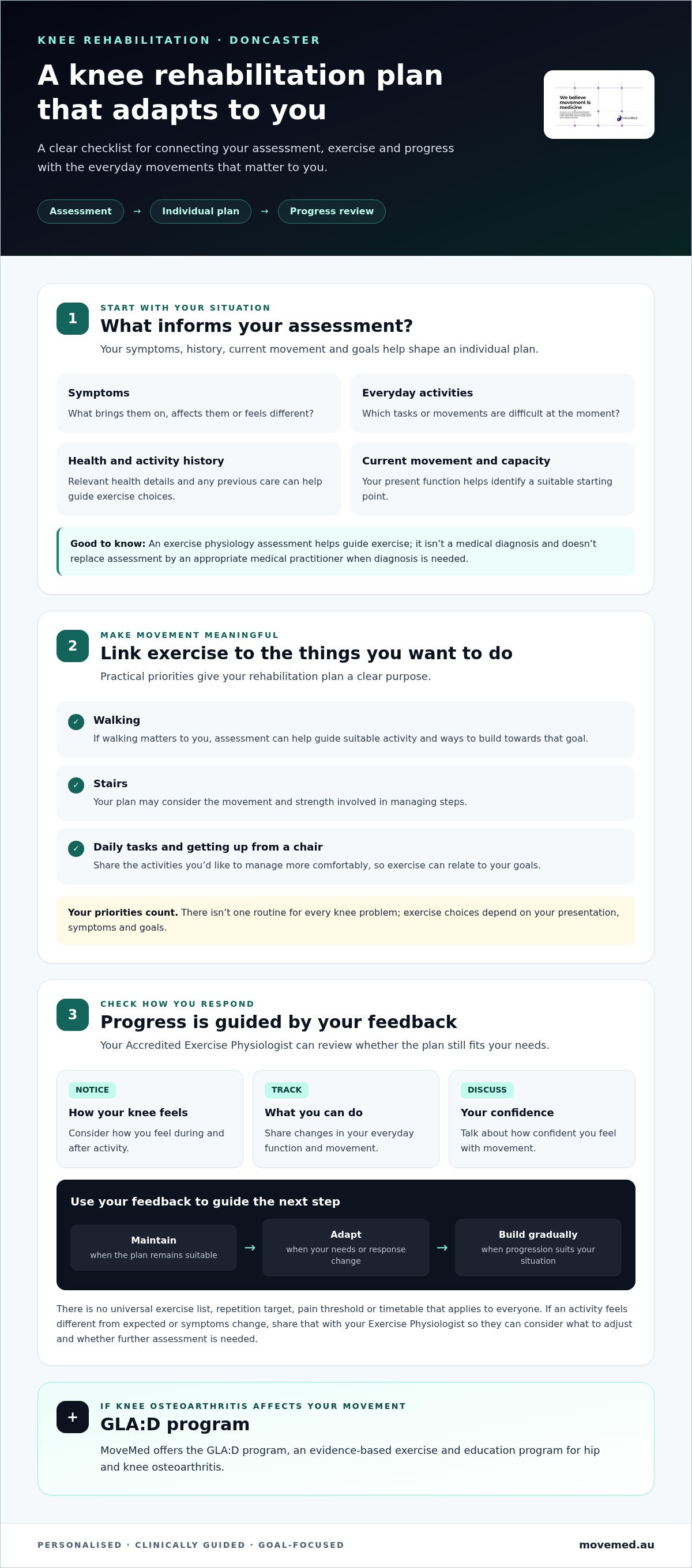
A knee exercise plan shouldn’t be a fixed list that ignores how you’re feeling. Assessment gives an Accredited Exercise Physiologist a clearer picture of your symptoms, relevant health and activity history, current movement and the changes you want to work towards. This context helps guide which exercises are appropriate and how they may be adapted as your needs change.
How assessment informs a knee exercise plan
You may discuss what brings on or affects your symptoms, which daily activities are difficult, any previous care and what you’d like to do more comfortably. The Exercise Physiologist may also consider how you move and what your current capacity allows. These findings help shape an individual plan, rather than assuming the same exercises suit everyone with knee pain.
The aim is to connect exercise with function. For example, if stairs are a priority, your plan may consider the movement and strength involved in managing steps. If walking is your focus, the assessment can help guide suitable activity and ways to build towards your goal. The precise choices depend on your presentation, not an online exercise checklist.
How exercise can progress while symptoms are monitored
It’s understandable to worry that movement could make knee symptoms worse. Exercise isn’t automatically unsuitable, but the type and level of activity need to fit your circumstances. An Accredited Exercise Physiologist can guide exercise selection and progression, while checking how your knee responds and whether the plan remains relevant to your everyday needs.
Exercise should progress in response to your symptoms, function and goals, not according to a one-size-fits-all timetable. This means discussing how you feel during and after activity, changes in what you can do, and your confidence with movement. Your Exercise Physiologist can use that feedback to maintain, adapt or gradually build the plan. There’s no universal exercise list, repetition target or pain threshold that applies to every person.
If an activity feels different from expected or your symptoms change, share that information rather than pushing through a plan that no longer feels suitable. It helps your Exercise Physiologist decide what to adjust and whether further assessment is needed. For people considering exercise physiology for knee rehabilitation Doncaster, MoveMed’s exercise physiology consultations provide a local, clinically guided starting point for planning around your needs.
Is Exercise Physiology Safe for a Painful Knee? What to Expect
It’s understandable to worry that exercise could aggravate a painful knee. Movement isn’t automatically unsuitable, but the right activities and level of challenge depend on your symptoms, health history and current function. An assessment helps an Accredited Exercise Physiologist consider what may be appropriate for you. It doesn’t replace medical assessment when diagnosis or other care is needed.
Clinical exercise versus general fitness training
Accredited Exercise Physiologists are university-qualified allied health professionals who design, deliver and evaluate safe and effective exercise interventions. In plain terms, they assess your needs and prescribe exercise for health, injury or functional goals. A personal trainer generally works with healthy people on fitness or weight-loss goals and isn’t qualified to prescribe clinical exercise for chronic conditions.
| Clinical exercise physiology | General fitness training |
|---|---|
| Begins with consideration of your health, symptoms, function and goals. | Usually focuses on general fitness or weight-loss aims. |
| Exercise is selected and adapted to your individual presentation. | Training is guided by fitness goals and may not address clinical needs. |
| Progress can be reviewed in relation to symptoms and everyday function. | Progress is generally considered in relation to fitness goals. |
This distinction can help when you’re considering exercise physiology for knee rehabilitation Doncaster. Clinical exercise is planned around your needs, rather than asking you to follow a standard gym routine. It can also form part of your care alongside other appropriate health support.
How your plan can respond to changing symptoms
Your response matters. Share what you notice during or after an activity, and whether everyday movement feels different. An Accredited Exercise Physiologist can use your feedback about symptoms, function and confidence to review exercise choices or adjust how the plan progresses. Discomfort shouldn’t automatically be dismissed as harmless, and exercise can’t be promised to resolve pain.
If symptoms change, let your Exercise Physiologist know so the plan can be reconsidered. Sudden, severe or otherwise concerning symptoms warrant appropriate medical advice. Exercise physiology supports planned exercise; it isn’t a substitute for medical review when your symptoms need assessment. The aim is to make informed decisions together, with your comfort and functional goals guiding each next step.
Your Knee Rehabilitation Pathway Around Doncaster: From Goals to Progress
A clear pathway can make starting rehabilitation feel more manageable. You share what you want to do, your Accredited Exercise Physiologist learns about your knee and current function, and together you agree on an exercise plan. Progress is then reviewed so the plan can respond to your experience and changing needs.
- Identify your goals. Think about which everyday activities you’d like to manage more comfortably, such as walking, using stairs or completing household tasks.
- Complete an assessment. Discuss your symptoms, relevant health and injury history, previous care and current movement.
- Agree on a plan. Exercise choices are guided by your assessment and the goals that matter to you.
- Review progress. Share how the plan feels and whether your movement, confidence or participation in daily activities has changed.
Preparing for an exercise physiology appointment
A little preparation can help you explain what you’re experiencing. Note which activities are difficult, when symptoms tend to arise, and what you hope to work towards. Bring relevant referral or care information if you have it. You don’t need to have all the answers. Your questions and concerns are useful parts of planning, so raise anything that would help you feel informed and supported.
It’s also helpful to share relevant medical history and any changes in your knee symptoms. These details give your clinician context for understanding your current presentation and discussing suitable next steps. For people considering exercise physiology for knee rehabilitation Doncaster, this conversation helps connect the assessment to practical goals rather than relying on a generic routine.
Reviewing progress in everyday activities
Progress isn’t measured only by completing exercises. You and your Exercise Physiologist can also consider whether you feel more confident moving, how daily activities are going, and whether your ability to participate has changed. If your needs or capacity shift, the plan can be reviewed and adjusted with you.
Rehabilitation doesn’t always move in a straight line. Symptoms and day-to-day demands can vary, so sharing what’s going well and what feels difficult helps guide the next step. MoveMed provides personalised exercise physiology in Doncaster and nearby suburbs. Learn more about exercise physiology services and consider how a plan shaped around your goals could support your next steps.
MoveMed Knee Rehabilitation for Doncaster: Take Your Next Step
You don’t have to work out your next steps alone. MoveMed supports people in Doncaster and nearby suburbs, including Templestowe Lower, Templestowe, Doncaster East, Bulleen, Warrandyte, Lower Plenty, Balwyn North and Box Hill. Care is led by Accredited Exercise Physiologists and shaped around your assessment, symptoms and functional goals.
A personalised, evidence-based management plan takes your circumstances into account. Rehabilitation can focus on the activities that matter to you and be reviewed as your needs or capacity change. The aim is to support recovery and longer-term function, while building a clearer understanding of how exercise fits into your care.
When the GLA:D program may be relevant
If knee osteoarthritis is affecting your movement, MoveMed’s GLA:D program may be relevant. It’s an evidence-based exercise and education program for people with hip or knee osteoarthritis. It isn’t a general program for every knee injury or condition, so whether it suits you depends on your needs and assessment.
Local support for your rehabilitation goals
Whether you’re in Doncaster, Templestowe or Doncaster East, your priorities can guide the conversation. You might be working towards greater confidence with everyday movement or maintaining your independence in daily life. Your Accredited Exercise Physiologist partners with you to understand those goals and plan exercise around your presentation, without promising a particular result or timeline.
Taking a first step can simply mean learning more about the care available and considering what you’d like to work towards. If you’re exploring exercise physiology for knee rehabilitation Doncaster, MoveMed’s local team can guide you through an individualised approach grounded in your needs. Explore MoveMed’s exercise physiology care to learn more.
Take a Confident Step Towards Knee Rehabilitation
Knee rehabilitation is more useful when it reflects your symptoms, current function and the activities you want to return to. An assessment with an Accredited Exercise Physiologist helps shape a plan around your needs, while reviews can guide adjustments as your capacity changes. If you have knee osteoarthritis, the GLA:D program may also be relevant to discuss.
MoveMed provides personalised, evidence-based exercise physiology in Doncaster and surrounding suburbs, including Templestowe Lower, Templestowe, Doncaster East, Bulleen, Warrandyte, Lower Plenty, Balwyn North and Box Hill. With ESSA-accredited practitioners guiding your care, you can work together on practical goals that support confidence and independence. Exercise physiology for knee rehabilitation Doncaster can be a considered starting point for understanding your options and planning your next step.
Explore exercise physiology at MoveMed and take the first step towards a plan shaped around you. Progress is personal, and you can begin by focusing on the movement that matters most in your everyday life.
Frequently Asked Questions
Can exercise physiology help with knee rehabilitation?
Yes. Exercise physiology can support knee rehabilitation through an exercise plan shaped around your needs. An Accredited Exercise Physiologist can consider your symptoms, health history, movement and goals, then plan relevant activities that may focus on strength, balance, mobility or daily function. The right approach varies from person to person. General information can help you understand your options, but it isn’t a personal diagnosis or exercise prescription.
Is exercise safe if my knee hurts?
Knee pain doesn’t automatically mean all exercise is unsuitable, but activity should reflect your circumstances. An Accredited Exercise Physiologist can consider your symptoms, current function and goals when discussing suitable exercise. If your symptoms are sudden, severe or concerning, seek appropriate medical advice before continuing or changing your activity. Share any changes with your clinician so they can help you consider the next step safely.
What happens at an exercise physiology appointment for knee rehabilitation?
An appointment may begin with a conversation about your knee history, symptoms, daily activities and rehabilitation goals. Your Accredited Exercise Physiologist may then assess movement and function in a way that relates to your needs. This information can guide a personalised exercise plan and future progress reviews. Bring any relevant referral or care information you have, and write down questions or concerns you’d like to discuss.
How is an exercise physiologist different from a personal trainer for knee rehabilitation?
Accredited Exercise Physiologists are university-qualified allied health professionals who design, deliver and evaluate safe and effective exercise interventions. Their clinical exercise plans can address health, injury and functional needs. A personal trainer generally works with healthy clients on fitness or weight-loss goals and isn’t qualified to prescribe clinical exercise for chronic conditions. The difference lies in the professional’s training and the purpose of the exercise plan.
Can exercise physiology help knee osteoarthritis?
Exercise physiology can support you with knee osteoarthritis through exercise planned around your symptoms, function and goals. MoveMed also offers the GLA:D program, an evidence-based exercise and education program for hip and knee osteoarthritis. Whether this or another approach suits you depends on your individual needs and circumstances. It isn’t a program for every knee condition, and no particular result can be guaranteed.
Where can I access exercise physiology for knee rehabilitation near Doncaster?
MoveMed provides exercise physiology for knee rehabilitation for Doncaster residents and people in nearby suburbs. Local areas include Templestowe Lower, Templestowe, Doncaster East, Bulleen, Warrandyte, Lower Plenty, Balwyn North and Box Hill. Accredited Exercise Physiologists develop personalised, evidence-based management plans. Explore MoveMed’s exercise physiology service to learn about local care and consider a next step that reflects your goals.


