
How do you know when it’s safe to start moving again after a cardiac event? It’s understandable to feel cautious, especially when you’re unsure how much activity is appropriate. For post cardiac event exercise rehabilitation Balwyn North residents can access individualised support through MoveMed exercise physiology, with your treating team’s advice guiding when and how you begin.
This article explains how structured exercise may support your recovery, what to discuss with your treating team before starting, and how an Accredited Exercise Physiologist can help you plan activity around your needs and goals. The aim is to help you feel informed, not rushed.
Cardiac rehabilitation and exercise physiology can play different, complementary roles in your care. Exercise physiology doesn’t replace your cardiologist, GP or a hospital cardiac rehabilitation service. MoveMed’s personalised, evidence-based management plans can provide exercise guidance alongside your broader cardiac care. Here, you’ll find practical points to clarify before your first session, ways to discuss progress and how local support in Balwyn North and nearby communities may help you take your next steps with greater confidence.
Key Takeaways
- Cardiac rehabilitation may combine education with supervised exercise, while exercise physiology can provide individualised support alongside your broader cardiac care.
- Before restarting or increasing activity, get guidance from your treating team. The right timing and starting point depend on your cardiac event and recovery.
- Bring relevant discharge or treatment instructions when discussing your goals, current capacity and possible next steps.
- For post cardiac event exercise rehabilitation Balwyn North, MoveMed’s Accredited Exercise Physiologists can shape exercise planning around your goals and medical advice.
- Progress can be gradual and guided, helping you approach activity with greater understanding and confidence.
What post-cardiac event exercise rehabilitation can involve near Balwyn North
After a cardiac event, even familiar activities can feel different. You might wonder whether a short walk is appropriate or feel unsure how exercise fits into your recovery. That uncertainty is understandable. Post cardiac event exercise rehabilitation Balwyn North support can involve different forms of care, and the right starting point depends on your circumstances and medical advice.
What recovery support may include after a cardiac event
Cardiac rehabilitation is structured support to help people manage recovery and work towards appropriate activity. It may include heart health education, supervised exercise and goals shaped around individual needs. The format varies between services and people, so a schedule used by one programme shouldn’t be treated as a universal plan for everyone recovering from a cardiac event.
Cardiac rehabilitation can involve different phases and contributions from several health professionals. Understanding this broader approach may help you discuss how exercise support fits with the care you’re already receiving. Any exercise plan should sit alongside, not take the place of, advice and treatment from your cardiologist, GP or cardiac care team.
How exercise physiology can fit into your recovery
After your treating team has advised whether and when you can begin, exercise physiology can provide individualised guidance on exercise goals. Accredited Exercise Physiologists are university-qualified allied health professionals who design, deliver and evaluate exercise interventions. They take your needs, current capacity and goals into account when planning suitable activity and reviewing your progress.
Recovery doesn’t follow a standardised timetable. Your starting activities and progression need to reflect the advice you’ve received and your situation, rather than a routine copied from someone else. MoveMed’s personalised, evidence-based exercise physiology management plans can complement your broader cardiac care, with goals discussed in light of relevant medical guidance. They don’t replace cardiac rehabilitation or medical care.
If you’re unsure what support is appropriate, first clarify with your treating team whether you’re ready to start or change your activity. This gives you and your exercise physiologist a clearer foundation for discussing goals and planning next steps together.
When can you start exercise after a cardiac event? Safety comes first
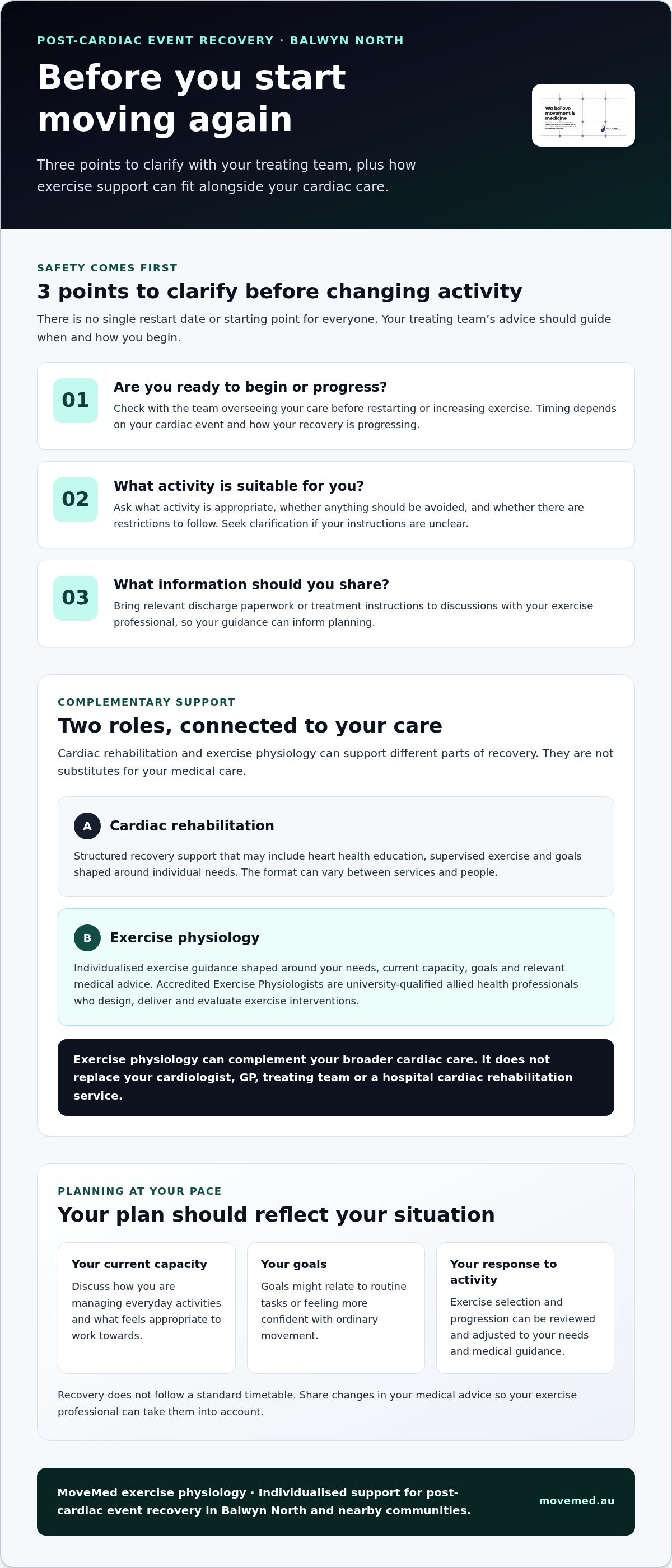
There isn’t one restart date that suits everyone. After a cardiac event, don’t resume or increase exercise without appropriate guidance from your treating team. The right timing and starting point depend on what happened, how your recovery is progressing, and any advice or restrictions from your doctors. If you’re considering post cardiac event exercise rehabilitation Balwyn North, begin by clarifying what activity is appropriate for you.
This guidance helps shape a plan; it isn’t a reason to push through uncertainty. If you’re not sure what your instructions mean, seek clarification from the team overseeing your care before changing your activity. The US Centers for Disease Control and Prevention outlines the benefits of cardiac rehabilitation, but your treating team’s advice should guide decisions about your recovery and exercise.
What medical clearance means in practical terms
Guidance from your treating team helps establish what activity is suitable, whether anything should be avoided and whether you’re ready to begin or progress. There isn’t one clearance process or timeline for everyone. If you have discharge paperwork or other treatment instructions, share the relevant information with your exercise professional so it can inform planning.
How an exercise plan can progress at your pace
Once you have guidance to proceed, an Accredited Exercise Physiologist can discuss your current capacity and the everyday activities you want to work towards. Your goals might relate to managing routine tasks or feeling more confident with ordinary movement. These are starting points for a conversation, not a prescribed exercise list or a promise of a particular outcome.
Exercise selection and progression should reflect your treating team’s advice and how you tolerate activity. Your plan can be reviewed and adjusted to your needs rather than following a fixed timetable or someone else’s routine. Share any changes in your medical guidance so your exercise professional can take them into account. This partnership keeps your goals connected to your broader care.
MoveMed’s Accredited Exercise Physiologists develop personalised, evidence-based management plans with your needs and relevant medical advice in mind. To learn more about exercise physiology as part of your recovery, explore MoveMed exercise physiology.
Cardiac rehabilitation or exercise physiology: which support suits your needs?
These forms of support can serve different purposes, so you don’t necessarily have to think of them as competing options. Formal cardiac rehabilitation is structured support focused on recovery after a heart event. Exercise physiology can offer individualised exercise planning around your goals and relevant medical guidance. Your treating team can help you understand which pathway, or combination of support, suits your circumstances.
| Consideration | Formal cardiac rehabilitation | Exercise physiology |
|---|---|---|
| Purpose | Structured recovery support that may include education and supervised exercise. | Exercise planning shaped around your individual needs and functional goals. |
| Clinical oversight | Delivered through a programme with oversight and support arranged by that service. | An Accredited Exercise Physiologist plans exercise in light of relevant medical advice. This doesn’t replace your cardiac care. |
| Goal-setting | May combine programme activities with goals suited to participants. | Can focus on personal goals, including everyday activities that matter to you. |
| Place in your care | One structured part of recovery after a cardiac event. | May complement cardiac rehabilitation and ongoing care, rather than take their place. |
What a formal cardiac rehabilitation programme may offer
Education and supervised exercise are common elements, but the format, eligibility and referral process can differ between services. For example, Monash Health describes a community programme that includes education, exercise and a home exercise plan. That is one service’s approach, not a schedule or structure that applies to every programme. Discuss with your treating team how a formal programme fits your recovery and what support is appropriate for you.
What individual exercise physiology may add
Exercise physiology centres on planning and reviewing exercise in response to your needs, relevant medical advice and goals. You might want to work towards daily tasks that matter to you, such as moving around your home with more confidence. These goals can guide a conversation, but they aren’t promised results. An Accredited Exercise Physiologist can use evidence-based exercise planning to help shape a suitable approach, while your cardiologist, GP and cardiac team remain central to your care.
For post cardiac event exercise rehabilitation Balwyn North, the useful question isn’t simply which option is “better”. It’s how each type of support could fit your situation. Discuss your recovery, goals and existing care with your treating team, then use that guidance to shape exercise support alongside your cardiac care.
How to prepare for post-cardiac event exercise support in Balwyn North
A little preparation can make an exercise consultation feel more manageable. You don’t need to arrive with every answer. Share what you know about your recovery, what you’re unsure about and what you’d like to work towards. This helps guide the discussion around your circumstances and medical advice.
What to bring and discuss at your first exercise consultation
Bring relevant discharge or treatment instructions from your cardiac care team if you have them. These can help your exercise professional understand any guidance or restrictions you’ve been given. It may also help to write down questions beforehand, especially if you’re uncertain about which activities are suitable.
Think about how recovery is affecting everyday movement. Describe activities you’d like to resume or manage with more confidence, such as moving around your home, doing household tasks or getting out into your local community. Be specific about what feels manageable and what causes concern. This gives you a practical starting point for discussing goals without assuming you should push beyond the advice you’ve received.
Useful things to share include:
- Relevant instructions from your treating team, including activity guidance or restrictions.
- What you currently feel comfortable doing and any concerns about returning to activity.
- Everyday tasks or personal goals you’d like your exercise plan to take into account.
- Changes to your recovery or medical guidance that may affect exercise planning.
Planning ongoing support close to Balwyn North
MoveMed supports people in Balwyn North and nearby communities, including Templestowe Lower, Templestowe, Doncaster, Doncaster East, Bulleen, Warrandyte, Lower Plenty and Box Hill. At an exercise physiology consultation, you can discuss your goals and current capacity with an Accredited Exercise Physiologist, who can shape a personalised, evidence-based plan around relevant clinical guidance. The plan can be considered alongside your wider cardiac care, not as a replacement for it.
If you’re looking into post cardiac event exercise rehabilitation Balwyn North, a useful next step is to gather your questions and clarify your current medical advice. For more about what an exercise physiology consultation may involve, read Exercise Physiology in Templestowe: What to Expect.
To discuss your goals with MoveMed, explore MoveMed exercise physiology and take a considered next step towards supported activity.
How MoveMed exercise physiology can support your next step
Once you’ve received guidance from your treating team, you may still have questions about approaching everyday activity. MoveMed’s Accredited Exercise Physiologists can discuss your goals, current capacity and the medical advice relevant to your recovery. This gives you a supported way to consider exercise as part of your broader care, without treating it as a substitute for cardiac or medical support.
What to expect from MoveMed exercise physiology
Accredited Exercise Physiologists are university-qualified allied health professionals who design, deliver and evaluate safe and effective exercise interventions. At MoveMed, exercise physiology includes personalised, evidence-based management plans. The discussion starts with your circumstances: what activities matter to you, what feels manageable now and what guidance you’ve received from your treating team.
Rather than applying a standard cardiac protocol, exercise planning is shaped around individual needs and relevant clinical advice. You might discuss functional goals connected with daily life, such as managing routine movement or building towards an activity your treating team has advised is suitable. Your plan can be reviewed in light of your goals and capacity. It doesn’t replace the role of your cardiologist, GP or any cardiac rehabilitation service involved in your care.
Raise questions openly, including what you’re uncertain about or concerned might feel too demanding. Sharing those concerns helps keep the discussion practical and your goals connected to the guidance you’ve been given. If your medical advice changes, that information can also inform exercise planning.
Taking a supported next step in Balwyn North
MoveMed serves people in Balwyn North and nearby communities, including Templestowe Lower, Templestowe, Doncaster, Doncaster East, Bulleen, Warrandyte, Lower Plenty and Box Hill. If you’re considering post cardiac event exercise rehabilitation Balwyn North, an exercise physiology conversation can help you explore how individualised exercise support may fit alongside your cardiac care, once your treating team has advised that it’s appropriate.
You don’t need to have every question resolved before starting a conversation. Bring relevant instructions, explain what you’d like to work towards and discuss a suitable next step with an Accredited Exercise Physiologist. MoveMed supports personalised exercise planning in partnership with you and in light of your medical guidance.
When you’re ready, explore MoveMed exercise physiology as a considered next step towards supported, goal-focused activity.
Take your next step with confidence
Returning to activity after a cardiac event can raise questions, and you don’t need to work through them alone. The safest starting point is guidance from your treating team, because timing and suitable activity depend on your circumstances and recovery.
Formal cardiac rehabilitation and exercise physiology can play complementary roles. Exercise physiology offers individualised planning around your goals and medical advice, while remaining part of your broader care, not a replacement for it. For post cardiac event exercise rehabilitation Balwyn North, MoveMed’s Accredited Exercise Physiologists create personalised, evidence-based management plans to support your next steps.
MoveMed serves Balwyn North and nearby communities. If you’re ready to explore exercise physiology and discuss goals that matter to you, take your next step with support.
Frequently Asked Questions
Is exercise safe after a cardiac event?
Exercise may be suitable after a cardiac event, but follow guidance from your treating team before restarting or increasing activity. What’s appropriate depends on your event, recovery and individual medical advice. Don’t assume an activity that feels easy is automatically right for you. An exercise professional can take relevant clinical guidance into account when discussing a plan, while your cardiologist, GP and cardiac care team remain central to your recovery.
When can I start exercising after a heart attack or heart procedure?
There’s no single start date that applies to everyone. Timing depends on the event or procedure, your recovery and advice from your treating team. Before you resume or increase exercise, ask what activity is appropriate for your circumstances and whether any restrictions apply. Share relevant discharge or treatment instructions with your exercise professional so exercise planning can reflect the guidance you’ve received.
What is the difference between cardiac rehabilitation and exercise physiology?
Cardiac rehabilitation is structured recovery support that may include education and supervised exercise. Exercise physiology focuses on planning and reviewing exercise around your individual needs and goals, with relevant medical advice guiding the approach. These forms of support can complement each other. Exercise physiology doesn’t replace cardiac rehabilitation, your cardiologist or your GP. Your treating team can help you understand how each may fit into your broader care.
Do I need a referral for exercise rehabilitation after a cardiac event?
Referral requirements can vary between cardiac rehabilitation programmes and exercise services, so don’t assume one process applies everywhere. The appropriate pathway may also depend on your circumstances and any funding arrangements. Discuss your options with your treating team and clarify what guidance they recommend before beginning exercise. If you have referral or treatment instructions, share them when discussing exercise physiology so they can inform the conversation and planning.
What exercises are included in post-cardiac event rehabilitation?
Exercise may include supervised activity as part of a cardiac rehabilitation programme, but there isn’t one exercise list or routine for everyone. The type and progression of activity should reflect your medical advice, recovery and current capacity. Don’t choose exercises or increase their demands based on another person’s plan. Your treating team can guide what’s appropriate, and an Accredited Exercise Physiologist can use that guidance when discussing individual exercise goals.
Can an exercise physiologist help after a cardiac event?
Yes. An Accredited Exercise Physiologist can help plan and review exercise around your needs and goals once you’ve received appropriate medical guidance. At MoveMed, university-qualified Accredited Exercise Physiologists create personalised, evidence-based management plans. You can discuss your current capacity, everyday activities you’d like to work towards and relevant instructions from your treating team. Exercise physiology complements broader cardiac care; it doesn’t replace your cardiologist, GP or cardiac rehabilitation.
Is there exercise rehabilitation near Balwyn North?
MoveMed provides exercise physiology for people in Balwyn North and nearby communities, including Templestowe Lower, Templestowe, Doncaster, Doncaster East, Bulleen, Warrandyte, Lower Plenty and Box Hill. If you’re considering post cardiac event exercise rehabilitation in Balwyn North, MoveMed’s Accredited Exercise Physiologists can discuss personalised exercise support in light of relevant medical advice. This service complements your wider cardiac care and isn’t a substitute for a formal cardiac rehabilitation programme or medical treatment.


