

What if an exercise plan for type 2 diabetes management Box Hill residents can follow began with your health, goals and daily routine, rather than a one-size-fits-all schedule? If you’re unsure whether walking, strength exercises or other activities suit you, or how blood glucose, medication or another health condition may affect exercise, it makes sense to seek guidance before you begin.
Exercise can support type 2 diabetes management, but the right starting point and pace vary from person to person. A useful plan takes your current capacity into account and builds gradually, so activity feels more manageable over time.
In this article, you’ll learn how exercise can support diabetes management, what steady progress may look like and what to consider when planning activity around blood glucose and medication. You’ll also see how MoveMed’s Accredited Exercise Physiologists can assess your needs and guide a personalised, evidence-based approach in Box Hill, turning general advice into a routine that fits your life.
Key Takeaways
- A personalised plan considers your health background, current abilities and goals, rather than relying on a generic routine.
- Accredited Exercise Physiologists can guide assessment, activity choices, gradual progression and review.
- Aerobic, strength-based and balance-focused activities can serve different purposes, with choices tailored to your needs.
- An exercise plan for type 2 diabetes management Box Hill can be built through manageable steps and thoughtful review.
- MoveMed’s exercise physiology consultations offer a supportive way to shape an evidence-based plan around your life.
Why an exercise plan for type 2 diabetes management in Box Hill should be personal
Wanting to move more is a positive first step. But if you’re unsure what’s suitable, where to begin or how to keep activity manageable, a generic routine can leave you with more questions than confidence. A personalised exercise plan gives you a clearer starting point: it is assessed, adapted to your circumstances and reviewed as your needs change.
Regular movement can support blood glucose management and help maintain or build physical capacity for everyday activities. It doesn’t replace medical care or guarantee a particular result. Your experience depends on your health and circumstances, so exercise planning works best alongside the care and advice you receive from your health professionals. For general background on type 2 diabetes management, you can also read the overview on Wikipedia.
How exercise can support type 2 diabetes management
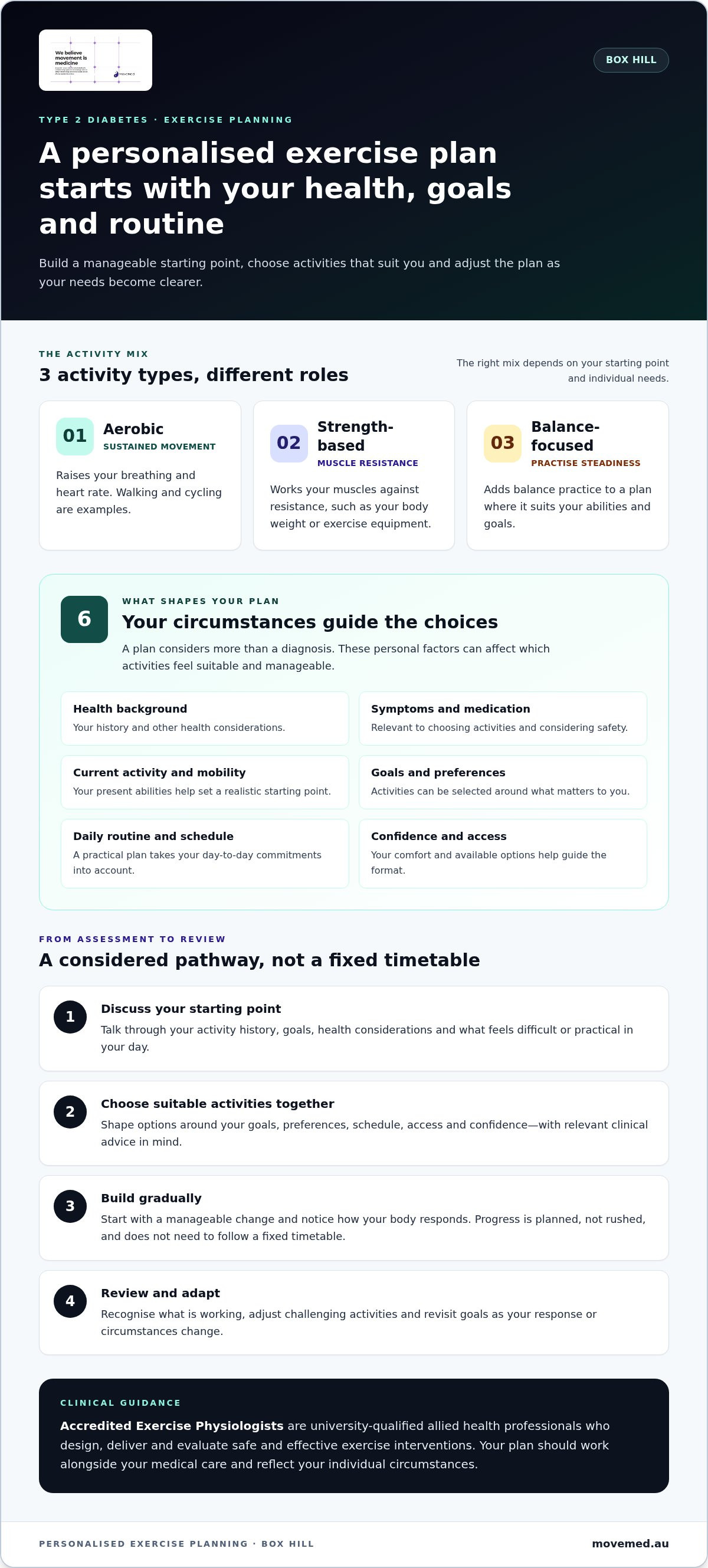
Aerobic activity raises your breathing and heart rate, as walking can. Strength-based exercise works your muscles against resistance, such as using your body weight or exercise equipment. These activities have different roles and can contribute to physical health and blood glucose management. The right mix depends on you, so a plan should reflect your starting point rather than assume one type of exercise suits everyone.
Why a generic routine may not fit your circumstances
Your health history, symptoms, current activity, mobility, medication and other health considerations can affect which activities are appropriate. Your confidence, goals and daily routine matter too. A demanding schedule may be difficult to maintain if you’re returning to activity after a break or fitting movement around work, caring responsibilities or changing energy levels.
Starting with a manageable change can help you notice how your body responds and build confidence before progressing. Progress doesn’t need to follow a fixed timetable. Instead, choices and adjustments should reflect your capacity and individual needs.
If you’re in Box Hill, an exercise physiology consultation with an Accredited Exercise Physiologist can give you a local starting point. They can discuss your health background, goals and current abilities, then help shape an evidence-based plan that can be adapted and reviewed over time. This gives you a structured approach based on your circumstances, rather than relying on general advice alone.
How an Accredited Exercise Physiologist builds your diabetes exercise plan
A plan should begin with a conversation, not a set routine. An Accredited Exercise Physiologist considers your health background and current abilities, then works with you to choose suitable activities and plan how to progress. Accredited Exercise Physiologists are university-qualified allied health professionals who design, deliver and evaluate safe and effective exercise interventions.
What the initial assessment helps establish
Your first appointment can cover your activity history, what you’d like to work towards and any health considerations that may affect exercise. You might discuss the movement you already do, what feels difficult and what would make activity practical in your day. The aim is to agree on a realistic starting point, rather than assume your current capacity from a diagnosis alone.
Clinical decisions need to be individualised. A general article can offer background, but it can’t assess your symptoms, medication or other health circumstances. Diabetes Australia provides useful guidance on exercise safety considerations; your own plan should reflect your situation and relevant clinical advice.
Turning your goals into a plan you can maintain
Once you’ve agreed on a starting point, the exercise physiologist can shape a programme around activities that suit your goals, preferences, schedule, access and confidence. You can discuss different ways to include aerobic movement or strength-based exercise without assuming one format works for everyone.
Progress is planned, not rushed. You and your practitioner can adjust activities as your response, ability and goals become clearer. If an exercise feels too challenging or your circumstances change, the plan can be adapted rather than treated as a pass-or-fail test.
Review gives you both a chance to recognise what’s working and decide what may need to change. You might build on an activity that feels manageable, adapt an exercise or revisit a goal that no longer fits your routine. This ongoing process helps keep the plan relevant to your capacity and circumstances.
For people seeking an exercise plan for type 2 diabetes management Box Hill, this assessment-to-review approach turns broad activity advice into a programme shaped around individual needs. MoveMed’s Accredited Exercise Physiologists can work with you through an exercise physiology consultation to develop an evidence-based plan around your goals and current capacity.
How to weigh exercise options and safety considerations for type 2 diabetes
Choosing an activity isn’t simply about finding the exercise that sounds most effective. It means matching its purpose and demands to your health, abilities and preferences. An Accredited Exercise Physiologist can help you weigh up options and consider how they fit your goals, while your treating health team can advise on diabetes-related concerns.
Aerobic, strength and balance activities each have a role
Aerobic activity is movement you sustain over time, such as walking or cycling. Strength-based exercise challenges your muscles, with options that can be adapted to your ability. Balance-focused activity practises steadiness and control during movement. Each approach can serve a different purpose, and none is automatically right for everyone.
| Activity type | Potential role | Personalisation considerations |
|---|---|---|
| Aerobic | Builds capacity for sustained movement. | Consider your current activity, mobility, preferred setting and how the activity feels. |
| Strength-based | Challenges muscles to support strength for everyday tasks. | Exercise choice and resistance can be adapted to your ability and health needs. |
| Balance-focused | Practises steadiness and control. | Consider your balance, confidence and any mobility or sensation changes. |
Your practitioner can help select and balance activities according to what matters to you. Use the table as a way to compare activity purposes, not as a prescription. The same activity may feel different depending on your health, experience and current capacity.
Plan around blood glucose, medication and other health needs
Blood glucose responses to exercise vary. Medication, meals, symptoms and the type of activity may all be relevant to your personal safety plan. Don’t change medication based on general exercise advice. Discuss questions about medication, meal timing or glucose monitoring with your treating health team and exercise professional, who can help you understand what guidance applies to you.
Reduced sensation in your feet can make it harder to notice pressure or rubbing during activity. Other health concerns may also affect suitable exercise choices or how you prepare. Share relevant symptoms and changes with your health team so they can be considered in your plan. If you’re unsure whether an activity is appropriate, pause and seek individual advice rather than relying on a general rule.
For an exercise plan for type 2 diabetes management Box Hill residents can approach with greater clarity, compare activities by purpose, then discuss personal considerations with an Accredited Exercise Physiologist and your treating health team. This makes exercise choices part of a considered plan, not guesswork.
How to get started with a manageable exercise plan in Box Hill
Starting doesn’t mean changing everything at once. Turn your questions into a conversation, then agree on an activity that fits your health, confidence and daily life. An exercise plan for type 2 diabetes management Box Hill residents can build on over time should be practical and collaborative.
Prepare for your first planning conversation
Before you meet with an exercise professional, think about what you want movement to help you do. You might want to feel more confident being active, build strength for everyday tasks or find an activity that fits your routine. Bring questions about exercise, blood glucose or how your health may affect activity. Share relevant health information with your treating team and practitioner so it can inform planning.
Your first steps should make sense to you. Together, you can clarify your goals, discuss health considerations, choose a suitable starting activity and decide how to review your response. You don’t need to arrive with a complete routine already worked out.
Build a routine that can adapt with you
Consistency is easier to work towards when activity fits into your life. If leaving home for exercise feels difficult, discuss options that can be done in a familiar setting. If you enjoy guided movement, MoveMed’s Clinical Reformer Pilates guide describes supervised movement using a Reformer. For water-based activity as a lower-impact option to discuss with your practitioner, read the hydrotherapy guide.
Small adjustments can help you find what feels manageable without setting a demanding target before your needs have been assessed. Your exercise professional can help you decide whether to maintain, adapt or gradually progress an activity in line with your response and agreed goals. There’s no need to follow a fixed frequency, intensity or duration based on general advice alone.
Plans can change too. A shift in symptoms, routine, confidence or physical capacity may be a reason to review your activity with your practitioner and treating health team. Use that review to discuss what’s working and make considered adjustments together.
If you’re in Box Hill and would like support turning your goals into a manageable starting point, book an exercise physiology consultation with MoveMed.
MoveMed exercise physiology for type 2 diabetes management near Box Hill
Knowing that exercise may support diabetes management is one thing. Working out what suits your health, goals and routine is another. MoveMed’s exercise physiology consultations offer a collaborative way to turn your goals into an evidence-based plan, with guidance from Accredited Exercise Physiologists and a focus on your individual needs.
What personalised support can look like
Planning starts with understanding what you want to work towards and what may affect your choices. Your exercise physiologist can consider your health background and current abilities, discuss suitable activities with you and agree on a starting point. The plan can then be reviewed and adjusted as your needs, confidence or goals evolve.
Clear explanations are part of the process. You should understand why activities have been selected and how they relate to your aims, so you can take an active role in shaping a realistic routine. MoveMed highlights ESSA accreditation alongside its Accredited Exercise Physiologists, whose role is to design, deliver and evaluate safe and effective exercise interventions. This supports a clinically guided approach without promising a particular outcome.
An evidence-based plan is more than a list of exercises. It connects professional guidance with your preferences and daily life, with room to adapt. This can help you work towards making activity a more sustainable part of your routine at a pace informed by your circumstances.
Taking your next step from Box Hill
If you live in Box Hill and are considering an exercise plan for type 2 diabetes management Box Hill, start by discussing what you hope to achieve and any concerns you have. You may be unsure which activities fit your current ability, or want support making general advice more practical. These are useful questions to bring to MoveMed’s exercise physiology team.
You don’t need to have every detail figured out before exploring guided planning. A discussion can help you understand how an individual assessment, suitable exercise choices and ongoing review could fit your needs. Your treating health team can also provide guidance on health considerations that affect your exercise planning.
To explore how this approach could support your goals, explore MoveMed exercise physiology and take the next step at a pace that feels right for you.
Take a supported first step towards regular movement
Exercise can support type 2 diabetes management, but your starting point should reflect your health, abilities and goals. The most useful plan is one you can adapt as your confidence, capacity and routine change. For an exercise plan for type 2 diabetes management Box Hill, guidance from an Accredited Exercise Physiologist can help turn general activity advice into an individual approach.
MoveMed’s Accredited Exercise Physiologists create personalised exercise plans grounded in evidence-based care, with ESSA accreditation supporting the practice’s clinical focus. You can discuss suitable activities and health considerations, then review your plan together over time. Exercise supports diabetes management, but it doesn’t replace care from your treating health team.
You don’t have to work out every detail before taking a first step. Explore MoveMed exercise physiology and take your next step to discuss guided planning. MoveMed supports clients in Box Hill and nearby Templestowe Lower, Templestowe, Doncaster, Doncaster East, Bulleen, Warrandyte, Lower Plenty and Balwyn North. A clear, personal starting point can help you build confidence and work towards a routine that fits your life.
Frequently Asked Questions
Can exercise help manage type 2 diabetes?
Yes, regular physical activity can support blood glucose management and physical capacity. Aerobic movement, such as walking, and strength-based exercise can contribute in different ways, but results vary between people. Exercise is one part of diabetes management, not a replacement for medical care. Your health background, current abilities and goals can help guide which activities may be suitable for you.
What exercises are best for type 2 diabetes?
There isn’t one best exercise for everyone. Aerobic activities, such as walking or cycling, involve sustained movement, while strength-based exercises challenge your muscles. Balance-focused activities may also suit some people’s goals. The right choices depend on your health, mobility, confidence and preferences. An Accredited Exercise Physiologist can help you consider suitable options and build a plan around your needs.
How often should you exercise with type 2 diabetes?
General Australian guidance commonly recommends working towards 150 to 300 minutes of moderate-intensity activity each week, or 75 to 150 minutes of vigorous activity, alongside strength activities. These are general targets, not an individual prescription. Your starting point may need to be different, especially if you’re new to exercise or have other health considerations. Discuss a safe, achievable progression with your treating health team or exercise professional.
Is it safe to exercise if you have type 2 diabetes?
Exercise can be appropriate for many people with type 2 diabetes, but safety considerations vary. Medication, meals, symptoms, blood glucose responses and reduced sensation in your feet may affect your planning. Don’t change medication based on general exercise advice. Discuss concerns with your treating health team and exercise professional, who can help you understand which precautions and guidance are relevant to your circumstances.
Do I need an exercise physiologist for type 2 diabetes?
You don’t necessarily need an exercise physiologist to be active, but clinical guidance can help if you’re unsure how to begin or adapt exercise to your health needs. Accredited Exercise Physiologists assess your abilities and goals, then develop and review an exercise plan with you. This can help translate broad activity advice into considered choices without treating a generic routine as a personal prescription.
Can I get an exercise plan for type 2 diabetes near Box Hill?
Yes. MoveMed provides exercise physiology consultations for people in Box Hill and nearby suburbs, including Doncaster, Doncaster East, Bulleen and Balwyn North. An Accredited Exercise Physiologist can discuss your goals and relevant health considerations, then work with you on a personalised, evidence-based plan. If you’re looking for an exercise plan for type 2 diabetes management Box Hill, a consultation can help you establish a suitable starting point.


