

What if managing arthritis isn’t about pushing through stiffness, but finding movement that feels right for you? Pain can make everyday activity less predictable, and questions about exercise or Medicare referrals can make it hard to know where to start. If you’re considering an allied health plan for managing arthritis with medicare Lower Plenty, a conversation with your GP can help clarify your options.
For eligible people, a GP Chronic Condition Management Plan may support access to subsidised allied health sessions. Your GP can explain whether a referral is appropriate and how current Medicare requirements apply to you. Medicare support can be one pathway to care, while your arthritis goals and abilities should guide the plan.
In this article, you’ll learn what to discuss with your GP, how Accredited Exercise Physiologists can tailor evidence-based exercise to your needs, and how MoveMed can support your next steps in Lower Plenty and nearby communities. Whether you want to move with greater confidence or manage daily tasks more comfortably, you can work towards goals at a pace that feels manageable.
Key Takeaways
- Your GP can explain whether a Medicare-supported allied health referral may suit your arthritis needs and which eligibility rules apply.
- Ask how subsidised sessions are counted across allied health services and whether you may have out-of-pocket costs.
- An Accredited Exercise Physiologist can tailor exercise to your capabilities and goals instead of relying on a one-size-fits-all routine.
- Use your daily activities and movement priorities to guide conversations about an allied health plan for managing arthritis with medicare Lower Plenty.
- MoveMed provides personalised exercise physiology support for Medicare clients in Lower Plenty and nearby areas, including Templestowe, Doncaster and Bulleen.
Medicare allied health for arthritis in Lower Plenty
Pain and stiffness can make familiar tasks, such as getting dressed, walking to the shops or standing to prepare a meal, feel less predictable. You may also be unsure whether exercise is appropriate or how Medicare could help. Arthritis covers a range of conditions affecting the joints; the Arthritis overview explains common types and symptoms. An allied health plan for managing arthritis with medicare Lower Plenty can start with a discussion with your GP about your health needs and practical goals.
In Australia, a GP may prepare a GP Chronic Condition Management Plan (GPCCMP) for an eligible person with an ongoing condition. The plan records relevant health needs and care goals, and may support a referral to eligible allied health services, including exercise physiology where appropriate. Medicare requirements can change, so ask your GP or check Services Australia for the current rules that apply to you.
What does an allied health plan mean for arthritis?
Think of the plan as a way to organise care with your GP, not as a treatment in itself. Your GP can consider how arthritis affects you, what support may be suitable and whether a referral is appropriate. A referral and care plan don’t guarantee free or unlimited sessions: eligibility, rebates and out-of-pocket costs depend on current Medicare rules and your circumstances. Subsidised sessions may also be shared across eligible allied health services.
Movement goals can sit alongside other parts of your care. You might discuss getting up from a chair more comfortably or feeling steadier during everyday activities. Your GP remains central to your medical care, while allied health support can focus on movement goals suited to your needs.
Which arthritis-related goals might exercise support?
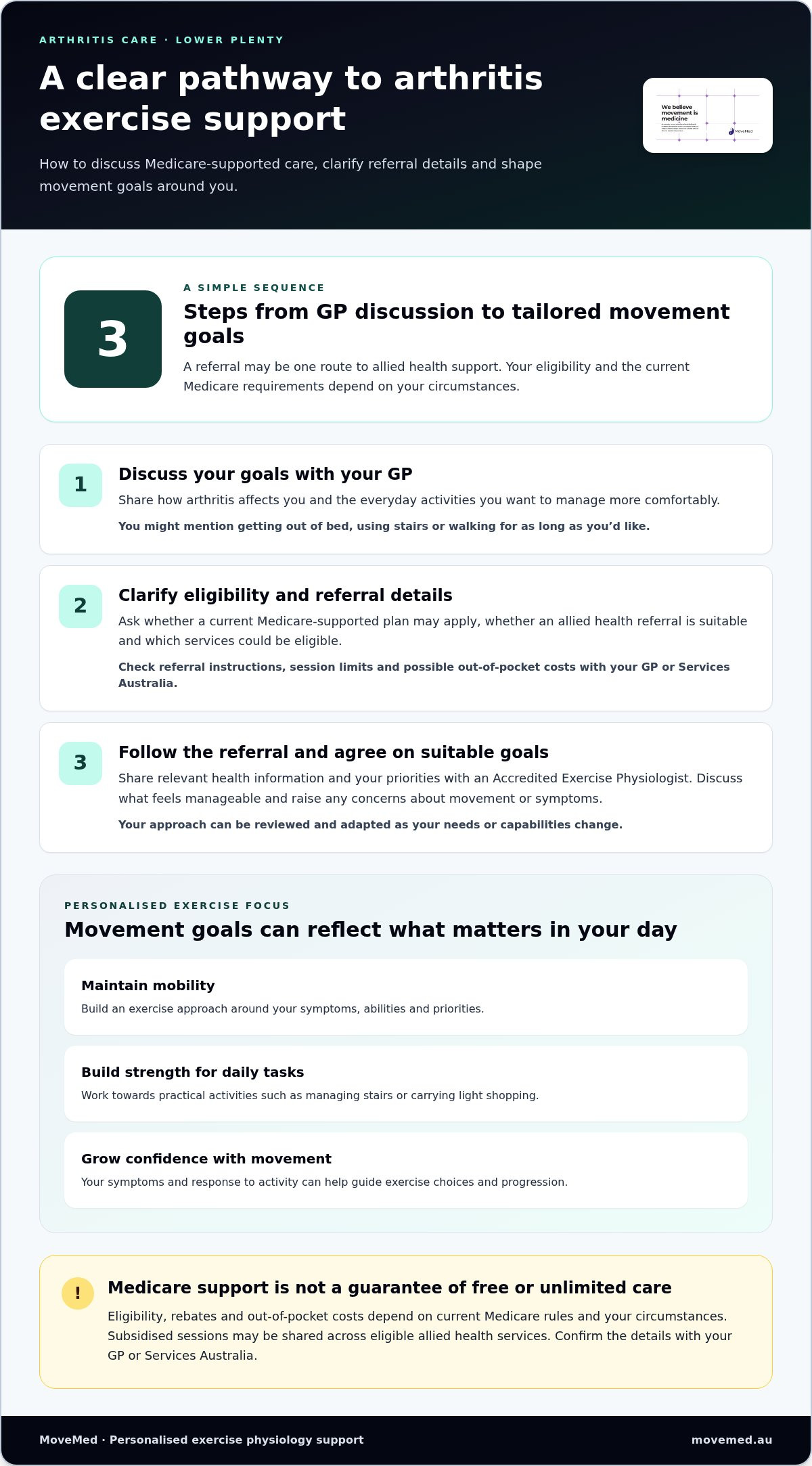
Exercise support is not one fixed routine for everyone. An Accredited Exercise Physiologist can consider your symptoms, abilities and priorities when shaping a programme. You might work towards maintaining mobility, building strength for daily tasks or becoming more confident with movement. The right starting point depends on your individual circumstances.
Goals can be practical and specific, such as walking around the block, managing stairs or carrying light shopping. Your symptoms and response to activity help guide exercise choices and progression. Exercise may form part of arthritis management, but it cannot be presented as reversing arthritis or guaranteeing pain relief. If you live in Lower Plenty, a GP discussion can help clarify whether a Medicare-supported referral and personalised exercise support fit into your wider care.
How to access Medicare-supported arthritis care near Lower Plenty
A clear conversation can make the Medicare pathway easier to understand. Your GP can discuss how arthritis affects you, whether a Medicare-supported care plan and allied health referral may be appropriate, and what current requirements apply. Eligibility and rebates depend on your circumstances and the rules in place, so treat a referral as a possible route to support, not a guarantee of a particular rebate or fully covered treatment.
What should you discuss with your GP?
Before your appointment, note the symptoms you experience and the activities they affect. You might mention stiffness when getting out of bed, discomfort on stairs or difficulty walking for as long as you’d like. Then explain what you hope to work towards, such as maintaining mobility or feeling more confident with everyday movement. Specific examples help your GP understand what matters to you.
Ask whether a current Medicare-supported plan may apply to your situation, whether an allied health referral is suitable and which services could be eligible. The Australian Government’s Medicare chronic condition management plan information outlines current requirements. Review the details with your GP or Services Australia, including referral instructions, session limits and possible out-of-pocket costs. A referral alone doesn’t mean a service will be free.
What happens after a referral?
Follow your GP’s referral instructions, then share relevant health information and your priorities with the allied health clinician. An Accredited Exercise Physiologist can discuss your health history, current ability and goals before working with you on an individualised exercise approach. Talk about what feels manageable and raise any concerns about movement or symptoms.
Your care should connect with what you and your GP are aiming to address. Your clinician can help set practical goals and review your progress, adapting the approach as your needs or capabilities change. This keeps exercise relevant to daily life rather than relying on a standard routine.
For an allied health plan for managing arthritis with medicare Lower Plenty, think of the process in three steps: discuss your goals with your GP, clarify current eligibility and referral details, then follow the referral pathway and agree on suitable goals with your allied health clinician.
MoveMed supports Medicare clients with personalised exercise physiology in Lower Plenty and nearby communities. To explore movement support shaped around your goals, learn about MoveMed’s exercise physiology support.
What an Accredited Exercise Physiologist can tailor for arthritis
Exercise support for arthritis should reflect more than the name of your condition. Your symptoms, confidence with movement, health needs and everyday priorities all help shape a suitable approach. An Accredited Exercise Physiologist can work with you to build a gradual programme around what you want to do, whether that means maintaining mobility, building strength or practising movements used in daily tasks.
Accredited Exercise Physiologists are university-qualified allied health professionals who design, deliver and evaluate safe and effective exercise interventions. They assess your needs and adapt exercise to your capabilities, rather than giving you a standard routine. Exercise Right’s guidance on arthritis explains why appropriately planned movement can be helpful in managing these conditions.
How can exercise be adjusted around joint symptoms?
There’s no single exercise prescription for everyone with arthritis. Depending on your presentation, a clinician may adjust the type of movement, its range, pace or resistance. If a particular movement feels difficult, they can consider another way to work towards the same functional goal. The aim is to match the programme to your current ability, not to push through symptoms without guidance.
Your response to activity can help guide what happens next. You and your clinician can review how exercises feel, discuss any changes in symptoms and adjust the programme over time. Other health factors and your day-to-day capacity matter too. This individual approach helps keep exercise relevant and manageable as your needs evolve.
When might hydrotherapy or the GLA:D program be relevant?
For some people, water-based exercise may be suitable. Hydrotherapy takes place in water and may support movement with reduced weight-bearing compared with similar activity on land. Whether it fits your needs depends on your goals, health and clinical guidance.
The GLA:D program is an evidence-based exercise and education option for people with hip or knee osteoarthritis. It may be worth discussing if those joints are affected and the programme aligns with your needs. It isn’t a universal choice for every type of arthritis, so suitability depends on your circumstances. MoveMed’s Accredited Exercise Physiologists provide evidence-based exercise support for Medicare clients in Lower Plenty and nearby communities.
An allied health plan for managing arthritis with medicare Lower Plenty can connect GP-led care with exercise support shaped around your functional goals. The focus is on a suitable, adaptable plan, not a promise of a cure or guaranteed pain relief.
Choosing your next arthritis-care step: Medicare, goals and expectations
A useful next step brings together what Medicare may cover, what you want to do more comfortably and which allied health support suits your needs. Use the guide below to prepare for a conversation with your GP and clinician.
| Area | Questions to consider | What it helps clarify |
|---|---|---|
| GP plan | Could a current Medicare-supported plan and referral apply to me? What requirements, referral conditions and service limits should I know about? | Your individual eligibility and the steps to access a rebate. |
| Allied health goals | What everyday activity would I like to manage with greater ease or confidence? | A practical focus, such as walking more comfortably or maintaining mobility. |
| Service fit | Would exercise physiology suit my health needs, current abilities and goals? | Whether the proposed support is relevant and appropriately tailored. |
| Progress review | How will we review the programme and adjust it if my symptoms or needs change? | A shared way to discuss what is working and what may need adapting. |
How do you know whether the care fits your goals?
Make the goal specific to your life. Rather than aiming simply to “exercise more”, you might want to manage a regular walk or complete daily routines with greater confidence. Your clinician can use that goal to shape relevant exercise and review how it fits over time. Progress is individual; symptoms and capacity can vary, so the plan may need adjustment rather than following a fixed timetable.
What should you understand about Medicare rebates?
A Medicare plan doesn’t automatically make every service free. Eligibility, referral conditions and service limits depend on current rules and your circumstances, and a rebate may not cover the full cost of a service. Before proceeding, clarify with your GP which referral applies, what services may be eligible, how many sessions are available to you and whether you may have an out-of-pocket expense. Don’t assume a particular rebate or level of cover until these details are clear.
This practical approach can help you make an informed choice about an allied health plan for managing arthritis with medicare Lower Plenty, while keeping your movement goals in focus. MoveMed’s Accredited Exercise Physiologists provide personalised exercise support for Medicare clients in Lower Plenty and nearby communities. Explore MoveMed exercise physiology support as you consider a next step that fits your goals.
MoveMed arthritis exercise support for Lower Plenty and nearby communities
Living with arthritis can make it harder to trust how your body will respond to movement. Support should take your symptoms and priorities seriously while helping you build a practical approach to activity. MoveMed provides personalised, evidence-based Exercise Physiology support for Medicare clients, shaped around your goals and clinical needs.
How MoveMed can support your arthritis goals
MoveMed’s Accredited Exercise Physiologists work with you to develop an individualised exercise management plan. They consider your current abilities, relevant health needs and what you want to do in daily life. That might mean working towards maintaining mobility, building strength for routine tasks or feeling more confident with movement. Your plan can be adapted as your needs and responses change.
This support works alongside your GP’s care, rather than replacing it. Your GP remains an important partner in managing your health, while an exercise physiology consultation focuses on movement and function. If you’re exploring an allied health plan for managing arthritis with medicare Lower Plenty, the aim is to connect appropriate clinical guidance with exercise that reflects your circumstances. There’s no promise of a cure or identical results for everyone; progress and the right approach are personal.
Taking a first step in Lower Plenty
A little preparation can make your GP conversation more useful. Before your appointment, write down:
- the symptoms or stiffness you’ve noticed and when they affect you
- daily tasks or activities you’d like to manage more comfortably
- questions about whether a Medicare-supported referral may apply to you
These notes give you a starting point for discussing your care goals and potential next steps. If your GP provides a referral, share the details and your priorities with your allied health clinician so your exercise plan can be considered in the context of your broader care.
MoveMed supports people in Lower Plenty and nearby communities, including Templestowe Lower, Templestowe, Doncaster, Doncaster East, Bulleen, Warrandyte, Balwyn North and Box Hill. If personalised exercise support feels like a suitable next step, explore MoveMed’s Exercise Physiology service and consider how it may fit with your arthritis goals and GP-led care.
Take a confident next step with arthritis support
A Medicare-supported referral may help you access eligible allied health care, but it doesn’t guarantee that every service is fully covered. Your GP can explain current requirements and whether a referral may suit your circumstances. From there, your goals can guide the conversation about movement support, with an Accredited Exercise Physiologist tailoring exercise to your needs and abilities.
If you’re considering an allied health plan for managing arthritis with medicare Lower Plenty, MoveMed offers personalised, evidence-based exercise management plans for Medicare clients. Our Accredited Exercise Physiologists support people in Lower Plenty and nearby communities, including Templestowe Lower, Templestowe, Doncaster, Doncaster East, Bulleen, Warrandyte, Lower Plenty, Balwyn North and Box Hill, working alongside your GP as part of your care.
Start with the activities you’d like to manage more comfortably and the questions you want answered. Explore MoveMed Exercise Physiology and take a supported next step. A thoughtful conversation can help you move forward at a pace that feels right for you.
Frequently Asked Questions
Is an allied health plan for managing arthritis covered by Medicare?
Medicare may provide a rebate for eligible allied health services when you meet current requirements, but coverage isn’t automatic. A rebate may also leave some of the service fee for you to pay. Ask your GP whether a Medicare-supported plan and referral may suit your circumstances. Before arranging care, confirm your eligibility, applicable service limits and any out-of-pocket costs with your GP or Services Australia.
Can I see an exercise physiologist for arthritis with a Medicare referral?
You may be able to see an Accredited Exercise Physiologist for arthritis support if you meet current Medicare eligibility and referral requirements. Your GP can discuss whether a referral is appropriate. The exercise physiologist can then consider your health history, symptoms, abilities and goals when planning movement support. They can review how you respond and adjust your programme to keep it relevant to your needs.
How do I get a Medicare allied health plan for arthritis in Lower Plenty?
Start by discussing your arthritis, daily activities and movement goals with your GP. Ask whether a Medicare-supported plan and referral may apply to your circumstances, then follow your GP’s instructions. Confirm current requirements and service limits before arranging care. MoveMed provides personalised Exercise Physiology support for Medicare clients in Lower Plenty and nearby communities, including Templestowe Lower, Templestowe, Doncaster, Doncaster East, Bulleen, Warrandyte, Balwyn North and Box Hill. Your GP can guide the referral decision.
How many allied health sessions does Medicare cover for arthritis?
The number of eligible allied health services depends on current Medicare rules and your circumstances. Some subsidised services may be shared across allied health professions, so don’t assume every appointment is covered or that a rebate pays the entire fee. Ask your GP how the current limits apply to you and check Services Australia information before arranging sessions. Confirm which services your referral covers and how they count towards any limit.
Does a Medicare plan cover all the costs of arthritis exercise therapy?
Not necessarily. A Medicare rebate may contribute towards the cost of an eligible service, but it may not cover the full fee. Your eligibility and the amount you pay depend on current requirements and your circumstances. Before your appointment, ask about any out-of-pocket cost and confirm the referral details. Avoid relying on old online rebate figures, as Medicare rules and rebates can change.
Is exercise safe if arthritis makes my joints painful or stiff?
Exercise may be part of arthritis management, but suitable movement depends on your symptoms, health and functional ability. An Accredited Exercise Physiologist can tailor and adjust a programme to your needs rather than prescribe the same routine for everyone. Discuss new, severe or changing symptoms with your GP, and seek appropriate clinical advice before changing your activity. You don’t need to push through pain to make progress.
What does an Accredited Exercise Physiologist do for arthritis?
An Accredited Exercise Physiologist considers your health needs, current abilities and goals to develop an appropriate exercise approach. For arthritis, this may focus on movement, strength or everyday function, with adjustments as your needs change. They can work alongside your broader care team, while your GP remains involved in medical management and Medicare referral decisions. At MoveMed, exercise support is personalised and evidence-based for clients in Lower Plenty and nearby communities.


