

When back pain or stiffness makes land-based exercise difficult, hydrotherapy for back pain Melbourne may offer a more supported way to practise movement. Water’s buoyancy changes how much your body supports itself, while its resistance lets you work on purposeful movement at a pace that suits you.
It’s understandable to wonder whether exercising in water is suitable for your back or how it could relate to everyday activities. Hydrotherapy is supervised, goal-focused exercise, not simply time in a pool. MoveMed’s Accredited Exercise Physiologists tailor programmes to your needs and goals, helping you build movement skills and confidence through guided exercise. Your plan is shaped around your individual presentation.
This article explains how water changes the demands of exercise, what an individualised hydrotherapy programme may involve, and how pool-based movement can connect with practical goals such as walking, standing or managing daily tasks. You’ll also learn how MoveMed supports people in Templestowe Lower and nearby suburbs to take a considered step towards better movement and function.
Key Takeaways
- Supervised hydrotherapy adapts exercise to your needs and goals, offering a supported way to practise movement when land-based activity feels difficult.
- Buoyancy, warmth and water resistance change how movement feels, from gentle mobility work to controlled strengthening.
- Water-based and land-based exercise can each have a role. An individual assessment helps guide which setting suits your current needs.
- A tailored plan may include assessment, goal setting, exercise and review. Your experience and confidence help guide the programme.
- MoveMed provides hydrotherapy for back pain Melbourne, supporting people in Templestowe Lower and nearby suburbs, including Doncaster, Bulleen and Box Hill.
Hydrotherapy for back pain in Melbourne: moving in water
When your back is sore or stiff, familiar movements can feel uncertain. You might worry that bending, walking or exercising will aggravate your symptoms. Back pain can have different causes and presentations, so there isn’t one movement plan that suits everyone. The right exercises and starting point depend on your individual needs.
If you’re considering hydrotherapy for back pain Melbourne, start by understanding what the approach involves. Hydrotherapy is supervised, water-based exercise tailored to your needs and functional goals. It isn’t simply being in a pool, and it doesn’t address every cause of back pain. An Accredited Exercise Physiologist considers your movement, symptoms and goals when shaping your exercise plan.
Why back pain can make movement feel difficult
Back pain may come with stiffness, sensitivity during particular movements or less confidence about what your body can manage. An activity may feel different from one day to the next, or you may become cautious about movements that once felt ordinary. These experiences don’t, on their own, identify the cause of your pain.
It’s useful to avoid assuming that the same exercises work for everyone with back pain. A suitable starting point takes account of what you can manage now and what you’d like to do more comfortably. Guided exercise gives you a chance to practise movement at an appropriate level, without treating discomfort as something you have to push through.
What water changes during exercise
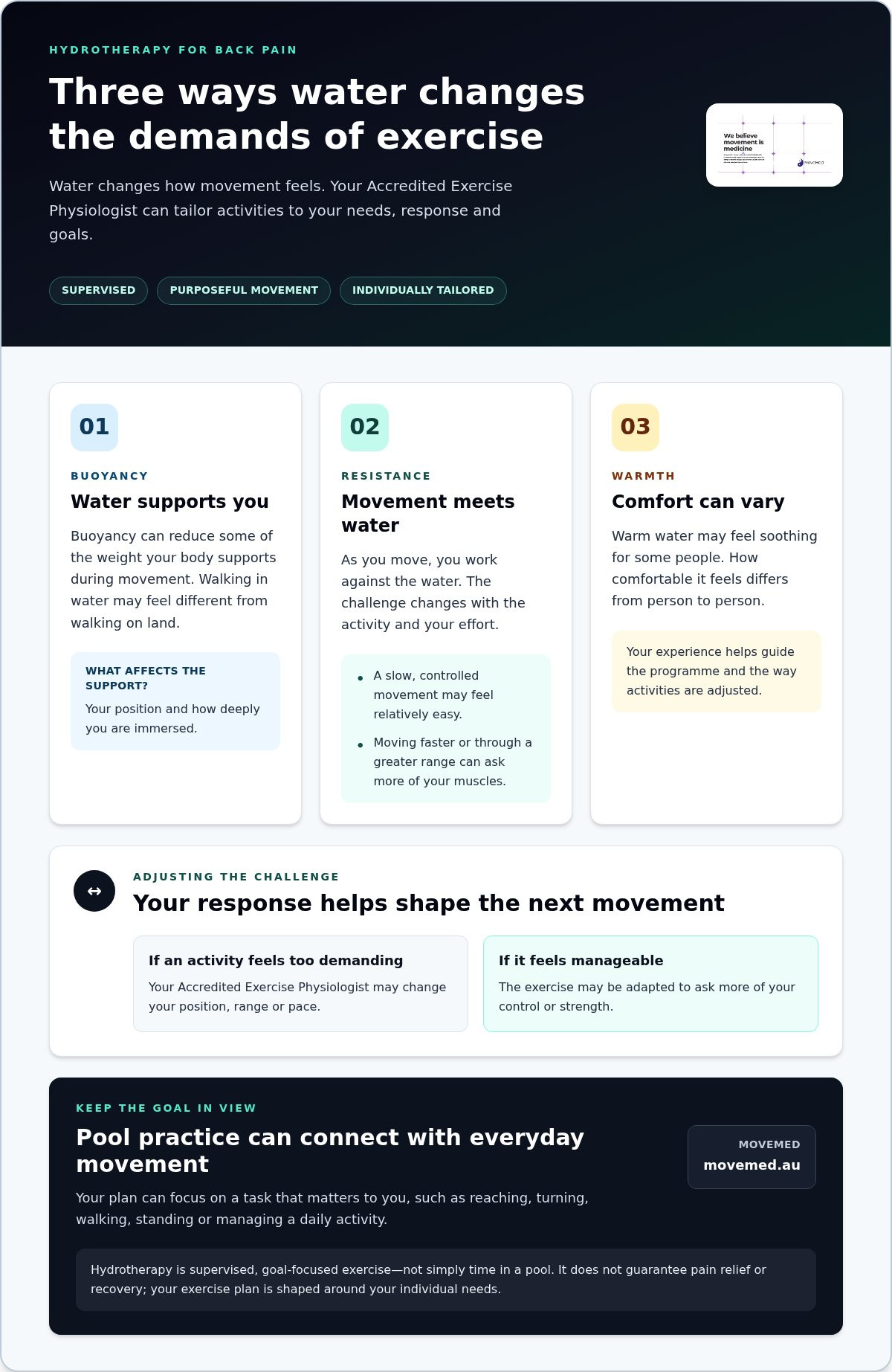
Buoyancy is the upward support water provides. Depending on your position and how deeply you’re immersed, it can reduce some of the weight your body supports during movement. For example, walking in water may feel different from walking on land because the water helps support you. This can make some movements feel more manageable, but it doesn’t remove all effort or guarantee pain relief.
Water also creates resistance. As you move, you work against it, and the challenge changes with the exercise and your effort. A slow, controlled movement may feel relatively easy, while moving faster or through a greater range can ask more of your muscles. A supervisor can use these differences to adjust an activity to your current ability and response.
Warm water may feel soothing for some people, although comfort varies. The broad term Hydrotherapy covers water-based approaches used in different ways. Here, the focus is on purposeful exercise, not a promise that water itself will resolve back pain.
MoveMed’s hydrotherapy programmes are supervised and tailored to support recovery and physical wellbeing. Your Accredited Exercise Physiologist can help identify a suitable starting point and match exercises to your goals. Water changes the demands of an activity, while your plan and how it fits your needs guide the programme.
How hydrotherapy may support back-pain movement and exercise
The value of water-based exercise partly comes from the way a clinician can select and adapt activities to your current capacity. Rather than following a generic pool routine, your programme can focus on movements related to something you want to manage more confidently, such as turning to reach an object beside you or practising a controlled change of direction.
Buoyancy, resistance and supported movement
Water’s support and resistance give an Accredited Exercise Physiologist options for adjusting the challenge of a movement. If a task feels too demanding, they may change your position, range or pace. If it feels manageable, they may adapt the exercise to ask more of your control or strength. The aim is to choose an appropriate challenge for your presentation and goals, rather than chasing effort for its own sake.
Back pain can make people cautious about particular movements, but avoiding all movement isn’t the aim of a supervised programme. Your clinician can help identify a starting variation, observe how you respond and use that information to guide the next step. How an exercise feels matters, alongside your movement ability and the activities you’re working towards.
Hydrotherapy offers a setting to practise goal-relevant exercise, but exercise itself doesn’t guarantee pain relief or recovery. A carefully selected activity can support practice and confidence. Outcomes vary between people and depend on individual circumstances. For those exploring advanced spine care when physical exercise alone is not enough, discover Minimally Invasive Neurosurgery of Texas to learn more about specialised surgical options.
From comfort in the pool to functional goals
Exercise is more useful when it connects with life outside the pool. If household tasks are a priority, your clinician might consider exercises involving controlled reaching or turning. If getting in and out of a vehicle is difficult, that goal can guide a discussion about relevant movement patterns to practise. These are examples to help shape a conversation, not a prescription for everyone with back pain.
Your Accredited Exercise Physiologist can consider how an exercise relates to your routine and what you’d like to return to. Choose one task that matters to you, describe what makes it difficult and discuss how exercise could help you work towards it. This keeps the programme centred on your priorities, rather than measuring progress only by how much you do in the pool.
MoveMed’s Hydrotherapy: The Complete Guide to Water-Based Recovery in Melbourne provides broader context about water-based exercise. To explore how supervised exercise can be shaped around your needs, read about MoveMed’s hydrotherapy support.
Hydrotherapy or land-based exercise for back pain: how to think about the options
Choosing between pool-based and land-based exercise isn’t about finding one setting that is best for everyone. The question is which setting fits your current needs and the activities you want to work towards. An assessment can consider how your symptoms affect movement, what feels manageable and what you can fit into your routine.
These practical differences can help you think through the options:
- Access: Consider which setting you can attend and take part in consistently. A suitable plan needs to work in your routine, not just sound appealing in theory.
- Task relevance: Land-based exercise can resemble everyday activities more directly, while pool exercise provides a different environment for practising selected movements.
- Confidence: Your comfort in each setting matters. If one feels intimidating or difficult to manage at present, include that in the assessment and discussion.
- Choice of challenge: Exercises and effort can be selected to match your current capacity in either setting. Your clinician can explain how each activity relates to your goals.
When supported water-based movement may suit your starting point
Water-based exercise may be worth discussing if you find it difficult to begin or continue some land-based activities. That alone doesn’t establish that hydrotherapy is right for your back-pain presentation. An Accredited Exercise Physiologist considers your symptoms, function, confidence, practical circumstances and goals. Together, you can identify which movements and setting make sense as a starting point.
When prescribed and delivered as exercise, hydrotherapy involves practising selected movements for a purpose. It’s not simply spending time in water. Your clinician can explain why an activity is included and how it relates to your goals. You can take an active role by sharing feedback about what feels manageable and what you want to work towards.
How pool and land exercise can fit together
Pool and land exercise don’t have to be competing options. Depending on your assessment, a plan may include one setting or both. The approach can change as your needs and goals change, and an exercise that suits one setting won’t necessarily be the right next step in another. Review helps keep the plan connected to the activities that matter to you.
MoveMed’s Clinical Pilates for Back Pain: Long-Term Relief Guide explores a related land-based exercise option. To discuss how supervised hydrotherapy can support your goals, explore MoveMed’s hydrotherapy support.
What to expect from a supervised hydrotherapy plan for back pain
A useful review looks beyond whether an exercise felt comfortable in the moment. It helps you and your clinician consider how the programme fits into daily life, what has changed since you began and what still needs attention. There’s no fixed timetable for progress, so review points should reflect your circumstances.
Assessment and personal goals
Before a review, notice any patterns between exercise and everyday activities. You could make a brief note of which tasks felt easier or harder, whether symptoms changed afterwards and what you found difficult to manage. You don’t need a detailed diary. A few clear observations can make it easier to discuss how the plan is working for you.
Progress isn’t only about pain. You might also notice whether you feel more confident attempting an activity, can manage it with less hesitation or are taking part more consistently. These observations provide useful context for a review, but they don’t replace clinical judgement or establish a diagnosis on their own.
Adjusting exercise as your capacity changes
At a review, your clinician can consider your feedback alongside how you perform the exercises. Explain what felt manageable, what seemed to bring on symptoms and whether anything changed later that day or the following day. These details provide a fuller picture than judging an activity by one moment alone.
Review helps keep exercise responsive to your experience, rather than tied to a fixed timetable. Share changes in your routine, symptoms or priorities. Your clinician can reconsider the plan in light of what’s happening, rather than assuming you should always increase the challenge or continue unchanged.
It can also help to bring one question to a review, such as whether a particular daily activity should remain a focus or how to describe a change you’ve noticed. MoveMed’s Hydrotherapy: The Complete Guide to Water-Based Recovery in Melbourne offers more context on water-based exercise.
If you’re considering hydrotherapy for back pain Melbourne, explore MoveMed’s supervised hydrotherapy support.
MoveMed hydrotherapy for back pain in Melbourne: take a supported next step
Back pain can make it difficult to know which kind of exercise is a sensible place to start. MoveMed provides supervised hydrotherapy and personalised exercise support, with programmes tailored to support recovery and physical wellbeing. The focus is on movement that reflects your needs, with guidance from Accredited Exercise Physiologists.
Local hydrotherapy support around Templestowe Lower
MoveMed supports people in Templestowe Lower, Templestowe, Doncaster, Doncaster East, Bulleen, Warrandyte, Lower Plenty, Balwyn North and Box Hill. Accredited Exercise Physiologists help shape exercise around your goals and the activities that matter in your daily life. For more information about the local service, read Hydrotherapy in Templestowe Lower: A Complete Guide.
MoveMed’s Accredited Exercise Physiologists develop personalised, evidence-based management plans and guide supervised exercise. They consider your movement, symptoms and functional goals when planning hydrotherapy, then tailor the approach to your needs. This clinical guidance helps you understand why particular exercises are included and how they relate to activities you want to manage.
You can start by identifying the goals you have in mind and the movements that currently feel difficult. That gives you a clear basis for discussing how supervised hydrotherapy could fit your needs and what an individual assessment involves.
As you consider hydrotherapy for back pain Melbourne, think about the everyday activities you’d like to work towards. Note what currently feels manageable, what feels difficult and any questions you’d like answered. Sharing these details helps your clinician understand your perspective and consider an appropriate approach.
MoveMed’s hydrotherapy is supervised and tailored, with Accredited Exercise Physiologists supporting your exercise journey. Visit MoveMed’s website to explore hydrotherapy support and take a considered next step towards improving movement and function.
Take a considered next step towards movement
You don’t need to decide in advance exactly what your rehabilitation should look like. Start by thinking about what you’d like to do more comfortably and what currently makes movement feel uncertain. Those details can guide a discussion about how hydrotherapy could fit your goals.
For hydrotherapy for back pain Melbourne, MoveMed provides personalised, evidence-based management plans developed by Accredited Exercise Physiologists. The service supports people in Templestowe Lower and surrounding Melbourne suburbs, with exercise tailored to individual needs. Your next step can be learning more and considering what support fits your goals.
Explore hydrotherapy support with MoveMed and take a considered first step towards building confidence in movement.
Frequently Asked Questions
Is hydrotherapy good for back pain?
Hydrotherapy may help some people with back pain practise exercise in water, but it isn’t suitable for every person or every cause of pain. Whether it fits depends on your symptoms, movement and goals. For example, you might want to discuss whether water-based exercise could support an activity you find difficult. An individual assessment can help guide that decision without promising a specific outcome.
Can hydrotherapy make back pain worse?
An exercise can feel uncomfortable if it doesn’t suit your current symptoms or capacity. Tell your supervising clinician if pain increases, a movement feels difficult or symptoms change during or after exercise. They can review the activity and consider whether to adjust or pause it. Don’t feel you need to push through worsening symptoms. Seek individual health advice if you’re concerned about a change in your back pain.
Do I need to know how to swim to do hydrotherapy?
Hydrotherapy is supervised exercise, not necessarily lap swimming, so swimming skill may not be central to the activity. Your comfort and confidence in water are still relevant when planning exercises. Tell your Accredited Exercise Physiologist if you can’t swim, feel uneasy in water or have questions about taking part. They can consider your needs and discuss an appropriate approach.
How often should you do hydrotherapy for back pain?
There isn’t one frequency that suits everyone. The appropriate schedule depends on your assessment, goals, symptoms and how you respond to exercise. Your Accredited Exercise Physiologist can help determine a plan that fits your circumstances and review it as needed. Discuss what you can manage and how hydrotherapy could fit alongside your usual activities, rather than setting a target based on someone else’s routine.
Can hydrotherapy help with sciatica?
Hydrotherapy may offer a way to practise movement for some people experiencing sciatica, but it can’t establish the cause of your symptoms or guarantee relief. Sciatica describes symptoms such as pain travelling from the lower back into the leg, and presentations differ. Share where you feel symptoms and which activities affect them with a health professional. They can assess your situation and advise whether supervised exercise is appropriate for you.
Is hydrotherapy covered by NDIS funding in Australia?
NDIS funding may cover therapy when it aligns with your individual plan and funding arrangements. MoveMed provides NDIS funded therapy, but that doesn’t mean every participant’s hydrotherapy will be funded automatically. Review your plan goals and available supports, and discuss how the proposed therapy relates to them with your plan manager or support coordinator. Funding decisions depend on your circumstances, so general information can’t confirm eligibility.
Where can I access hydrotherapy for back pain near Templestowe?
MoveMed provides supervised hydrotherapy for people in Templestowe Lower, Templestowe, Doncaster, Doncaster East, Bulleen, Warrandyte, Lower Plenty, Balwyn North and Box Hill. Accredited Exercise Physiologists provide personalised exercise support, with activities guided by your needs and goals. Explore MoveMed’s hydrotherapy service to take a considered next step.


