
What if the sharp ache you feel when squatting or the stiffness that sets in after a long lunch isn't actually a sign that your joint is "wearing out"? It's incredibly common to feel a sense of dread when you first notice pain behind knee, especially if you've been told that ageing is just a process of inevitable decay. You might find yourself avoiding the stairs or skipping your morning walk because you're worried about doing more damage. We understand that anxiety; it's exhausting to live with a body that feels like it's failing you.
The good news is that clinical reality is often far more optimistic than the myths suggest. You're about to discover why that persistent ache behind your knee isn't always what it seems and how specialised, evidence-based exercise can help you get back to your best. We will explore the actual causes of posterior knee pain, why modern clinical guidelines now strongly favour movement over rest, and how targeted programs can help you return to the activities you love right here in the Manningham area.
Key Takeaways
- Learn to identify the difference between typical popliteal (behind the knee) discomfort and the specific "red flag" symptoms that require a prompt GP visit.
- Understand why avoiding movement actually worsens the deconditioning cycle and how specialised exercise helps protect your joint from further irritation.
- Uncover the clinical reality behind common causes of pain behind knee, such as meniscus tears and hamstring tendinopathy, to move past the fear of "wear and tear".
- Discover how low-impact therapies like hydrotherapy and Clinical Pilates build the resilience needed to return to walking and sport in the Manningham area.
- Explore the GLA:D® programme as a world-leading, non-surgical pathway for managing osteoarthritis through targeted education and neuromuscular exercise.
Understanding Pain Behind the Knee: More Than Just a "Ping"
The back of your knee, known clinically as the popliteal region, is more than just a simple hinge. It's a busy intersection where major tendons, ligaments, and nerves converge to facilitate every step you take. When you feel pain behind knee, it rarely presents in exactly the same way for everyone. You might experience a deep, dull ache after a morning in the garden, or perhaps a sharp, pinching sensation when you try to squat down to reach a low cupboard. Some people even describe a vague sense of "fullness" that makes the leg feel heavy or difficult to move.
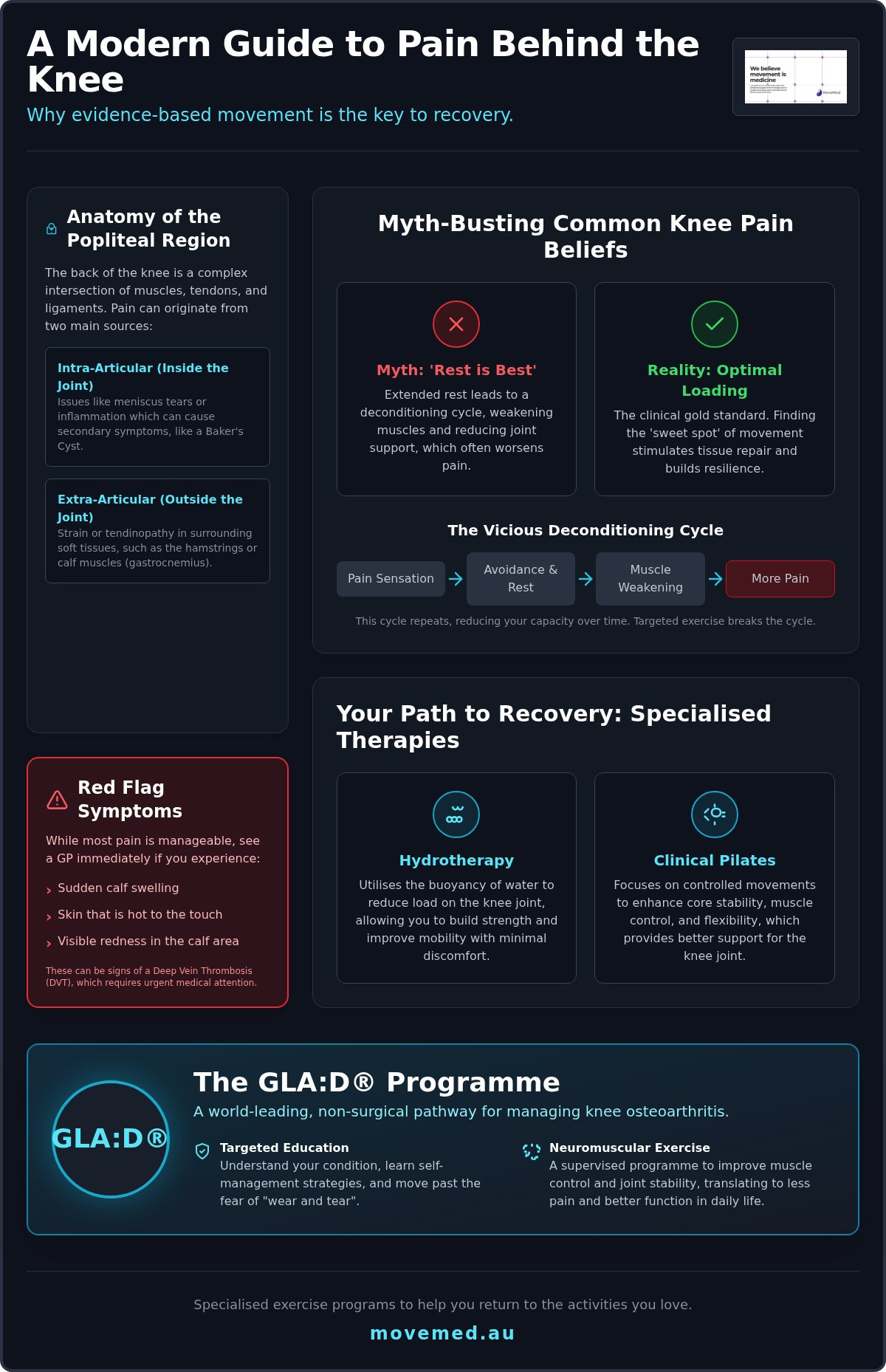
While most discomfort in this area is manageable through movement, we want you to feel safe and informed. If you notice your calf is suddenly swollen, hot to the touch, or visibly red, please see a GP immediately. These can be signs of a Deep Vein Thrombosis (DVT), which is a blood clot that requires urgent medical attention. Outside of these rare "red flag" scenarios, understanding your pain usually comes down to a simple framework: is the issue inside the joint (intra-articular) or in the soft tissues surrounding it (extra-articular)?
Because the back of the knee is a crossroads for the hamstrings, calf muscles, and the Posterior Cruciate Ligament (PCL), pinpointing the source requires a methodical approach. It's often not a single "event" that causes the issue, but rather a change in how these structures are sharing the load during your daily activities.
Is it a Baker’s Cyst? The "Pressure" Myth
Many people visit us in Templestowe Lower worried about a noticeable lump or an intense feeling of pressure behind their leg. This is often a Baker's cyst, or a popliteal cyst. A common myth is that the cyst itself is the root cause of the problem. In clinical reality, a cyst is almost always a secondary symptom; it's the knee's way of reacting to inflammation or a small tear inside the joint. You'll likely feel a distinct "tightness" or "fullness" when trying to fully straighten your leg or during a deep bend. While it's tempting to think that draining the fluid will fix the issue, the cyst will often return unless the underlying joint health is addressed through proper loading and exercise.
Hamstrings and Gastrocs: The Extra-Articular Culprits
Not every instance of pain behind knee starts deep inside the joint. Frequently, the muscles that cross the back of the knee, your hamstrings and gastrocnemius (calf) muscles, are the primary drivers of discomfort. Referred pain occurs when the brain interprets a signal from one area, such as a strained muscle belly or tendon, as coming from a different nearby location like the back of the knee joint. We see this quite often in the Manningham area when locals suddenly increase their walking intensity on hills or start a new hiking trail. These soft tissue strains aren't signs of permanent damage, but rather signals that your muscles need better conditioning to handle the "return to sport" or increased activity levels you're aiming for.
Myth-Busting: Why 'Rest is Best' May Make Your Knee Worse
For decades, the instinctive response to any joint ache was to "stay off it" until the feeling subsided. While this approach might make sense for a fractured bone, it's often the most counterproductive thing you can do for persistent pain behind knee. When you stop moving, your body quickly enters what we call a deconditioning cycle. Muscles like the quadriceps and hamstrings begin to weaken, a process known as atrophy, which leaves the knee joint with less structural support. This lack of support means the joint has to work harder during basic tasks, leading to increased sensitivity and, ironically, more pain the next time you try to be active.
Rather than complete rest, the modern clinical gold standard is "Optimal Loading." This is the "sweet spot" of movement where you're doing enough to stimulate tissue repair and muscle growth without over-irritating the joint. Finding this threshold can be difficult to do alone, especially when you're worried about making things worse. Our Accredited Exercise Physiologists specialise in identifying your current capacity and gradually increasing your activity levels. It’s about building a body that is resilient enough to handle the hills of Templestowe, rather than one that is protected into weakness.
The "Bone-on-Bone" Fallacy
Hearing the term "bone-on-bone" can feel like a structural dead end, leading many to believe they should stop moving to "save" what’s left of the joint. In reality, your knee cartilage isn't like the tread on a tyre that simply wears down with use. Cartilage is a living tissue that actually thrives on the "pumping" action of movement. Because it doesn't have a direct blood supply, it relies on the compression and release of weight-bearing exercise to receive nutrients and flush out waste products. By strengthening the surrounding glutes and quads, you create a natural shock-absorption system that significantly reduces the pressure on the joint itself.
Do I Need a Scan? The MRI Misconception
It's natural to want an MRI to find the "smoking gun" behind your discomfort. However, clinical research shows that many "abnormalities" found on scans, such as minor meniscus tears or mild osteoarthritis, are present in a huge percentage of people who have no pain at all. These are often just normal signs of ageing, similar to grey hair or wrinkles on the inside. A scan can't tell us how well you move or how much strength you have, which are the factors that actually determine your quality of life. We treat the person, not the picture. A thorough physical assessment is almost always more valuable for your recovery than an isolated image of your pain behind knee.
Common Causes: From Meniscus Tears to Tendinopathy
Identifying the source of your discomfort starts with listening to the specific "language" your knee is speaking. Is it a sharp, mechanical catch that stops you in your tracks? Or is it a persistent, heavy ache that feels worse after a long day on your feet? Distinguishing between these sensations helps us categorise your pain behind knee into what we call the "Big Three": meniscus tears, osteoarthritis, and hamstring tendinopathy. Each has a distinct personality and requires a slightly different approach to management.
Beyond the "Big Three," we also look at the deeper structures that provide stability. The Posterior Cruciate Ligament (PCL) acts as the primary stabiliser preventing your shin bone from sliding too far back. While PCL injuries are less common than ACL tears, they often present as a vague sense of instability or "fullness" in the popliteal space. Then there's the popliteus muscle. This tiny, triangular muscle is often called the "key" that unlocks the knee because it initiates the rotation needed to bend your leg from a fully straightened position. If this little muscle is overworked, it can cause a surprisingly sharp pinch right in the crease of the knee.
Meniscus Tears: Degenerative vs. Traumatic
The meniscus is a C-shaped piece of cartilage that acts as a shock absorber. While younger athletes often experience "traumatic" tears from a sudden twist, many adults over 40 develop "degenerative" tears. These aren't necessarily injuries; they're often just part of the natural ageing process of the tissue. Clinical research shows that for these degenerative tears, surgery is rarely more effective than a structured exercise program. We find that Clinical Reformer Pilates in Templestowe is exceptionally effective here. It allows us to stabilise the joint and strengthen the supporting muscles without placing excessive vertical pressure on the meniscus itself.
Osteoarthritis (OA) and the Posterior Joint
Osteoarthritis is often the culprit behind that classic "morning stiffness" that takes ten or fifteen minutes to clear. When the joint surfaces become irritated, the body produces extra synovial fluid (joint lubricant) as a protective measure. This extra fluid can't always be absorbed quickly, leading to a buildup that creates pressure at the back of the knee. Managing OA is a marathon, not a sprint. It's about consistently feeding the joint with movement and building the strength to offload the sensitive areas. While the ache can be frustrating, it's a condition that responds beautifully to the right type of load, helping you stay active in the community for years to come.
The Path to Recovery: Why Hydrotherapy and Pilates are "Game Changers"
Recovery isn't about pushing through the pain; it's about changing the environment in which your knee operates. Once we've identified why you're experiencing pain behind knee, the focus shifts to building resilience. Generic gym routines often fail here because they apply too much pressure too quickly, leading to flare-ups that set you back weeks. Instead, we use specific modalities like hydrotherapy and Clinical Pilates to "cheat" the physics of gravity, allowing you to strengthen your muscles without irritating the sensitive structures inside the joint. This isn't about a "cookie-cutter" approach; it's about a tailored journey designed by an Accredited Exercise Physiologist who understands your specific threshold for movement.
For a deeper dive into how water-based movement can transform your rehabilitation, explore our pillar article on Hydrotherapy: The Complete Guide to Water-Based Recovery in Melbourne. By choosing the right environment, we can turn a painful squat into a comfortable, strengthening exercise.
Hydrotherapy: Taking the Weight Off
The magic of hydrotherapy lies in the principle of buoyancy. When you're submerged to neck height, the water supports your body, reducing the impact on your knee joint by up to 90%. This weightless environment is a sanctuary for those with severe osteoarthritis or recent meniscus tears. Beyond just being "easier," the hydrostatic pressure (the gentle compression the water exerts on your skin) is incredibly effective at reducing the swelling associated with a Baker’s cyst. We frequently utilise our local Templestowe Lower hydrotherapy centre to help clients transition from being unable to walk comfortably to regained confidence in their stride.
Clinical Pilates for Knee Stability
While hydrotherapy handles the early stages of load, Clinical Pilates is where we build long-term durability. Using the Reformer, we can perform "closed-chain" exercises, where your feet are fixed against a bar or platform. This is significantly safer for painful knees than "open-chain" movements (like a leg extension machine) because it distributes forces across the whole leg. We focus heavily on the "posterior chain," which includes your glutes and hamstrings, to provide a natural brace for the back of the joint. By emphasising "eccentric" muscle control-where the muscle lengthens under tension-we can effectively manage hamstring tendinopathy and ensure your knee is ready for the demands of real-world walking and stairs.
If you're ready to stop guessing and start a structured plan, our team can help you book an Exercise Physiology consultation to find the best path forward for your recovery.
The GLA:D® Programme: A Better Alternative to Knee Surgery?
If you've been told that surgery is the only way to resolve your chronic pain behind knee, it's time to look at the clinical evidence. The GLA:D® (Good Life with Arthritis: Denmark) programme is a world-leading initiative specifically designed to help people with hip and knee osteoarthritis manage their symptoms through movement rather than just medication or operations. It isn't just a gym circuit; it's a structured pathway that has been rigorously tested. Research from the original Danish studies demonstrated a 27% reduction in pain symptom progression for participants, while Canadian data shows improvements in quality of life of over 45%. At MoveMed, we provide this specialised programme to our Templestowe community, offering a conservative first-line treatment that empowers you to take control of your joint health.
The programme consists of two vital components that work together to change your recovery trajectory:
- Education: Two sessions where you learn about the latest osteoarthritis research, why movement is safe, and how to manage your symptoms at home.
- Neuromuscular Exercise: Twelve supervised group sessions (twice a week for six weeks) focused on improving joint control, muscle strength, and confidence in movement.
Who is GLA:D® for?
A common misconception is that you need a formal "bone-on-bone" diagnosis or a severe MRI report to qualify for this programme. In reality, GLA:D® is for anyone experiencing symptoms of hip or knee osteoarthritis, regardless of how "mild" or "severe" it might seem on a scan. Whether you're struggling with stiffness after sitting or find that your knee feels unstable during morning walks, this programme is designed to build the capacity you need. There is also a significant benefit to the community aspect of the sessions; you'll be working alongside others from the Manningham area who are on a similar journey toward reclaiming their independence.
How to Get Started at MoveMed
Starting your journey is straightforward and begins with a comprehensive initial assessment with one of our Accredited Exercise Physiologists (AEPs). During this session, we'll discuss your history, measure your current physical function, and ensure the programme is tailored to your specific needs. We also understand that navigating healthcare costs can be stressful. You may be eligible for support through DVA, NDIS, or a Medicare Chronic Disease Management (CDM) plan (formerly known as an EPC), which can help subsidise the cost of your sessions. We handle the clinical details so you can focus on your progress.
Ready to see if this evidence-based approach is right for you? You can book an initial assessment for the GLA:D® programme today and take the first step toward a more active, confident future.
Step Forward With Confidence
Your journey with pain behind knee doesn't have to lead toward a surgical theatre or a life of avoiding the activities you love. We've explored how common myths often keep us stuck in a cycle of rest and weakness, whereas clinical reality shows that your joints actually thrive on structured, evidence-based movement. Whether it's through the buoyancy of hydrotherapy, the stability of Clinical Pilates, or the world-leading GLA:D® programme, the path to recovery is about building resilience rather than protecting a perceived "wear and tear."
As Accredited GLA:D® Program Providers and specialists in NDIS, DVA, and TAC recovery, we've been trusted by the Templestowe community for over a decade to guide this process. You don't have to navigate the complexity of joint health alone. We are here to help you find your "optimal load" and return to your best self with a plan that prioritises your long-term independence. Book your initial knee assessment with a MoveMed Exercise Physiologist today. Let's work together to get you back on the walking trails and moving with ease once again.
Frequently Asked Questions
Why does the back of my knee hurt when I straighten my leg?
Pain when fully extending the leg is often caused by a Baker's cyst or a meniscus tear that is creating pressure at the back of the joint. When you straighten your leg, the structures at the back of the knee are compressed; if there is extra fluid or damaged tissue present, this compression triggers a sharp or tight sensation. It's a common sign that the joint is currently over-sensitised.
Can a Baker’s cyst burst, and what should I do if it does?
Yes, a Baker’s cyst can burst, which usually causes the internal fluid to leak into the surrounding calf muscle. This often results in sudden, sharp pain and significant swelling or redness in the lower leg. If you suspect your cyst has ruptured, you should see a GP or visit an urgent care centre to rule out other serious conditions like a blood clot or infection.
Is walking good for pain behind the knee?
Walking is generally excellent for managing pain behind knee, provided you stay within your "optimal loading" threshold. Movement helps circulate synovial fluid, which nourishes the cartilage and reduces joint stiffness. However, if walking causes your pain to increase significantly the following day, you may need to reduce your distance or intensity while you build up your strength with an Accredited Exercise Physiologist.
How can I tell the difference between a hamstring strain and a knee joint issue?
Hamstring strains typically feel like a localised, tender "pull" in the muscle belly or where the tendon attaches, often aggravated by stretching or explosive movements. Joint issues, such as a meniscus tear, tend to feel deeper within the knee and may include mechanical symptoms like clicking, catching, or locking. A physical assessment is the most reliable way to clarify whether the issue is muscular or structural.
Do I need a referral from my GP to see an Exercise Physiologist at MoveMed?
You don't need a referral to see us as a private client or through the NDIS. However, if you're looking to access subsidies through a Medicare Chronic Disease Management plan or DVA funding, you will need a specific referral from your GP. We're always happy to chat with your doctor to ensure your recovery journey is well-coordinated and that you're receiving the right level of support.
How many sessions of hydrotherapy will I need for my knee pain?
Most clients see significant improvements in their pain behind knee within 6 to 12 sessions of hydrotherapy. The exact number depends on your specific condition and your long-term goals. We usually recommend two sessions per week initially to build momentum before transitioning you back to land-based exercise or Clinical Pilates as your joint tolerance improves and your confidence in movement grows.
Can I do Pilates if my knee is currently swollen?
You can certainly participate in Clinical Pilates while your knee is swollen, as we can modify the exercises to avoid aggravating the joint. Using the Reformer allows us to strengthen the surrounding muscles without putting direct weight through the knee. This "unloaded" movement actually helps the body reabsorb excess fluid and reduces the feeling of fullness or pressure behind the leg.
Is pain behind the knee a sign of a blood clot?
While most posterior knee pain is musculoskeletal, it can occasionally be a sign of a Deep Vein Thrombosis (DVT). If your pain is accompanied by sudden swelling, heat, or redness in the calf, you must seek medical attention immediately. It's always better to have these specific symptoms checked by a professional to ensure your safety before starting any new exercise or rehabilitation programme.


