
What if the right kind of movement could help you feel more confident using your knee, rather than putting it at greater risk? When pain makes walking, climbing stairs or keeping up with daily life difficult, it’s understandable to worry that exercise will make things worse or that surgery is inevitable. The next step depends on your symptoms, what matters to you and how your knee responds. Non-surgical treatment for chronic knee pain Bulleen can include a personalised, clinically guided approach to movement.
You’ll learn how exercise-based care may support knee function, what different options involve and how to choose a practical next step near Bulleen. Accredited Exercise Physiologists can tailor movement to your current ability and personal goals. Options include exercise physiology, hydrotherapy, Clinical Reformer Pilates and the GLA:D program for hip and knee osteoarthritis. Each has a different focus, and suitability depends on your needs. The aim is to build a manageable plan with guidance and progress at a pace that feels right for you.
Key Takeaways
- Chronic knee pain can affect everyday activities, and its cause and impact differ from person to person.
- Accredited Exercise Physiologists assess your movement, symptoms and goals to shape a suitable exercise plan.
- Exercise physiology, hydrotherapy and Clinical Reformer Pilates offer different movement settings to consider.
- Non-surgical treatment for chronic knee pain Bulleen can be shaped around the activities you want to improve.
- MoveMed’s local exercise-based services can help you explore a practical next step.
Chronic knee pain in Bulleen: when might non-surgical care help?
If your knee hurts on the walk to the shops, makes stairs harder or interrupts everyday tasks, a familiar routine can start to feel like a challenge. The experience varies: you may have a constant ache, pain that comes and goes, or discomfort with particular movements. Persistent knee pain can be frustrating, but it doesn’t automatically mean you need surgery.
Chronic knee pain is pain that continues or keeps returning over time. The term describes how long the problem has affected you, not what caused it. Osteoarthritis is one possible cause, but it isn’t the only one. A non-surgical treatment for chronic knee pain Bulleen residents may consider is a personalised plan to help manage symptoms and support everyday function. It cannot promise a cure.
What can sit behind persistent knee pain?
Knee pain can be associated with osteoarthritis, a previous injury or other issues affecting the muscles, tendons, ligaments or joints. These are possibilities, not a diagnosis. An assessment can help make sense of your symptoms and identify whether further medical input may be appropriate. You can read a general overview of knee pain, including possible causes and approaches to care.
Pain can change how you move. You might avoid bending your knee, rely more on the other leg or feel less steady when walking. Reduced activity may affect strength and mobility, while concern about triggering pain can make movement feel less manageable. These factors can influence each other, so understanding what happens during your day matters as much as describing where it hurts.
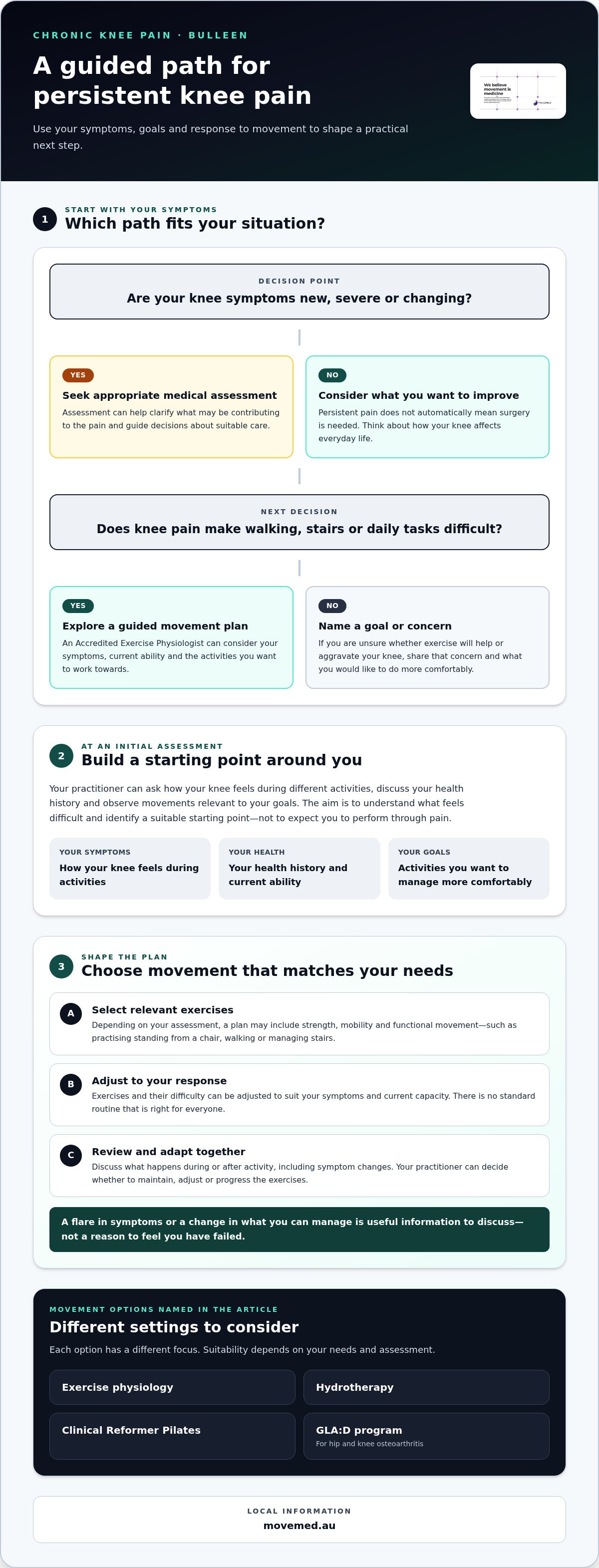
If your symptoms are new, severe or changing, seek appropriate medical assessment. This can help clarify what may be contributing to the pain and guide decisions about suitable care. Exercise should be planned with your health and current capacity in mind, rather than pushed through without guidance.
What does non-surgical treatment aim to achieve?
The goal is to support activities that matter to you, such as walking more comfortably, managing stairs or completing daily tasks with greater confidence. Progress may involve adjusting how you move, building capacity gradually or finding an exercise setting that feels manageable. The right approach depends on your symptoms, health history and personal goals.
Symptom management can support function, but it can’t guarantee a particular outcome or remove the need for surgery in every case. Treatment needs and responses vary. A clinically guided plan gives you and your practitioner a way to review how movement feels and adapt the approach to your needs, without assuming persistent pain has only one solution.
How exercise physiology can support chronic knee pain near Bulleen
If you’re unsure whether exercise will help or aggravate your knee, a tailored starting point can make movement feel less daunting. Exercise physiology uses planned physical activity to address health and movement needs. Accredited Exercise Physiologists are university-qualified allied health professionals who design, deliver and evaluate safe and effective exercise interventions. They can guide you through a plan that considers your symptoms, current ability and the activities you want to work towards.
An initial assessment helps build that picture. Your practitioner may ask how your knee feels during different activities, discuss your health history and observe movements relevant to your goals. This isn’t about judging how well you move or expecting you to perform through pain. It helps identify a suitable starting point and gives you a chance to explain what feels difficult, what concerns you and what you’d like to do more comfortably.
An individualised exercise plan responds to your body and goals. Generic advice can’t account for how your knee feels or what you need to do each day.
What might an exercise physiology plan include?
Depending on your assessment, a plan may include strength, mobility and functional movement exercises. Functional movement means practising actions used in everyday life, such as standing from a chair, walking or managing stairs. The aim is to select activities that fit your current capacity and connect with tasks that matter to you, rather than follow a one-size-fits-all routine.
The exercises and their difficulty can be adjusted to suit your symptoms and response. There’s no standard routine that is right for everyone, so don’t assume an exercise you’ve seen online is suitable for your knee. Your Exercise Physiologist can explain the purpose of each activity and how to approach it. If you’re worried about movement, say so. Appropriate exercise is planned with you, not a demand to ignore pain or push through it.
How progress and symptom responses can guide care
Your plan can be reviewed as you take part in activities and learn how your knee responds. You might discuss whether standing feels manageable, how you tolerate a walk, or what happens when you practise a movement used on stairs. Sharing these details helps your practitioner decide whether to maintain, adjust or progress the exercises. Be open about changes in symptoms, concerns during or after activity, and any shift in your goals.
Progress may be gradual, and it won’t look the same for everyone. A flare in symptoms or a change in what you can manage is useful information to discuss, not a reason to feel you’ve failed. The plan can be adapted to your experience, capacity and goals. For people considering non-surgical treatment for chronic knee pain Bulleen, exercise physiology offers a guided way to explore movement without assuming one approach will suit every knee.
If you’d like support to make exercise more relevant to your needs, explore MoveMed’s exercise physiology care.
Comparing non-surgical knee pain options around Bulleen
Exercise physiology, hydrotherapy and Clinical Reformer Pilates all use movement, but differ in setting and approach. The most suitable option depends on your assessment, symptoms and goals. This comparison can help you understand the differences and decide what to discuss with your Exercise Physiologist.
| Option | Setting and movement approach | May suit you if… |
|---|---|---|
| Exercise physiology | Clinician-guided exercise planned around your individual needs and functional goals. | You want a tailored approach to strength, mobility or everyday movements. |
| Hydrotherapy | Supervised, low-impact exercise in water, where buoyancy can make movement feel more manageable. | You’d like to explore water-based rehabilitation as part of your care. |
| Clinical Reformer Pilates | Clinician-led movement using a reformer, with exercises adapted to specific physical conditions and mobility. | You’re interested in guided movement that considers your condition and how you move. |
| GLA:D program | An evidence-based exercise and education program designed for hip and knee osteoarthritis. | You have hip or knee osteoarthritis and want to consider a program developed for that condition. |
When might land-based exercise or Clinical Reformer Pilates suit?
Land-based exercise physiology can be tailored by an Accredited Exercise Physiologist to your current ability and the tasks you want to practise. Clinical Reformer Pilates may also be considered as part of condition-specific care, with clinician-led sessions addressing physical conditions and mobility. Read more about the Clinical Reformer Pilates in Templestowe approach to understand how this option differs from general exercise.
When might hydrotherapy or the GLA:D program be considered?
Hydrotherapy offers supervised, water-based rehabilitation in a lower-impact setting. Buoyancy may make some movements feel more comfortable, though suitability depends on your needs and assessment. MoveMed’s hydrotherapy recovery guide explains how water-based exercise can form part of a recovery approach.
The GLA:D program is specific to hip and knee osteoarthritis, so it isn’t a general programme for every cause of knee pain. If osteoarthritis is relevant to your situation, it may be an option to discuss as part of your care. Non-surgical treatment for chronic knee pain Bulleen should match your goals and clinical needs. An assessment can help guide which approach, or combination of movement options, is appropriate for you.
Choosing a practical knee pain plan in Bulleen
Choosing a plan can feel easier when you start with what you want to do, rather than a treatment name. A useful discussion connects your knee symptoms with daily life, then considers a suitable setting and how movement can be adjusted to your needs. This gives you a clearer basis for exploring non-surgical treatment for chronic knee pain Bulleen, without assuming that one approach suits everyone.
Use this simple sequence to prepare:
- Name your goal. Think of one or two activities you’d like to manage more comfortably, such as walking to local shops, getting up from a chair or using stairs.
- Describe your symptoms. Note what tends to bring on discomfort, how it affects movement and whether anything has changed.
- Discuss your history and preferences. Share relevant health information, previous treatment and any worries about movement. Say whether you’d prefer to explore land-based or water-based exercise.
- Agree on a starting approach. An assessment can help guide the choice of movement, setting and starting level, with adjustments based on how you respond.
Questions to bring to an initial discussion
Before you meet, consider which tasks are most affected and what a meaningful change would look like in your daily routine. Mention previous treatment and anything that has helped or felt difficult. If you’re concerned that exercise could aggravate your knee, explain what worries you. Your preferences matter too: discussing land-based or water-based movement can help shape a plan that feels practical and appropriate for you.
Exercise doesn’t have to mean pushing through pain. The type and level of activity should be considered in light of your symptoms and health history. Tell your practitioner how your knee feels during an activity and afterwards, including if discomfort changes or you feel unsure. That information can guide the next step, rather than leaving you to guess whether to continue, modify or pause an exercise.
How to recognise a plan that fits your life
A practical plan connects movement with an activity you care about. It should take account of your routine, preferences and capacity, and be reviewed in response to your experience. Progress may mean building confidence with a task or finding a manageable way to stay active. Pain doesn’t have to disappear for your experience and goals to be discussed and reviewed.
Exercise-based care isn’t automatically suitable for every symptom. If knee pain is new, severe or changing, seek appropriate medical assessment before assuming an exercise plan is the right next step. That assessment can help clarify what care is suitable. Funding arrangements may also depend on your circumstances, so consider cost and eligibility separately from the clinical decision about which movement approach fits your needs.
To discuss your goals, symptoms and a practical movement plan, book an exercise physiology discussion with MoveMed.
Take your next step with MoveMed near Bulleen
Living with knee pain can leave you unsure where to begin, especially if movement feels uncomfortable or you’re concerned about making symptoms worse. You don’t need to arrive with a diagnosis or a finished plan. A conversation about what you’re experiencing and what you’d like to do can help identify a practical next step.
MoveMed supports people in Bulleen and nearby communities with exercise physiology, hydrotherapy and Clinical Reformer Pilates. Care is personalised and evidence-based, with movement choices shaped around your circumstances rather than a standard programme for every knee. The team includes Accredited Exercise Physiologists who design and guide exercise interventions.
What working with MoveMed can involve
Your goals and health needs help shape the care approach. Exercise physiology provides clinician-guided exercise support, while hydrotherapy offers a water-based option that may suit lower-impact movement. Clinical Reformer Pilates can also be considered within condition-specific care. These options aren’t interchangeable or automatically suitable for everyone. The focus is on finding a relevant way to work towards activities that matter to you.
If hip or knee osteoarthritis is relevant to your situation, the GLA:D program may also be considered. It’s an evidence-based exercise and education program designed specifically for hip and knee osteoarthritis, not every cause of knee pain. For other symptoms, an assessment and discussion of your needs can help determine what type of movement support is suitable to explore.
MoveMed serves Bulleen and surrounding communities, including Templestowe Lower, Templestowe, Doncaster, Doncaster East, Warrandyte, Lower Plenty, Balwyn North and Box Hill. You don’t need to have settled on a particular treatment before making an enquiry. You can explain what you find difficult and talk through what matters most to you.
Take a supportive first step
Before the conversation, think about the movements or daily activities you most want to manage, what tends to affect your knee and any concerns you have about exercise. Sharing these details can help make the discussion relevant to you. Mention previous treatment or health information that may affect movement, too.
Choosing non-surgical treatment for chronic knee pain Bulleen doesn’t require a promise that pain will disappear or that one service is right for you. The first step is to discuss your experience and goals, then consider a suitable way forward together. Any plan can be shaped around your needs and reviewed as you go.
Discuss your knee pain goals with MoveMed and talk through a suitable next step.
Take a confident step towards movement that fits you
Living with ongoing knee pain can make it hard to know what to try next. You don’t need to have every answer before starting a conversation. Share what you hope to do more comfortably and what’s making movement difficult, then discuss an approach that takes your circumstances into account.
MoveMed’s Accredited Exercise Physiologists provide clinically guided support. Their ESSA accreditation, NDIS provider registration and NDIS Practice Standards inform the care offered. This can give you a considered starting point for discussing non-surgical treatment for chronic knee pain Bulleen, without assuming a particular outcome or that one plan suits everyone.
Your goals are personal, and your next step can be too. Talk through your knee pain and what matters to you with MoveMed. Talk with MoveMed about a practical next step for your knee pain.
Frequently Asked Questions
Is chronic knee pain always caused by osteoarthritis?
No. Osteoarthritis is one possible cause, but knee pain can also be associated with an injury or other issues affecting the muscles, tendons, ligaments or joint. The word “chronic” describes pain that persists or returns over time; it doesn’t identify the cause. If you haven’t had the cause assessed, a health professional can help determine what may be contributing and whether further medical investigation is appropriate.
Can exercise make chronic knee pain worse?
It can aggravate symptoms if the activity or level of effort doesn’t suit your current needs. That doesn’t mean all movement is harmful. Tell your clinician which movements trigger pain, how your knee feels during activity and whether symptoms change afterwards. They can use that information to adjust the exercise approach. Seek medical advice if you develop new or severe symptoms rather than trying to push through them.
How long does non-surgical treatment for chronic knee pain take?
There’s no fixed timeframe for non-surgical treatment for chronic knee pain Bulleen, because the plan depends on your symptoms, health history and goals. The approach may change as your needs or activity tolerance shift, so duration is best considered through ongoing review rather than a set promise. Discuss what you hope to achieve and how progress will be reviewed with your Accredited Exercise Physiologist.
Can hydrotherapy help if land-based exercise feels difficult?
It may be an option to discuss. Water buoyancy can make some movements feel less demanding than exercising on land, while supervised hydrotherapy allows activity to be guided to your needs. It isn’t automatically suitable for every person or knee problem, so your health history and symptoms matter. Explain which land-based movements are difficult and what you’d like to manage, then discuss whether water-based exercise could fit your care.
Does Medicare cover exercise physiology for knee pain?
Medicare may subsidise exercise physiology if you have a GP-prepared Chronic Disease Management plan and meet the relevant requirements. The plan can provide access to up to five subsidised allied health services per calendar year, shared across included allied health providers. Ask your GP whether this pathway applies to your circumstances and what referral is needed. The amount you pay depends on the service fee and applicable rebate.
Can NDIS funding be used for exercise physiology for knee pain?
It may be possible when exercise physiology relates to your disability support needs and aligns with your NDIS plan. Exercise physiology is generally funded through the capacity building support category, which includes Improved Health and Wellbeing or Improved Daily Living. Review your plan to see whether this type of support relates to your goals and available funding. You can discuss how exercise physiology may support the functional outcomes that matter to you.
Do I need a referral to discuss knee pain care with MoveMed?
You can contact MoveMed to discuss your knee pain and possible next steps without first choosing a treatment. A referral may be relevant if you’re seeking support through a funding pathway, including Medicare’s Chronic Disease Management arrangements. If you already have a GP referral or NDIS plan, have the relevant information ready for the discussion. That can help clarify which care options and funding questions apply to your situation.


