

Could exercising in water help you work towards strength, movement or greater confidence after a spinal cord injury? Exploring TAC hydrotherapy for spinal cord injury Templestowe can raise practical questions: whether it fits your rehabilitation goals, how transfers and symptoms will be managed, and what TAC funding may involve.
It’s understandable to want clear answers before starting. Hydrotherapy is supervised exercise in water, not unrestricted pool access. Whether it is suitable depends on your goals, clinical assessment and safety needs. TAC funding is a separate consideration, so it helps to clarify both clinical suitability and claim requirements before planning sessions.
MoveMed provides hydrotherapy and TAC-funded therapy in Templestowe and nearby suburbs. An Accredited Exercise Physiologist can discuss your priorities, access needs and relevant health information, then help you understand how hydrotherapy may fit into your rehabilitation. This guide outlines what to consider and how to prepare for a focused discussion.
Key Takeaways
- Understand what supervised hydrotherapy involves and how it differs from unrestricted pool access.
- Learn what a clinician may consider when assessing your goals, health needs and safety in the water.
- Clarify how your TAC claim and current scheme requirements relate to funding for proposed treatment.
- Prepare for a discussion by noting your daily goals, access needs, current concerns and relevant health changes.
- Discuss TAC hydrotherapy for spinal cord injury Templestowe with MoveMed through personalised, evidence-based planning.
TAC hydrotherapy for spinal cord injury in Templestowe: what it can involve
Choosing rehabilitation after a spinal cord injury can feel uncertain, especially when you’re also trying to understand funding. Start by asking what a proposed therapy session would involve and how its activities relate to your priorities. A diagnosis alone doesn’t determine the right programme. The plan needs to account for your abilities, health needs and wider rehabilitation goals.
When considering TAC hydrotherapy for spinal cord injury Templestowe, treat the first discussion as a way to assess the option, not a commitment to a set routine. Ask what the proposed activities are intended to address and how they could sit alongside your other care. Clinical suitability and TAC funding are separate questions, and each needs to be considered on its own.
What does hydrotherapy mean in spinal cord injury rehabilitation?
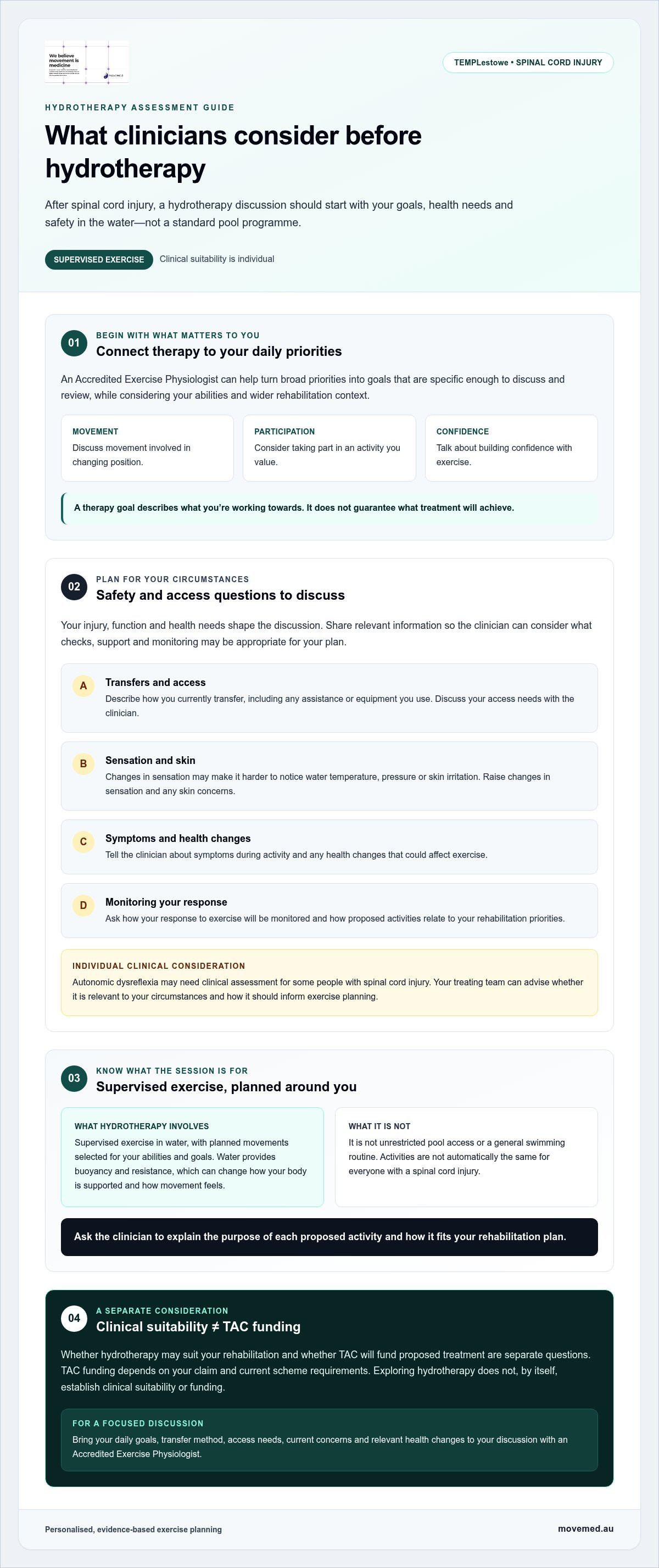
Hydrotherapy is supervised exercise in water. A rehabilitation session may include planned movements selected for your abilities and goals, rather than a general swimming routine. Water provides buoyancy and resistance, which can change how your body is supported and how movement feels. The clinician should explain the purpose of each activity and how it fits your plan. Activities are not automatically the same for everyone with a spinal cord injury.
Aquatic therapy, also known as hydrotherapy, is used in rehabilitation for a range of conditions, including spinal cord injuries. This overview provides general context, but it cannot determine which activities are appropriate for you or how they may fit your rehabilitation.
Who might consider TAC-funded hydrotherapy near Templestowe?
You may want to discuss supervised aquatic exercise if you’re exploring different ways to work towards a rehabilitation priority. The key question is not simply whether you have a spinal cord injury, but whether the proposed activities make sense for your individual plan. You might discuss practising a particular movement or taking part in a valued daily activity. These are possible areas to explore, not guaranteed results.
An Accredited Exercise Physiologist can help you consider the purpose of the sessions and how they relate to your wider rehabilitation priorities. TAC funding depends on your claim and current scheme requirements. Exploring hydrotherapy does not, by itself, establish that it is clinically suitable or that TAC will fund it.
How clinicians assess hydrotherapy goals and safety after spinal cord injury
An assessment should begin with your circumstances, not a standard pool programme. Accredited Exercise Physiologists are university-qualified allied health professionals who design, deliver and evaluate safe and effective exercise interventions. They can consider your current function, health needs and priorities when discussing whether hydrotherapy may suit you and how it could fit your rehabilitation.
Proposed activities should relate to goals that matter to you, with your response considered as part of ongoing planning. Spinal Cord Injuries Australia discusses how hydrotherapy may support strength, mobility and physical wellbeing for people with spinal cord injuries. These possible benefits do not establish that hydrotherapy is suitable for everyone or predict an individual outcome.
Which goals could a hydrotherapy plan address?
Begin with activities that matter in your daily life. You might want to discuss movement involved in changing position, participating in an activity you value or building confidence with exercise. An Accredited Exercise Physiologist can help you turn broad priorities into goals that are specific enough to discuss and review, while considering your abilities and rehabilitation context.
A therapy goal describes what you’re working towards. It does not guarantee what treatment will achieve.
What safety questions matter for spinal cord injury?
Safety planning needs to reflect how your injury affects you. Changes in sensation may make it harder to notice water temperature, pressure or skin irritation. Tell the clinician about changes in sensation and any skin concerns so they can consider what checks and monitoring are relevant to your plan.
Transfers into and out of the water also need individual consideration. Describe how you currently transfer, including any assistance or equipment you use. The clinician can discuss an approach in light of your function and access needs. Share symptoms that occur during activity and any health changes that could affect exercise. General information cannot establish that hydrotherapy is safe for you.
- Describe your usual transfer method and any support or equipment you use.
- Raise skin concerns or changes in sensation.
- Discuss symptoms during activity and relevant health changes.
- Ask how your response to exercise will be monitored.
Autonomic dysreflexia is a condition-specific risk that may need clinical assessment for some people with spinal cord injury. It can involve a sudden, potentially serious response to a trigger. Your treating team can advise whether it is relevant to your circumstances and how it should inform exercise planning.
Clinical suitability and TAC funding are separate considerations. MoveMed’s Accredited Exercise Physiologists can discuss your goals and relevant clinical context as part of personalised planning. To raise your questions locally, explore MoveMed’s hydrotherapy and TAC-funded therapy.
TAC funding and hydrotherapy: what to clarify before starting in Templestowe
Understanding whether hydrotherapy is worth discussing is only one part of the decision. You’ll also need to clarify how the proposed treatment relates to your TAC claim and what current scheme requirements apply. A transport-related injury does not automatically mean hydrotherapy will be funded. Clinical suitability and funding approval are separate questions, so neither should be assumed in advance.
How does TAC funding relate to hydrotherapy?
TAC-funded therapy is considered through the TAC scheme, while private payment is handled outside that funding arrangement. The details depend on your circumstances and the current requirements for your claim. If funding has not been clarified, don’t assume a proposed session will be covered. Before making financial arrangements, establish what approval or payment arrangements apply and whether you may have any private costs.
Processes can change, so use current TAC guidance for claim and treatment requirements rather than relying on general information that may be out of date. MoveMed provides hydrotherapy and TAC-funded therapy, and can discuss your proposed treatment, rehabilitation goals and relevant enquiry details. Funding is not guaranteed by an initial discussion.
What information helps clarify the next step?
A few details can make a funding discussion more focused. You don’t need to resolve every question before raising an enquiry. Begin with the information you have, then clarify any gaps through the appropriate TAC process and your treating team.
- Have your relevant TAC claim details available, including correspondence about treatment funding.
- Describe the rehabilitation priorities you want to work towards and how hydrotherapy might fit into your wider recovery plan.
- Note whether another part of your care team is coordinating rehabilitation, so the proposed therapy can be considered alongside that plan.
- Ask what information or approval is needed before sessions are arranged, and how payment would work if TAC funding does not apply.
A practical sequence is to review your claim information, clarify whether the proposed treatment is approved, discuss how its goals fit your rehabilitation plan, and then plan sessions. This keeps funding questions in view without confusing approval with a clinician’s assessment of suitability. If the claim process feels difficult to follow, take it one question at a time and keep a record of the guidance you receive.
For background on how exercise physiology can support recovery for TAC clients, read MoveMed’s TAC exercise physiology recovery guide. It can help you consider how a structured therapy plan relates to your goals. For TAC hydrotherapy for spinal cord injury Templestowe, an informed enquiry can bring the clinical and funding questions together while leaving each decision to the relevant assessment and claim process.
Preparing for a hydrotherapy discussion: goals, access and practical needs
You don’t need every answer before starting a conversation. A few notes about what matters to you can make the discussion more useful, whether you’re exploring hydrotherapy for the first time or considering how it could fit into your rehabilitation plan. This preparation is not a formal document list, and it does not mean that a referral or TAC approval is required.
What should you bring to an initial conversation?
If it’s useful, have relevant TAC claim information and any rehabilitation recommendations already shared with you nearby. You can also note medicines you take, recent health changes and questions you want answered. These details give the clinician context for the discussion. You don’t need to gather paperwork you don’t have.
- Your current rehabilitation priorities and what you hope to discuss.
- Relevant claim details or TAC correspondence, if available.
- Recommendations from your existing rehabilitation team, if you have them.
- Health or medication changes you think may affect exercise.
- Questions about how hydrotherapy might fit with your wider care plan.
You can bring a support person if you’d like help remembering details or expressing your preferences. You remain central to the conversation: share what you’re comfortable sharing, and ask for clinical terms to be explained in plain language.
How can you describe your goals and access needs?
Describe a daily activity rather than relying only on a broad goal such as “get stronger”. For example, you could discuss movements involved in changing position, participating in an activity you value or building confidence with exercise. The clinician can work with you to consider whether these priorities are appropriate to explore through a tailored programme.
Access needs are part of the planning conversation. Explain how you currently transfer, what mobility equipment you use and whether you need assistance with particular movements. You can also raise practical considerations that affect your comfort, such as getting ready for exercise or the support that helps you feel at ease. These details help the clinician understand your circumstances, but do not determine suitability on their own.
To prepare, note three things: the activity you’d like to work towards, what currently makes it challenging, and any support or access considerations that may matter. Your plan should reflect your goals and circumstances alongside clinical assessment, rather than relying on a standard set of exercises.
If you’d like general background before your discussion, explore MoveMed’s hydrotherapy guide to learn more about water-based recovery. For TAC hydrotherapy for spinal cord injury Templestowe, bring your questions to MoveMed’s Accredited Exercise Physiologists and start a conversation about your hydrotherapy goals.
MoveMed hydrotherapy in Templestowe: turn your TAC enquiry into a clear plan
Start with what you want to work towards and which questions are still unresolved. MoveMed provides hydrotherapy and TAC-funded therapy, with personalised planning informed by your rehabilitation priorities and relevant health context. This gives you a clearer basis for considering possible next steps without assuming that hydrotherapy is clinically suitable or that TAC will approve funding.
How MoveMed can support an individual rehabilitation plan
Accredited Exercise Physiologists are university-qualified allied health professionals who design, deliver and evaluate safe and effective exercise interventions. At MoveMed, they consider your circumstances and goals when discussing how exercise may fit your rehabilitation. The aim is to make therapy decisions purposeful and relevant to you, rather than starting with assumptions about what you need.
Individualised clinical guidance helps you consider exercise in relation to your own goals and circumstances.
What happens when you enquire about TAC hydrotherapy?
An enquiry gives you the opportunity to explain what you want to discuss and raise questions about your situation. You might talk about a rehabilitation priority, relevant health information or details of your TAC claim. This can help identify the clinical and funding questions that need attention, while keeping the two decision-making processes distinct.
Before the conversation, you may find it useful to note:
- The main question you want answered about hydrotherapy.
- Any relevant clinical information you want the team to understand.
- Claim details or TAC correspondence you’d like to discuss.
- What you need clarified before deciding on a next step.
You don’t need to have everything worked out in advance. The discussion can help you understand what remains to be considered and whether further clinical or funding clarification is needed. Take the process at a pace that allows you to make an informed decision.
If you’re ready to discuss your circumstances, talk with MoveMed about your next step. Start with your questions and decide together what information would help you move forward.
Take your next step at your own pace
You don’t need to settle every question before moving forward. A first conversation can help you shape what you want to ask, identify what matters most and decide what information you still need. That is a practical step, especially when rehabilitation and funding decisions can feel like a lot to manage at once.
If you’re considering TAC hydrotherapy for spinal cord injury Templestowe, start with the question that feels most important today. You might want to discuss a personal goal, an access concern or how to bring your rehabilitation priorities into one clear conversation. Take it one step at a time, with space to consider what feels right for you.
Talk with MoveMed about TAC hydrotherapy and your next step. A thoughtful conversation can help you move forward with greater clarity.
Frequently Asked Questions
Can TAC fund hydrotherapy after a spinal cord injury?
Yes, hydrotherapy may be funded by TAC, but payment depends on your individual claim and current scheme requirements. Before arranging treatment, clarify how TAC will consider the proposed service and whether any costs would be your responsibility. Keep relevant claim correspondence together so you can refer to the information you’ve received and follow up on anything that remains unclear.
Is hydrotherapy suitable for everyone with a spinal cord injury?
No. A clinician needs to consider your individual circumstances before deciding whether water-based exercise is appropriate. Changes in health, other conditions and how you respond to activity may all be relevant. Suitability can also change over time, so share new concerns with your treating team rather than relying on an earlier assessment or another person’s experience.
What are the possible benefits of hydrotherapy after spinal cord injury?
Depending on your abilities and clinical plan, exercising in water may provide an opportunity to practise movement in a different setting. Water resistance can be used as part of exercise, while buoyancy changes how your body is supported. A clinician can explain which activities may relate to your goals, without promising a specific improvement.
What safety issues should I discuss before spinal cord injury hydrotherapy?
Tell the clinician about concerns that could affect your response to exercise, including changes in skin, sensation or symptoms. Ask how your individual plan will account for temperature awareness, transfers and monitoring during activity. If autonomic dysreflexia is relevant to your injury, raise it with your treating team so they can consider appropriate precautions. Don’t rely on general advice to clear yourself for exercise.
Do I need TAC approval before beginning hydrotherapy?
Don’t assume funding is approved simply because your injury followed a transport accident. Clarify with TAC what applies to your claim and the proposed treatment before making financial arrangements or starting sessions. Clinical assessment and funding decisions are separate: a clinician can consider whether hydrotherapy is suitable, while TAC determines funding under current scheme requirements.
Where can I ask about TAC hydrotherapy near Templestowe?
MoveMed provides hydrotherapy and TAC-funded therapy for people in Templestowe and nearby eastern Melbourne suburbs, including Templestowe Lower, Doncaster, Doncaster East and Bulleen. MoveMed also serves people in Warrandyte, Lower Plenty, Balwyn North and Box Hill. If you’re considering TAC hydrotherapy for spinal cord injury Templestowe, discuss your rehabilitation priorities and claim questions with MoveMed.
What should I tell a hydrotherapy clinician at the first discussion?
Describe what a typical day involves and which tasks or movements you’d like to discuss. Mention the support you currently use, symptoms that arise during activity and health changes that may affect exercise. You can also share what would help you feel comfortable communicating during a session. These details help the clinician understand your perspective and focus the discussion on your needs.


