

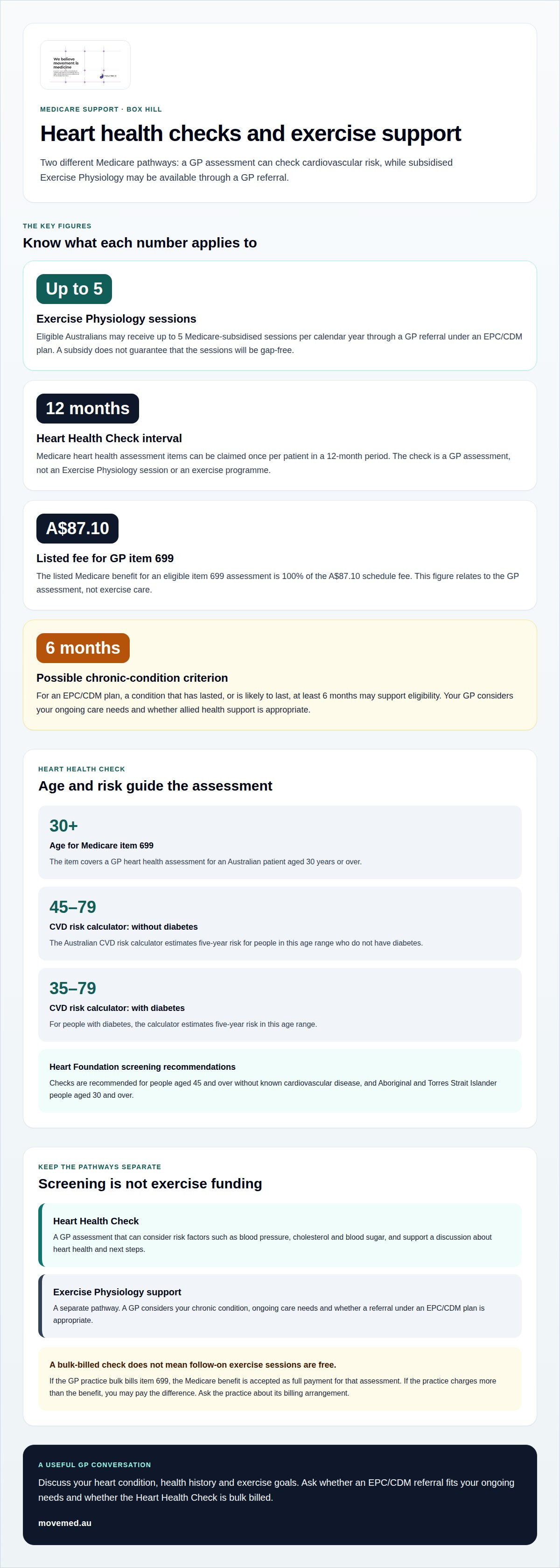
A Medicare-funded exercise plan for a heart condition in Box Hill isn’t automatically free. Eligible Australians may receive up to 5 Medicare-subsidised Exercise Physiology sessions per calendar year through a GP referral under an EPC/CDM plan, but a subsidy doesn’t guarantee there’ll be no out-of-pocket cost. Understanding eligibility is an important first step.
If you’re looking for a Medicare-funded exercise plan for a heart condition in Box Hill, first separate Medicare-subsidised appointments from services that are bulk billed. You’ll also want to know whether your condition may qualify and what happens after a Heart Health Check. Understanding these points can help you consider your options.
This article explains how Medicare support works, who may be eligible and how exercise physiology can fit alongside your broader heart care. You’ll have a clearer idea of what to discuss with your GP and how MoveMed can support your next step.
Key Takeaways
- A Medicare Heart Health Check and subsidised Exercise Physiology are different services, so understand which one you need.
- Age can determine access to a Heart Health Check; learn how the eligibility rules apply to you.
- A long-term heart condition may support eligibility for subsidised Exercise Physiology through a GP referral.
- A Medicare subsidy doesn’t automatically make sessions free. Find out what affects any out-of-pocket cost.
Bulk billing and Medicare coverage
A Medicare Heart Health Check is a GP assessment of your cardiovascular risk, not an Exercise Physiology session. The Australian Government Department of Health and Aged Care states that Medicare heart health assessment items can be claimed once per patient in a 12-month period. The check helps identify risk factors and supports a conversation about your heart health, lifestyle and next steps.
For Medicare item 699, the Australian Government Department of Health and Aged Care lists a schedule fee of A$87.10 for a GP heart health assessment. For an eligible assessment, the listed benefit is 100% of that A$87.10 fee, according to the Australian Government Department of Health and Aged Care. This is the Medicare benefit for the GP assessment, not a quoted price for exercise care.
Bulk billing affects what you pay at the appointment. When a GP practice bulk bills the item 699 service, it accepts the Medicare benefit as full payment, so you have no gap for that assessment. If the practice charges more than the Medicare benefit, the difference is an out-of-pocket gap. The practice’s billing arrangement determines which applies, so ask specifically whether it bulk bills the Heart Health Check.
A Heart Health Check may include a risk calculator to estimate your chance of a heart attack or another cardiovascular event. Your practitioner can use the result to discuss risk factors and lifestyle changes, then consider whether further support is appropriate. The check is for screening and prevention; it does not itself fund or provide a structured exercise program.
Keep the two Medicare questions separate: whether your GP Heart Health Check is bulk billed, and whether you qualify for subsidised Exercise Physiology. A free item 699 assessment does not mean every follow-on service is free. If you are an Aboriginal or Torres Strait Islander person, tell your GP, as this can inform the way your cardiovascular risk is assessed. The next section explains age and risk eligibility.
Eligibility by age and cardiovascular risk
Age and risk help determine whether a Heart Health Check is appropriate, but this assessment is separate from funding for ongoing exercise support. According to the Australian Government Department of Health and Aged Care, Medicare item 699 covers an Australian GP heart health assessment for a patient aged 30 years or over. Eligibility for the assessment does not automatically establish eligibility for a Medicare rebate on exercise services.
For cardiovascular risk assessment, the Australian CVD risk calculator estimates five-year risk for people aged 45 to 79 without diabetes, and for people aged 35 to 79 with diabetes. A GP can use your health information and risk factors to guide that assessment. The Heart Foundation recommends checks for people aged 45 and over without known cardiovascular disease, and Aboriginal and Torres Strait Islander people aged 30 and over. These age recommendations describe screening, not a diagnosis of cardiovascular disease.
For an EPC/CDM plan, the key issue is a chronic condition that has lasted, or is likely to last, at least 6 months. The Australian Government Department of Health and Aged Care identifies this duration as a possible eligibility criterion. Your GP considers the condition, ongoing care needs and whether allied health support is appropriate, then can make a referral. A heart condition may be relevant, but age alone does not establish eligibility for subsidised exercise sessions.
Do I need a GP or specialist referral for a Medicare rebate for cardiac exercise services? A GP referral under an EPC/CDM plan is the pathway to Medicare-subsidised Exercise Physiology sessions. A Heart Health Check is an assessment, not a referral for those sessions.
Which Box Hill clinics or hospitals offer cardiac rehabilitation or heart-condition exercise programs? Item 699 is a GP assessment item, not a directory of rehabilitation programs or local enrolment sites. Ask your GP about the suitable referral pathway for your care.
What should I do to enrol in a cardiac rehabilitation or exercise program near Box Hill? Discuss your heart condition and exercise goals with your GP, and ask whether an EPC/CDM referral fits your ongoing needs. If you have a referral, Exercise Physiology Consultations can provide a clinical exercise pathway.
Are there public hospital, private health insurance, or community options for low-cost cardiac exercise near Box Hill? Funding depends on whether your care is referred through Medicare, arranged through a hospital or covered by your insurance policy. Ask your GP which pathway suits your condition and referral. Medicare eligibility and private health insurance benefits are separate considerations.
Chronic conditions covered
Medicare-subsidised Exercise Physiology is linked to chronic disease care, rather than a heart diagnosis alone. Cardiovascular disease is listed as a condition that may qualify under an EPC/CDM plan. A GP considers whether your condition has lasted, or is likely to last, at least 6 months, and whether allied health support forms part of your ongoing care.
If you have a heart condition, discuss how structured exercise might fit alongside your other clinical care. Your GP can consider your diagnosis, health history and current needs when deciding whether to refer you. A Heart Health Check can identify cardiovascular risk, but its results alone do not constitute a referral for exercise sessions.
Heart health assessments consider risk factors as well as diagnoses. Blood pressure, cholesterol and blood sugar are among the factors measured during a Heart Health Check. A risk calculator can help your practitioner assess cardiovascular risk and guide a discussion about lifestyle changes. For Aboriginal and Torres Strait Islander people, relevant background can inform the assessment and care conversation.
What safety checks and risks should people with heart conditions consider before starting exercise? Before beginning, tell your GP and exercise practitioner about your heart condition, health history, symptoms and current care. They can consider your cardiovascular risk factors and clinical needs when planning appropriate exercise and deciding whether further assessment is needed.
Eligibility for an EPC/CDM plan centres on having a chronic condition and needing coordinated, ongoing care. High cholesterol or another risk factor may prompt a Heart Health Check discussion, but does not automatically qualify you for subsidised exercise sessions. A GP referral links an eligible condition with the allied health support required in your care plan.
For Box Hill residents, the practical distinction is between screening for risk and managing an established chronic condition. A Heart Health Check assesses cardiovascular risk; an EPC/CDM referral supports eligible allied health care. Discuss your diagnosis, goals and current treatment with your GP so the referral reflects the support you need.
Medicare-subsidised Exercise Physiology sessions
Medicare support for Exercise Physiology is accessed through a GP referral under an EPC/CDM plan. The subsidy helps with eligible sessions, but it doesn’t automatically make every appointment free.
Available Exercise Programs
For people with heart conditions in Box Hill, the pathway described here is individual Exercise Physiology sessions arranged through a GP referral. Your GP considers whether exercise support suits your chronic condition and care needs. Cardiac rehabilitation is a separate pathway, so discuss with your GP which option fits your referral and wider treatment. This distinction matters when considering a Medicare-funded exercise plan for a heart condition in Box Hill.
Sessions, Item Numbers and Rebates
According to the Australian Government Department of Health and Aged Care, eligible Australians may receive up to 5 Medicare-subsidised Exercise Physiology sessions per calendar year through a GP referral under the EPC/CDM plan. A person may qualify if their medical condition has lasted, or is likely to last, 6 months or longer, according to the Australian Government Department of Health and Aged Care. The yearly limit is a maximum, not an automatic allocation.
How many Medicare-funded sessions are available, and what are the item numbers and rebates? The allowance is up to 5 subsidised sessions per calendar year. Item 699 relates to a GP Heart Health Check, not an Exercise Physiology session; the EPC/CDM referral is the pathway for allied health support. A subsidy doesn’t establish that an appointment is bulk billed or has no gap.
How do cardiac rehabilitation programs compare with Medicare-funded individual Exercise Physiology sessions? They are distinct care pathways. Your GP can consider your condition and referral needs when discussing which pathway suits your care.
What Medicare-funded exercise programs are available for people with heart conditions in Box Hill, Victoria? The pathway discussed here is individual Exercise Physiology through an EPC/CDM referral. If you’re exploring a Medicare-funded exercise plan for a heart condition in Box Hill, discuss your goals and referral with your GP, then explore Exercise Physiology support.
MoveMed: Exercise Physiology Consultations
MoveMed provides Exercise Physiology Consultations to help you take a safe, structured approach to movement that reflects your health needs. If you have a heart condition and a GP referral, an accredited exercise physiologist can consider your goals, health history and current capacity when planning exercise support.
Medicare eligibility and billing arrangements are separate from the clinical program. Bring your referral and relevant health information to your consultation so your exercise needs can be discussed in context. MoveMed also offers Hydrotherapy, Aged Care Funded Therapy and NDIS Funded Therapy for people with different support needs or funding pathways.
If you’re ready to discuss exercise support for your heart health, book an appointment with MoveMed online or call the clinic.
Take your next step towards supported exercise
Starting an exercise routine can feel like a big decision when you’re managing a heart condition. Consider what you’d like movement to help you do, and note any questions or concerns to raise with your care team.
If you’re considering a Medicare-funded exercise plan for a heart condition in Box Hill, MoveMed can help you explore a suitable next step in the context of your goals and care needs.
Contact MoveMed to discuss your options, and take the next step towards moving with greater confidence.
Frequently Asked Questions
Is it free?
It depends on the appointment and its billing arrangement. Before attending, ask the practice whether it bulk bills that service or charges a gap, and how any Medicare benefit will be applied. If you’re comparing a GP assessment with exercise sessions, confirm each separately: one service being bulk billed doesn’t determine the cost of another.
What is the EPC or CDM plan?
An EPC or CDM plan helps a GP coordinate care for a chronic condition, including appropriate allied health support. It can give your care team a clearer picture of how exercise fits into your broader health management. At your appointment, explain your functional goals, current treatment and any barriers to exercise so the plan reflects your needs. For patients exploring how chronic conditions can be managed outside traditional clinical settings, home healthcare services such as hakeemathome.com demonstrate how dedicated medical care and monitoring can also be delivered directly in a home environment.
Who’s eligible?
Your GP assesses whether your circumstances fit the relevant Medicare pathway. To make the discussion useful, bring any referral paperwork, a current list of medicines and relevant letters from your treating team. Explain how your condition affects everyday activity and what you hope to work towards. This context helps distinguish a screening appointment from ongoing exercise support.
Does Medicare cover cardiac rehabilitation or exercise physiology for heart conditions in Australia?
Medicare can subsidise eligible individual Exercise Physiology sessions through the GP-coordinated pathway discussed here. That doesn’t mean every cardiac rehabilitation program is funded in the same way. If you’re offered hospital-based rehabilitation or a group program, ask what funding applies to that program and whether it complements your individual exercise care.
What eligibility criteria apply for Medicare-funded cardiac rehabilitation or exercise physiology?
For exercise support, relevant considerations include your documented condition, ongoing care needs and whether an appropriate GP referral connects the service to your care. Bring details of previous treatment and your exercise goals to help your GP assess the pathway. Cardiac rehabilitation may have its own entry process, so clarify its referral and funding arrangements separately.
Which Box Hill clinics or hospitals offer cardiac rehabilitation or heart-condition exercise programs?
Ask your GP about a suitable referral pathway. With a referral, MoveMed’s Exercise Physiology Consultations offer a clinical exercise pathway.


