

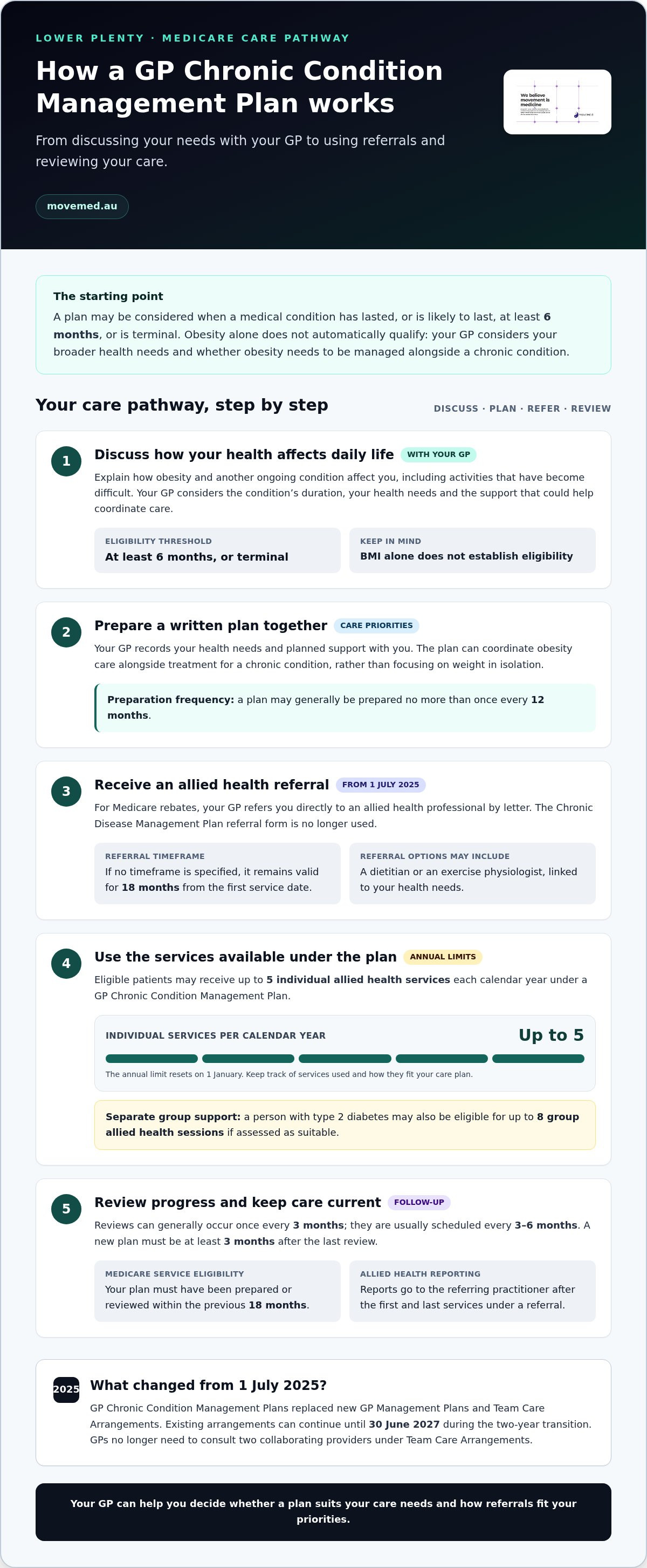
A GP Chronic Condition Management Plan may be considered for a medical condition that has lasted, or is likely to last, at least six months, or is terminal. Medicare chronic disease management for obesity in Lower Plenty may be relevant when obesity needs to be managed alongside a chronic condition.
It can be hard to know whether a plan applies to your situation, or how it differs from the older GP Management Plan and Team Care Arrangements. You’ll learn when a plan may be considered, how often it can be prepared or reviewed, and how referrals to allied health professionals may support your care. The article also explains how the arrangements changed from 1 July 2025, including the annual limit on individual allied health services, so you can better understand the options to discuss with your GP.
Key Takeaways
- A GP Chronic Condition Management Plan may be considered when a condition has lasted, or is likely to last, at least six months, or is terminal.
- Understand the timing: plans may generally be prepared once every 12 months and reviewed every three months.
- A plan can help coordinate care for obesity alongside a chronic condition, including support from allied health professionals.
- Learn how the newer plan arrangements differ from GP Management Plans and Team Care Arrangements, including the yearly limit on individual allied health services.
When should a GP chronic condition management plan be considered?
In Lower Plenty, discuss a plan with your GP if obesity is affecting your health alongside another ongoing medical condition. Medicare chronic disease management for obesity in Lower Plenty focuses on coordinating care around your health needs, rather than addressing weight alone.
Eligibility for chronic or terminal conditions
A plan may be relevant when a chronic or terminal condition calls for coordinated care. The key question is how the condition affects your health and what support could help coordinate its management. For example, if obesity and another long-term condition affect your mobility, explain how they interact during daily activities. That context can help you have a focused discussion with your GP.
Patient eligibility for a GP plan
BMI can describe weight categories, but it does not by itself establish eligibility for a Medicare plan. The commonly used categories are 18.5 to less than 25 for the healthy weight range, 25.0 to less than 30 for overweight, and 30.0 or higher for obesity. These figures provide context only. While data-driven body metrics and precision wellness services from clinics like NAWRA offer detailed insights into body composition, your GP considers your broader health needs, including how obesity relates to another condition, rather than using a BMI figure alone.
Getting a plan from a Lower Plenty GP
To explore Medicare chronic disease management for obesity in Lower Plenty, prepare a clear picture of how your health affects everyday life. Before your appointment, note activities that have become difficult, such as walking to local shops or keeping up with household tasks. Bring relevant health information and explain what you hope to work towards. Your GP can discuss whether a written plan suits your care and what priorities it could address. This keeps the conversation focused on practical goals, not just a number on the scales.
Plan preparation and review frequency
Your GP prepares the plan with you and reviews it to keep your care relevant. Timing can affect follow-up and Medicare access.
Preparing and reviewing a plan
A GP Chronic Condition Management Plan records your health needs and planned support. It may be prepared no more than once every 12 months, and a new plan must be at least 3 months after the last review. Reviews can generally occur once every 3 months; they’re usually scheduled every 3-6 months. This gives you and your practitioner opportunities to discuss progress and adjust care. Allied health professionals must report to the referring practitioner after the first and last services under a referral.
Visits and Medicare rebates
Eligible patients may receive 5 individual allied health services each calendar year under a GP chronic condition management plan. A dietitian referral may support nutrition care for obesity alongside a chronic condition; the relevant rebate depends on the practitioner and service.
For Medicare rebates, your GP refers you directly to allied health by letter under the arrangements introduced from 1 July 2025. The Chronic Disease Management Plan referral form is no longer used. If the referral gives no timeframe, it remains valid for 18 months from the first service date. Patients also need a plan prepared or reviewed within the previous 18 months to be eligible for services.
For a telehealth discussion with your GP, have your current care needs and questions ready. You can ask how the plan will document referrals, dietitian support and review timing. The annual limit resets on 1 January, so note when you use each referred service and how it fits your care plan.
Using a GP chronic condition management plan to support obesity management
A plan can coordinate obesity care with treatment for a chronic condition, bringing relevant care together in one written approach.
Chronic condition duration threshold
For a GP Chronic Condition Management Plan, a medical condition must have lasted, or be likely to last, at least six months, or be terminal. This threshold helps determine whether ongoing care can be arranged through this Medicare pathway. Chronic conditions may require continuing medical care or affect daily activities; your GP considers the condition’s duration and support needs when preparing the plan.
Obesity and plan eligibility
Obesity alone does not automatically qualify you for a plan: eligibility depends on the chronic or terminal condition criteria. Obesity and metabolic syndrome are examples of conditions for which a person may be eligible. A plan may be appropriate when obesity needs to be managed alongside a chronic condition. This distinction matters because the plan coordinates care rather than addressing weight in isolation.
Medicare services for obesity care
A GP Chronic Condition Management Plan can identify supports such as your GP, a dietitian or an exercise physiologist. These professionals can contribute to a multidisciplinary approach, with each support linked to your health needs. A person with type 2 diabetes may also be eligible for up to 8 group allied health sessions if assessed as suitable. The GP and patient shape the listed care around the condition and treatment priorities. For patients interested in broader medical research and emerging therapies, healthcare resources from primary care centres such as Stay Medical Clinic explain how clinical trials evaluate new treatments for complex conditions.
Medicare chronic condition management differs from Better Access. A Mental Health Care Plan is a separate arrangement that provides Medicare rebates for psychology sessions. Private health insurance rebates depend on your level of cover, and you cannot claim private insurance and Medicare for the same session.
Plan changes and limitations
GP Chronic Condition Management Plans replaced new GP Management Plans and Team Care Arrangements from 1 July 2025. Existing arrangements can continue until 30 June 2027 during a two-year transition. New plans from 1 July 2025 must meet the updated requirements, while GPs no longer need to consult two collaborating providers under Team Care Arrangements. Referral limits and eligibility criteria shape which allied health care Medicare supports.
GP Management Plans and Team Care Arrangements
Australia’s transition changes how Medicare chronic condition management connects people with allied health care. Knowing which arrangement applies can help you understand referrals, annual limits and what your GP can organise.
Before 1 July 2025, a GP Management Plan and Team Care Arrangement could support eligible patients with chronic conditions lasting, or likely to last, at least six months. Under a Team Care Arrangement, the GP collaborated with at least two other health professionals or care providers involved in ongoing treatment. MBS item 723 identified this arrangement. From 1 July 2025, GPs no longer need to consult two collaborating providers under Team Care Arrangements.
New plans follow the GP Chronic Condition Management Plan requirements. GPs and prescribed medical practitioners refer patients to allied health services directly by letter, rather than using the former Chronic Disease Management Plan referral form. New allied health referrals made from 1 July 2025 must meet the updated requirements, whether made under an older GP Management Plan, a Team Care Arrangement or a new plan. Existing arrangements can still support individual and group allied health services until 30 June 2027.
Eligible patients may access 5 individual allied health services each calendar year under these arrangements. Eligible patients of Aboriginal or Torres Strait Islander descent may access up to 10 individual services per year. Eligibility resets on 1 January, so services used in one calendar year do not reduce the next year’s allowance. Unused referred services may carry into the next calendar year, but count towards that year’s five rebates.
Keep the referral and note its timeframe: if it states no timeframe, it remains valid for 18 months from the first service date. Allied health reports go to the referring practitioner after the first and last services. These details help you track remaining sessions and care coordination. For exercise-based support alongside a chronic condition, explore options for your care.
MoveMed: Exercise Physiology Consultations
MoveMed provides Exercise Physiology Consultations to help you incorporate safe, structured movement into chronic condition care. If your GP includes an exercise physiologist in your plan and refers you, this can connect your management goals with practical, personalised exercise support.
MoveMed’s accredited exercise physiologists prescribe evidence-based programs after a one-on-one assessment, tailored to your health needs, capacity and goals. This support may be useful if obesity affects how you manage a chronic condition or take part in everyday activities. Medicare eligibility and the relevant referral arrangements determine whether sessions can be claimed.
Hydrotherapy, delivered in a warm-water pool, offers low-impact exercise and may suit people who need a supported setting for movement. To explore exercise support alongside your care plan, book an appointment with MoveMed to discuss Exercise Physiology Consultations.
Take your next step towards supported care
Planning a conversation with your GP can help connect your health priorities with practical changes that feel manageable in everyday life. Before the appointment, consider what you would like to do more comfortably, such as walking, building strength or keeping up with daily tasks. These goals can guide a discussion about suitable support and how to approach progress.
If you’re exploring Medicare chronic disease management for obesity in Lower Plenty, remember that Medicare eligibility and clinical exercise support are related but separate considerations. Your GP can guide the plan and referral process, while an exercise physiologist can help you work on safe, structured movement. MoveMed also provides Hydrotherapy and Aged Care Funded Therapy for people whose circumstances make those services relevant.
When you’re ready to consider exercise support alongside your care, contact MoveMed to discuss your care. A considered next step can help you move towards health goals with the right support around you.
Frequently Asked Questions
Chronic Disease Management, what is changing?
From 1 July 2025, new GP Chronic Condition Management Plans follow updated requirements, and GPs refer directly to allied health by letter. Existing GP Management Plans and Team Care Arrangements can still support individual and group allied health services until 30 June 2027. If your Lower Plenty referral began under the older arrangements, its date and terms help establish which process applies.
How can you avoid being charged a full private fee?
Before booking, confirm your Medicare eligibility, plan and referral requirements, and ask about the fee and available rebate. Medicare rebates may not cover the full appointment cost, so an out-of-pocket gap may remain. Bring your referral details and Medicare card, and ask how to claim the rebate.
Who is considered part of a multidisciplinary care team?
A multidisciplinary care team brings together health professionals whose roles address different parts of your care. For example, a GP may coordinate with a dietitian for nutrition support and an exercise physiologist for prescribed movement. Under the earlier Team Care Arrangement model, the GP worked with at least two other providers. The newer plan arrangements do not require the same collaboration rule.
Who is chronic condition management for?
It is for patients who need ongoing care for a medical condition that has lasted, or is likely to last, at least six months, or who have a terminal condition. Obesity may be relevant when it needs management alongside a chronic condition. For example, someone managing obesity and type 2 diabetes could discuss coordinated care needs with their GP.
What are the current eligibility rules for Medicare-subsidised chronic condition management plans?
Your GP assesses whether you have a qualifying chronic or terminal condition and whether a written plan suits your care needs. To access services, patients must have had the plan prepared or reviewed within the previous 18 months. If you’re registered through MyMedicare, use your registered practice for plan and review services. Your usual practitioner is generally the GP who provides most of your care.
Does Medicare cover dietitian, exercise physiologist or psychologist visits for obesity management?
A plan may include referrals to a dietitian or exercise physiologist as part of allied health care, subject to eligibility and the annual service limit. Psychology rebates through a Mental Health Care Plan are a separate arrangement. Ask your GP which referral suits your care goals and condition.


